.png&w=96&q=75)

This guide compares the AI inside 10 customer support stacks, and only the AI. We assume you already run a helpdesk, so we score what the AI does and what the AI costs. Platform fees like Zendesk Suite seats or Intercom seats appear as entry requirements, not blended into the math. 5 checks:
- what triggers the AI charge;
- whether the AI resolves tickets or routes them;
- what proof each vendor publishes;
- where the AI runs;
- days to first resolved ticket.
CoSupport AI is our product and sits at #1. Every tool here, ours included, gets the same five fields and the same limitation line.
How the AI in 10 customer support tools compares in 2026
| AI | What the AI costs | Runs on | Watch out for |
|---|---|---|---|
| CoSupport AI | $0.19 per resolved ticket, $0.04 per response, or flat from $99 a month per 1,000 tickets | Your existing Zendesk, Freshdesk, Zoho Desk, or any helpdesk | No free tier beyond the 30-day pilot |
| Intercom Fin | Outcomes from $0.99, 50-outcome monthly minimum | Intercom, with seats from $29 per agent alongside | The AI meter grows with your success, on top of seats |
| Zendesk AI | Automated resolutions at a rate Zendesk doesn't publish; Copilot $50 per agent | Zendesk Suite only ($55 to $115 per agent) | You learn the resolution rate by running it |
| Ada | Custom quote, not published | Deploys alongside your existing stack | Budgeting needs a sales cycle before you see a number |
| Forethought AI Agents by Zendesk | Quote through Zendesk Sales, $40,000 to $100,000 a year in Vendr data | Zendesk ecosystem since the March 2026 acquisition | 20,000+ historical tickets to start, 2,000 a month minimum |
| Gorgias AI Agent | $0.90 per AI resolution on annual billing, $1.00 monthly | Gorgias helpdesk only (tiers $10 to $900 a month) | AI fee lands on top of the ticket tier you already pay |
| Decagon | Custom quote, not published | Deploys alongside your existing stack | Pricing surfaces late in the sales cycle |
| eesel AI | Attempts: one ticket or chat session is one task at $0.40 | Plugs into many helpdesks | A $250 monthly spend cap by default stops the agent |
| Freshdesk Freddy AI | Sessions: 500 included, then $49 per 100; Copilot $29 per agent | Freshworks only (Freshdesk plans $19 to $89 per agent) | No life of its own outside Freshworks |
| Tidio Lyro | Conversations: 50 free a month, Lyro packs from $32.50 | Tidio's own chat channels | Conversation caps arrive early |
Quick Comparison
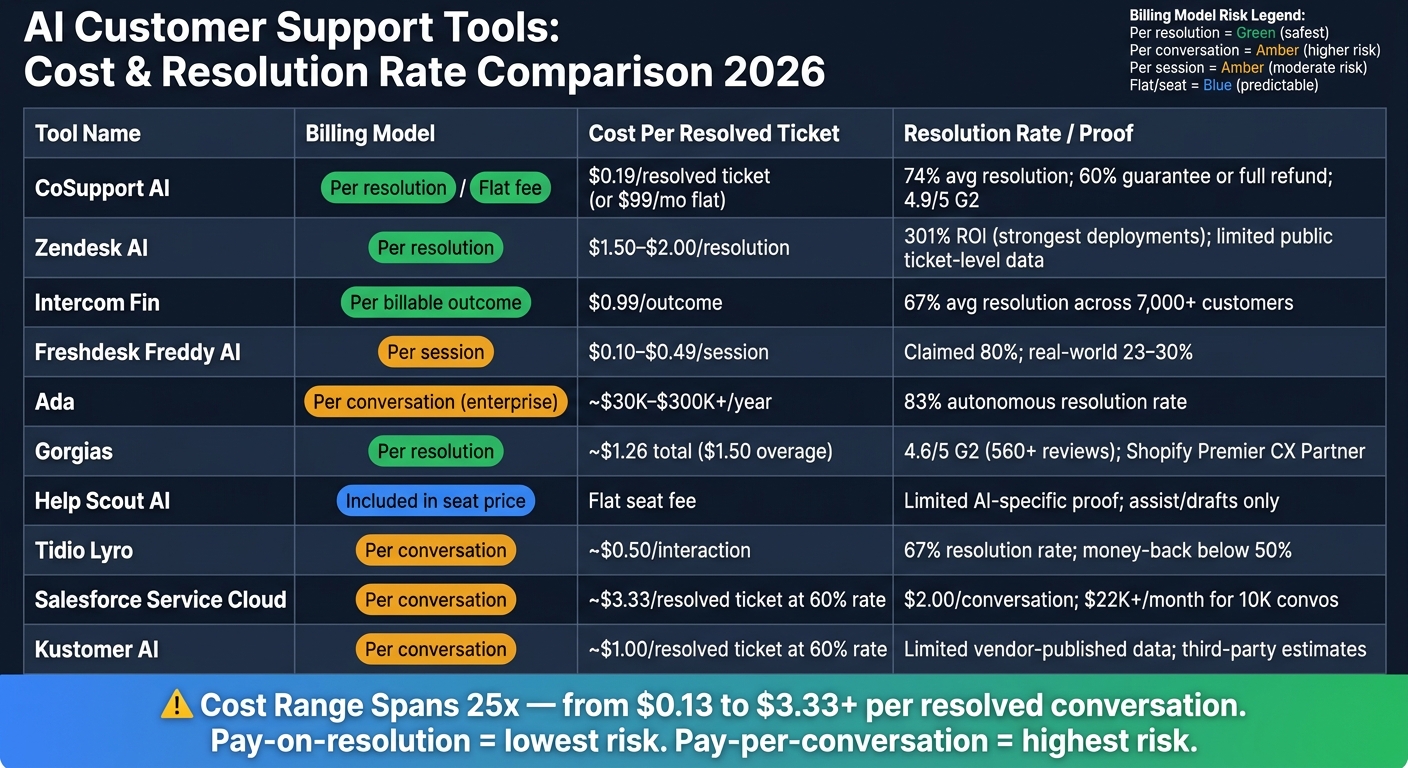
AI Customer Support Tools: Cost & Resolution Rate Comparison 2026
How we picked these tools
We scored the AI in every stack on five checks, and we apply all five to our own product too.
1. What triggers the AI charge. Some vendors bill when the AI tries, some when it succeeds, some per session. At the same ticket volume, these produce very different invoices, and it's the thing buyers notice last.
2. Resolve or deflect. The word a vendor uses for its own metric tells you what it optimizes. Deflection counts a customer who stopped writing. Resolution counts a request that got finished. We note which word each vendor uses.
3. Published proof. What the vendor puts on its own site: named customers with numbers, aggregate averages, or nothing. We checked every site in July 2026 and quote what's there.
4. Where the AI runs. Some AI is locked to one platform, so choosing it means adopting or keeping that helpdesk. Some plugs into the stack you already have. This decides whether you're buying an AI or migrating a helpdesk.
5. Time to live. Days from kickoff to the first resolved ticket.
Disclosure: CoSupport AI is our product and we rank it first. That's a bias worth stating plainly, so we gave every tool the same five fields, the same length, and the same limitation line. Check our entry against the others.
The 10 tools
1. CoSupport AI
- Best for: support teams with 500 to 10,000+ tickets a month that want AI costs they can forecast.
- What the AI costs: $0.19 per resolved ticket, $0.04 per response, or a flat plan from $99 a month per 1,000 tickets. Tickets the AI can't finish don't bill on the per-resolution plan. No platform fee of its own.
- Resolve or deflect: resolution. The AI takes action inside connected tools, and the ticket closes without a human.
- Where it runs: your existing Zendesk, Freshdesk, or Zoho Desk. You keep the helpdesk; the AI plugs in.
- Published proof: named customers. 81% automated resolution at Cocoatech, a SaaS company on Zendesk. 80% deflection and about $14K a month saved at SupportYourApp, a BPO. Resolution time reduced from 2 hours to 6 minutes at ProjectFitter. Plus a contractual floor: 60% AI resolution by day 60 or a full refund.
- Limitation: no permanent free tier. The 30-day pilot is the free path, and it ends on day 30.
Chat, email, and voice, in 40+ languages. Runs on a patented multi-model architecture, a dedicated model per client instead of one shared LLM. About 10 minutes to connect, about 3 days to go fully live. Pricing.
2. Intercom Fin
- Best for: teams already running support inside Intercom.
- What the AI costs: outcomes, from $0.99 each with a 50-outcome monthly minimum. Intercom seats from $29 per agent billed annually, $39 monthly, sit alongside as the platform requirement.
- Resolve or deflect: Intercom bills on what it calls an outcome, so the meter runs on completed work rather than attempts.
- Where it runs: the Intercom ecosystem, and the seats come with it.
- Published proof: aggregate only. Fin publishes 76% average resolution across 12,000+ customers, with many over 85%, and doesn't attach a rate to a named customer on its site.
- Limitation: the AI meter grows with your success, on top of fixed seats, and the 50-outcome floor applies even in a quiet month.
3. Zendesk AI
- Best for: organizations already standardized on Zendesk that want zero integration work.
- What the AI costs: automated resolutions, metered at a rate Zendesk doesn't publish; third-party teardowns put it near $1.50 to $2.00. Copilot adds $50 per agent per month. Entry requirement: a Zendesk Suite plan at $55 to $115 per agent.
- Resolve or deflect: Zendesk calls its billing unit an automated resolution.
- Where it runs: Zendesk only. Choosing this AI means staying on Zendesk. Not the same product as Forethought (#5 below) — that's a separate enterprise offering Zendesk acquired in March 2026 and sells on its own contracts.
- Published proof: named customers. Vimeo at 30–40% automation, Best Egg at 80% on messaging, TeamSystem at 80%, UrbanStems at 80%, and Lush at a 90% reduction in live chat handling time. No time periods are given.
- Limitation: the resolution rate isn't published, so the only way to learn your AI bill is to run it.
4. Ada
- Best for: enterprise B2C teams with a dedicated ops owner for the automation.
- What the AI costs: a custom quote. Ada doesn't publish pricing.
- Resolve or deflect: Ada publishes an automated resolution rate as its headline metric.
- Where it runs: deploys alongside your existing stack rather than replacing it.
- Published proof: named customers. Tilt at an 84% automated resolution rate on chat, and Cebu Pacific at 34%+ higher automated resolution after replacing a declarative chatbot. No time periods are given, and the Cebu figure is an improvement rather than an absolute rate.
- Limitation: with no public pricing, you can't compare the AI on cost until you've run a sales cycle.
5. Forethought AI Agents by Zendesk
- Best for: Zendesk-suite teams that want multi-agent triage and routing.
- What the AI costs: a quote through Zendesk Sales. Vendr transaction data puts Solve contracts at $40,000 to $100,000 a year for teams handling 10,000 to 30,000 tickets a month.
- Resolve or deflect: Forethought publishes deflection and self-serve rates, which count customers who stopped needing an agent.
- Where it runs: the Zendesk ecosystem since the March 26, 2026 acquisition. It's a separate product from the native Zendesk AI in #3: its own contract, its own entry bar, sold through Zendesk Sales.
- Published proof: named customers with time periods, which is rare here. YAZIO at an 80% ticket deflection rate over 6 months, Cotopaxi at a 28% increase in deflection over six months, Upwork at a 65% average self-serve rate. An aggregate "up to 98% resolution rate" isn't attached to any customer.
- Limitation: the entry bar. 20,000+ historical tickets to start and a 2,000-ticket-a-month minimum.
6. Gorgias AI Agent
- Best for: Shopify and ecommerce brands that need order actions, not just answers.
- What the AI costs: $0.90 per AI resolution on annual billing, $1.00 monthly. Entry requirement: a Gorgias helpdesk tier, $10 a month for 50 tickets up to $900 for 5,000.
- Resolve or deflect: Gorgias bills per AI-resolved conversation and publishes an automation rate.
- Where it runs: the Gorgias helpdesk only. The AI doesn't leave the platform.
- Published proof: one named customer with an automation figure, Orthofeet at a 56% automation rate in under 2 months. Its other named results are ROI and cost metrics rather than automation rates.
- Limitation: the AI fee lands on top of the ticket tier you already pay, and both grow with volume.
7. Decagon
- Best for: large B2C enterprises that want a hands-on deployment team.
- What the AI costs: a custom quote. Decagon doesn't publish pricing.
- Resolve or deflect: Decagon publishes both, resolution for some customers and deflection for others.
- Where it runs: deploys alongside your existing stack.
- Published proof: named customers, and a lot of them. Chime at 70% chat and voice resolution, Duolingo at an 80% deflection rate, Valon at 50%+ deflection on voice, Rippling at a 32% increase in deflection. No time periods are given.
- Limitation: pricing surfaces late in the sales cycle, so cost comparison isn't possible until you're already deep in the process.
8. eesel AI
- Best for: small teams that want an AI layer running on their helpdesk within hours.
- What the AI costs: attempts. One ticket or chat session is one task at $0.40, charged whether the AI closes it or hands it to a human on the first reply. At a 70% resolution rate, that's about $0.57 for every ticket that actually gets resolved. Enterprise runs $1,000 a month.
- Resolve or deflect: neither is the billing trigger. Eesel bills the attempt, so the outcome doesn't change the invoice.
- Where it runs: plugs into many help desks in hours.
- Published proof: one named customer, Gridwise, at 73% on tier-1 tickets in the first month.
- Limitation: the default $250 monthly spend cap. At $0.40 a ticket, the ceiling arrives at 625 tickets, and past it the agent stops answering customers until someone raises it.
9. Freshdesk Freddy AI
- Best for: companies running the Freshworks stack end to end.
- What the AI costs: sessions. 500 are included, then $49 per 100, which works out to $0.49 a session. Copilot is $29 per agent per month. Entry requirement: a Freshdesk plan at $19 to $89 per agent.
- Resolve or deflect: Freshworks publishes deflection rates as its headline metric.
- Where it runs: Freshworks only. Outside that stack, it has no life of its own.
- Published proof: one named customer, iPostal1, resolving 54% of support queries automatically, plus an aggregate 65% average deflection across early-access customers with some reaching 80%.
- Limitation: a session is billed whether or not the issue got solved, so the meter behaves like a per-attempt one.
10. Tidio Lyro
- Best for: small businesses starting with live chat plus AI.
- What the AI costs: conversations. The free tier covers 50 a month; Lyro AI packs start at $32.50.
- Resolve or deflect: Tidio publishes a resolution rate.
- Where it runs: Tidio's own chat channels, not your existing helpdesk.
- Published proof: aggregate only. Tidio states Lyro boosts resolution rate to 67% on average, without attaching it to a named customer.
- Limitation: the conversation caps. They're what teams hit first as volume grows, and the jump to the next tier arrives early.
What does the AI cost per ticket in 2026?
Per-resolution pricing in 2026 runs from $0.19 with CoSupport AI to roughly $2.00 with Zendesk AI's unpublished meter, and Gartner benchmarks an assisted-channel contact at $13.50 against $1.84 for self-service.
The math below is AI fees only — platform fees are listed underneath as entry requirements, because if you already run that helpdesk, you already pay them. It assumes 60% AI resolution and separates tools that bill on attempts from tools that bill on results. Pick your volume: 1,000 · 3,000 · 10,000 tickets a month.
At 3,000 tickets a month (1,800 resolved):
| AI | Billed on | AI cost per month |
|---|---|---|
| CoSupport AI, flat plan | Volume, fixed | $297 |
| CoSupport AI, per resolution | Results | $342 |
| eesel AI | Attempts, all 3,000 | $1,200 |
| Freshdesk Freddy AI | Sessions, ~1 per ticket | ~$1,225 |
| Gorgias AI Agent | Results | $1,620 |
| Intercom Fin | Outcomes | $1,782 |
| Zendesk AI | Results, rate unpublished | ~$2,700 |
At 1,000 tickets a month (600 resolved):
| AI | AI cost per month |
|---|---|
| CoSupport AI, flat plan | $99 |
| CoSupport AI, per resolution | $114 |
| Freshdesk Freddy AI | ~$245 |
| eesel AI | $400 |
| Gorgias AI Agent | $540 |
| Intercom Fin | $594 |
| Zendesk AI | ~$900 |
At 10,000 tickets a month (6,000 resolved):
| AI | AI cost per month |
|---|---|
| CoSupport AI, flat plan | $990 |
| CoSupport AI, per resolution | $1,140 |
| eesel AI | $4,000 |
| Freshdesk Freddy AI | ~$4,655 |
| Gorgias AI Agent | $5,400 |
| Intercom Fin | $5,940 |
| Zendesk AI | ~$9,000 |
Entry requirements on top of the AI fee, if you're not already on the platform: Intercom seats from $29 per agent · Zendesk Suite $55 to $115 per agent · Gorgias tiers $10 to $900 a month · Freshdesk plans $19 to $89 per agent. CoSupport AI and eesel have no platform fee of their own. Freddy math assumes one session per ticket, with the 500 included sessions counted in.
Response-based billing at $0.04 per response is the third CoSupport model, useful when you meter by answers. All three are on the pricing page. Run your exact numbers in the ROI calculator.
Which AI fits your stack?
Match the AI to the helpdesk you already run, your industry second.
- On Zendesk: CoSupport AI through the Zendesk integration, Zendesk AI, Ada, Forethought.
- On Freshdesk: CoSupport AI through the Freshdesk integration, Freddy AI. iubenda runs 5,000 tickets a month on Freshdesk with CoSupport.
- On Zoho Desk: CoSupport AI through the Zoho integration.
- On Gorgias or shopping for ecommerce: Gorgias AI Agent if you're staying; CoSupport AI on Zendesk (50% deflection at eCatering, and Nordic Knots, an ecommerce brand on Zendesk, saves $7K a month); Lyro for stores just starting.
- BPO and outsourcing: CoSupport AI. SupportYourApp saves about $14K a month at 80% deflection.
- EU-based teams: check where the vendor hosts your data before you compare AI prices. Some tools make EU residency contingent on an enterprise plan, which changes the entry cost before the first ticket.
Still picking the helpdesk itself? That's a different decision, and it comes first: start with the Zendesk vs Freshdesk vs Intercom comparison.
Test the #1 pick on your own tickets
A 30-day pilot on your live helpdesk: 1,000 AI responses included, no setup fees, about 10 minutes to connect, and about 3 days to go fully live. From day 60, the guarantee applies: 60% AI resolution or a full refund.
sbb-itb-97114f1
.png)


.png&w=828&q=100)
.png&w=96&q=100)
.png&w=828&q=100)
.png&w=96&q=100)