7

Walmart Sparky is the generative AI shopping assistant in the Walmart app, on Walmart.com and in Walmart stores. It answers product questions, summarizes reviews, turns a photo of a handwritten list into a cart, plans meals and parties, and reorders what you buy often. Walmart launched it in June 2025. It now runs in the US, Mexico and Canada.
Walmart's executives say Sparky can help take care of customer service. The support work Walmart has actually shown, finding orders, processing returns, giving delivery updates, runs on a different AI called the Customer Support Assistant. One assistant sells and the other serves. If you run support for an online store, study that split.
What is Walmart Sparky
Walmart introduced Sparky on June 6, 2025, with a post titled "Walmart: The Future of Shopping Is Agentic. Meet Sparky." In the app it sits behind a smiling "Ask Sparky" button. Tap it, then type, talk or share a photo, and Sparky answers in a chat. Walmart's own examples include a Friendsgiving menu for 15 people on a $125 budget, a photo of a stain you want gone, and a picture of a handwritten grocery list.
Within a year it worked well beyond the app. By May 2026 Walmart said Sparky ran across the app, the website and its stores. It speaks Spanish, and French arrived with the Canadian launch on October 29, 2026. Walmart de Mexico added it to its app in September 2026, and with the October 30 holiday release Walmart said it is extending Sparky to Sam's Club members in the US.
Walmart lists no separate charge for Sparky. It comes with the app and the website.
Sparky works for Walmart. David Guggina, who runs Walmart U.S., said on the May 2026 earnings call that Sparky recommends products "based on our inventory positioning, our prices, and our delivery speed capabilities." That's an honest description of a store assistant. It picks from what Walmart can sell you and deliver fast.
What Sparky does today
Here's what Walmart has shown Sparky doing, sorted by the job a shopper brings to it. The last column is the one a support lead should read.
| Shopper's job | What Sparky does | Is it support work? |
|---|---|---|
| Research a product | Answers questions, summarizes reviews, compares items | No |
| Plan an occasion | Builds a party, holiday or gift list around a budget and local stock | No |
| Turn a list into a cart | Reads a photo of a handwritten list or a list exported from Notes and fills the cart | No |
| Ask with a picture | Takes an image, a stain or a look, and suggests a method first, then products | No |
| Find it in the store | Shows the item on the store map and lights up its shelf tag | No |
| Buy again | Reorders items you buy on repeat | Close: it happens after the order |
| Check out | Helps finish the purchase | Close |
| Get help with an order | Walmart says Sparky "can help you take care of customer service" and gave no example | Claimed, no details |
| Return an item | Named as a goal in 2025; we found no feature page | Not documented |
| Reach a person | We found no handoff path described | Not found |
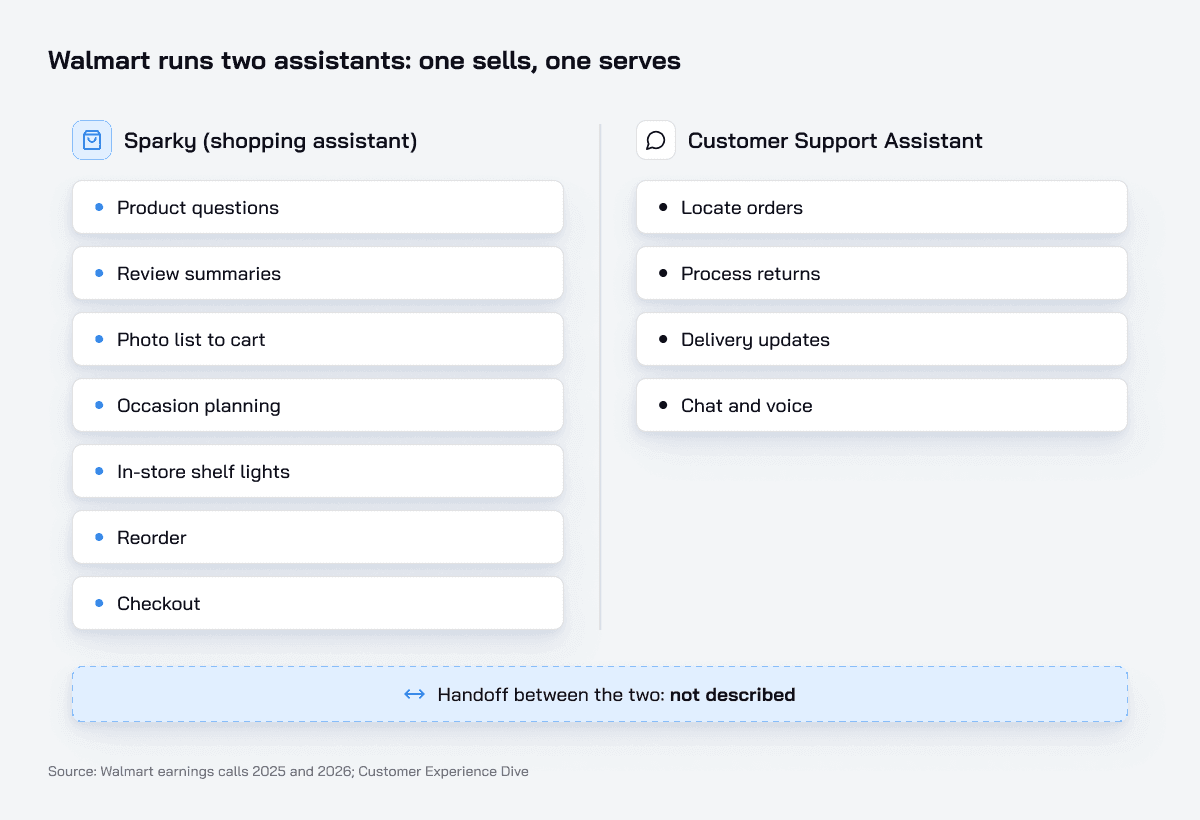
Sparky's documented work ends at checkout. After the order, where support teams spend their day, Walmart offers a few promises and little else.
Sparky and support: two assistants
Walmart's AI comes in several pieces. In July 2025 it named four "super agents": Sparky for customers, one for store associates, Marty for suppliers, sellers and advertisers, and one for developers. Customer support sits with yet another system.
That system is the Customer Support Assistant, which Walmart first showed in an upgraded form in October 2024. It recognizes the customer, works out what they want and takes action. Customer Experience Dive described its jobs as "locating orders, processing returns and offering delivery updates," over chat or voice.
Walmart's support numbers belong to the care operation too. In July 2025 Walmart said AI had cut resolution times in its customer support "by up to 40%." It gave no baseline, and the claim is about the care side.
Sparky's support role rests on three lines. Walmart's July 2025 fact sheet said Sparky would "provide always-on support." CEO Doug McMillon said in August 2025 that Sparky "will be the primary digital vehicle for discovery, shopping, and for managing everything from reorders to returns." And in September 2026 Guggina told investors: "Sparky can help you take care of customer service." None of the three came with an example or a description of how a shopper reaches a person.
The split makes sense once you look at what each assistant is judged on. A shopping assistant wins when the basket grows. A support assistant wins when the problem is gone and the customer doesn't come back about it. An assistant tuned to recommend what's in stock and fast to deliver is the wrong one to decide a refund.
Two assistants only work if the context travels between them. A shopper who asked Sparky about a late order shouldn't have to explain it again to the support assistant. Walmart hasn't said whether that handover happens. Amazon took the other road and folded its shopping bot into one assistant that also tracks orders, checks refund status and answers billing questions. We covered what happened to Amazon Rufus and what that merge leaves open.
What Walmart's numbers measure
The headline figure comes from Walmart's August 2026 earnings call. John Furner, by then Walmart's CEO, said customers and members who use Sparky for shopping "spend 40% more per order than others who don't." On the same call he said the number of customers using Sparky is up 70% from a year earlier. Both lines are in Walmart's Q2 FY27 call transcript. In May, Guggina said units bought through Sparky had grown more than 4x in a single quarter.
Read the 40% slowly. It compares people who use Sparky with people who don't, and the people who open a shopping assistant may be the ones who already buy more and buy more often. A data scientist quoted by Moneywise put it in six words: "Causality and correlation are different things." Walmart gave no method, period or control group on the call, and we found none published elsewhere.
The number also drifts. In February and May 2026 Walmart said Sparky users had an average order value "about 35% higher." In August it was "40% more per order." In September, at an investor conference, it became an order value that "jumps 40%." The wording changes every quarter, and no definition comes with any of it.
Walmart has published no support metric for Sparky. That's fine for a sales tool and a gap for one that's supposed to help with customer service.
If you're measuring your own assistant, run a holdout instead. Keep a slice of visitors, say 10%, who never see the assistant for four weeks. Then compare the two groups on orders per visitor, contacts per order, and the share of conversations the assistant closed without a person. A bot that sells more and leaves more tickets behind is a cost, and a users-versus-non-users chart will never show it.
Sparky's timeline so far
The promise to handle returns dates from August 2025. Nothing in this timeline ships it.
- June 6, 2025. Walmart announces Sparky.
- July 2025. Walmart names its four "super agents" and says Sparky will provide always-on support.
- August 21, 2025. McMillon calls Sparky the future vehicle for "everything from reorders to returns."
- October 14, 2025. Walmart announces that its products will be buyable inside ChatGPT through Instant Checkout.
- February 19, 2026. Walmart says roughly half of its app users have used Sparky.
- March 2026. Walmart drops in-chat checkout in ChatGPT and puts Sparky inside ChatGPT instead.
- May 21, 2026. Sparky works in stores and reorders repeat items on its own.
- September 24 and October 29, 2026. Sparky launches in Mexico, then across Canada in English and French.
- October 30, 2026. The holiday release adds photo-to-cart lists, in-store shelf lights, recipes and healthier swaps, with voice promised by the end of the year.
What the ChatGPT checkout taught Walmart
By March 2026 Walmart had pulled back from selling inside ChatGPT. Daniel Danker, Walmart's executive for AI, product and design, told WIRED that purchases made inside the chat converted at roughly one-third the rate of shoppers who clicked through to Walmart.com, and called the in-chat checkout "unsatisfying." Martech summarized the interview.
Walmart kept its own assistant and sent it out instead. Sparky now runs inside ChatGPT, and Walmart announced a shopping deal with Google's Gemini in January 2026. In October 2026 it opened Agent Gateway, a limited beta that lets approved outside AI agents search, fill a cart, buy and track orders through Walmart's own server. Outside agents never see card details, and Walmart says customers will be able to require approval for every purchase or set a spending limit.
Google is heading the same way. Its developer page for the Universal Commerce Protocol, the standard behind the Gemini deal, lists post-purchase support for tracking and returns as an upcoming feature and says the merchant keeps the post-purchase experience.
For a store, the takeaway is practical. Agents that shop for customers ask about orders too: order tracking is one of the jobs Walmart opened to them. Whoever asks, the answer has to come from your own order record and return policy.
What an online store can take from Sparky
- Start from the questions shoppers already ask. Sparky started with product questions and reviews because that's where search let shoppers down. Pull your top contact reasons before you pick features. For most stores "Where is my order?" tops the list.
- Decide who owns order status and returns. Walmart keeps them with a separate support AI, and Amazon put them inside one assistant. Either works if someone chose it on purpose. If returns eat your team's week, automating the refund flow is often the faster win.
- Make the context travel. If you run two assistants, or an assistant and a team, pass the conversation along with the customer. Nobody should repeat an order number twice.
- Measure with a holdout. Users versus non-users flatters every assistant ever built. Compare like with like, and put resolution next to revenue.
- Label what's paid. Walmart has tested ads tied to Sparky answers and hasn't said how shoppers can tell them apart. If your assistant recommends products, mark the sponsored picks in the answer itself.
CoSupport AI Agent works the serving half. It answers customers in your helpdesk or a storefront chat and reads the order data before it replies. What it can't resolve goes to your team with the history attached. We count a conversation as resolved when the customer doesn't reply within 72 hours of the AI's answer, and that's the number we report and bill on. See how it works for e-commerce support teams.
Walmart built the selling half first and is still writing the serving half. Build yours in the other order. Fix the questions that already flood the inbox, then teach the assistant to sell.