5
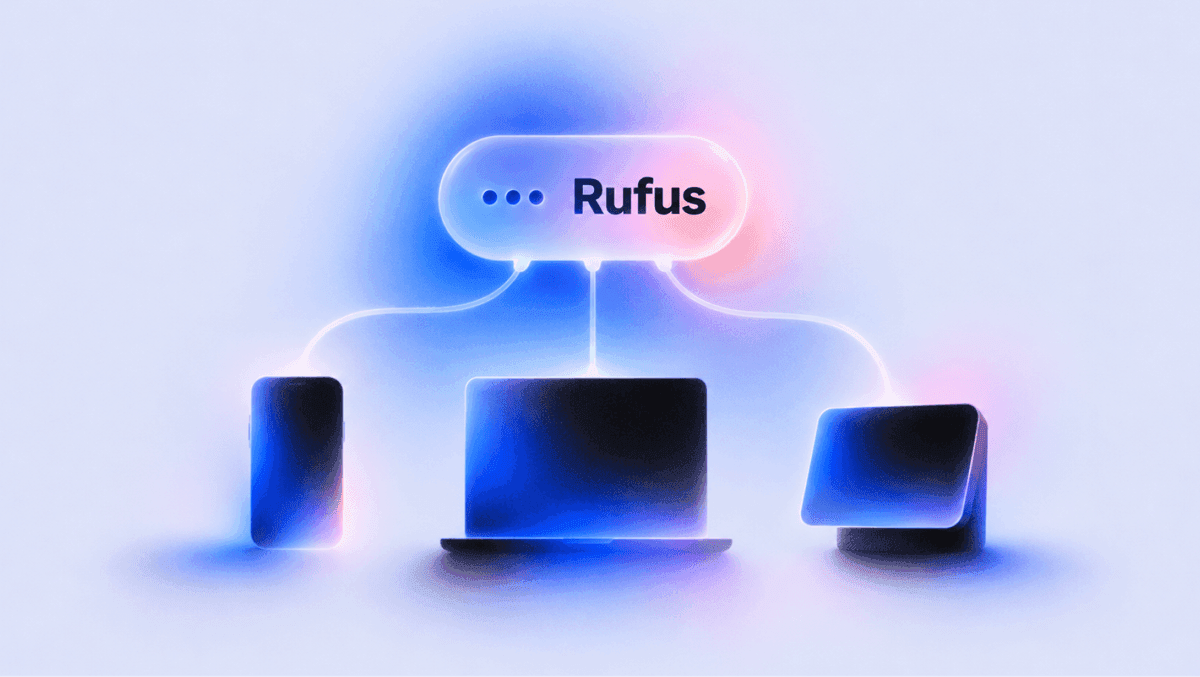
Amazon Rufus is now Alexa for Shopping. On May 13, 2026, Amazon merged its Rufus shopping chatbot with its Alexa+ voice assistant into one assistant for US customers in the Amazon app, on the website and on Echo Show. The chat bubble is gone. A cursive "A" sits in its place, and questions go straight into the search bar. Amazon calls it a rename. CNBC called it discontinued. Both are true.
If you run support, the interesting part is what happened on the way. A shopping bot picked up package tracking, returns, refunds and billing questions. And the live-agent handoff Amazon described for Rufus in late 2025 doesn't appear anywhere in what Amazon has published about the new assistant.
Is Amazon Rufus discontinued? What changed on May 13, 2026
Amazon put the change in one line: "Amazon brings together Rufus and Alexa+ to create 'Alexa for Shopping' on the Amazon Shopping app and website." The old Rufus posts on Amazon's news site now carry a banner: "On May 13, 2026, Rufus was renamed Alexa for Shopping."
What changed for US shoppers:
- The entry point is the Alexa icon, in the bottom navigation bar of the app or at the top of the screen on desktop. Questions can also go into the main search bar, which recognizes a question and answers it. A plain search like "pants" still returns normal results.
- It's free for anyone signed in to an Amazon account. No Prime membership, Echo device or Alexa app needed.
- The full Amazon store now works on Echo Show screens, and in November 2026 the assistant started answering by text message for an invited group.
- Memory carries across the phone, the laptop and Echo devices. Rajiv Mehta, Amazon's vice president of conversational shopping, summed it up: "you don't have to start over."
CNBC reported that Amazon will keep using Rufus's recommendation features and shopping history for some Alexa for Shopping questions, so the technology lives on inside the new assistant.
Outside the US the picture is patchier. Rufus launched in India in August 2024, in the UK in September 2024, in Canada, Germany, France, Italy and Spain in October 2024, and in Japan in September 2025. Amazon's May announcement covered US customers, and we couldn't find a country-by-country list of where the Rufus name remains.
What Rufus was
Rufus was Amazon's generative AI shopping assistant. It launched in beta on February 1, 2024, and opened to every US customer in the app in July 2024. It answered product questions from listings, reviews and customer Q&A, compared items and summarized what buyers said. Later it tracked prices, bought automatically when a price dropped, remembered your household and reordered what you buy often.
It also learned support work. A TechCrunch review five weeks after launch found it couldn't check an order or start a return. By November 2025 Amazon described Rufus as "a 24/7 customer service expert" that tracks packages, answers order status questions, explains returns and refunds and, Amazon said, connects a shopper with a live agent.
Rufus, from launch to merge
| When | What changed | What it meant for support |
|---|---|---|
| Feb 2024 | Beta launch in the US app: product questions, reviews, comparisons | Nothing yet: an early review found it couldn't check an order or start a return |
| Jul 2024 | Open to all US customers in the app | Package tracking arrives in the chat |
| Sep 2024 | Amazon starts testing sponsored ads inside answers | Answers can now carry ads |
| Nov 2025 | Account memory, reorders, Auto Buy, and a "24/7 customer service" role | Order status, returns and refunds explained, live-agent handoff described |
| Feb 2026 | Amazon says 300 million+ customers used Rufus in 2025 | Scale, reported in sales; resolved questions go unreported |
| May 13, 2026 | Rufus and Alexa+ become Alexa for Shopping | One assistant, shared memory, questions in the search bar |
| Oct 29, 2026 | 100+ new actions, from subscriptions to delivery instructions | Refund status, gift card balances and unrecognized charges move into the assistant |
| Nov 6, 2026 | Shopping by text message, invite-only | "Where's my package?" by SMS |
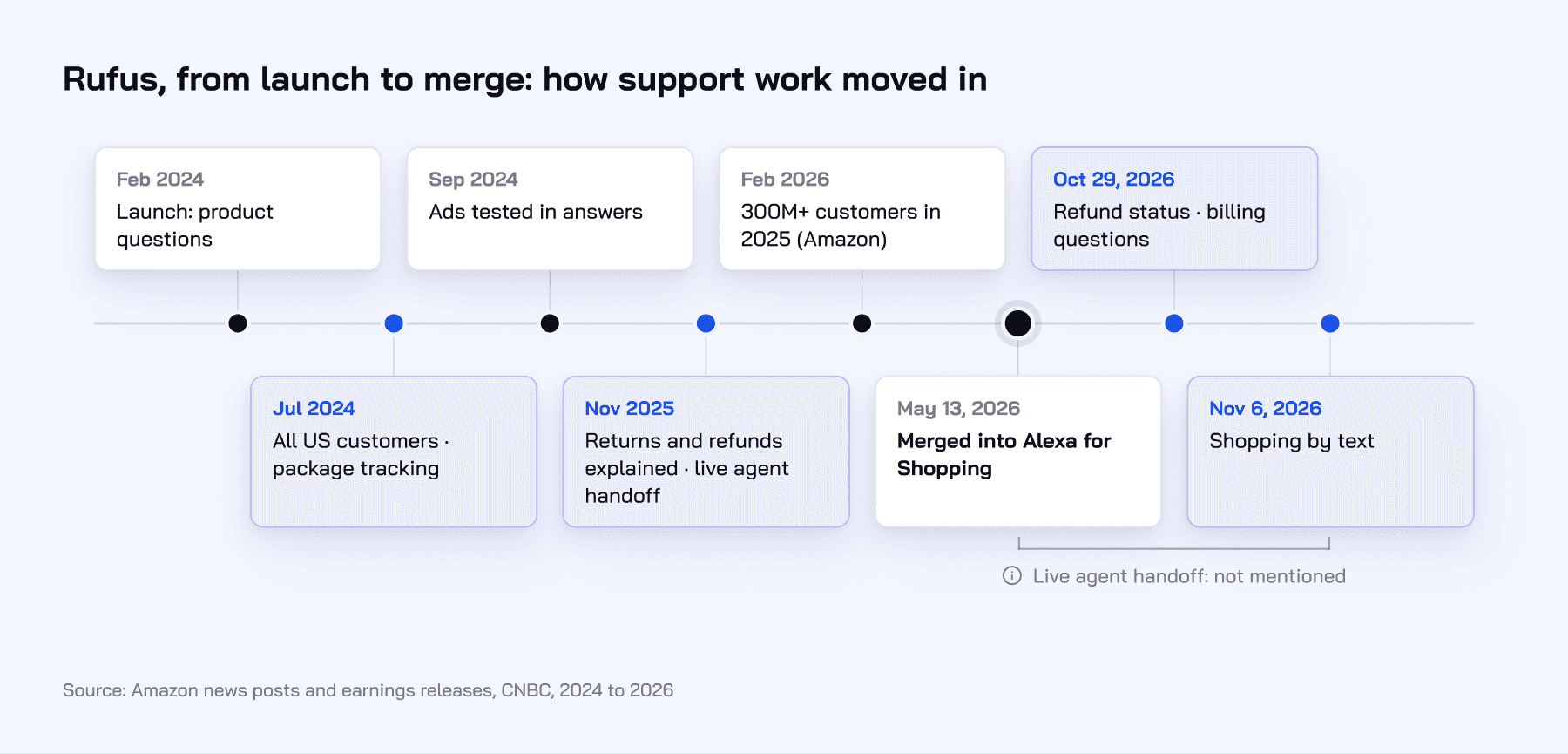
A product-research bot turned into the place people ask about orders, refunds and charges. The support work grew inside the assistant customers already used. Amazon's own launch post for Alexa for Shopping even shows it troubleshooting: a shopper types a dishwasher error code into the search bar and gets steps to try before calling a technician.
What Amazon's numbers say, and what they don't
Amazon talks about Rufus in big round numbers, and all of them come from Amazon.
- Users. "Rufus was used by 300 million+ customers" in 2025, according to Amazon's fourth-quarter results. In October 2025 CEO Andy Jassy put the year-to-date figure at 250 million, part of the same total.
- Sales. "Nearly $12 billion in incremental annualized sales" in 2025, from the same release. Amazon hasn't published the method. When Jassy projected "over $10 billion" in October 2025, Fortune reported that the measure credits Rufus for purchases that follow a chat, even days later, inside a seven-day window.
- Buying. Jassy said customers using Rufus during a shopping trip were "60% more likely to complete a purchase." Amazon didn't say who they were compared with.
- After the merge. Amazon says more than 400 million customers used Alexa for Shopping in the 12 months to October 2026, a window that includes months when it was still Rufus. On the October earnings call Jassy said US customers using it are spending 50% more per order than those who don't.
Walmart reports an almost identical figure for its Sparky assistant, 40% more per order, measured the same way: users against non-users. Outside data is thin. Sensor Tower's panel of 60,000 US shoppers found Rufus users about 2.7 times more likely to buy, which runs into the same problem. People who open a shopping assistant were already shopping.
Every one of these numbers measures reach or basket size. In the posts, releases and calls we read, Amazon never gave a resolution rate, a deflection figure, a satisfaction score or a handoff rate for Rufus or Alexa for Shopping. Now that the assistant answers "Where is my refund?", that's the missing half of the scorecard.
Why Amazon chose one assistant over two
Until May 2026 Amazon ran two assistants with overlapping jobs. Rufus lived in the shopping app. Alexa+ lived on speakers and screens and could buy things too. Juozas Kaziukenas, the e-commerce analyst who founded Marketplace Pulse, described the problem to Modern Retail: "They have two assistants that seemingly can do similar things, and yet they're two separate things." He called the merge "a graduation party for Rufus." CNBC noted that Rufus still carried a beta label more than two years after launch.
The merge put one memory behind every surface. Amazon's help page says the assistant "remembers conversations across Amazon's website and app," Echo devices, Fire tablets and Fire TV. A customer who asked about a stroller on a phone doesn't explain it again to a speaker.
Scope kept growing in the same place. Product questions came first, then package tracking, then returns, then billing. Each new job landed inside the assistant people already opened, so nobody had to find a new door.
Behind that single face sit several models. Amazon said Rufus ran on Anthropic's Claude Sonnet, Amazon Nova and a custom model, picked per question by "a real-time router." The customer sees one assistant. The routing stays out of sight.
The test is whether the customer's context travels. Walmart runs a separate support AI next to its shopping assistant, and that can work if the conversation moves with the shopper. Amazon removed the seam instead. It's now selling the same idea to other stores: in May 2026 AWS packaged the technology as a shopping assistant for retailers and named Kate Spade as a customer. If you're shopping for one, ask the question Amazon hasn't answered in public: how does it hand a customer to a person?
What went wrong on the way
Rufus's numbers grew fast. So did the problems. Read them before you ship your own.
- Accuracy, 2024. Early tests caught wrong answers and uneven product picks, and Marketplace Pulse said later answers were "more confident but not more intelligent." Your assistant needs a way to say it doesn't know.
- Ads inside answers, from September 2024. Amazon began testing sponsored ads in Rufus replies. Once an answer can be paid for, customers start to wonder which ones are.
- Partners and regulators, 2026. In January, Amazon's "Buy for Me" and "Shop Direct" features listed some brands' products without asking them. In July a Columbia Law School center questioned how Amazon's and Walmart's shopping bots handle "Made in USA" claims, and in September Senators Tammy Baldwin and Rick Scott asked the FTC to investigate. Anything your assistant says on your behalf is your statement.
- The handoff. Rufus's November 2025 description promised a live agent. The help page and the launch post for Alexa for Shopping mention handing off to Alexa+ for smart-home and music requests. Neither mentions a person.
What support teams can take from Rufus
Give customers one conversation history. The merge was about memory. If your chat widget, help center and email bot don't share history, customers start over every time they switch, which is exactly the friction Amazon's merge removes.
Grow support inside the same assistant. Rufus picked up order tracking, returns and refunds without a second launch. Start where your volume sits, usually order status and returns, and add jobs as the assistant proves it can close them.
Keep the human handoff visible. It's the support feature that dropped out of Amazon's public description. Customers forgive an assistant that says "let me get a person" and passes the context along. They don't forgive a loop. Here's what a clean AI-to-human handoff looks like.
On the handoff, CoSupport AI Agent answers customers in your helpdesk or a storefront chat, reads the order data, and passes unresolved conversations to your team with the history attached.
Count resolved conversations. Amazon can report sales because it sells. A support team needs to know how many conversations ended with the problem solved and no follow-up. Check that number against resolution rate benchmarks for your industry.
Say what it can't do. Amazon's help page admits the assistant "may not always get things right." Put that sentence where customers read it: in the assistant.
Amazon absorbed Rufus because customers wanted one assistant that remembers them. The part Amazon hasn't shown yet, resolved questions and a visible path to a person, is the part support teams get judged on.