.png&w=96&q=75)

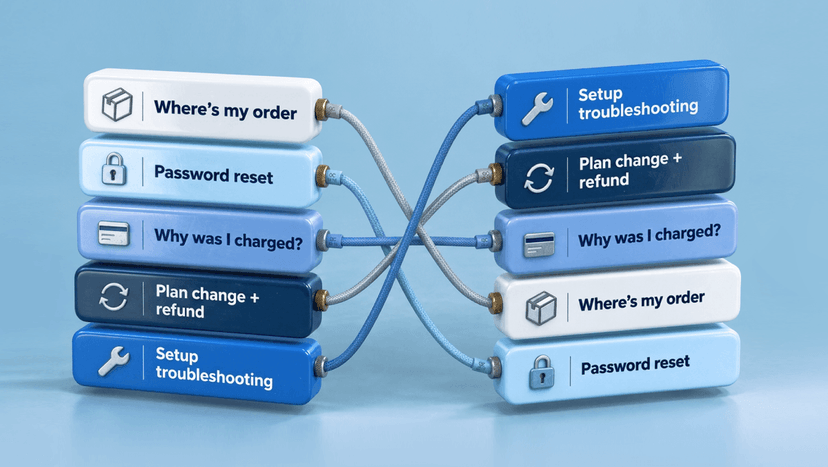
AI agents in customer support answer routine questions like password resets, order tracking, and billing, and take actions such as updating an order or issuing a refund. The features that decide whether one works are training on your own content, actions in your systems, support across channels and languages, handoff to people with full context, agent assist, and performance data. They work 24/7 and leave the complex cases to your team.
Key takeaways:
- What they do: AI agents read customer questions, pull the answer from your resources, and reply with a response that fits the case.
- How they work: They answer from your FAQs, help articles, and past tickets, and escalate complex issues to human agents.
- Why use them: They save time and cut costs by handling repetitive questions across channels and languages.
Features to know:
- No-code setup: Launch by connecting your helpdesk and uploading your materials.
- Custom training: Answers come from your company's own content.
- Actions: Updates orders, processes refunds, and changes account details in your systems.
- Multi-channel support: Works across chat, email, and voice.
- Language detection: Replies in the customer's language. CoSupport AI covers 60+ supported languages (120+ compatible).
- Brand tone: Replies in your brand's voice, set by your instructions and past answers.
- Human handoff: Transfers complex issues to live agents with full context.
- Agent assist: Drafts replies for your team when a person should answer.
- Performance analytics: Tracks trends, resolution rates, and customer feedback.
Avoid the common mistakes: using generic AI, skipping the human handoff setup, and not tracking performance.
What are AI agents in customer support?
AI agents are automated systems that handle customer support conversations. Think of them as virtual assistants that understand customer questions, search your company's knowledge base, and give clear, accurate answers.
Unlike basic chatbots, these agents use language models to grasp the context and intent behind a question. A standard chatbot follows a flowchart: if the customer says X, reply with Y. An AI agent reads "I tried logging in but it kicked me out" as a sign-in problem, even though the word "password" never appears. It handles varied phrasing and follow-up questions, and the conversation stays natural.
AI agents connect to the support tools you already use, whether that's a website chat widget, an email inbox, or a messaging app. When a customer writes in, the AI works out the request, pulls the relevant information from your documentation, and replies.
How AI agents work
AI agents follow a process similar to how human support agents handle queries. First, they analyze the customer's message to understand the question, even if it's phrased in different ways.
Then, they search your knowledge base. This could include FAQs, help articles, product manuals, or past support conversations. Using this information, the system writes a response that addresses the customer's issue. When the request needs more than an answer, the agent acts in your systems: it checks an order, updates a delivery address, or starts a refund.
Finally, the AI decides whether it can resolve the matter on its own or needs to escalate it to a human agent. For complex or sensitive concerns, it passes the conversation, with all relevant context, to your support team. As a result, customers get faster replies and support costs go down.
Why businesses use AI agents
AI agents are a cost-effective way to deliver consistent customer service. Hiring and training extra staff to manage high volumes of routine inquiries is expensive. AI agents handle many conversations at once and reply in seconds.
They also keep answers consistent. Two human agents may answer the same question differently. An AI agent works from the same source content for every customer, so the substance of the answer stays the same. AI agents are especially useful for repetitive tasks like resolving login issues, explaining features, checking order statuses, outlining return policies, scheduling appointments, or answering billing questions. That lets businesses put their people on the more complex customer needs.
AI agent use cases by industry
The repetitive questions differ by industry, so the first tasks to hand over differ too.
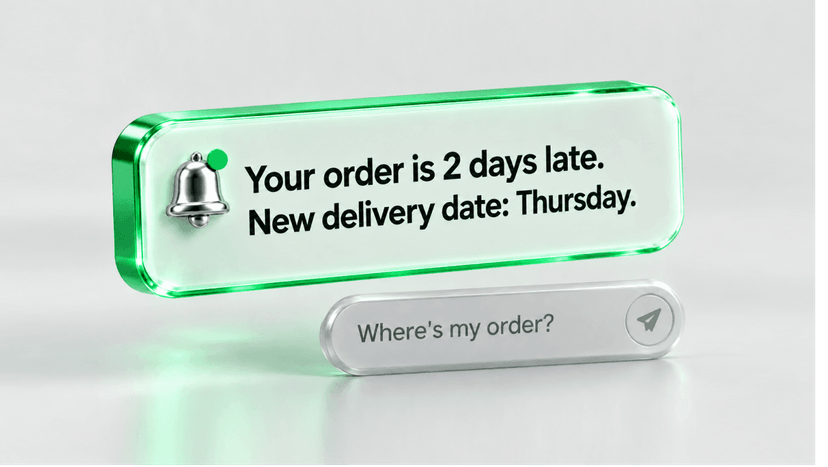
- Ecommerce. Order status, delivery changes, returns, and refunds make up a large share of tickets. An ecommerce AI assistant answers "where is my order" and can process the return in the same conversation. Some stores also let it suggest a matching item when a customer asks about sizes or alternatives.
- SaaS. Login problems, plan changes, invoices, and "how do I" questions about features. The agent answers from your docs and, when it's connected to your billing system, can handle subscription changes too.
- Services and healthcare. Booking, rescheduling, and cancelling appointments, opening hours, and intake questions. Anything clinical should go to a person.
- Finance. Balance and payment-status questions, card delivery, and account updates. Route suspicious activity and disputes straight to your team.
Whatever the industry, start with the ticket type that comes in most often.
sbb-itb-97114f1
AI agent features for customer support automation
Here's a closer look at the features that decide how much of your support work an AI agent can take on.
| Feature | What it does | What to check before you choose |
|---|---|---|
| No-code setup | Connects to your helpdesk and content without developers | How long connecting takes and how you test before launch |
| Training on your content | Answers from your help center, docs, and past tickets | Which sources it can learn from |
| Brand tone | Writes replies in your brand's voice | Whether you can set tone and response structure |
| Actions | Issues refunds, updates orders, changes account details | Which systems it can act in, and under what rules |
| Channels and languages | Works across chat, email, and voice, in the customer's language | Which channels and languages are covered |
| Human handoff | Passes the case to a person with a summary | What context your agent receives |
| Agent assist | Drafts replies for your team | Whether drafts appear inside your helpdesk |
| Analytics and logs | Shows resolution rates, top topics, and why the AI answered as it did | Whether every answer has a decision log |
| Security | Protects customer data | Certifications, and whether your data trains other models |
No-code setup and quick launch
Traditional automation tools needed long development cycles. With no-code AI agents, support teams start by connecting their helpdesk, uploading existing materials, and adjusting a few settings.
The setup has three parts: connect your support content, adjust the basic settings, and test the responses. With CoSupport AI Agent, connecting takes about 10 minutes with no code. Test on real questions before you go live. After launch, you update the content the moment a product feature or policy changes, and the answers follow.
Start small. Pick one high-volume issue, run a test phase on real but anonymized questions, and expand from there.
Training on your own content
Generic answers leave customers feeling unheard, especially when they need specific information about your products or services. AI agents that learn from your own materials fix this.
These agents pull from FAQs, help articles, past support tickets, and product documentation. If a customer asks about your return policy, the AI quotes your actual return window and conditions. When new content or new issues come up, the AI picks up the updates, so answers stay current.
Because the answers come from your own approved content, the AI has less room to guess. It's only as accurate as that content. How you prepare that content matters more than any setting, and the knowledge base setup guide walks through it step by step. CoSupport AI also validates information across your sources before it answers, which is how AI support reduces hallucinations.
Brand tone and reply style
Customers notice when a reply sounds like a different company. AI agents can be set up to write in your brand's voice, formal for a bank and relaxed for a consumer brand. The tone comes from two places: the instructions you give the agent, and the past replies it learns from.
In CoSupport AI, you set the tone of voice and response structure as instructions. CoSupport AI Assistant learns from your resolved tickets, so its drafts match the answers and tone your best agents already use.
Actions in your business systems
Many requests end with something that has to be done: a refund issued, an order changed, a subscription cancelled. An AI agent connected to your helpdesk, store, or billing system can do that work in the same conversation, within the rules you set.
CoSupport AI Agent updates orders, cancels subscriptions, processes refunds, and pulls account-specific data. It logs every step with the sources and reasoning behind it, so your team can check any decision later.
Multi-channel and multi-language support
Your customers reach out through chat, email, social media, and messaging apps. AI agents bring these channels into one system and give consistent answers wherever the question comes from. CoSupport AI Agent works across chat, email, and voice, either inside your helpdesk or as a standalone chat widget on your site.
AI agents also detect the customer's language and reply in it. CoSupport AI answers in 60+ supported languages (120+ compatible) and keeps the customer's language for the whole conversation. A customer in Tokyo and one in Berlin each get the answer in their own language, with the earlier messages still in view.
Automatic handoff to human agents
AI agents know their limits. When a conversation gets too complex or emotionally charged, the system transfers it to a human agent. During the handoff, the AI passes a summary of the customer's issue, its previous replies, and any relevant details, so the human agent picks up right where the AI left off.
Customers don't have to repeat themselves. That cuts frustration and gets them to a resolution faster.
Agent assist for your support team
Some tickets need a person's judgment, and some teams want AI working in the background before it replies to customers on its own. That's what agent assist is for.
CoSupport AI Assistant works inside the ticket view your team already uses. It drafts replies, summarizes long conversations, suggests resolutions, and translates when a customer writes in a language your agent doesn't speak. Your agent reviews the draft, edits where needed, and sends it, so nothing reaches a customer without a person.
The two products work together. CoSupport AI Agent resolves the repetitive requests on its own, and the Assistant prepares drafts for everything that reaches a human.
Performance data and customer insights
AI agents also produce analytics. These show which topics produce the most tickets and where the AI hands off most often.
Metrics like resolution rates, average response times, common question categories, and customer satisfaction scores show what's working and what needs adjustment. If many questions are about one confusing feature, the documentation for that feature probably needs an update.
Analytics also show peak support hours and seasonal patterns, which helps teams plan staffing. In CoSupport AI, every answer comes with a decision log of the sources, checks, and actions behind it, so you can see why the AI replied the way it did.
Security and data privacy
Support conversations carry names, order details, and sometimes payment questions, so check where that data goes before you connect anything. CoSupport AI is ISO 27001 certified and GDPR and CCPA compliant. CoSupport AI Agent learns from your content on a dedicated server per client, and your data never trains anyone else's model. The security page has the details.
3 common AI agent implementation mistakes
A capable AI agent still falls short when it's set up badly. These 3 mistakes hurt results most often.
Using generic AI without customization
Deploying an AI agent without tailoring it to your business leads to poor customer experiences. When the AI isn't trained on your company's content, it gives generic, robotic replies or wrong information. A generic model won't know your return policy, warranty terms, or pricing.
The fix: train your AI on real support materials. Build a knowledge base that reflects your company's tone, policies, and product details. Then your AI can answer questions about your shipping options, tell your plans apart, and avoid describing features you don't offer.
Missing human handoff setup
A common mistake is not setting up a clear process for handing conversations to human agents. Customers end up stuck with an AI that can't resolve their issue. Your AI should recognize when a person is needed: when a customer shows frustration, raises a complex technical question, or brings up a billing dispute or refund. Set these as escalation rules by topic and by the customer's tone, then review them after the first weeks.
When a handoff happens, make sure the human agent gets all the context: a summary of the customer's issue, what the AI already tried, and the relevant account details. That way the customer doesn't have to explain the problem twice.
A similar problem comes up when companies don't watch how their AI performs.
Not tracking AI performance
Without performance tracking, you won't know whether your AI is helping customer relationships or hurting them. Small issues grow into bigger ones, and customer satisfaction pays for it.
Watch the performance metrics and update the AI's training content regularly. If a recurring theme shows up around a confusing feature, pass it to your product team. Check the metrics weekly in the first month, and fix the content behind any question the AI keeps getting wrong.
Key points about AI agents for customer support
AI agents let businesses handle growing customer volume while keeping costs in check. Their success depends on customization and control: they work best when they learn from your own content, which reduces errors and guesswork.
No-code setup makes the launch quick, and deeper actions in your internal systems can be added through integrations. Multi-language support reduces the need to hire multilingual staff for a global audience. Actions turn answers into resolutions, because the agent issues the refund or changes the order while the customer is still in the conversation. Human handoff gets complex issues to people with full context, agent assist speeds up the replies those people write, and performance tracking shows what to fix next.
When you compare platforms, check that you control the knowledge base, that the AI can act in your systems, and that you can see why it gave each answer. CoSupport AI Agent learns from your tickets and help center, resolves repetitive requests across chat, email, and voice, and hands the rest to your team with a summary. See how pricing works.
.png)