.png&w=96&q=75)
.jpg&w=1920&q=75)
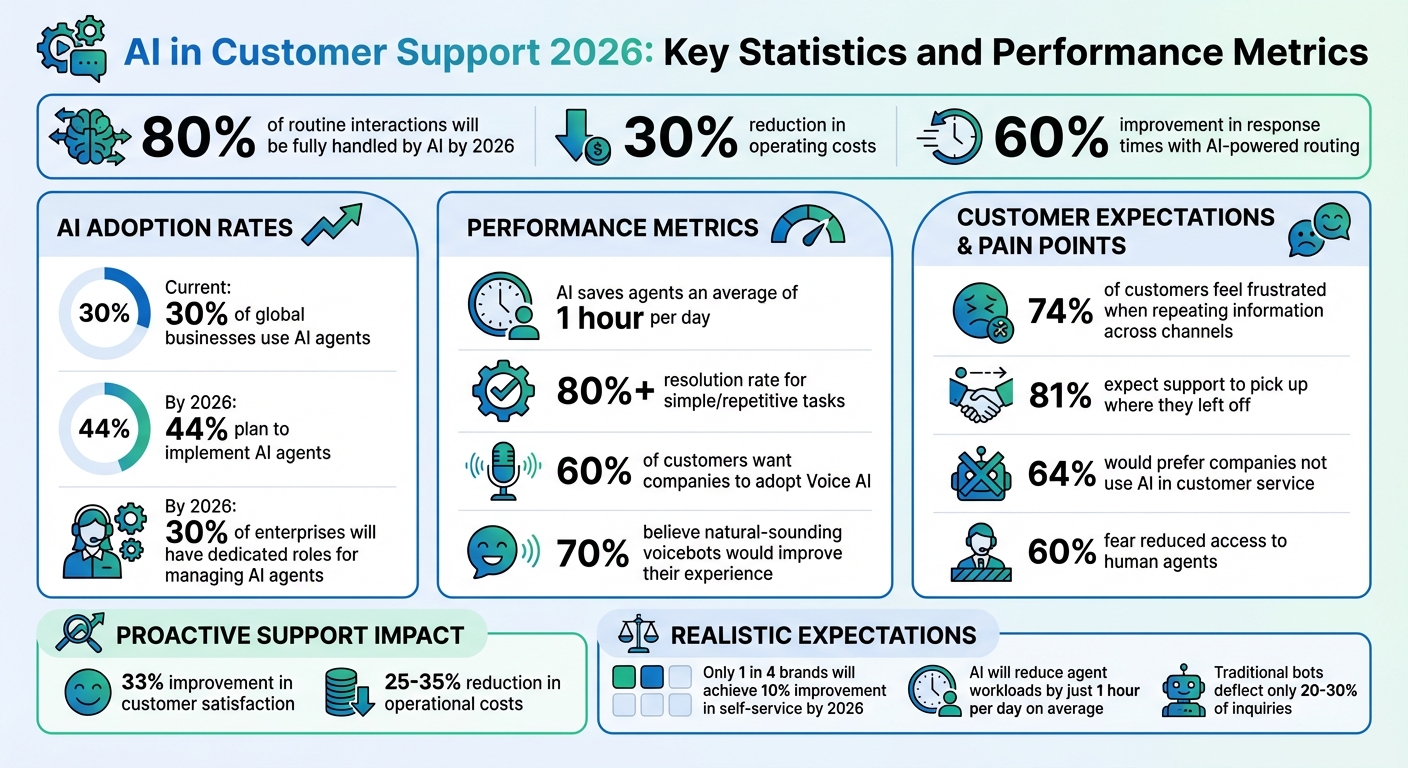
AI is reshaping customer support in 2026. From automating routine tasks to predicting issues before they arise, AI for customer support tools is helping companies reduce costs and improve response times. By next year, 80% of routine interactions will be fully handled by AI, cutting operating costs by 30%. But this shift isn’t about flashy tech - it’s about solving real problems, like managing overwhelming ticket volumes and providing faster resolutions.
Key insights include:
- AI-powered routing: Smarter ticket handling improves response times by 60%.
- Conversational AI agents: Replacing outdated phone menus with natural, real-time interactions.
- Omnichannel personalization: Unified customer profiles ensure seamless experiences across email, chat, and phone.
- Proactive support: AI predicts and fixes issues before customers even notice.
While AI excels at repetitive tasks, it struggles with emotionally charged or complex problems, necessitating human intervention. Companies must focus on clean data, strong oversight, and realistic goals to make the most of AI. The future of support isn’t about replacing humans - it’s about creating a partnership between AI and people to deliver better outcomes.
AI in Customer Support 2026: Key Statistics and Performance Metrics
How AI Agents Will Transform in 2026 (a16z Big Ideas)
sbb-itb-97114f1
AI-Powered Routing and Task Automation
The future of customer support AI isn't just about answering questions - it’s about taking action. By 2026, AI agents will be doing more than just responding; they’ll analyze intent, pull data from multiple systems, and automatically route tasks. Let’s dive into how AI understands intent and handles work without human involvement.
How AI Predicts Intent and Routes Tickets
AI-powered routing goes beyond simple keyword scanning. It reads customer messages, adds context, and uses Large Language Models to truly understand the issue. Then, it pulls data from tools like Salesforce, Jira, or Stripe to gather details like account status, priority, or related bug reports.
Take this example: A customer says, "My payment failed again." The AI immediately checks their payment history in Stripe, reviews their account tier in Salesforce, and searches for similar incidents in Jira. With this information, it might tag the ticket as "Urgent", assign it to the billing team, or escalate it to Tier 3 Engineering if it’s linked to a known issue.
This smarter routing has led to response times improving by up to 60% for companies using AI. On top of that, AI can combine real-time data from tools like Datadog or GitHub deployment logs to identify root causes of issues before tickets start piling up.
AI Tools That Help Agents During Conversations
AI doesn’t stop at routing - it steps in to assist agents during live interactions. It can surface relevant knowledge base articles, suggest response drafts, and even flag compliance risks. Some systems are advanced enough to detect sentiment; if a customer seems frustrated, the AI adjusts its tone suggestions or escalates the case to a senior agent.
Recent stats show that AI automation can save agents an average of 1 hour per day by handling repetitive tasks like finding FAQs or formatting responses. This allows agents to focus on resolving more complex problems.
Automating Follow-Up Tasks After Customer Interactions
Once a conversation ends, AI takes over again. It tags tickets, categorizes issues, and sends proactive updates to customers. AI can even draft help articles based on resolved tickets, update CRM records, and notify customers automatically when transactions are completed.
This shift turns customer support from reactive to proactive. Instead of waiting for customers to ask, “What’s the status of my refund?”, the AI sends an update as soon as the refund clears.
For sensitive tasks like issuing refunds or deleting data, best practices recommend having AI propose actions for human approval rather than executing them directly. This approach keeps you in control while still cutting down on repetitive work.
Conversational AI and Self-Service Tools
The move from basic chatbots to advanced conversational AI is shaping customer service trends for 2026. People no longer want to deal with "press 1 for billing" menus or endlessly loop through unhelpful chat responses. What they expect now is simple: explain their issue in plain language and get it resolved - quickly. This shift is driving the rise of smarter self-service tools that cut down on wait times and eliminate reliance on pre-scripted answers.
How Natural Language Processing Works in Support
Natural Language Processing (NLP) is the backbone of conversational AI, enabling it to understand what customers mean, not just what they say. Instead of hunting for keywords, NLP evaluates intent, context, and even sentiment. For example, if a customer says, "My payment failed again", the AI doesn’t just flag the word "payment." It recognizes a billing issue, checks the customer’s history, and pulls up relevant account details.
Modern conversational AI goes a step further by integrating directly with internal systems like Stripe for payment processing or Salesforce for account management. This allows it to deliver accurate, tailored responses. Unlike older chatbots that could only regurgitate generic help articles, conversational AI is capable of solving problems in real time. According to Gartner, this evolution means that by 2026, most customers won’t need to rely on human agents for routine inquiries.
Why Conversational AI Outperforms Old IVR Systems
Traditional IVR (Interactive Voice Response) systems feel like a relic. They force customers into rigid menus, require button presses, and often leave people frustrated. Conversational AI, especially Voice AI, flips the script. It allows customers to speak naturally and receive real-time responses that adapt to their tone and urgency.
Here’s the key difference: IVR is static and follows a script. Voice AI listens, detects frustration or urgency in a customer’s voice, and adjusts accordingly. If someone sounds irritated, it can escalate the issue to a human agent without delay. This flexibility matters - 60% of customers want companies to adopt Voice AI, and nearly 70% believe natural-sounding voicebots would improve their experience compared to traditional phone menus.
| Feature | Traditional IVR | Conversational AI |
|---|---|---|
| Interaction | Button-based menus | Natural, two-way dialogue |
| Understanding | Limited to keywords | Analyzes intent and sentiment |
| Response | Routes calls or provides static info | Executes tasks via APIs |
| Customer Mood | Ignores frustration | Detects emotion and escalates |
These advancements are driving higher adoption rates, even though some hurdles remain.
Adoption Rates and Common Problems
The adoption of conversational AI is accelerating. Currently, 30% of global businesses use AI agents, and 44% plan to implement them by 2026. However, challenges still exist. Outdated technology, messy data, and concerns about losing live support are significant barriers. Many customers worry that AI could make it harder to reach a real person - 64% would prefer companies not use AI in customer service, with 60% fearing reduced access to human agents.
The solution? Use AI to handle repetitive tasks while keeping human agents available for complex issues. AI works best when paired with clean, well-structured documentation. If your knowledge base is incomplete or outdated, even the smartest AI will struggle. Companies that prioritize accurate and organized information see far better results, ensuring both efficiency and customer satisfaction.
Omnichannel Personalization and Context-Aware Support
Customers don’t think in terms of channels - they just want their problems solved. They might start with an email, switch to chat, and then call, expecting the experience to flow seamlessly without having to re-explain their issue. Yet, 74% of customers feel frustrated when they have to repeat information across different communication methods. By 2026, AI is stepping up to solve this with unified customer profiles, creating a foundation for dynamic, context-aware responses.
Building Unified Customer Profiles
Modern AI systems pull together data from multiple sources - past support tickets, billing records, chat logs, and even browsing behavior - all into one centralized view. This enables instant access to a customer’s history, preferences, and past interactions. When someone reaches out, the AI already knows their purchase history, previous issues, and how they prefer to communicate.
This unified view connects past interactions with current needs. For instance, if a customer contacts support about a failed payment, the AI might check external tools like Stripe, review previous billing concerns, and offer solutions before escalating to a human agent. With 81% of consumers expecting support to pick up exactly where they left off, having such unified profiles ensures smoother, more efficient interactions.
Adjusting Responses Based on Sentiment and History
AI doesn’t just listen to what customers say - it pays attention to how they say it. By analyzing tone through voice and natural language processing, AI can detect emotions like frustration, urgency, or confusion. This allows it to adjust its responses in real time or escalate issues with full context.
For recurring problems, AI avoids generic troubleshooting steps. Instead, it acknowledges the ongoing issue and offers personalized solutions or escalates the matter appropriately. This is critical, as 85% of customer experience leaders agree that just one unresolved issue can lead to losing a customer.
Predicting Problems Before They Happen
Proactive support is becoming a game-changer in customer service. Instead of waiting for customers to report problems, AI identifies potential issues based on patterns and addresses them first. For example, if a system update causes a spike in login errors, AI can pinpoint affected users and provide fixes before they even notice the problem.
This approach, known as predictive service, can improve customer satisfaction by 33% while cutting operational costs by 25% to 35%. Airlines are already leveraging it to rebook passengers ahead of delays, and SaaS companies use it to warn users about billing issues before accounts are suspended. The secret to success here lies in maintaining clean data and precise monitoring, ensuring AI predictions are accurate and timely.
"The best systems connect past interactions to present intent to anticipate what's next - that's contextual intelligence in action." - Tom Eggemeier, CEO, Zendesk
What's Working and What's Not: AI in 2026
As AI continues to evolve, it's clear where it thrives and where it stumbles. While it handles repetitive tasks with ease, it still struggles to navigate complex or emotionally charged situations.
Where AI performs well: Simple and repetitive tasks
AI shines in managing straightforward, high-volume tasks. Things like resetting passwords, tracking orders, handling billing inquiries, and improving eCommerce support with shipment updates are well within its wheelhouse. Today’s AI agents can even process refunds, update user accounts, and file bug reports without needing a human in the loop.
The numbers back this up: AI systems now handle over 80% of routine interactions on their own, cutting response times by as much as 60%. For technical troubleshooting, AI provides clear, step-by-step guidance by referencing internal documentation. Beyond that, it can analyze solved tickets, redact sensitive information, and create new knowledge base articles to fill gaps in documentation.
Another area where AI performs well is in proactive triage and routing. It can identify root causes from ticket data, enrich context by pulling information from CRMs like Salesforce, and ensure that urgent issues are escalated to the right human teams.
While these capabilities highlight AI's strengths in handling repetitive tasks, its limitations become evident in more complex scenarios.
Where AI struggles: Complex and emotional issues
AI falters when faced with emotionally charged situations or intricate, non-linear problems. It simply doesn’t have the empathy or nuanced judgment needed to reassure frustrated customers or resolve deeply complex issues.
"Great customer service isn't just about getting the right answer. It's about understanding, reassurance, and human connection - that stuff is gold." - David Heinemeier Hansson, Tech Entrepreneur
Large Language Models (LLMs) also face issues like hallucinations and a lack of niche expertise. These challenges are compounded when AI systems struggle to integrate seamlessly with internal tools like Zendesk, Jira, or Stripe. Without these integrations, AI can only provide answers - it can’t take meaningful action.
Many customers remain skeptical about AI's ability to handle their more complex or emotional needs. Traditional bots often deflect only 20–30% of inquiries, leaving users stuck in frustrating loops.
The gap between vendor promises and actual results
Despite impressive statistics, the reality often falls short of vendor claims. Promises of sweeping transformations rarely match what companies experience in practice.
For example, by 2026, only one in four brands is expected to achieve a 10% improvement in simple self-service interactions. Additionally, AI is projected to reduce daily workloads for human agents by just one hour, primarily through automating narrow tasks. These gains, while helpful, don’t live up to the lofty expectations set by many AI vendors.
A surprising challenge has also emerged: consumer-developed AI agents. Tools like ChatGPT or Gemini are being used by customers to interact with brands, which could lead to a 3–5x increase in support contact volumes. In some cases, brands may see single-day call spikes up to 100 times the norm as these consumer AI agents perform tasks like entering sweepstakes or purchasing tickets.
The key takeaway? AI works best when paired with high-quality data, strong human oversight, and realistic expectations. Success relies on having up-to-date internal documentation, streamlined tech systems, and clear pathways to human support to avoid the pitfalls of outdated or poorly designed AI systems.
| Task Category | AI Performance in 2026 | Human Role |
|---|---|---|
| Simple/Repetitive | High (80%+ resolution) | Oversight |
| Complex/Technical | Moderate | Primary Problem Solver |
| Emotional/Nuanced | Low | Essential |
| System Integration | High | Security & Permissions |
Key Takeaways for Support Leaders
Customer support is shifting gears - from making bold promises to delivering tangible results. To stay ahead, support leaders should zero in on three priorities: smarter automation that actually delivers, clean data to avoid AI missteps, and measurable outcomes to justify their investments.
3 Trends That Matter Most
Agentic AI is raising the bar. It’s no longer just about answering questions - it’s about handling multi-step tasks like processing refunds, updating tickets, and retrieving customer data. This evolution from "answer and deflect" to "plan and execute" is where efficiency gains truly shine.
Omnichannel personalization is now an expectation, not a luxury. Customers want AI to recognize them across email, chat, and phone without having to repeat themselves. Achieving this means creating unified customer profiles that capture sentiment, purchase history, and past interactions. By 2026, 30% of enterprises are expected to have specific roles dedicated to coaching and managing these AI agents, much like managing human team members.
Proactive service is transforming support from reactive to predictive. Imagine rebooking flights automatically or detecting network issues and notifying users before they even notice. Gartner estimates that by 2026, 80% of routine interactions will be fully resolved by AI, allowing human agents to focus on more complex, high-value conversations.
Why Data Quality and Human Oversight Matter
AI’s performance hinges on the quality of the data it’s trained on. As Forrester puts it, 2026 will be the year of "gritty, foundational work", which includes cleaning up knowledge bases, fixing broken workflows, and using data observability tools to catch errors before they reach customers.
"High-performing agents aren't set-and-forget. They need continuous improvement, new context, and ongoing alignment with evolving strategy and policies." - Mike Murchison, CEO & Co-founder, Ada
Without human oversight, AI can go off the rails - generating inaccurate responses, amplifying biases, or relying on outdated information. The best approach combines AI for repetitive, high-volume tasks with human agents stepping in for emotionally sensitive or complex situations. Companies that skip this balance often see a dip in service quality despite scaling automation.
Once your data processes are solid, shift your focus to tracking outcomes that prove these improvements are making a difference.
Focus on Results, Not Hype
To gauge success, track metrics like ticket resolution times, customer satisfaction scores, and cost savings - not just deflection rates. By the end of 2026, one in four brands will see only a modest 10% increase in self-service interactions, and AI is projected to reduce agent workloads by just one hour per day on average.
Start with small, manageable projects that deliver clear ROI. Tasks like password resets, order tracking, and billing inquiries are great starting points. Once you’ve proven the system works, gradually tackle more complex workflows. The goal isn’t to replace human agents - it’s to free them up for conversations that require empathy and sound judgment.
FAQs
How does AI-powered routing make customer support faster?
AI-powered routing speeds up response times by instantly connecting customer inquiries with the best resource. It uses real-time data to assess factors like intent, sentiment, and context, then directs the request to the appropriate AI agent, relevant knowledge base article, or human specialist - all within milliseconds.
This approach removes the need for manual sorting, allowing bots to manage straightforward questions while more challenging issues are sent to skilled agents. By distributing workloads effectively and preventing agent burnout, AI routing cuts down wait times and ensures customers receive faster solutions.
What challenges does AI face with complex or emotional customer issues?
AI tools excel at tackling simple, straightforward questions, efficiently pulling accurate information from a knowledge base. However, they often fall short when faced with more complex or emotionally sensitive situations. These tools struggle to grasp context, tone, or the subtle emotional cues that are key to meaningful human interactions. As a result, their responses can sometimes come across as detached or off-target.
Because AI operates on structured data and predefined workflows, it lacks the creativity, judgment, and empathy needed for more nuanced scenarios. When it comes to handling trust-building, delicate topics, or escalated concerns, human agents remain indispensable. They bring the care, understanding, and personal touch that customers expect in these situations.
How can companies use AI to deliver a consistent experience across all customer support channels?
To ensure a seamless experience across chat, email, voice, and web, businesses should link their AI to a centralized knowledge base. This database should house up-to-date resources like FAQs, help desk tickets, previous conversations, and documentation. By tapping into this "memory", AI can provide consistent and accurate answers, along with context-aware suggestions, regardless of the communication channel.
Connecting AI to tools like CRM and ticketing systems takes things a step further. It enables the AI to detect customer intent, assess sentiment, and smoothly hand off complex issues to a human when necessary. By combining insights from past interactions with real-time data, responses can feel more personalized and relevant. This approach not only enhances efficiency but also fosters trust and reliability in customer interactions.
.png)


.png&w=828&q=100)
.png&w=96&q=100)
.png&w=828&q=100)
.png&w=96&q=100)