2

Agentforce is Salesforce's platform for building and running AI agents on its CRM data, and it only runs inside Salesforce. An agent reads a request, decides the next step and acts: it answers a customer, updates a case, books an appointment. Salesforce announced it on September 12, 2024, and made it generally available in late October that year.
Salesforce runs Agentforce on its own help site and has published resolution rates for it anywhere from 63% to 85%. How a resolution gets counted is the part to understand before you compare it with anything else.
How Salesforce Agentforce works
An agent has five working parts. Salesforce has renamed several of them, and its own pages still mix old and new names.
| Part | What it does | Other names you'll see |
|---|---|---|
| Atlas Reasoning Engine | Breaks a request into steps, picks an action, checks the result and repeats until the job is done | None |
| Subagents | The jobs an agent is allowed to do, each with its own instructions and rules | Topics |
| Actions | The single tasks inside a job, like looking up an order or asking for an account number | None |
| Data 360 | The customer and knowledge data the agent answers from | Data Cloud, until October 2025 |
| Trust Layer | Masks personal data before a prompt reaches the language model | Einstein Trust Layer |
You assemble these in Agentforce Builder by describing the agent in plain language and testing it before it goes live. Salesforce also says the model provider doesn't keep prompts or answers and doesn't train on them.
Agent Script matters for anyone who has to trust the output. It lets a developer fix parts of a workflow in code while the language model handles the conversation. Salesforce's own executives say a language model's reasoning can waver as workflows get complex, so the strict steps, an identity check for example, get scripted.
Is Agentforce just a chatbot?
No. Salesforce's older Einstein Bots navigate a conversation with predefined dialogs, steps and scripted messages. An Agentforce agent has no pre-drawn dialog: a reasoning engine and a language model work out the next step from the request and the data the agent can reach, inside the rules you set. Salesforce documents an upgrade path from a bot to a service agent.
For the customer it's still a conversation, in a chat window, on the phone or in a messaging app. What they notice is whether the answer was right and whether a person was reachable.
The agents Salesforce sells
Agentforce is a platform, and Salesforce also ships finished agents on it. In September 2026 it named them by job: Casey for customer help, Paige for IT and HR requests, Carter for shoppers, Piper for inbound sales, Hunter for outbound sales, and Marshall for supply chain.
The same list includes Fin. Salesforce completed its acquisition of Fin, the company formerly known as Intercom, that month, so Fin's AI agent now sits next to Agentforce under one owner. We cover that deal in Fin alternatives.
What Agentforce does in customer service
Service was the first job Salesforce shipped, and two agents matter here.
Service Agent came first. It answers customers on web chat, messaging apps and voice, and it grounds its answers in your knowledge base and CRM records.
Help Agent became generally available in July 2026. It's a prebuilt agent with guided setup that can run workflows such as scheduling appointments and managing orders, and it's sold per resolution.
When an agent can't finish, it escalates through Salesforce's routing. If a rep is free, the session and its history go to that queue. If nobody is free, the agent picks the conversation back up. Escalation is tried once per session, so write the handoff rules before launch.
What a team needs before launch
Salesforce describes Help Agent as deployable in minutes. Its readiness guide for service agents lists more:
- The right Salesforce edition. Help Agent comes with the Advanced and Max service editions.
- Data 360 switched on. The agent reads customer and knowledge data through it. Salesforce puts the provisioning at 15 to 60 minutes.
- A searchable knowledge base. The agent answers from what you've written, so thin articles mean thin answers.
- A user account for the agent. An admin creates it and assigns the permissions it needs.
- A routing rule for handoffs. Someone decides which queue gets which escalation.
The published timelines don't agree, and none of the longer ones is about Help Agent. Salesforce's September 2026 agent story cites six weeks to go live for a retailer's shopper agent and 45 days on average for its inbound sales agent. In April 2025 Ben McCarthy, founder of Salesforce Ben, put setup, training and testing at weeks, if not months. A pilot is quick when your data is clean. Most of the time goes into the data.
Agentforce from 2024 to now
These are announcement dates. Several features shipped weeks or months later.
- September 12, 2024. Salesforce announces Agentforce, with pricing from $2 per conversation.
- Late October 2024. Service Agent and the builder become generally available.
- December 2024. Agentforce 2.0 is announced, with pre-built skills and deployment in Slack.
- March 2025. Agentforce 2dx is announced: agents that run in the background, triggered by data changes.
- May 2025. Flex Credits arrive as a second option: pay per action instead of per conversation.
- June 2025. Agentforce 3 is announced, with a command center for monitoring agents due that August.
- October 2025. Agentforce 360 launches at Dreamforce, and Data Cloud becomes Data 360.
- June 2026. Help Agent is announced with pay-per-resolution pricing.
- September 2026. New service editions (Core, Advanced, Max), the job-ready agents, and the Fin deal closes.
- Autumn 2026. With the Winter '27 release, Salesforce is switching Agentforce on by default for eligible orgs, according to Salesforce Ben.
Salesforce counts four major releases before Agentforce 360. A page written a year ago describes a product with different names and different prices.
What Salesforce's numbers say
All of these are Salesforce's own figures.
In August 2026 Salesforce said Agentforce annual recurring revenue passed $1.5 billion, up more than 240% from a year earlier. Its release adds that from that quarter the figure includes its other AI offerings, so it may not be like for like with earlier quarters.
Customer counts come in three versions. Salesforce reported more than 9,500 paid Agentforce deals in December 2025 and more than 29,000 deals since launch in February 2026. Its product page says more than 18,000 companies run on Agentforce, with no date. Deals, paid deals and companies are three different things.
On its own support team, Marc Benioff said in 2025 that he'd cut support headcount "from 9,000 heads to about 5,000," as Fortune reported.
Then the resolution rate. For its own help site Salesforce has published 83% in December 2024, 70% in June 2026, and 85% and 63% on two undated pages. A fifth figure, 77%, covers its Japanese launch only.
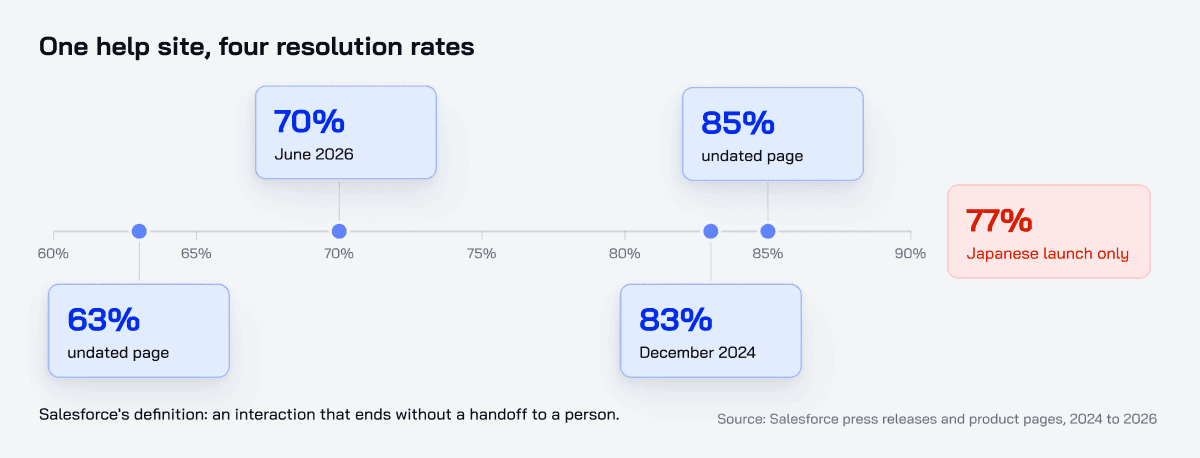
Salesforce doesn't explain the spread. The figures cover different periods, and several pages don't say how they count. What it does publish, in a post on its support metrics, is three buckets. A resolution is an interaction that ends without a handoff to a person. A customer-confirmed resolution is one where the customer says the problem is solved. An abandon is a customer who leaves before asking anything.
Help Agent adds a third meaning, the one you pay on: Salesforce charges when Help Agent resolves an issue on its own, start to finish. For what other industries report, see our resolution rate benchmarks.
Where Agentforce falls short
Four limits keep coming up.
Traction. CIO reported in July 2026 that KeyBanc analysts, in a research note, questioned the product's maturity and said their customer checks hadn't been strong.
Data readiness. A consultant quoted in the same article said the appetite is there, but customers' CRM data is fragmented, duplicated and inconsistent. An agent grounded in messy records gives messy answers.
Cost predictability. Forrester named Salesforce a Leader in its 2026 customer service evaluation. CX Today's summary of the report lists complex pricing and slower value from AI agents as cautions. Usage pricing is harder to budget than seats.
Setup effort. One Salesforce practitioner told Salesforce Ben the documentation reads as if many teams each own a piece of the story.
Agentforce is a platform project, with the timeline and the admin work that come with one.
How much Agentforce costs
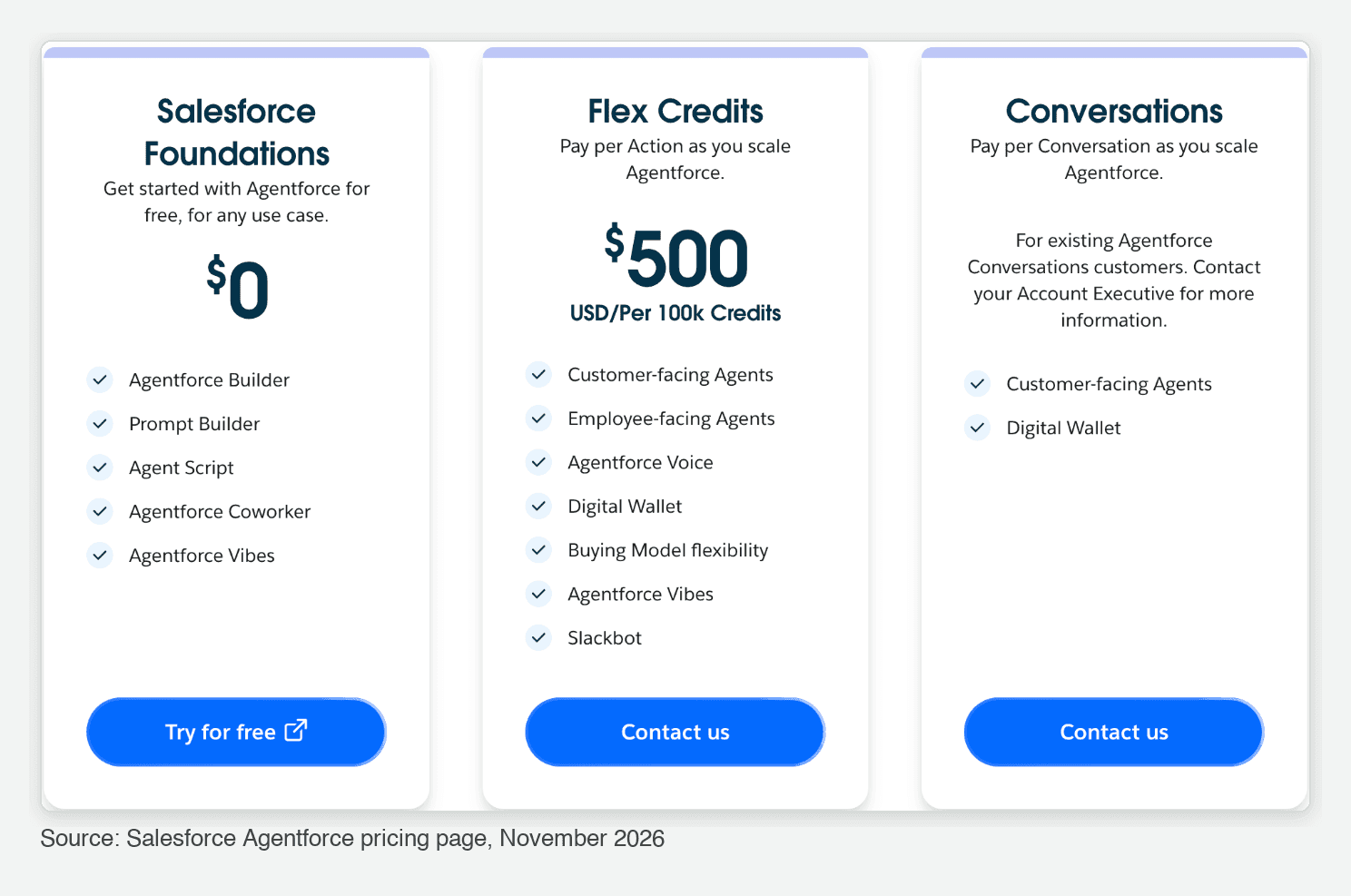
Salesforce prices Agentforce by Flex Credits at $500 per 100,000 credits, with 20 credits per action, by the resolution for Help Agent, and per user for employee-facing agents. The $2 per conversation it launched with is now listed for existing Conversations customers, who are sent to their account executive. There's also a free starter tier, Salesforce Foundations. The service editions start at $195 per user a month. Our Agentforce pricing guide works through the bill at real volumes.
What a support team without Salesforce can take from it
Most teams reading about Agentforce won't buy it, because their customer records live somewhere else. We compare the two paths in Service Cloud vs AI-native support platforms.
For those teams there are agents that work inside the helpdesk they already use, with no CRM underneath. CoSupport AI Agent is one. Its rule for a resolved conversation is silence-based and stated up front: the customer doesn't reply within 72 hours of the AI's answer. Whatever agent you look at, four lessons from Agentforce carry over.
- Define a resolution before you buy. Ask what counts, what happens when the customer leaves without answering, and whether you can audit it.
- Ground the agent in your own knowledge. Every vendor's agent answers from your articles and records. Fix those first.
- Write the handoff rule. Decide which requests always go to a person and what the person sees when they arrive.
- Test on real tickets. A demo on clean examples tells you little. Run the agent on last month's queue.