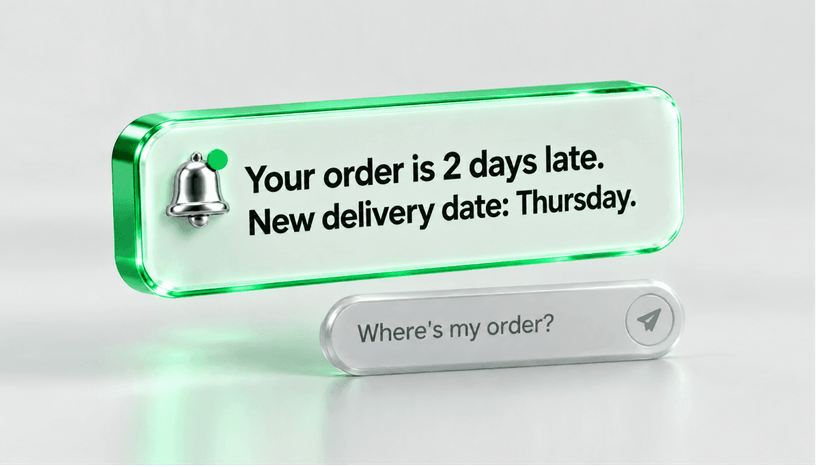
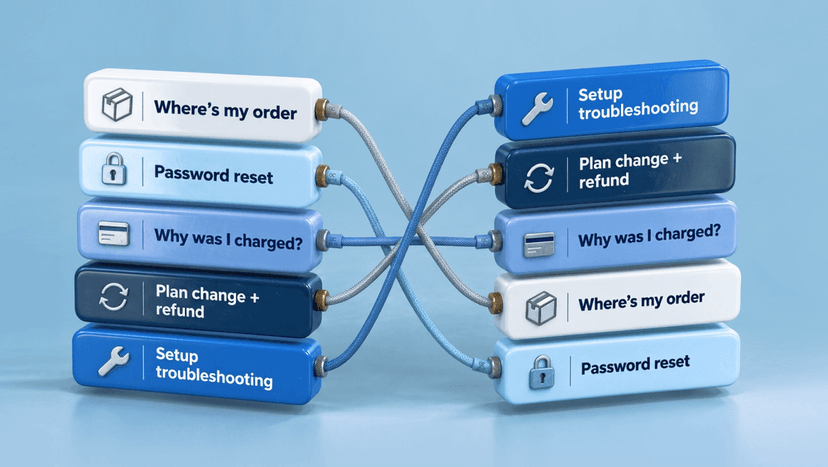
Online stores use AI in five places: customer support (order status, returns, product questions), sales (recommendations and shopping help), marketing (personalized emails and ads), operations (demand forecasting and order updates), and retention (spotting unhappy customers). For most stores, support pays off first. An AI agent can answer "Where is my order?" in seconds, at any hour, and handle holiday peaks without extra hires.
Setting up an online store is hard. You spend ages on photos and fonts, hit publish, and breathe a sigh of relief. Then the real work starts: bringing in customers and giving them support good enough to make them come back.
You only have so many hours in a day. If the store takes off, AI tools help you keep up by:
- Answering questions instantly.
- Recommending products.
- Analyzing customer data.
- Taking routine tasks off your team.
Here's how to use AI to automate ecommerce support and grow sales, and how to tell whether it's worth the cost.

Where can you use AI in an ecommerce business?
| Area | What AI does | Example | When a person steps in |
|---|---|---|---|
| Customer support | Answers order, return, and product questions | "Where is my order?" answered with live tracking | Complaints, damaged goods, policy exceptions |
| Sales help | Recommends products and answers pre-sale questions | Suggesting the right size or a matching item | High-value or custom orders |
| Marketing | Personalizes emails, offers, and ads | A reminder with a relevant offer after an abandoned cart | Campaign strategy and brand voice |
| Operations | Forecasts demand and sends order updates | Restocking a best-seller before it sells out | Supplier problems, unusual orders |
| Retention | Spots unhappy or at-risk customers | Alerting the team when a loyal buyer complains twice | Outreach to save the relationship |
AI for ecommerce customer support
Ecommerce customers don't build an in-person relationship with you, so support is often the only conversation they have with your brand. If they can't get an answer quickly, they'll buy from a competitor.
Bots have been around for years. Earlier ones only worked when customers used the right keywords. Generative AI understands the context of a question and writes a specific answer, which makes it far more useful for support.
Chatbots and virtual assistants
Modern AI agents can:
- Answer frequently asked questions about shipping, sizing, and policies.
- Track orders and give the latest status.
- Process returns, cancellations, and order changes.
- Check stock and suggest alternatives when an item is sold out.
For example, CoSupport AI for Shopify reads live order and product data from your store, so it can answer "Where is my order?" with the actual tracking details, change or cancel an order, and check refund eligibility. It runs as a standalone chat widget or inside Zendesk, Freshdesk, Zoho, and other helpdesks. Anything outside its knowledge goes to a person with the full conversation attached.
An AI agent is available 24/7 and handles many conversations at once, so a flood of requests doesn't leave anyone waiting. If "Where is my order?" fills your inbox, here's how to automate WISMO tickets.

Handling busy times
Is your store busiest before the holidays? During sales, holidays, and product launches, questions spike. Hiring and training extra staff for a few weeks is expensive, and new hires take time to learn your products.
AI absorbs the spike. It answers the routine questions at any volume, so your regular team can focus on the issues that need a person. With per-resolution pricing, a holiday spike adds cost only for tickets the AI actually closes.
Helping your support agents
AI also helps the agents themselves. If you're not ready to let AI talk to customers directly, start with an assistant inside your helpdesk: agents get suggested answers and send them after a quick review. CoSupport AI Assistant works this way.
You can also use AI to train your team. It can pull difficult conversations from your ticket history and turn them into practice scenarios for new agents.
Automating repetitive tasks
Beyond conversations, AI can handle routine work such as answering standard emails or flagging items to reorder. It doesn't get tired or have a bad day, so it gives the same accurate answer the hundredth time as the first.
Voice assistants
Speech recognition has improved a lot, and more shoppers would rather ask a question out loud than type it. Voice assistants help with tasks like checking an order or finding product details, and they suit customers who prefer talking to typing.
Is AI customer support worth it for an online store?
It pays off when closing a ticket by hand costs more than the AI does. The math depends on how many tickets you get, what share the AI fully resolves, and what an agent's time costs you.
The example below uses resolution-based pricing at $0.50 per AI-resolved ticket, the model CoSupport AI Agent uses. Teams typically reach 60–70% AI resolution in the first 60 days. The agent columns assume 6 minutes and $20 an hour per ticket, so about $2.00 per ticket closed by hand. Replace both with your own numbers.
| Tickets per month | AI-resolved at 60% | AI cost per month | Agent time for those tickets | Agent cost for those tickets |
|---|---|---|---|---|
| 1,000 | 600 | $300 | 60 hours | $1,200 |
| 3,000 | 1,800 | $900 | 180 hours | $3,600 |
| 5,000 | 3,000 | $1,500 | 300 hours | $6,000 |
Unresolved tickets cost nothing and go to your team as usual, and the first 1,000 AI responses are free. So the cost is tied to tickets the AI actually closed. Freed agent time saves money when it replaces hiring, overtime, or seasonal staff, or when agents move to work that brings in revenue.
Where AI support is less likely to pay off: very low volume, where setting up and maintaining the knowledge base takes more time than the AI saves, or a store where most tickets are complex complaints with few repeat questions.
AI ecommerce personalization
Customers expect stores to know something about them. Good personalization means relevant offers and recommendations, which tend to convert better and get more emails opened.
Personalized product recommendations
AI uses browsing behavior, purchase history, and abandoned carts to suggest what to buy next. If a customer buys the same shampoo every month, AI can suggest the matching conditioner, or offer a discount on the item they buy most. Track how often shoppers click and buy from these suggestions to see what works.
Repricing tools
Do you know what prices to set? Is a competitor offering a better deal? Would a small discount close the sale?
Repricing tools compare competitor prices with your supplier costs and adjust prices within rules you set. This helps dropshippers, whose supplier prices can change quickly. Set a price floor and check marketplace pricing rules before you switch one on.
Smarter site search
Can customers find what they need on your site? AI search understands misspellings and intent, much like Google's "Including results for…". Visitors find products faster, so they're more likely to stay and buy.
AI for ecommerce sales and marketing
Automated email marketing
AI sends promotions based on behavior. If a customer compared sneaker prices on your site, AI can follow up with similar shoes or a matching outfit.
Some messages should inform instead of sell. Say you sell water filters and a customer reads your guide on filter types but doesn't buy. AI can send them more information to help them decide. Relevant content like this nurtures leads and moves them toward a purchase.
AI-generated ad campaigns
Split testing ads is slow, because you build many versions and change one thing at a time. AI can create the variations for you and adjust them in real time based on who's looking.
Say you sell outdoor gear, and a shopper is browsing family tents. AI can show them an ad with a family campsite and the tent's room for four, and show the ultralight tent ad to people browsing solo hiking gear.
Chatbots for sales assistance
Your AI agent can answer pre-sale questions in real time:
- What's the biggest size in this style?
- Does this come in other colors?
- Is this in stock at my local store?
It can also act as a personal shopper. A customer looking for a wedding outfit might be asked about the color scheme, the dress code, and their style, then shown options that fit. The customer gets help at any hour and can shop when it suits them. The bot can also cross-check past purchases to suggest items that go together.
AI for inventory and order management
Few things disappoint a shopper more than finding the perfect product and seeing "Sold out". AI helps avoid that.

Demand forecasting
You want everything in stock, but overstock ties up cash. AI analyzes past sales, customer behavior on your site, and wider trends to forecast demand, which helps prevent both stockouts and overstock.
Order processing and updates
AI can automate parts of fulfillment and reduce transcription errors and missed items. It can also keep customers updated at every step: when the order is packed, when it ships with a tracking number, and when the status changes. Each update answers a "Where is my order?" question before the customer asks it.
Reaching customers before they ask
AI can spot problems early. If it detects a shipping delay, it can notify the affected customers before they contact you. They stay informed, and your team avoids a wave of "Where is my order?" tickets.
Keeping customers with AI
Sentiment analysis and customer insights
Sentiment analysis reads how a customer feels: frustrated, happy, or confused. Your team can prioritize urgent cases and respond in the right tone. Across thousands of conversations, it also shows which issues frustrate customers again and again, so you can fix them for good. Customer analytics adds the other side: which products are trending and where shoppers drop off.
Spotting at-risk customers
AI can identify signals that a customer might leave, such as repeated complaints or a drop in orders, and alert your team so someone reaches out in time.
Loyalty programs
Discounts on products customers buy regularly turn one-time buyers into repeat customers.
Challenges of AI in ecommerce and how to fix them
| Challenge | What goes wrong | Fix |
|---|---|---|
| Missing the human touch | AI lacks empathy in sensitive situations | Let AI handle routine requests and train it to hand complex or emotional cases to a person |
| Privacy | Customer data raises concerns, especially under strict regulations | Use encryption, follow data protection laws, explain how you use data, and let people opt out |
| Relying too much on AI | AI can't handle every case and sometimes gets it wrong | Keep agents alongside the AI and update its knowledge regularly |
| Hallucinations | A generic model invents an answer when it doesn't know one | Use AI that answers from your knowledge base, policies, and store data |
Hallucinations deserve extra attention in ecommerce. An AI that invents a refund policy or a delivery date creates real problems. Look for tools trained on your own help center and policies, which look for answers in specific sources and pass the question to a person when they can't find one.
How to choose an AI partner for your store
Before you sign up, check:
- Training on your data. Will the AI learn from your help center, policies, and past tickets, and answer only from them?
- Ecommerce experience. Does the vendor connect to your store platform and helpdesk? Can they show a demo with real order data?
- Hallucination handling. Can they explain, clearly, how the AI avoids making things up and what happens when it doesn't know?
- Reviews. Check independent review sites. You don't need thousands of reviews, but there should be believable ones, and you can see how the vendor handled the negative ones.
- Pricing model. Do you pay per conversation, per seat, or per resolved ticket? Work out what each costs at your volume and during your busiest month.
Conclusion
AI helps online stores answer faster, personalize offers, and keep up with busy seasons without adding staff for every peak. Start with support, where the payoff is quickest and easiest to measure, then expand to recommendations, marketing, and operations.
Balance automation with people. Let AI take the routine questions, protect customer data, and make sure a person steps in when the AI can't help.