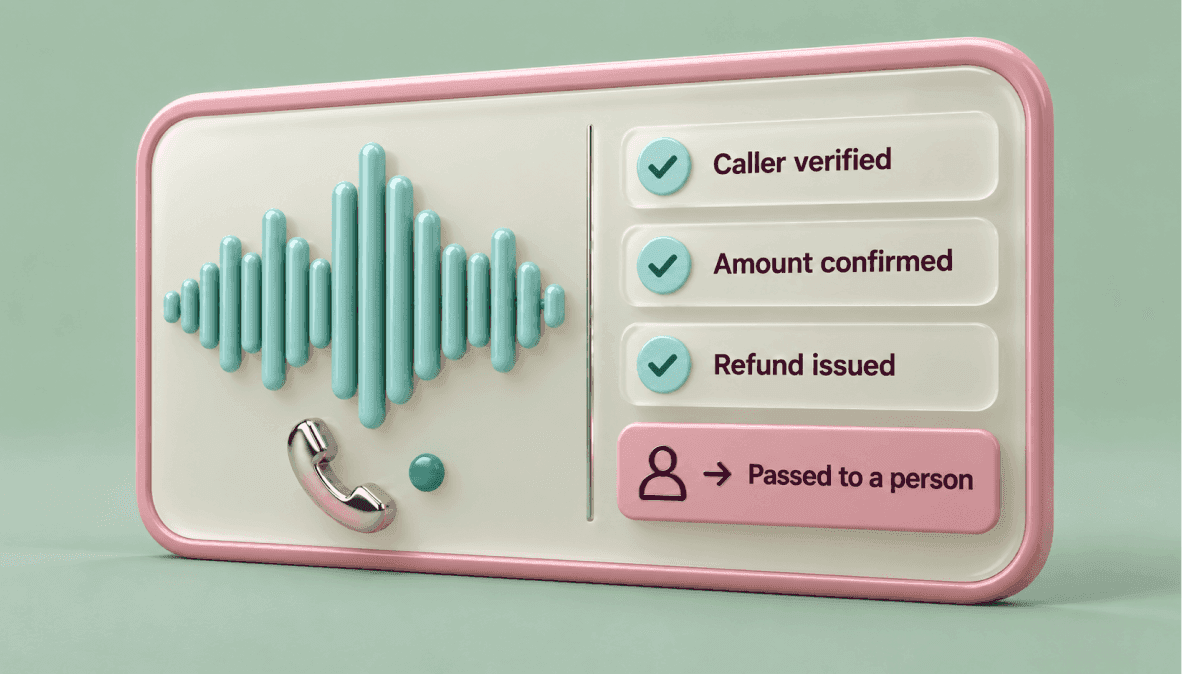
An AI call center answers support calls with AI voice agents. The agent understands what the caller says, checks the account, follows your policies, takes the action, and passes the call to a person when it can't finish the job. The phone line stays, and the AI picks up first.
Callers still choose the phone. In Deloitte Digital's 2026 survey of 3,000 consumers, people were twice as likely to prefer phone over self-service for simple issues, and 5.5 times as likely when the issue felt complex (Deloitte Digital).
What is an AI call center?
An AI call center is a phone support operation where AI voice agents answer first and resolve the routine share of calls, and people handle the rest with the context the AI already gathered. An AI voice agent is the software on the line. A call runs through it in three steps:
- Speech to text. The caller's words become text, in about 100 to 300 milliseconds. This is where a misheard digit or a noisy line starts a mistake.
- A language model with access to your systems. It works out the request, checks the account, applies your policy and takes the action. It starts a reply in about 150 to 500 ms. This is where the wrong account or the wrong refund happens if the checks are weak.
- Text to speech. The answer is spoken back, with the first sound in about 100 to 200 ms. This is where long silences make callers say "hello?" and hang up.
Those timings come from the SupportVoice page of SupportYourApp, our parent company, and its agent replies in under 800 ms.
Two more pieces decide whether a call feels like a conversation. Turn detection judges whether a pause means the caller is done or just taking a breath. Interruption handling lets the caller cut in mid-sentence, and the agent stops to listen. Some agents skip the text step and work speech to speech, which, per the same page, cuts latency by roughly 40 to 60% and keeps the caller's tone.
A demo can sound perfect at step 3 and still refund the wrong card at step 2. Judge the middle step.
"AI call center agent" sometimes means the same voice agent, and sometimes an assistant that helps a human agent during the call by pulling up the account and suggesting the next step. Both belong in an AI call center. For the assistant side, see how agent assist works in contact centers.
What happens on a call: an example
Here's an illustrative call to a subscription company. The caller was charged twice and wants money back for a cancelled order too.
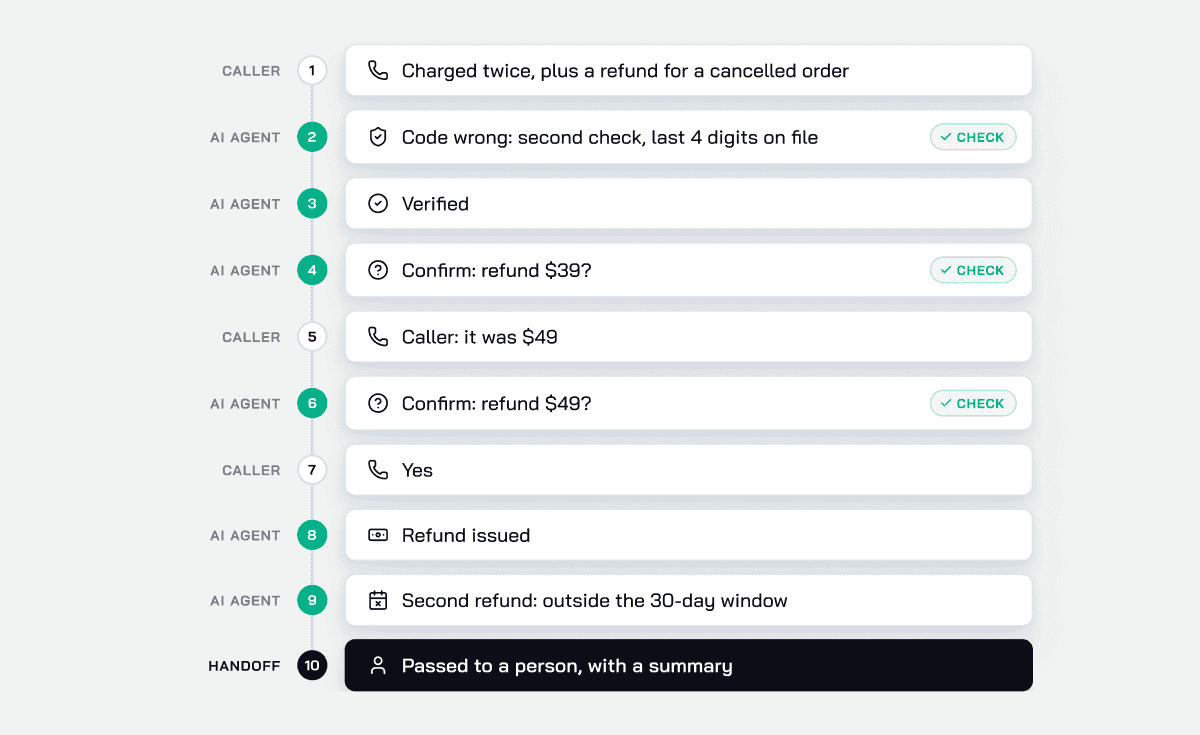
| Step | Caller | Voice agent |
|---|---|---|
| 1 | "I got charged twice this month. And I want my money back for an order I cancelled." | Notes two requests and asks for the code it just texted to the number on file |
| 2 | Reads a code with one digit wrong | Doesn't touch the account. Offers a second check: the last 4 digits of the card on file |
| 3 | Gives the last 4 digits | Verifies the caller and finds two charges on the same day |
| 4 | Reads the amount out loud: "I can refund $39 to the card ending 4421. Shall I go ahead?" | |
| 5 | "It was $49, actually." | Checks the account, agrees the charge was $49, and asks again: "Refund $49 to the card ending 4421?" |
| 6 | "Yes." | Issues the refund and says when it lands |
| 7 | "And the cancelled order?" | Finds the order was cancelled 45 days ago, outside the 30-day refund window. Says so, and offers a person who can decide on an exception |
| 8 | "Yes, put me through." | Passes the call to a person with a summary: caller verified, $49 refunded, second request outside policy |
Three things kept this call safe: a second identity check when the first failed, an amount read back until the caller agreed, and a handoff at the policy line. The AI resolved the first request and set up the second for a person.
AI voice agent vs IVR: why callers learned to beat the menu
For decades, automated phone support meant an IVR: press 1 for billing, press 2 for orders. Menus followed the company's departments, so callers had to translate their problem into the company's words. When the problem didn't fit a branch, they learned shortcuts: press 0, repeat "agent", pick any option that sounds like it leads to a person.
That habit shapes every AI phone call today. Callers expect the system to fail them, so they answer in one or two words and ask for a person straight away. It matters for satisfaction too: Deloitte's report says customers often rate their satisfaction based on how long it takes to reach a human.
| Press-1 IVR | Conversational IVR | AI voice agent | Human agent | |
|---|---|---|---|---|
| What the caller does | Picks from a menu | Says a short phrase | Explains the problem in their own words | Explains the problem |
| What it can do | Route the call | Route the call by intent | Verify, look up, act and resolve, or pass the call on with a summary | Anything within policy, plus exceptions |
| Typical failure | Wrong branch, menu loops | Misheard intent, then a menu anyway | Acting on a misunderstanding, or holding on too long | Hold times, repeat questions after a transfer |
| Best use | Simple routing | Faster routing | Routine calls end to end | Judgment, exceptions, distress |
Is IVR still relevant? A short menu still works as a router, for example to split sales from support. For resolving calls, an agent that understands the request in the caller's own words does a job a menu can't.
Where people stay on the line
People take the calls that need judgment, and they take over the moment a call goes off script.
Pass the call to a person when:
- the caller asks for one, the first time they ask;
- identity checks fail twice, or something looks like fraud;
- the request needs an exception to policy, like the second refund in the example;
- the caller is upset or grieving. Forrester warns that "overautomating complex (and emotional) inquiries will frustrate customers and erode satisfaction".
The person should get what the AI learned: who the caller is, whether they were verified, what was asked, what was done, and why the call was passed on. We cover the full checklist in AI to human handoff.
Keep the way to a person short from the first second. 87% of customers say it's essential that companies using generative AI offer an option to reach a human agent, and Gartner advises against making generative AI a mandatory first step for every issue (Gartner). In practice: the AI answers first, and "a person, please" works at any point.
With CoSupport, SupportVoice answers the calls in 32 languages, around the clock, and people from SupportYourApp take the calls it doesn't close, on the same queue.
Will AI replace call center agents? Gartner's survey says the cuts haven't happened at scale: of 321 service leaders asked in late 2025, only 20% had reduced agent staffing because of AI. In another Gartner survey, 85% of service and support leaders said they're expanding human agent responsibilities as AI reduces contact volume. Gartner also predicts that by 2027 half of the companies that cut staff because of AI will rehire for similar work under different job titles. The longer answer is in will AI take over customer service jobs.
Which calls should an AI voice agent take?
Sort your call reasons by two questions you can answer from your own data. Can the caller fix it alone, if they're given the right answer? And what does a wrong answer cost?
| Call reason | Can the caller fix it alone? | Cost of a wrong answer | Who should take it |
|---|---|---|---|
| Opening hours, delivery times | Yes | Low | Help center or AI voice agent |
| Invoice copy, appointment change | Yes, with account access | Low | AI voice agent |
| Address change, plan change | No, needs an action | Medium | AI voice agent, with verification and read-back |
| Double charge within policy | No, needs a refund | Medium | AI voice agent, with verification and read-back |
| Failed delivery before an event, locked account while travelling | No, and it's urgent | High | AI voice agent for the first steps, a person for any exception |
| Complaint, bereavement, refund outside policy | No | High | A person, with the AI's summary |
The middle rows are where voice agents have moved furthest: looking up account data, rescheduling a delivery, resetting a password, or freezing a card after a security check.
A rule of thumb: automate the calls where a wrong answer is cheap, or where verification and a read-back catch it before it costs anything. Keep people on the calls where a wrong answer can't be undone or costs trust. And if you closed your phone line to save on staffing, AI is a reason to look at it again.
Phone preference grows with complexity, which is why the bottom of that table matters. Deloitte's consumers were 5.5 times as likely to cite phone as a preferred option when the issue felt complex. McKinsey's survey of 3,500 consumers found live phone among the most preferred channels at every age, and many premium-segment customers said live phone support is part of what they pay for. Younger callers want it too: 71% of Gen Z listed live phone among their most preferred channels, against 94% of boomers.
Phone callers are wary of AI as well. Gartner found that only 35% of customers whose last service contact was by phone were willing to adopt a generative AI assistant. The agent has to be useful in the first exchange, and the way to a person has to stay short. For a scoring method across all ticket types, see how to prioritize tickets by cost to serve.
What phone staffing costs, and why it's hard to scale
Phone runs in real time. A chat can wait for a reply; a caller on hold can't. So phone teams staff for the peaks and pay for the quieter hours in between.
Benchmark data shows the strain. In a MetricNet benchmark of internal IT service desks, average voice analyst utilization was 45.3%, callers waited 89 seconds on average for an answer, and 5.8% of calls were abandoned. That's IT desk data, and a customer support benchmark may differ, but it shows how hard it is to match staffing to uneven call volume.
People are the biggest cost, and they leave. Gartner has said labor can make up to 95% of contact center costs. Deloitte Digital's 2026 survey puts contact center attrition at 38% in 2025 and calls traditional operations "stubbornly labor-intensive and difficult to scale".
Peaks may also get sharper. In November 2025, Forrester predicted that at least three major brands would see single-day call volume spikes 100 times above normal in 2026, as consumers' own AI agents call on their behalf. We haven't seen it confirmed yet. Either way, fixed staffing can't stretch that far in a day.
Night shifts and languages are the other expensive part: a separate overnight team for every region and language. A voice agent covers those hours without one, and can pick up the caller's language from the first sentence.
An AI voice agent takes the routine share of those calls without a shift plan, and people stay on the calls that need them. CoSupport AI Agent works across chat, email and voice. It understands customer intent, responds using your knowledge base and business systems, and takes the action the request needs, such as a refund, an order update or an account change. In chat and email it replies in the customer's language, across 120+ languages. See the CoSupport AI Agent page.
How to test an AI voice agent before you buy
In a scripted demo you hear the voice. To learn whether the agent can handle your callers, call it yourself, off script, and run these tests on your own systems, with real data. Run them on each call type you plan to automate.
| Call phase | Test | What a good agent does |
|---|---|---|
| Opening | Explain a real problem the way your customers do, with background noise | Gets the intent right or asks one clear question |
| Opening | Switch language mid-call, if your callers do | Follows the switch or offers a person who speaks the language |
| Opening | Interrupt the agent mid-sentence | Stops talking, listens and answers the new point |
| Identification | Give a wrong code, then the right answer to a second check | Doesn't touch the account until a check passes |
| Action | Let the agent read back an amount, then correct it | Accepts the correction, reads the new amount back, acts only after you agree |
| Action | Ask for something outside policy | States the limit and offers a person for the exception |
| Action | Ask while a connected system is down | Says it can't complete the action now and offers a callback or a person |
| Exit | Say "a person, please" early | Passes the call on the first request, with a summary |
| Exit | Let the transfer go unanswered | Keeps the caller: offers a callback or a message |
| Exit | Call after hours | Resolves what it can and says when a person will follow up |
| Throughout | Time the gaps after you stop talking | Replies without silences long enough to make you say "hello?" |
Then ask two questions. What does a resolved call cost, and how does the vendor define resolved? And who keeps the agent tuned after launch? Some platforms hand you a dashboard and an API key, and the setup, connectors and upkeep stay with your team. A managed service does that work for you.
Rules to know before you put AI on the phone
This is an overview. It isn't legal advice.
- EU, disclosure. Under Article 50(1) of the EU AI Act, providers must design AI systems that talk directly with people so those people are told they're dealing with an AI, unless that's obvious. It applies from 2 August 2026. On the phone, plan to say up front that the caller is speaking with an AI.
- US, AI-generated voices. The FCC has ruled that AI-generated voices count as an "artificial or prerecorded voice" under the Telephone Consumer Protection Act, which requires prior express consent to initiate such calls, outside emergencies and exemptions (FCC). The ruling is about initiating calls. For a line your customers call, ask counsel how it applies to you.
- US, disclosure proposal. The FCC has also proposed rules requiring callers to disclose when a call is AI-generated. We couldn't confirm a final version.
- EU, access to a person. Gartner predicts that by 2028 the EU will mandate "the right to talk to a human" in customer service. That's a forecast. A short path to a person costs little to build now.
Our security and compliance page covers how CoSupport handles customer data.
Your first three steps with a voice agent
- Pull 90 days of call reasons and place each one in the table above: can the caller fix it alone, and what does a wrong answer cost?
- Write the verification, read-back and handoff rules for the 3 to 5 routine call types you pick.
- Run the test script above on those call types, on your own systems, before any caller hears the agent.