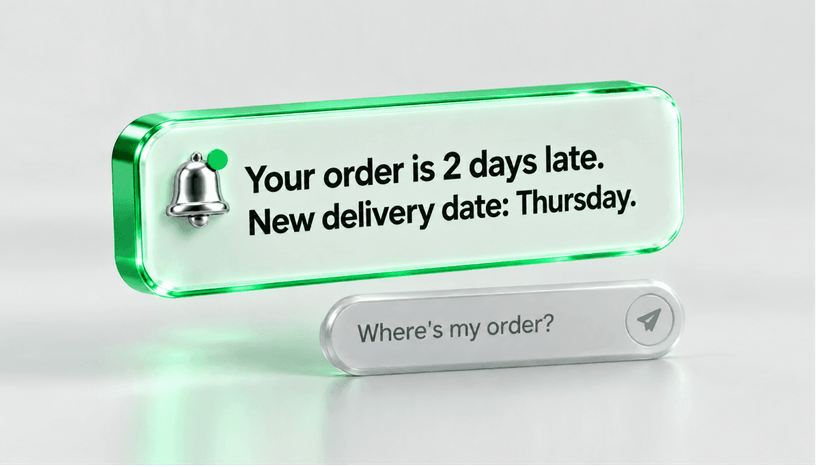
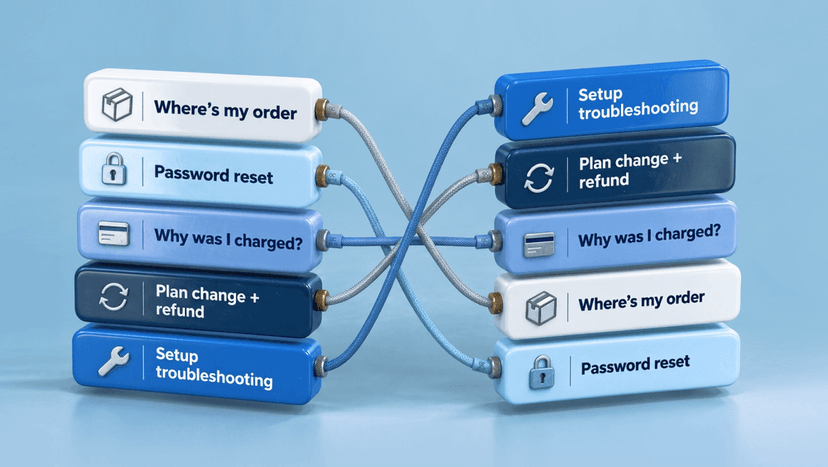
An AI to human handoff is the point where an AI agent passes a customer conversation to a person. A good one happens at the right moment, in the same conversation, and carries what the AI already learned: who the customer is, what they want, what the AI tried, and why it stopped. The customer never repeats themselves. The person starts at step two.
Customers want that standard. In a 2026 Gartner survey of 3,566 customers, 87% said it's essential that companies using generative AI offer an option to reach a human agent (Gartner, 2026).
Why the handoff decides whether customers trust your AI
In its 2023 report on chatbots in consumer finance, the US Consumer Financial Protection Bureau wrote that chatbots can lead customers "in continuous loops of repetitive, unhelpful jargon or legalese without an offramp to a human customer service representative". It added that deficient chatbots that prevent access to live, human support can lead to law violations (CFPB, 2023).
Offering a person helps even when few people take the offer. In a field experiment at a credit union, inviting customers to connect with a human loan agent raised the uptake of approved loans by 24%, even though very few customers contacted one (Kinch and Buell, Management Science, 2025). The result suggests that a visible path to a person helps the automated part of the flow too.
Design the handoff on day one. How customers get out of the AI decides whether they use it again.
When should the AI hand off? Six triggers
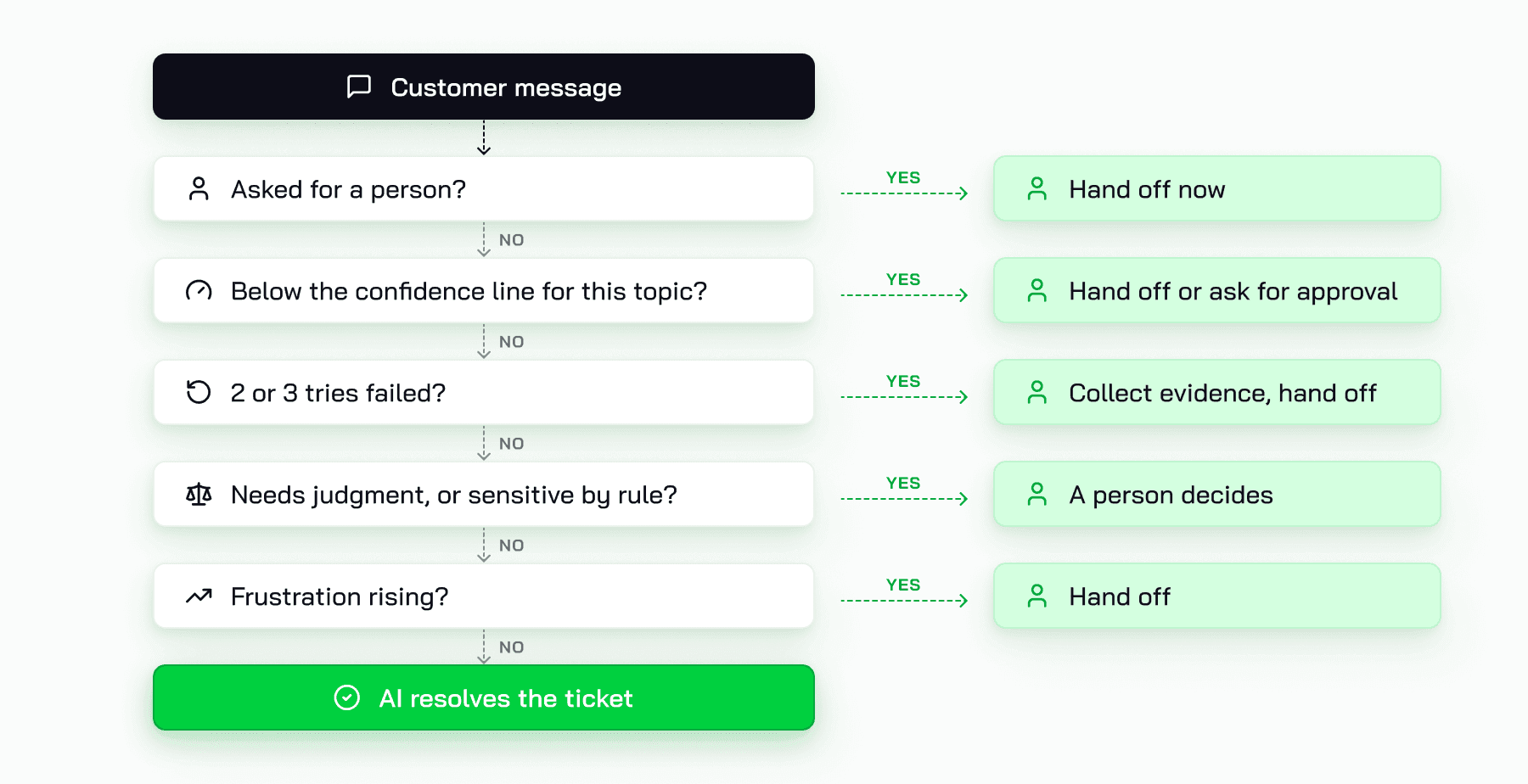
- The customer asks for a person. Hand off now. One more "let me try" turns a request into a complaint.
- Confidence drops below the line for this topic. A how-to question can run on a looser threshold than a refund outside policy or an account-security request. Set the line per topic, and set it stricter where a wrong answer costs money or trust.
- The AI has tried and it isn't working. Cap the attempts: 2 or 3 tries on the same problem is a sensible starting point. The same Gartner survey warns that customers forced through multiple unsuccessful AI interactions before they can reach a person are less likely to use that tool again. In troubleshooting, the last attempt should collect evidence: a screenshot, an error code, the steps that led to the error.
- The action needs judgment. An exception to policy, a goodwill credit, a refund above a limit. The AI can propose, but a person decides.
- The topic is sensitive by rule. Fraud, legal threats, consent, bereavement. One example: a customer asks you to send their full account history to a new email address. That touches data protection and identity, so a person checks it.
- The customer is getting more frustrated. Repeated messages, capitals, "this is the third time". Sentiment is a trigger on its own, even when the AI still has an answer.
One more design pattern is worth building on purpose: a known-issues list. If a failed troubleshooting attempt matches an issue engineering already tracks, a person confirms the match, and the customer learns the problem is known and has an owner.
Handoff rules by topic risk
| Topic | AI acts alone when | Person approves when | Hand off right away when |
|---|---|---|---|
| How-to and product questions | The answer is in your knowledge base | Rarely needed | The customer asks for a person |
| Order status, delivery, tracking | Order data is readable and matches the customer | Rarely needed | The order can't be found after identity is confirmed |
| Refund within policy | Policy is written and the amount is under your limit | The amount is over the limit | The customer disputes the policy itself |
| Refund or credit outside policy | Never | The AI proposes, a person approves or edits | The customer is angry or mentions a chargeback |
| Cancellation or plan change | The steps are clear and identity is verified | A retention offer needs a judgment call | The customer has asked twice to cancel |
| Account access and security | Standard reset after verification | Unusual login or device change | Any sign of account takeover or fraud |
| Billing dispute or legal complaint | Never | Never | Always, with the full record |
| Consent, privacy, data requests | Never | Never | Always |
| Bereavement or a customer in distress | Never | Never | Always, with care |
What should the AI pass to the person?
"Pass the transcript" isn't enough. A 40-message transcript turns the first minute of the person's work into reading. Give them a structured summary on top, plus links to everything the AI found.
Gartner's 2023 survey of 6,138 customers found that those who had a smooth transition from self-service to an agent said they were 74% more likely to start in self-service next time (Gartner, 2023). The same release advises giving agents the context gathered in self-service, so customers don't have to repeat information.
| Field | What it contains | Why the person needs it |
|---|---|---|
| Customer and verification | Who they are, and whether and how identity was confirmed | No second round of security questions |
| Intent | What the customer wants, in one line | The person knows the goal before reading anything |
| Summary | 3 to 5 lines: the problem, the facts found, where it stands | The first reply can be useful |
| What the AI already tried | Answers given, articles sent, troubleshooting steps done | The person doesn't repeat a step that already failed |
| Actions taken or pending | Refund started, order changed, password reset sent | No double refunds, no undoing the AI's work by accident |
| Why it handed off | The trigger, and the AI's confidence at that point | The person knows if this is a policy call, a bug or an upset customer |
| Evidence | Screenshots, photos, order IDs, error codes, recordings | Diagnosis starts from facts |
| Sources used | The knowledge-base articles behind the AI's answers | Wrong or outdated content gets spotted and fixed |
| Language and tone | The customer's language and current mood | The reply matches both |
| Priority | Account tier, SLA clock, how long the customer has waited | The queue sorts itself |
| Leave out | Full card numbers, passwords, data the person doesn't need | Less exposure, fewer compliance questions |
CoSupport AI Agent hands off to your team with the full transcript and a structured summary of what it found and did. It reads what customers send, including screenshots, photos and videos, and logs every visual observation. It runs inside Zendesk, Freshdesk and Zoho Desk, so the handoff happens in the helpdesk your team already works in. That covers the transcript and summary rows of the table. For the other rows, check what your platform passes.
How the handoff should sound on both sides
To the customer: say what's happening, who's next and how long it'll take. "I'm passing this to a person on our billing team. They'll see everything we've covered. Replies usually take about 2 hours." If nobody's online, say when they'll hear back, and keep the same thread.
From the person: open with something only a person who read the context could write. "I can see you've already reset the app twice and sent the error screenshot. Thanks, that saves us a step." Then move the case forward.
Speed can backfire. In a study of customers transferred to AI-assisted human agents after a chatbot failed to understand them, unusually rapid replies led customers to believe they were still talking to a chatbot only (Zhang and Narayandas, Management Science, 2026). A reply that comes back unusually fast can read as a bot, so the opening line has to show that a person read the case.
Be clear that the AI is an AI from the start. Under Article 50(1) of the EU AI Act, providers must design AI systems that talk directly with people so those people are told they're dealing with an AI, unless that's obvious. The rule applies from 2 August 2026. Ask your vendor how it's met. Customers notice too: Pew found that 41% of US adults would feel worse about a customer service experience if they later realized they were talking with an AI chatbot, while 53% say their views wouldn't change (Pew Research Center, 2025).
A handoff doesn't always end the AI's part
If your platform supports it, some cases need only a person's decision. The AI reaches a step it isn't allowed to take alone and proposes what it would do. A senior agent can accept the proposal, change the amount, add a fact the AI couldn't see, or answer the customer personally. Once the decision is made, the AI finishes the reply in the same thread.
It fits exceptions well. A refund requested a week after the window closed. A credit for a delayed order. The customer hears back in the same thread, and the person's time goes to the decision.
Once a person does own the ticket, the AI can still help them. CoSupport AI Assistant prepares a ready-to-send draft from your knowledge base and past tickets, and summarizes long threads, so the agent edits instead of writing from scratch.
How to measure handoff quality
Resolution rate tells you how often the AI closed a ticket. It says nothing about what happened to the rest. Measure the handoff on its own.
| Metric | What it tells you | How to read it |
|---|---|---|
| Handoff rate by topic | Where the AI stops | Compare against each topic's risk level. A high rate on simple topics points to a content gap |
| Time to first human reply after handoff | Whether the customer waits after being promised a person | Track it apart from your general first reply time |
| Repeat-question rate | Whether the payload works | Share of handed-off tickets where the person asked for something the AI already had |
| Late handoffs | Whether the AI holds on too long | Conversations where the customer asked for a person 2 or more times |
| Unneeded handoffs | Whether the AI gives up too early | Handed-off tickets the person closed using only information the AI had |
| Resolved on first human touch | Whether the person had everything | Handed-off tickets closed without another back-and-forth |
| CSAT on handed-off conversations | How the whole path felt | Compare with AI-only and human-only conversations |
Review the late and unneeded handoffs every week. Each one is either a trigger to tighten or a piece of content to add. For the broader loop, see how AI feedback loops improve support.
Why your AI pricing shapes handoff behavior
Ask how your vendor bills before you tune the triggers.
If AI is billed per conversation or per message, every exchange the AI holds counts, whether or not it solves anything. Nothing in that model rewards letting go early.
If AI is billed per resolution, and handed-off tickets are free, the economics point the other way. A ticket the AI can't close costs you nothing for the AI part, so there's no reason to keep a customer in a loop. CoSupport works this way: $0.50 per ticket the AI resolves. Unresolved and escalated tickets cost nothing.
Whatever the model, ask two questions: what exactly counts as a "resolution" on your invoice, and is a handed-off ticket ever billed?
Legal basics: where the law touches the handoff
This is an overview for support leaders. It isn't legal advice.
- EU, automated decisions. GDPR Article 22 covers decisions based solely on automated processing that have legal or similarly significant effects on a person. Where such decisions are allowed, the person keeps at least the right to obtain human intervention, to express their view and to contest the decision (GDPR, Article 22). Most routine support decisions are unlikely to reach that bar. An automated refusal of credit, of an insurance claim, or of access to a service the customer depends on comes closer.
- EU, financial services sold at a distance. From 19 June 2026, under Article 16d of Directive 2011/83/EU (inserted by Directive (EU) 2023/2673), when a trader uses online tools, the consumer has the right to request and obtain human intervention before the contract and, in justified cases, after it (Directive (EU) 2023/2673). Member States apply it through national law.
- EU, disclosure. AI Act Article 50(1) requires that AI systems interacting directly with people are designed so those people are informed they're dealing with an AI, unless that's obvious (Regulation (EU) 2024/1689, Article 50). The duty sits with the provider.
- US, consumer finance. The CFPB's 2023 report is an agency position, not a rule. It says deficient chatbots that prevent access to live, human support can lead to law violations.
If you work in finance, health or insurance, have your legal team map these to your triggers. Then write them into the "hand off right away" column. Our security and compliance page covers how CoSupport handles customer data.
Who takes the handoff?
Someone has to be on the other side. For most teams, that's their own agents. If you'd rather not grow the team to cover every hour, people can sit on the same queue for you: specialists from SupportYourApp, our parent company, take the tickets the AI hands off. In both cases the customer stays in one thread, and the handoff works the same.