.png&w=96&q=75)

Short answer: partly. AI is taking over the repetitive part of customer service work, and some roles are shrinking because of it. The freshest survey data points the same way: in Gartner's April 2026 survey of 321 service leaders, 85% said they're expanding what their human agents do, and only 31% had implemented or planned layoffs through early 2027. The pressure is real, though. Forrester expects 49% of today's customer service jobs to disappear by 2030.
Key points:
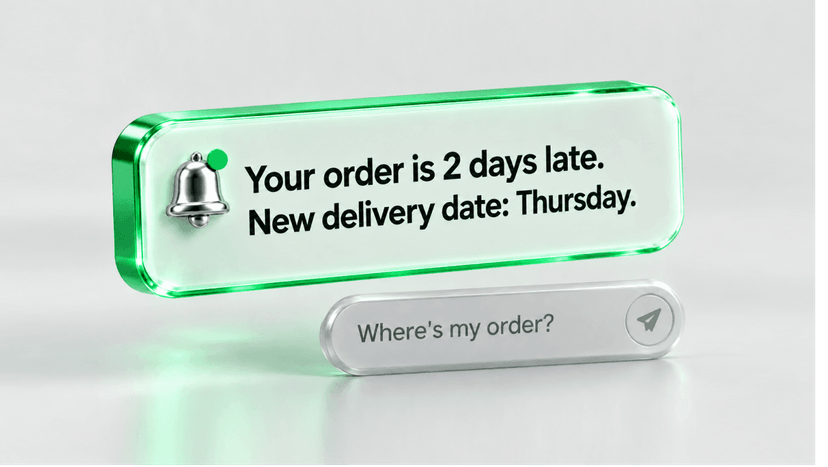
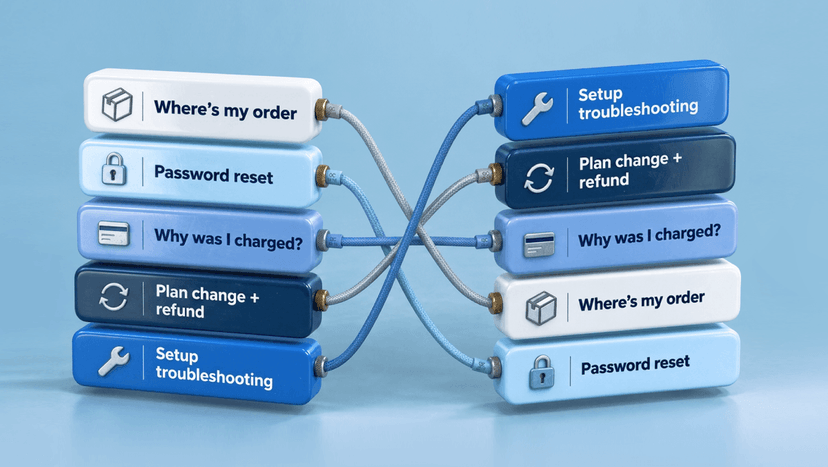
- AI handles the fast, repetitive, 24/7 part of support: order status, password resets, account changes.
- People keep the cases that need judgment, empathy, or a policy exception.
- Headcount is shrinking, so far mostly through attrition, while new roles appear around running the AI.
- Customers want to know when they're talking to AI and want a clear way to reach a person.
Will AI replace customer service? What the latest data says
The numbers below are the freshest we could find, each from the organization that published it.
- Gartner, April 2026. In a late-2025 survey of 321 customer service and support leaders, 85% are expanding human agent responsibilities. Only 31% had implemented or planned layoffs through early 2027, and 63% are reducing headcount gradually through attrition.
- Gartner, February 2026. From the same survey, only 20% of leaders had actually cut agent staffing because of AI. Gartner predicts that half of the companies that did will rehire by 2027, to do similar work under different job titles.
- Forrester, May 2026. Forrester's analysts expect AI to cause 49% of current customer service jobs to disappear by 2030, with the deepest cuts in high-volume consumer support.
- US Bureau of Labor Statistics. The 2025 to 2035 projection has customer service representative jobs falling 5%, about 141,800 positions, while still averaging around 289,500 openings a year as people leave the field.
- Gartner, March 2025. By 2029, Gartner expects agentic AI to resolve 80% of common customer service issues without a person.
The forecasts disagree on size, from a 5% decline over ten years (BLS) to 49% by 2030 (Forrester). They agree on direction: fewer people answer "where's my order", and the people who stay handle the cases AI escalates.
The video below walks through the same question.
sbb-itb-97114f1
AI in customer service: current impact and growth
Support teams use AI to absorb ticket growth without hiring at the same pace. AI takes the routine requests, and agents spend their time on the ones that need judgment. That's the trade: routine volume goes to AI, and the agents who stay take the harder cases.
Benefits of AI-powered customer support
Speed is the obvious one. AI answers in seconds at any hour, while an agent needs time to look things up. The answers are also consistent: the same question gets the same policy, whoever asked and whenever. And the cost per ticket drops on the repetitive requests, because a password reset no longer needs a person.
Job loss fears: are they justified?
Partly. Entry-level roles built around routine requests are the ones under pressure, and the BLS projection above shows the occupation shrinking. What the surveys show is that most companies are cutting slowly, through attrition, rather than in one round of layoffs.
Klarna is the case people cite in both directions. In February 2024 it said its AI assistant was doing the work of 700 full-time agents in its first month. By May 2025, its CEO was telling Bloomberg that cost had weighed too heavily and that customers should always be able to reach a person, and Klarna started recruiting people for support again. AI carried a large share of the volume, and the company still needed people for the rest.
Why human agents still matter
Say a customer's birthday order is late. The tracking data is simple. The conversation depends on what's at stake, and a good agent hears that and finds an option the policy allows. AI can flag that a customer is angry. Working out why, and what to offer, is still the agent's job.
Complex cases need the same kind of judgment. A billing question can turn out to be a misunderstanding about how the product works, and an agent who spots that fixes the real problem.
How AI changes daily customer service work
AI takes specific tasks off the queue and changes what an agent's day looks like.
AI takes over repetitive tasks
Password resets, order tracking, delivery questions, account updates, subscription changes, and billing questions with a documented answer all move to AI. Customers get an answer in seconds, and agents stop spending the morning on the same ten questions.
What AI closes well and what still needs people:
| AI closes well | Still needs people |
|---|---|
| FAQs with a documented answer | Escalated disputes |
| Order status and delivery updates | Edge cases and system errors |
| Basic troubleshooting | Long-running relationship issues |
| Appointment scheduling | Emotional support in a crisis |
| Returns and refunds inside policy | Decisions that need a policy exception |
Smarter personalization with AI
Modern AI systems learn from a company's own knowledge base, policies, and past tickets, so the answer fits this customer's history. Because it works from that content, AI can run many conversations at once, each answered from the same source.
AI as a partner for complex cases
On the cases it can't close, AI works for the agent. It summarizes the history, pulls up the relevant help center articles, suggests a reply, fills in ticket fields, and routes the case to the agent best placed to handle it. One way to set it up: the AI suggests two answers and the agent picks one. The reply goes out faster, and each pick is feedback for the model.
Keeping that handoff reliable is its own discipline. Parloa builds the testing and monitoring side into the agent lifecycle, so escalation paths get checked rather than assumed.
Pros and cons of AI vs human customer service
The useful question is which tickets go to AI and which go to people.
AI is strong on speed, availability, consistency, and volume. People are strong on empathy, judgment, and anything the documentation doesn't cover. The cost picture follows from that: AI is cheap per ticket on repetitive requests and needs setup and upkeep, while people cost more per ticket and handle the cases that keep customers.
AI vs human agents: side-by-side comparison
| AI | People | |
|---|---|---|
| Speed | Instant, 24/7 | Limited by shifts and queue |
| Cost per ticket | Low on repetitive requests | Higher, includes salary and training |
| Consistency | Same answer every time | Varies by agent and day |
| Empathy | Recognizes emotion, reasons poorly about it | Reads the situation and adjusts |
| Unusual cases | Escalates them | Solves them |
| Languages | Answers in many languages from one knowledge base | Limited to the languages on the team |
| Learning | Improves as the knowledge base and feedback improve | Improves with experience and coaching |
The teams that get this right design the handoff first: which requests AI may close, how it escalates, and what the agent sees when the ticket arrives.
What customers want from AI support
Customers will use AI, on their terms. Salesforce's 2024 State of the AI Connected Customer found that nearly 75% of consumers want to know when they're communicating with an AI agent. 45% are more likely to use one if there's a clear path to a person, and 44% if the AI's logic is clearly explained.
Regulators are moving the same way. Gartner predicts the EU will mandate a right to talk to a human in customer service by 2028, and expects AI-related regulation to raise assisted service volume by 30% by the same year. Volume is also coming from the other side: a Gartner analyst expects machine customers, AI assistants acting for consumers, to initiate 50% of service requests by 2030.
So a support team needs both: AI that says it's AI, and a person within reach.
The risks of fully automated customer service
Four things go wrong when support is fully automated:
- Confident wrong answers. An AI that answers from the open internet, or from a stale help center, can produce a wrong answer that sounds right. That's what AI hallucinations are, and in finance or healthcare they turn into compliance problems.
- Loops instead of escalation. If the AI can't tell that a conversation is going badly, it keeps answering and the customer gets angrier. Clear escalation triggers prevent this.
- Missed emotion. Sarcasm and frustration get literal replies. Sometimes the customer needs a person to say "I've got this".
- High-stakes industries. In healthcare, finance, and travel, the cost of one bad answer is high enough that more of the queue should stay with people.
More on where AI support goes wrong: the challenges of AI in customer service.
Common myths about AI replacing customer service jobs
AI works alongside humans, as the first line
AI usually takes the first contact and closes what it can. When the case needs judgment, it passes the ticket to an agent with the history and a summary attached, so the agent doesn't start from zero. The repetitive load that burns agents out goes to the AI.
Customer service jobs are evolving
The repetitive part of the job is shrinking, and new work is growing around the AI. In Gartner's December 2025 release, 42% of service leaders said they're hiring for new AI-related roles. Typical examples of that work:
- AI trainers who review answers and correct the model.
- Conversation designers who decide how the AI asks, answers, and hands off.
- Escalation specialists who take the hard cases AI passes on.
- Knowledge base owners who keep the content the AI learns from current.
Problem-solving and relationship management sit underneath all four.
Where CoSupport AI fits
CoSupport AI Agent takes the repetitive share of the queue. It learns from your tickets and help center, understands customer intent, and responds using your knowledge base and connected business systems. When it can't close a ticket, it passes it to your team with the context attached. CoSupport AI Assistant works the other side, drafting replies for agents on the tickets that stay with people. Answers come from your own content, on a patented architecture (US11823031B1), in 60+ supported languages (120+ compatible).
It connects to Zendesk, Freshdesk, Intercom, and Zoho Desk. Softorino, a consumer apps company, went from 69% to 82% AI resolution in 3 months, resolves 30% more tickets, and saves about $2,500 a month. More customer results.
For the bigger picture of where AI fits in support, see what AI for customer support is and agentic AI.
Key takeaways: the future of customer service jobs
AI is taking the repetitive work, and the job is shrinking at that end. The people who stay handle harder cases, and new roles are forming around running the AI. Most companies are getting there through attrition, and Gartner expects half of those that cut staff because of AI to rehire by 2027.
For support leaders, the practical move is to decide which requests AI may close, design the handoff, and invest in the skills AI can't cover: judgment, empathy, and ownership of the knowledge the AI learns from.
Start Free Pilot: a 30-day pilot on your live helpdesk, with the first 1,000 AI responses free.
.png)