

AI agent assist helps support reps reply faster by showing draft answers, help docs, policy checks, and call notes during live chats and calls. If I were sizing it up fast, I’d expect the best results from one small pilot, clean source content, and tight tracking of AHT, FRT, ACW, adoption, and resolution rates.
Here’s the short version:
- What it is: AI support that works with a human rep during live conversations
- What it does: shows reply drafts, article links, next steps, and post-call notes
- What it does not do: fully handle tickets from start to finish without a person
- Where teams start: billing, shipping, refunds, and account access
- What shapes results: help center quality, macros, past ticket quality, and pilot scope
- What teams often see first: lower reply times, less after-call work, and more consistent answers
- What to watch: accepted suggestions, time saved per ticket, cost per ticket, and ticket outcomes
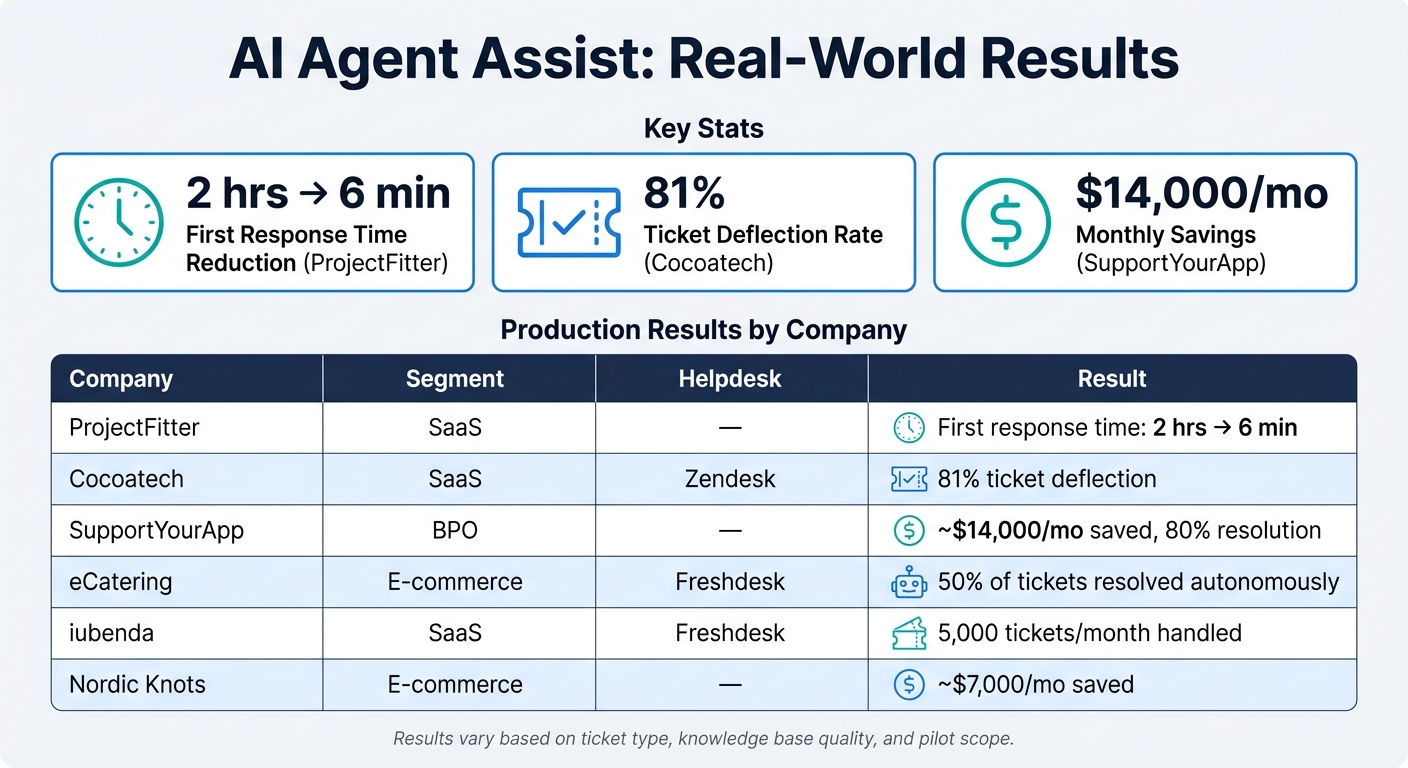
A few numbers stand out right away: one team cut first response time from 2 hours to 6 minutes, another saw 81% ticket deflection, and another reported about $14,000/month in savings. At the same time, results change based on ticket mix and data quality, so I’d treat those as reference points, not promises.
A fast way to think about it is this: agent assist helps the rep do the work, while an autonomous AI agent tries to do the whole job. That difference matters when picking use cases and setting goals.
| Area | Agent Assist |
|---|---|
| Who handles the ticket | Human rep with AI support |
| Best use | Live chat and call workflows |
| Main inputs | Help center, macros, past tickets, order and billing data |
| Main outputs | Draft replies, source links, reminders, CRM notes |
| First pilot focus | One queue, one team, repeat ticket types |
| Common mistakes | Using messy source content and picking end-to-end cases |
If I had to sum up the article in one line, it would be this: start small, clean your content first, connect the tools reps already use, and measure weekly before you expand.
Introduction: why AI agent assist matters in contact centers
Agents waste time jumping between tools, and every extra search slows the reply. That drag hits every ticket and every shift, so the cost stacks up fast.
Next, we'll show where it fits in the support stack and what agents see live.
The business problem teams are trying to fix
For SaaS and e-commerce teams, the pain is familiar. An agent may bounce between a helpdesk, help docs, order data, and billing tools to handle a single ticket. That pushes handle time up and first-contact resolution down. Agent assist is meant to fix that by sitting right inside the agent's workspace.
Where agent assist fits in the support stack
AI agent assist is integrated into the Zendesk AI helpdesk or agent desktop. The AI does the retrieval and makes suggestions. The agent brings judgment and handles the customer relationship.
Next, we'll break down the live workflow inside a call or chat.
sbb-itb-97114f1
What AI agent assist does and how it works
AI agent assist is software that works next to a live agent during a call or chat. It reads the conversation as it happens and pulls up the right information before the agent has to hunt for it. Inside the agent desktop, it suggests the next step in real time.
Here’s what that looks like during a live call or chat.
The real-time workflow during a call or chat
Once the conversation begins, the system transcribes it live and detects intent. Then it pulls relevant content from your knowledge base and shows suggested replies or next-step guidance on the agent’s screen. After the ticket closes, it drafts the CRM note on its own. The system uses your knowledge base and shows the source it pulled from.
What agents see on screen
Agents usually see four things on screen:
- A suggested reply draft
- Relevant article links
- Verification or policy reminders
- A CRM note draft ready to post after the call
Agent assist vs autonomous AI agent
These are two different modes, and the distinction matters when you’re planning a rollout.
| Mode | Who handles the ticket | Best for |
|---|---|---|
| Agent assist | Live human agent, AI co-pilot | Live conversations |
| Autonomous AI agent | AI end-to-end, no human needed | End-to-end ticket resolution |
Next, we’ll look at what teams track after rollout and what changes in the first 30 to 60 days.
What to expect after rollout
AI Agent Assist: Real Results from Real Contact Centers
Metrics teams track first
Support leaders usually start by watching Average Handle Time (AHT), First Response Time (FRT), and After-Call Work (ACW). In the first 30 to 60 days, they also track answer consistency and how fast new hires get up to speed. Those numbers connect straight to resolution speed and lower support cost.
ProjectFitter saw first response time drop from 2 hours to 6 minutes after rollout.
Named examples support leaders can benchmark against
These are production results, not projections.
| Company | Segment | Helpdesk | Result |
|---|---|---|---|
| ProjectFitter | SaaS | Not listed | First response time: 2 hours to 6 minutes |
| Cocoatech | SaaS | Zendesk | 81% ticket deflection |
| SupportYourApp | BPO | Not listed | ~$14,000/month saved, 80% resolution |
| eCatering | E-commerce | Freshdesk | 50% of tickets resolved autonomously |
| iubenda | SaaS | Freshdesk | 5,000 tickets/month handled |
| Nordic Knots | E-commerce | Not listed | ~$7,000/month saved |
Results vary based on ticket type, knowledge base quality, and how tightly the pilot is scoped. Still, these teams had one thing in common: they measured early and adjusted fast.
The next step is a small pilot with one workflow and one helpdesk.
What changes in the first 30 to 60 days
In the first few days, teams usually see shifts in routing accuracy, reply speed, and agent adoption. CoSupport AI connects with Zendesk, Freshdesk, Shopify, and Stripe. It can start resolving tickets in under 3 days.
The first month is usually about content cleanup, pilot measurement, and workflow tuning. Those early signals show where the workflow needs a tighter pass next.
How to roll out AI agent assist in a contact center
Pick the right workflows and data sources first
Start with the ticket types that show up all day, every day. Go for the repetitive ones first: billing questions, shipping status, refund requests, and account-access issues. Those tend to follow the same paths, which makes them a good fit for AI agent assist.
The quality of your source material shapes the quality of the suggestions. If your help center articles are messy, your macros are out of date, or your resolved tickets include weak replies, the AI will pull from that and serve up shaky answers. That’s why it helps to clean things up before launch.
Before you connect anything, review your approved macros, recent resolved tickets, and help center content. Trim outdated replies, fix gaps, and remove anything agents shouldn’t reuse. Once that source material is in good shape, start with one queue.
Connect your helpdesk and run a small pilot
Keep the pilot small. Pick one queue or one team, not every workflow at once. That makes it much easier to spot what’s working and what’s off.
The system uses your past tickets, macros, and help center content to generate suggestions. During the pilot, look closely at suggestion quality. Then watch for patterns in what agents accept, skip, or edit. That feedback tells you a lot. If agents keep skipping one type of suggestion, there’s usually a reason. Maybe the source content is weak. Maybe the wording is off. Maybe the reply is missing one key detail.
Use those signals to tighten your knowledge sources before you expand the rollout.
Measure cost, adoption, and resolution impact
In the first 30 to 60 days, focus on a small set of numbers:
- Accepted suggestions
- Time saved per ticket
- Cost per ticket
- Ticket resolution outcomes
Accepted suggestions tell you whether agents trust the system. Time saved per ticket shows whether the workflow is actually changing or if the tool is just sitting there.
On cost, CoSupport AI's pricing gives you a simple way to check return. At $0.19 per resolved ticket or $0.04 per AI response, you can compare cost per resolved ticket before and after rollout with a direct side-by-side view.
Track these numbers weekly. Weekly tracking makes it easier to catch issues early and clean up the rollout before you scale.
What most teams get wrong, and key takeaways
Mistake 1: using agent assist for end-to-end resolution
After the pilot, the two issues we see most often are simple: teams use the wrong ticket type, and they feed the system weak source material.
AI agent assist works best on human-led tickets. It gives live agents real-time context and approved knowledge when a case still needs a person in the loop. If your goal is full ticket resolution from start to finish, an autonomous AI agent is the better fit.
Mistake 2: skipping knowledge base cleanup before launch
The second common failure point is source quality.
If the help center, macros, or past tickets are messy, the suggestions will be messy too. There’s no magic trick here. The quality of the source material shapes the quality of the suggestions. Before launch, remove old content and fix weak articles.
Key takeaways
- Use agent assist for human-led tickets, not end-to-end resolution.
- Clean up source material before launch. Weak content leads to weak suggestions, and that shows up fast in the pilot.



.png&w=828&q=100)
.png&w=96&q=100)
.png&w=828&q=100)
.png&w=96&q=100)