.png&w=96&q=75)

If you're looking to automate customer support, three platforms stand out: OpenAI Agent Builder, Google Vertex AI Agents, and Microsoft Copilot Studio. Each offers unique strengths tailored to different needs:
- OpenAI Agent Builder: Great for fast deployment and flexible workflows, with a drag-and-drop interface and strong language capabilities. OpenAI is shutting it down on November 30, 2026, so new projects should start on the Agents SDK.
- Google Vertex AI Agents: Designed for large-scale operations, it handles high interaction volumes and offers deep integration with Google Cloud. Best for enterprises with complex data needs. It's now part of Google's Gemini Enterprise Agent Platform.
- Microsoft Copilot Studio: Perfect for businesses already using Microsoft 365. It works closely with tools like Teams and Outlook and offers strong governance features.
What changed in 2026: OpenAI announced in June 2026 that Agent Builder is being deprecated, and it shuts down on November 30, 2026. ChatKit, its embeddable chat interface, stays available, and OpenAI points existing users to the Agents SDK or ChatGPT Workspace Agents. Google has folded Vertex AI and its Agent Builder into the Gemini Enterprise Agent Platform, where Agent Engine is now called Agent Runtime. The comparison below uses the names most teams still know.
Quick Comparison
| Platform | Ease of Use | Best For | Key Strengths | Limitations |
|---|---|---|---|---|
| OpenAI Agent Builder | Visual drag-and-drop | Startups, support teams | Fast setup, advanced language processing | Shuts down Nov 30, 2026; complex workflows need code |
| Google Vertex AI | Enterprise-grade setup | Large enterprises | Scales well, supports multimodal inputs | Complex pricing, needs technical expertise |
| Microsoft Copilot | Microsoft ecosystem focus | Microsoft-centered teams | Native Microsoft 365 integration, strong security | Other systems need connectors |
Key Takeaway
Choose OpenAI for rapid deployment (on the Agents SDK, since Agent Builder shuts down on November 30, 2026), Google for enterprise scalability, or Microsoft for a secure, integrated solution within its ecosystem. Match your choice to your tech stack and operational needs.
I Built an AI Agent That Handles ALL Customer Support 24/7 (No Code)
What AI Agent Builders Do and Why They Matter
AI agent builders are tools that help businesses create and deploy automated customer support agents without needing to write any code. These platforms typically feature drag-and-drop interfaces that make it easy to design workflows for managing customer inquiries, processing requests, and knowing when to escalate complex issues to human agents.
Here’s how they work: AI agent builders connect to your existing business data - like help documentation, support tickets, and internal knowledge bases - and train AI models to respond in your brand’s tone. Once set up, these agents can handle multiple interactions at once, offering instant responses around the clock. This automation takes care of repetitive tasks, freeing up human agents to focus on more complicated problems.
The impact on customer service operations is hard to ignore. A 2026 Gartner survey found that AI spending by customer service leaders surged 38% while overall service budgets rose just 2%, and much of it goes into AI-powered virtual agents. Companies that adopt these tools often see lower support costs by automating routine inquiries that typically take up most of their team’s time.
Businesses across industries are turning to these solutions to meet growing customer demands while maintaining high service standards.
Main Features of AI Agent Builders
Modern AI agent builders come packed with features that make them highly effective for automating customer service. One standout capability is natural language processing (NLP), which enables these agents to understand questions written in everyday language - not just specific keywords or phrases.
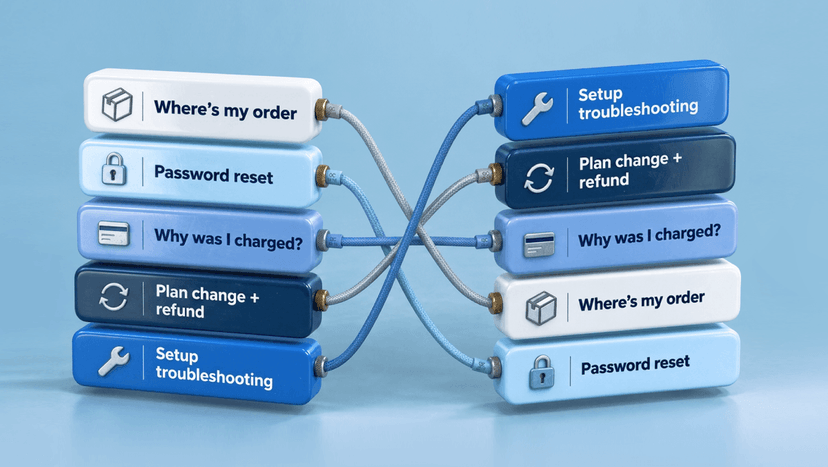
Another key feature is automated response generation, which handles common tasks like password resets, order tracking, billing queries, and basic troubleshooting.
The handoff mechanism ensures that when an issue is too complex for the AI to handle - like a billing dispute or a sensitive matter - it gets smoothly transferred to a human agent. What’s more, the AI passes along the full context of the conversation, so customers don’t have to repeat themselves.
To maintain trust and accuracy, safety guardrails are in place to prevent AI agents from giving false information or making promises they can’t keep. These safeguards protect customer relationships and help avoid potential liability risks.
Finally, multi-agent workflows allow different specialized agents to collaborate on complex cases. For example, one agent might handle initial triage, another could process a refund, and a third might escalate a technical issue to the engineering team. Together, these features give customers one continuous support experience.
Why Integration and Custom Training Matter
While the core features are impressive, the real value of AI agents comes from their ability to integrate with your systems and undergo custom training. Integration capabilities determine whether an AI agent can access the information it needs to provide accurate, up-to-date responses. Without integrations with tools like CRM systems or helpdesks, AI agents are limited to offering generic answers.
For example, OpenAI Agent Builder includes a centralized connector registry that integrates with apps like Google Drive, Microsoft Teams, and SharePoint. This allows agents to pull real-time data from various sources and even take actions across platforms during a single customer interaction.
Custom training is what elevates AI agents from basic chatbots to highly effective support tools. By training them on your company’s product documentation, past support tickets, and internal policies, you ensure they understand your business context and can deliver precise, brand-aligned responses.
When companies invest in thorough custom training, the results speak for themselves. Well-trained agents give accurate answers within their areas of expertise, which reduces the need for human intervention and builds customer trust in automated support.
Platform Comparison: OpenAI Agent Builder vs Google Vertex AI Agents vs Microsoft Copilot Studio
When it comes to building AI support agents, each platform takes a unique approach, tailored to different needs and priorities. Here's a closer look at how OpenAI Agent Builder, Google Vertex AI Agents, and Microsoft Copilot Studio stack up, especially in terms of integration and custom training.
OpenAI Agent Builder
OpenAI Agent Builder offers a user-friendly, drag-and-drop interface, making it easy to design conversational workflows without needing to write code. This approach allows teams to create detailed customer service scenarios by visually connecting actions, such as answering FAQs or managing multi-step processes.
The platform’s advanced language capabilities shine when dealing with complex customer queries. Its generative AI supports multi-turn context, which is especially helpful in troubleshooting scenarios where detailed back-and-forth interactions are required.
Another standout feature is its integration flexibility. OpenAI Agent Builder connects to external tools through MCP nodes, enabling you to pull data from CRMs, helpdesk software, or internal databases during interactions. Built-in safety features, such as human reviews and guardrails, ensure accuracy when handling sensitive tasks.
That made it a good fit for teams that prioritize adaptable workflows and iterate quickly. Since OpenAI announced its deprecation in June 2026, treat it as a prototyping tool: OpenAI's migration guide moves Agent Builder workflows to the Agents SDK, and ChatKit, the embeddable chat interface, stays available.
Google Vertex AI Agents
Google Vertex AI Agents, now part of the Gemini Enterprise Agent Platform, is built for large-scale operations, capable of managing massive volumes of customer interactions across text, voice, and even image inputs. This omnichannel capability makes it ideal for support scenarios where customers might submit screenshots or use voice commands.
Its integration with Google Cloud is a major advantage, particularly for data-heavy applications. Businesses can link their agents to BigQuery for real-time analytics, use compliance tools for regulated industries, and tap into Google’s broader AI infrastructure for advanced functionality.
This platform is particularly well-suited for industries with strict data governance needs, such as finance and healthcare. Enterprises in these industries benefit from its compliance features and its handling of sensitive data. While it requires more technical setup compared to other options, it’s a powerful solution for organizations with complex data requirements.
Microsoft Copilot Studio
Microsoft Copilot Studio works closely with Microsoft 365 and Azure, making it a natural fit for teams already using tools like Teams, Outlook, and other Microsoft products. This integration eliminates the need for separate logins and additional training, which makes adoption easier.
The platform includes strong governance features, such as access controls, compliance management, and audit trails, which ensure IT oversight while allowing support teams to deploy agents quickly. Agents can be published to channels such as Teams, SharePoint, WhatsApp, Facebook, and email.
Mid-sized companies have successfully used Copilot Studio to automate internal processes like IT helpdesk and HR support. By integrating directly with Teams and Outlook, it provides a smooth, unified experience for employees and customers alike. This makes it a great choice for businesses looking to improve internal operations or customer-facing support within a Microsoft-centered ecosystem.
Feature Comparison Table
Here’s a quick breakdown of how these platforms compare:
| Platform | Ease of Use | Pricing Model | Best Integrations | AI Capabilities | Target Audience |
|---|---|---|---|---|---|
| OpenAI Agent Builder | Visual drag-and-drop interface | API usage-based | OpenAI ecosystem, custom APIs | Advanced language processing, multi-step workflows | Startups, support teams, developers |
| Google Vertex AI Agents | Enterprise-grade setup | Pay-as-you-go | Google Cloud, BigQuery | Multimodal support, compliance tools | Large enterprises, regulated industries |
| Microsoft Copilot Studio | Familiar Microsoft interface | Copilot Credits (prepaid packs or pay-as-you-go) | Microsoft 365, Azure, Power Platform | Multi-channel automation, governance | Businesses using Microsoft tools |
Choosing the right platform often depends on your existing tech stack and specific needs. OpenAI's agent tools suit flexible, custom workflows, Google Vertex AI Agents is perfect for large-scale, data-driven operations, and Microsoft Copilot Studio fits teams already embedded in the Microsoft ecosystem. These distinctions lay the groundwork for evaluating the pros and cons of each option in greater detail.
sbb-itb-97114f1
Pros and Cons of Each Platform
Choosing the right AI agent platform means weighing the strengths and limitations of each option. The right fit depends on your team's technical skills, operational needs, and existing tools.
OpenAI Agent Builder: Pros and Cons
OpenAI Agent Builder offers a user-friendly visual workflow canvas, letting teams design multi-step customer service scenarios without needing extensive coding knowledge. OpenAI named Ramp among the early teams that used it to build agents quickly.
The platform shines in handling multi-turn conversations and includes safety checks to monitor responses, reducing the risk of unsafe interactions.
However, its no-code approach has limitations. Advanced workflows or custom integrations often require coding expertise, which may be a hurdle for non-technical teams. The bigger issue now is its lifespan: Agent Builder shuts down on November 30, 2026, so anything built there has to move to the Agents SDK or ChatGPT Workspace Agents.
Google Vertex AI Agents: Pros and Cons
Google's platform is built for large-scale customer interactions, handling text, voice, and image inputs with ease. Vertex AI Agents are designed for high interaction volumes.
Its integration with Google Cloud offers tools like BigQuery for real-time analytics, compliance features for regulated industries, and access to Google's broader AI infrastructure - making it ideal for data-driven operations.
Its pricing model can be complicated, which might deter startups or smaller teams. The technical setup also requires more expertise, potentially leading to longer onboarding times for resource-limited teams.
Microsoft Copilot Studio: Pros and Cons
Microsoft Copilot Studio focuses on security and compliance, making it a strong choice for organizations with strict data protection requirements. Its native integration with Microsoft 365 tools like Outlook, Teams, and SharePoint ensures a smooth adoption process for teams already using these platforms.
However, its ecosystem focus means extra setup may be required for non-Microsoft applications.
| Platform | Pros | Cons |
|---|---|---|
| OpenAI Agent Builder | Easy-to-use visual workflow, strong language capabilities, quick deployment, built-in safety features | Shuts down Nov 30, 2026; advanced features need coding |
| Google Vertex AI Agents | Handles large-scale interactions, integrates deeply with Google Cloud, supports multiple input types, highly reliable | Pricing complexity; requires significant technical expertise |
| Microsoft Copilot Studio | Strong focus on security, native Microsoft 365 integration, user-friendly for Microsoft teams | Other systems need connectors; credit-based pricing takes planning |
Each platform caters to different priorities. OpenAI's tools suit teams seeking flexibility and fast prototyping. Google Vertex AI Agents are better suited for enterprises managing high interaction volumes and complex data needs. Meanwhile, Microsoft Copilot Studio is a great option for organizations prioritizing security and already invested in the Microsoft ecosystem. Match your choice to your team's skills and existing tech stack to get the most out of your AI platform.
Teams whose agents must sit on their own governed data sometimes start from the data layer instead: Databricks combines data, analytics, and AI governance with tooling for building agent systems.
Key Takeaways: Finding the Right Fit for Your Team
When selecting an AI agent platform, it's essential to match it with your team's tools, expertise, and future goals. Each platform is designed to address specific organizational needs, so understanding their strengths can help you make an informed choice.
OpenAI Agent Builder suited teams that need to prototype quickly, with a visual workflow canvas and connector registry. With the shutdown set for November 30, 2026, plan production work on the Agents SDK, and use ChatKit if you want to embed an agent directly in your product.
Google Vertex AI Agents, now the Gemini Enterprise Agent Platform, cater to enterprise-level demands, particularly for teams already using Google Cloud. This platform offers strong data governance, making it ideal for industries with strict compliance requirements or those managing high-volume customer interactions.
Microsoft Copilot Studio is tailored for organizations relying on Microsoft tools. It provides a secure solution that fits naturally with Microsoft 365 and Teams. This is the go-to option for teams seeking enterprise-grade security with minimal technical setup.
When deciding, focus on three key factors: how well the platform integrates with your existing tech stack, its ability to scale with your growth, and the predictability of its costs. Don't just consider upfront expenses - factor in setup, training, and ongoing support to get a clear picture of total investment.
.png)