.png&w=96&q=75)

AI customer support can save startups money, handle more customer inquiries, and provide consistent answers - all without needing a large team. Here’s why it works:
- Cut costs: Automate up to 90% of customer inquiries for as little as $0.10 per response.
- 24/7 availability: AI answers questions instantly, even outside business hours.
- Easy setup: Train AI on your existing help docs and FAQs in under 10 minutes - no coding required.
- Scalability: Handle spikes in demand without hiring extra staff.
- Accuracy: AI pulls from approved content, ensuring precise and reliable responses.
To avoid common pitfalls, train your AI with your own data, set up clear human handoffs for complex issues, and regularly update its training to reflect changes in your business.
How Startups Use AI for Customer Support | Real Tools & Examples | DURGASOFT AI Course
Introduction
New businesses face a tough balancing act: customers expect quick, accurate support 24/7, but building a full support team can be expensive. For startups juggling cash flow and trying to find their footing in the market, hiring dedicated support staff often feels out of reach. Outsourcing or bringing on in-house agents can lead to either inflated costs or impersonal customer interactions.
As customer bases expand, so does the number of emails, chats, and social media messages filled with questions, complaints, and service requests. Without a solid support system, companies risk alienating customers who might decide to look for better service elsewhere.
This is where a smarter approach to customer support becomes essential.
AI-powered customer support offers an affordable and efficient alternative. Startups no longer have to choose between draining their budgets on human agents or leaving customers frustrated. With AI trained on a company’s own content, businesses can automate up to 90% of their support tickets. The result? Fast, accurate, and personalized responses - delivered at a fraction of the cost.
Modern AI doesn’t just answer simple questions; it can handle complex inquiries, understand context, and even recognize when it’s time to escalate an issue to a human. For startups working with limited resources, this technology is a game-changer, enabling them to scale their support operations without breaking the bank.
What AI Customer Support Is and Why New Businesses Need It
In today’s fast-paced world, managing customer support efficiently is a top priority for new businesses. Let’s break down how AI customer support works and why it’s a game-changer for startups.
What AI Customer Support Does
AI customer support uses artificial intelligence to respond to customer questions and requests automatically. These systems are trained on your business’s unique data - like help center articles, past interactions, and product information - to provide fast, accurate answers.
Here’s what AI support can handle:
- Answering frequently asked questions.
- Guiding customers through your services or products.
- Resolving straightforward issues without human intervention.
When things get tricky, the AI seamlessly hands the conversation over to a human agent, ensuring customers get the help they need. Plus, AI systems can handle multiple conversations at once, meaning your customers get prompt, reliable service 24/7.
Why Startups Should Use AI Support
For startups, customer demand can be unpredictable. Some days, support requests might trickle in, while others bring a flood of inquiries. Staffing a team to handle these fluctuations can be costly, especially during slower periods. That’s where AI support shines.
AI scales effortlessly to meet demand, managing high volumes of requests without the need for extra staff. It keeps costs manageable while delivering consistent, reliable responses that help build trust with your customers.
However, while AI offers efficiency and scalability, startups need to use it wisely to avoid common missteps and truly make the most of its potential.
How AI Fixes Major Support Problems for New Businesses
Starting a new business comes with its fair share of challenges, especially when it comes to customer support. Managing costs, handling increasing inquiries, and maintaining consistency can all put a strain on resources. AI-powered customer support steps in to tackle these hurdles by streamlining operations, reducing expenses, and ensuring reliable service.
Save Money with Automation
For startups, building and training a customer support team can quickly drain budgets.
AI offers a cost-effective alternative by automating up to 90% of routine support tasks, operating 24/7 without the need for breaks or overtime pay. This significantly reduces the need to hire and train large teams. Unlike traditional support staff, AI systems don’t require ongoing training. Once set up, they learn from your existing content and are ready to assist immediately. Updates are simple, requiring minimal effort to keep the system running smoothly.
Scale Effortlessly Without Adding Staff
When your customer base starts to grow, meeting the increased demand for support can be tough - especially if hiring takes time.
AI solves this by managing multiple conversations simultaneously, ensuring every customer gets fast, consistent attention. Unlike human agents who have a limit to how many inquiries they can handle at once, AI can effortlessly scale to manage large volumes of tickets without sacrificing quality. This ability to handle spikes in demand ensures customers don’t face long wait times, even during busy periods.
Deliver Consistent, Reliable Answers
Inconsistent information from support teams can frustrate customers and damage trust - something no new business can afford.
AI eliminates this risk by pulling answers directly from your pre-approved content. Customers always receive accurate, up-to-date information, no matter when they reach out. This consistency reduces errors and ensures a smooth experience, building customer confidence in your brand.
While AI handles routine queries with ease, human agents remain crucial for addressing more complex issues. By taking care of repetitive tasks, AI frees up your team to focus on higher-priority interactions. With reliable and efficient support, your business can foster loyalty and encourage positive word-of-mouth from satisfied customers.
sbb-itb-97114f1
3 Common Mistakes When Using AI for Customer Support
AI can be a game-changer for customer support, but missteps can easily derail its effectiveness. These errors not only frustrate customers but also create extra challenges for support teams. Let’s break down three common mistakes and how to avoid them.
Using Generic AI Instead of Custom Training
Relying on generic AI that isn’t tailored to your business is a major misstep.
Generic AI pulls responses from broad datasets that often don't align with your specific products, services, or policies. This can lead to vague or irrelevant answers that confuse customers. Imagine a customer asking about your return policy and receiving a generic explanation about returns in general - this is both unhelpful and frustrating.
The solution? Train your AI using your company’s actual resources, like help docs, FAQs, and past support interactions. For instance, tools like CoSupport AI allow you to upload content from platforms like Zendesk, Intercom, or even Slack. This ensures the AI understands your unique processes and provides precise answers.
Here’s an example: Instead of giving a generic response about returns, a custom-trained AI can say, “We offer a 60-day return window for all items purchased through our website, except for personalized products.” This level of specificity builds trust and reduces follow-up questions.
But even the best-trained AI has its limits, which is why human involvement is still crucial.
Not Setting Up Human Handoffs
Even with custom training, AI isn’t a one-size-fits-all solution - some situations require a human touch.
AI should be able to identify when it’s out of its depth. For example, complex issues like billing disputes or technical troubleshooting often need a human agent. Without a seamless handoff process, customers can feel stuck or ignored.
Set clear triggers for when the AI should escalate to a human. These triggers might include phrases like “I want to speak to a manager” or scenarios where the AI’s confidence in its response is low. Make sure the handoff includes all relevant context, so the agent doesn’t have to ask the customer to repeat themselves.
This approach keeps things smooth: customers get quick answers for simple questions and expert help for more complicated ones - without the frustration of starting over.
Forgetting to Update AI Training
AI training isn’t a “set it and forget it” task - your business is constantly evolving, and your AI needs to evolve with it.
Whether you’re launching new products, updating policies, or noticing new ways customers phrase their questions, your AI needs regular updates to stay accurate. Without these updates, it risks providing outdated or incorrect information.
Make it a habit to review your AI’s performance regularly. Look for unanswered questions or common areas of customer confusion. When you update your help docs or roll out new features, make sure the AI’s training data is updated too.
Tools like CoSupport AI simplify this process by syncing with your data in real time. That way, your AI stays current without requiring constant manual adjustments.
The businesses that see the best results treat their AI as a dynamic system that grows and adapts alongside their company - not as a static tool running on autopilot. By addressing these three common mistakes, you’ll set your AI up for success and, more importantly, keep your customers happy.
Key Takeaways
AI-powered customer support is a game-changer for startups trying to stretch every dollar. When resources are tight, finding cost-effective solutions is critical, and AI can deliver noticeable savings compared to hiring a full support team.
By automating up to 90% of customer inquiries, startups can reallocate funds toward other priorities like product development or marketing. This allows teams to focus on growth without sacrificing customer service.
One of the biggest advantages of AI support is its ability to scale effortlessly. As your customer base grows, AI can handle increasing ticket volumes - whether it’s 50 or 500 inquiries a day - while maintaining consistent response quality and speed. No need to worry about the time and expense of onboarding new staff.
Accuracy is another key benefit. By training your AI using your help docs, FAQs, and past customer interactions, it can provide reliable, policy-aligned responses. This consistency helps reduce customer confusion and builds trust in your brand.
To get the most out of AI support, customize its training, ensure complex issues can be escalated to human agents, and keep the system updated regularly.
For startups on a budget, AI customer support isn't just about saving money - it’s about delivering better service and creating happier customers.
Try CoSupport AI Free for 14 Days
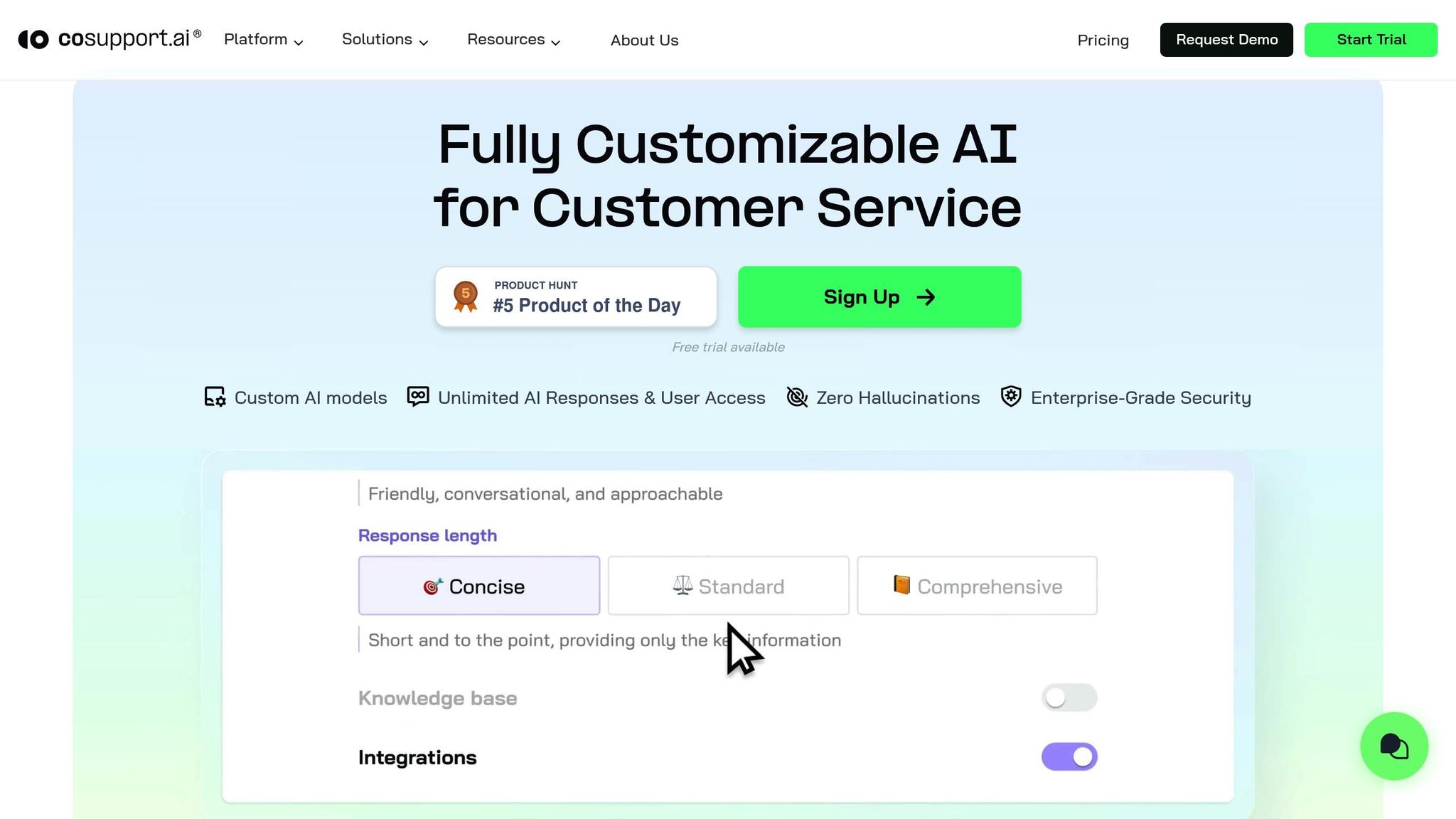
Getting started is quick and simple. In less than 10 minutes, upload your help docs, FAQs, or past chats, and your AI agent will be ready to assist customers. It’s like having a fully trained support agent that speaks in your brand’s voice right out of the gate.
During the trial, enjoy unlimited AI responses, seamless handoffs to human agents when needed, and support in over 40 languages. Automate up to 90% of your support tickets, saving both time and money. Plus, everything is offered with upfront, clear pricing.
Choose a pricing plan that fits your needs:
- Resolution-based pricing: $0.59 per resolved ticket
- Response-based pricing: $0.10 per AI response
- Flat rate: $190/month for unlimited responses
There’s no credit card required, no setup fees, and absolutely no hidden charges. It’s the perfect solution for growing businesses looking to streamline customer support on a budget.
FAQs
How can I tailor AI customer support to my business and ensure it delivers accurate answers?
To get the most out of AI customer support for your business, start by equipping it with your own resources - things like FAQs, helpdesk articles, and past customer interactions. Feeding the AI this information allows it to better understand your products and provide accurate answers to common customer inquiries.
Pick a platform that makes integrating your data straightforward, and make it a habit to update the AI with fresh content as your business evolves. Test its responses in real-world scenarios and keep an eye on how it performs. Regular updates and ongoing monitoring are key to ensuring the AI remains accurate and aligned with your business goals.
How can businesses ensure a smooth handoff from AI to human support for complex issues?
To make transitions from AI to human support seamless, set up well-defined escalation guidelines that trigger when the AI encounters situations beyond its scope, such as complex or sensitive issues. This ensures customers are smoothly connected to a human agent when necessary.
It's also crucial to maintain context continuity during these handoffs. Human agents should have access to the conversation history, allowing them to step in without requiring customers to repeat themselves. This not only saves time but also minimizes frustration.
Lastly, ensure your support team is trained to manage these escalations efficiently. Clear communication during the transition reassures customers, making them feel valued and supported throughout the process.
How often should I update my AI training data to keep it accurate and aligned with my business?
Keeping your AI up-to-date is crucial for maintaining its reliability and usefulness. Many businesses update their AI models every 3 to 6 months, but the right schedule really depends on how often your content changes. For example, if you regularly revise your FAQs, policies, or product information, you might need to update your AI more often to ensure it remains accurate and continues to provide value to your customers.
.png)