Key insight: By 2027, AI will manage 50% of service cases, up from 30% in 2025. Businesses now face a critical choice: stick with established CRM systems like Salesforce Service Cloud or opt for AI-native platforms designed for automation-first customer support.
Quick Summary
-
Salesforce Service Cloud:
- Best for large enterprises with complex workflows and compliance needs.
- Offers deep integration across sales, marketing, and support.
- Requires 3–6+ months for implementation and developer resources.
- Costs: $25–$330/user/month, plus add-ons and setup expenses.
-
AI-Native Platforms:
- Built for speed and automation, ideal for fast-growing or mid-sized businesses.
- Deploys within 2–4 weeks, with minimal IT involvement.
- Uses usage-based pricing (e.g., resolved tickets), reducing overhead.
- Automates up to 72% of routine inquiries, cutting support costs by 24%. This efficiency depends on how you prepare your knowledge base for AI.
Quick Comparison
| Feature | Salesforce Service Cloud | AI-Native Platforms |
|---|---|---|
| Implementation Time | 3–6+ months | 2–4 weeks |
| Customization | Requires developers | Simple, point-and-click |
| Pricing | $25–$330/user/month + extras | Usage-based, cost-efficient |
| Automation Rate | Up to 72% | 29%–72% (varies by setup) |
| Best For | Enterprises with complex needs | Teams prioritizing speed |
What to Consider
- Salesforce is ideal if you're already using its ecosystem and need extensive customization for compliance-heavy industries.
- AI-native platforms excel in fast deployment, cost savings, and high-volume ticket handling.
Takeaway: Your decision should align with your team size, technical resources, and the urgency of deployment. AI-native platforms are better for speed and cost efficiency, while Salesforce suits enterprises needing deep integration and governance.
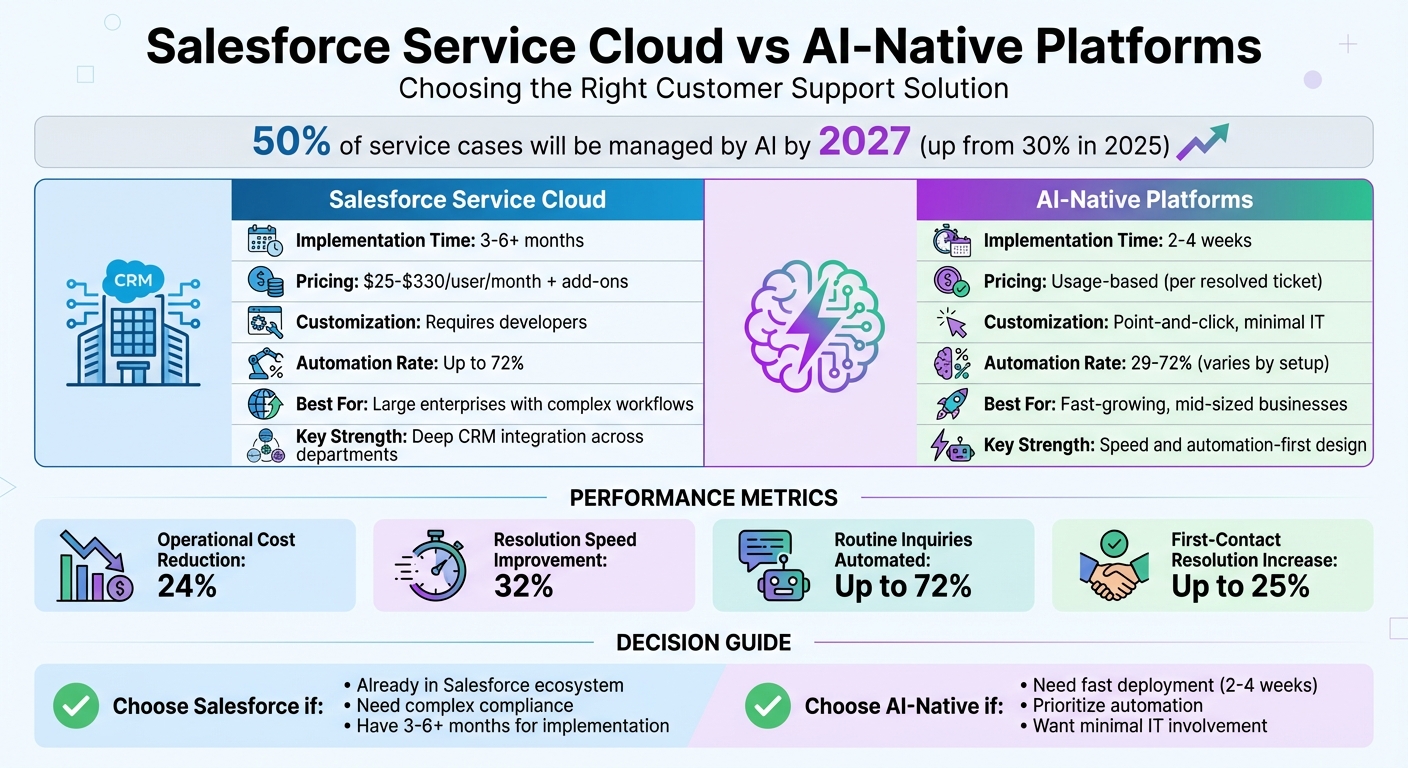
Salesforce Service Cloud vs AI-Native Support Platforms: Feature and Cost Comparison
We Automated 80% of Customer Support With One AI Agent (No Code)
sbb-itb-97114f1
Key Takeaways
- By 2027, AI will manage 50% of service cases, reshaping the future of customer service.
- Traditional CRM systems like Salesforce require lengthy setup times (3–6 months) and burden agents with administrative tasks.
- AI-native platforms streamline operations, cutting operational costs by 24% and speeding up resolutions by 32%.
- Modern AI agents go beyond basic chatbots, autonomously handling complex workflows and escalating only when necessary.
- Choosing the right platform will determine whether support teams can scale effectively or become overwhelmed by growing demands.
What You Need to Know
Here’s a closer look at what sets these platforms apart in terms of usage, cost, and AI capabilities.
When to Use Each Platform
For large enterprises, Salesforce is a go-to option. It offers an integrated, all-encompassing view of customers, which makes it invaluable for teams across sales, marketing, and support. Its strength lies in managing complex workflows and meeting governance demands, making it ideal for organizations with intricate operational needs.
On the other hand, AI-native platforms shine in environments that prioritize speed and automation. These platforms are designed for teams that need quick deployment and minimal reliance on legacy CRM systems. They emphasize intelligent automation and require less customization, making them a great choice for businesses looking for efficiency.
Of course, beyond functionality, pricing, and scalability are key factors in making the right choice.
Pricing and Growth Considerations
Salesforce Service Cloud pricing ranges from $25 to $330 per user per month, depending on the edition. However, advanced features like Einstein come with additional costs. The overall expense also includes professional services, developer support, and training, which can add up quickly.
AI-native platforms, by contrast, tend to have lower upfront costs and more straightforward pricing structures. They reduce IT complexity by eliminating the need for middleware and simplifying integrations. Plus, features like automated case deflection can help businesses save significantly on operational costs.
But there’s more to consider - especially when it comes to how each platform handles AI.
AI Features and Performance
Salesforce integrates AI into its existing ticketing system through tools like Einstein and Agentforce. These features enable complex routing and predictive insights, helping organizations achieve 40% faster response times and offload up to 72% of routine inquiries.
AI-native platforms take a different approach by embedding intelligence into every interaction from the start. Their AI systems are designed to autonomously handle multi-step tasks, improving first-contact resolution rates by up to 25% and speeding up resolutions by 32%.
Ultimately, the choice comes down to what your business values more: extensive customization and integration or fast, modern automation. These insights pave the way for a deeper feature comparison in the next section.
Salesforce Service Cloud: CRM-Based Support for Large Organizations
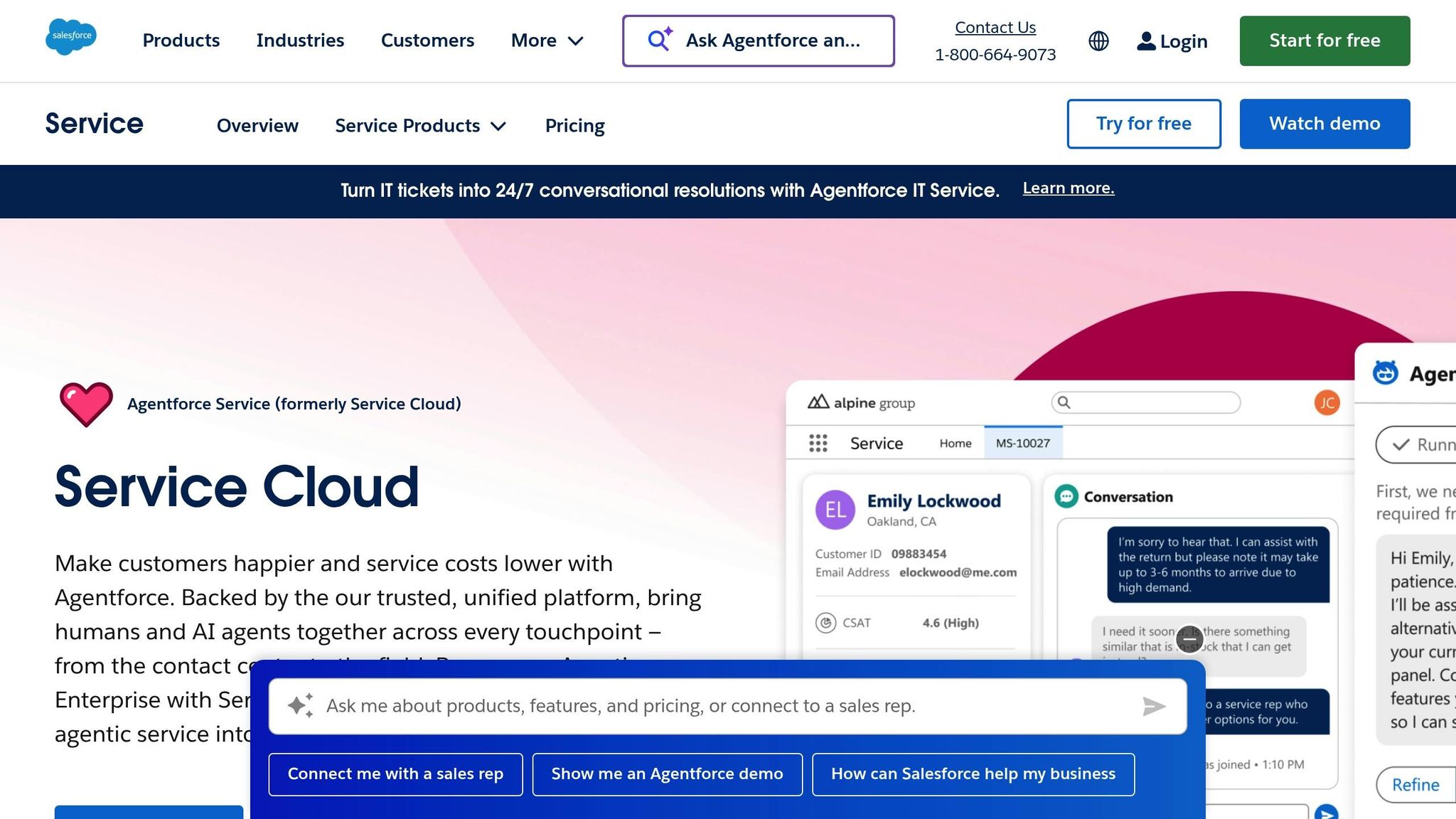
Salesforce Service Cloud enhances the Salesforce CRM ecosystem by seamlessly connecting sales, marketing, and support data. This integration gives service teams instant access to purchase histories, engagement records, and product usage - all without needing to switch systems. By streamlining workflows, the platform boosts efficiency and sets the foundation for its standout features.
The platform consolidates customer interactions across multiple channels, giving service reps a complete view of engagement history along with real-time sentiment indicators. This comprehensive approach reduces the time agents spend searching for context, directly improving productivity. Managers benefit from the Supervisor Command Center, which provides real-time performance monitoring for both human and AI agents.
Platform Design and Main Features
Salesforce has reimagined its service suite under the Agentforce Service banner, blending advanced AI agents with human representatives. These AI agents handle routine tasks, like processing refunds or rescheduling appointments, through seamless back-end integration. The platform also incorporates Einstein AI tools, offering features like natural language processing, sentiment analysis, and "next-best-action" recommendations.
The Unified Agent Workspace acts as a customizable dashboard, displaying customer context and engagement history in one place. When an AI agent escalates a case, it transfers the entire conversation history to a human agent, eliminating the need for customers to repeat themselves. This smooth transition is one of Salesforce's standout features, ensuring continuity and a better customer experience. These design elements make Salesforce Service Cloud a strong choice for enterprises that prioritize data-driven and compliant operations.
"Service Cloud brings customer data and AI together in one unified platform, helping teams resolve cases more quickly and provide more personalized support." - Amber Armstrong, CMO of Applications, Salesforce
Where Salesforce Service Cloud Works Best
Large enterprises with strict compliance requirements and complex workflows benefit the most from Salesforce Service Cloud. The platform supports regulations like GDPR, SOC 2, and HIPAA, while offering granular role-based access controls. It also handles intricate routing rules often needed in regulated industries.
Businesses already using other Salesforce products gain even more value. The platform's integration with Sales Cloud, Marketing Cloud, and Data Cloud creates a complete 360-degree view of the customer. For example, the system can analyze CRM data - such as low product usage or upcoming renewals - and automatically prompt proactive outreach before customers even request help.
Take Rara Avis Travel, a luxury tour operator in Mongolia. They adopted Agentforce Service in late 2024 to manage inquiries across WhatsApp and Messenger. Today, the AI agent autonomously handles 70% of tour inquiries around the clock, pre-qualifying leads for custom tours before passing them to human agents. CEO Tuvshin Erdenebaatar called the solution "a game-changer" for delivering fast and accurate information to their customers.
Set Up Requirements and Configuration
Implementing Salesforce Service Cloud is a significant undertaking, requiring extensive customization. The platform's complexity demands dedicated Salesforce-certified admins or developers to configure routing rules, integrations, and other customizations. Unlike AI for Zoho Desk or other simpler tools, Einstein AI requires clean historical data for training, along with considerable expertise and time for setup.
Organizations should plan for additional costs beyond licensing. Professional services, ongoing developer support, and paid add-ons for advanced features all add to the total cost of ownership. For instance, DPD, the delivery company, invested in Agentforce Service to reduce onboarding time for service reps. By integrating AI agents, they empowered their team to handle complex cases with greater confidence.
Key Insight: Salesforce Service Cloud is ideal for large enterprises willing to commit to a multi-month implementation process. While it delivers streamlined and compliant workflows, smaller teams or those needing quick deployment may find the platform's complexity challenging to manage.
AI-Native Support Platforms: Built for Automation First
AI-native support platforms take a completely different approach compared to traditional CRM-based systems. Instead of modifying older frameworks, these platforms are designed from scratch as "systems of intelligence". AI is integrated into every step, allowing for immediate analysis and automated handling of customer messages as soon as they come in.
This difference in design makes a big impact. Unlike CRMs, which mainly act as data storage, AI-native platforms use autonomous agents - software capable of analyzing context, making independent decisions, and solving problems without relying on pre-programmed scripts.
The results speak for themselves. These AI agents handle a large portion of routine tasks, freeing up human agents to focus on more complex cases. Companies adopting these platforms report faster resolution times - improving by 20% to 32% - and a 24% reduction in support costs. Customer satisfaction also gets a boost, with AI-driven support increasing CSAT scores by about 33%.
"Service leaders are being asked to do more with less - while customer expectations keep rising. With Agentforce Service, we're putting AI, real-time data, and fast deployment in every service team's hands... enabling companies to achieve 72% greater operational efficiency." - Kishan Chetan, EVP & GM, Agentforce Service
Core Design and Main Features
AI-native platforms are built on principles that set them apart from older support systems. One standout feature is confidence-based routing, which ensures that when AI isn't fully confident in its response, it either asks clarifying questions or hands the issue over to a human agent. This prevents customers from getting stuck in frustrating AI loops or receiving inaccurate information.
Another key feature is knowledge freshness. These platforms continuously update their understanding based on resolved tickets, policy changes, and product updates. Unlike static knowledge bases, this dynamic learning ensures the system always provides up-to-date information. And when escalation to a human agent is necessary, the system transfers the full conversation history, so customers don’t have to repeat themselves.
Additionally, AI-native platforms consolidate communication channels - email, chat, social media, and messaging apps - into one interface. Agents gain access to real-time summaries, purchase history, and sentiment data without switching between tools. This unified view saves time and improves both productivity and the quality of responses.
Where AI-Native Platforms Work Best
These integrated features translate into real-world benefits, especially for organizations seeking agility without the burden of legacy systems. Companies not tied to the Salesforce ecosystem often find AI-native platforms easier to implement and more cost-efficient. Their intuitive design allows teams to automate support quickly, without needing heavy IT involvement.
Small to mid-sized businesses, in particular, benefit from the lower entry costs and faster implementation times. These platforms offer pricing options that make advanced automation accessible, even for businesses without large budgets.
For companies experiencing rapid growth or seasonal demand spikes, AI-native systems shine. They’re designed to handle thousands of interactions at once, scaling effortlessly without requiring additional staff. This scalability is part of their core design, not an afterthought.
How AI-Native Platforms Improve Operations
AI-native platforms take support to the next level by enabling proactive assistance. They can identify potential issues - like low product usage or upcoming renewals - and initiate outreach before customers even file a ticket. This helps resolve problems before they escalate.
Their adaptive workflows go beyond simple if-then logic. AI agents can manage multi-step tasks like processing refunds, updating account details, or scheduling follow-ups - all within a single conversation.
By shifting from manual case management to autonomous agents, these platforms minimize delays and miscommunication. Shared inboxes and real-time collaboration tools ensure smooth transitions when human input is needed. Industry data shows that 89% of service professionals report higher self-service resolution rates with conversational AI, and 93% say it saves significant time.
Key Takeaways:
- AI-native platforms offer faster deployment, reduced costs, and higher automation rates compared to CRM-based systems.
- They’re particularly well-suited for companies focused on speed, efficiency, and delivering modern customer experiences - especially those not tied to Salesforce.
Feature Comparison: Automation, AI, and Integrations
This section dives into a detailed comparison of features, focusing on how platforms leverage AI for customer support automation.
Table: Features and AI Capabilities
Below is a side-by-side breakdown of how Salesforce and AI-native platforms approach customer support automation. Salesforce builds on its CRM foundation with added AI layers, while AI-native platforms embed intelligence into their core design.
| Feature | Salesforce Service Cloud (Agentforce) | AI-Native Platforms |
|---|---|---|
| Core Architecture | CRM-based system of record with layered AI | AI-native system of intelligence |
| Autonomous Agents | Agentforce agents handle routine and complex tasks via the Data Cloud | Agentic workflows designed for high-deflection self-service |
| Ticket Routing | Case-based routing using Einstein AI and CRM data | Intent and urgency-based intelligent triage |
| Knowledge Base | Grounded in Data Cloud, CRM records, and centralized FAQs | Constant knowledge updates from resolved tickets and real-time changes |
| Multilingual Support | Available through Einstein AI | Built-in support for 40+ languages in most platforms |
| Customization | Deep customization requiring developer expertise | Easy, point-and-click setup with little IT resource requirement |
| Implementation Time | 3–6+ months | 2–4 weeks |
| Deflection Rate | Up to 72% of routine inquiries automated | Typically 29%–70% depending on setup and use case |
Salesforce excels for organizations managing complex workflows across multiple departments and requiring strict governance. AI-native platforms, on the other hand, focus on speed, offering faster deployment and higher automation rates without the complexity of legacy systems.
Integrations and Data Handling
Salesforce Service Cloud integrates deeply with its ecosystem, including Tableau, Slack, MuleSoft, and thousands of AppExchange apps. This provides a comprehensive 360° view of customers. Its Data Cloud ensures AI responses are grounded in trusted CRM records, with robust security measures to protect sensitive information like payment details.
AI-native platforms emphasize plug-and-play connectivity with modern tools like Zendesk, Intercom, HubSpot, and Shopify. These platforms analyze message intent, urgency, and sentiment in real time, functioning as systems of intelligence. Their design enables quick deployment without heavy reliance on developers.
For example, Rara Avis Travel achieved seamless integration using Salesforce, benefiting from its ecosystem's depth. Meanwhile, smaller teams often lean toward AI-native platforms for their ease of use and rapid implementation.
Key Insight: Your choice depends on your operational needs. Salesforce is ideal for organizations needing cross-departmental integration and strict governance. AI-native platforms are better suited for teams prioritizing quick deployment, minimal IT involvement, and a modern AI-driven interface.
Pricing and Scalability: What to Know Before You Buy
When comparing support platforms, understanding their pricing models is crucial - especially as your team grows. The costs of these platforms often go beyond subscription fees, with scalability and total cost of ownership playing a big role. Let’s look at how Salesforce Service Cloud and AI-native platforms structure their pricing and what that means for your business.
Salesforce Service Cloud Pricing
Salesforce Service Cloud operates on a per-user licensing model with four main tiers: Essentials, Professional, Enterprise, and Unlimited. Pricing ranges from $25 to $330 per user/month, covering the base platform. However, additional expenses can quickly add up, including extended deployment periods, ongoing training, dedicated administration, and advanced AI tools like Einstein or Agentforce.
Implementation isn’t quick - it usually takes several months and often involves external consultants and developers. For larger enterprises using Salesforce Einstein, the return on investment typically becomes noticeable within 12 to 18 months. On top of that, costs for integrations and exceeding data storage limits can further increase the overall expense.
Key takeaway: Salesforce Service Cloud is best suited for businesses that need extensive customization and integration across departments, even if that comes with a higher total cost of ownership.
AI-Native Platform Pricing Models
AI-native platforms take a different approach, using usage-based pricing instead of charging per agent. You pay for metrics like AI-resolved tickets or successful interactions, which means costs don’t automatically rise with headcount. These platforms are also faster to implement, often taking just 2–4 weeks, and require minimal IT involvement.
For example, tools like Zendesk offer plans between $19 and $99 per agent/month, and AI-driven automation can reduce overall support costs by 24%. With AI handling up to 72% of routine inquiries, your team can focus on more complex tasks without adding significant overhead.
Key takeaway: AI-native platforms are ideal for teams prioritizing cost efficiency and fast deployment, especially in environments with high ticket volumes.
Implementation: Fast Deployment vs. Deep Customization
When deciding between platforms, it often comes down to how quickly you need to get up and running versus how much customization you require. Salesforce Service Cloud offers extensive customization capabilities but demands a longer timeline and significant technical resources. On the other hand, AI-native platforms are designed for speed and simplicity, allowing you to go live in just weeks.
This difference in setup time becomes critical when rapid deployment is a top priority.
Salesforce Service Cloud: 3–6+ Month Implementation
Deploying Salesforce Service Cloud typically takes 3–6 months - or even longer. Its complexity requires dedicated technical teams to handle configuration and integration. The platform's legacy architecture adds to the extended timeline, and its steep learning curve means your team will need substantial training. In fact, 66% of service leaders report their teams lack the skills to manage AI effectively.
"We can already see how Agentforce Service has the potential to change how our service reps work alongside AI agents. We see this as key to cutting onboarding time while giving our reps the confidence to work complex cases faster." - Adam Hooper, Head of Central Platforms, dpd
Key takeaway: Salesforce Service Cloud is a strong choice for businesses that need advanced customization and are equipped to invest the time and resources required for a detailed implementation process.
AI-Native Platforms: 2–4 Week Deployment
AI-native platforms, on the other hand, can be deployed in just 2–4 weeks. These platforms rely on simple, point-and-click configurations and require minimal IT involvement. This means your team can start handling routine inquiries almost immediately, avoiding the lengthy setup process associated with more traditional systems.
Key takeaway: AI-native platforms are ideal for organizations that need a fast, straightforward setup and want to scale their support operations without heavy technical demands.
Real Example: Implementation Timeline Comparison
Take DPD, a major logistics company, as an example. They implemented Salesforce's Agentforce Service to enhance how their service reps work with AI agents. While the system ultimately improved case resolution times and onboarding processes, the deployment required detailed planning and integration with their existing Salesforce infrastructure. By contrast, companies using AI-native platforms often report going live within days for basic functions. This contrast highlights the trade-off: deeper customization with Salesforce versus faster deployment with AI-native solutions. These timelines can significantly affect how quickly you begin to see returns on your investment.
How to Choose the Right Support Platform
Selecting the right support platform boils down to aligning it with your organization’s unique needs, resources, and growth trajectory. While both options bring advanced automation to the table, they cater to different business contexts.
Decision Guide
Here’s a breakdown to help you decide which platform works best for your business:
Opt for Salesforce Service Cloud if you're already part of the Salesforce ecosystem and need seamless integration with sales, marketing, and CRM data. It’s particularly suited for large enterprises managing complex, multi-department workflows, especially those requiring strict compliance and governance. With its deep customization options, it’s a good fit for organizations with robust IT teams and the budget to handle longer implementation timelines (3–6+ months). If your operations rely on detailed entitlement management and a comprehensive 360-degree customer view, Salesforce’s architecture offers reliability and depth.
Choose an AI-native platform if speed and automation are your priorities. These platforms are ideal for fast-growing SaaS, e-commerce, and mid-market companies that need to go live within 2–4 weeks, without heavy reliance on IT. If your focus is on automating routine inquiries and enhancing self-service options with conversational experiences, an AI-native platform provides a quicker path to achieving those goals.
Final Recommendations
When making your decision, consider key factors like implementation speed, customization requirements, and cost efficiency to ensure your support strategy aligns with your business objectives.
Before committing, take the time to assess your current tech stack, team capabilities, and the urgency of your deployment needs. Research shows that companies with unified customer data are 1.4 times more likely to succeed with AI implementation. Start by auditing your knowledge base - AI effectiveness depends heavily on the quality of your data rather than the platform itself. Testing with a pilot program can also reveal how well a platform handles your specific challenges, whether that’s high-volume ticket deflection or resolving complex issues that need human expertise.
Key decision points:
- Salesforce is ideal for enterprises requiring deep CRM integration and intricate workflow management.
- AI-native platforms excel at rapid deployment and minimizing IT involvement.
- Compatibility with your existing tech stack is critical before making a choice.
- High-quality data is more important than the platform when it comes to AI performance.
- Pilot programs are a practical way to test platform suitability for your needs.
Key takeaway: The right platform depends on your organization’s scale, budget, and approach to customer support. Salesforce Service Cloud shines with its customization capabilities, while AI-native platforms are built for speed and automation-focused strategies.