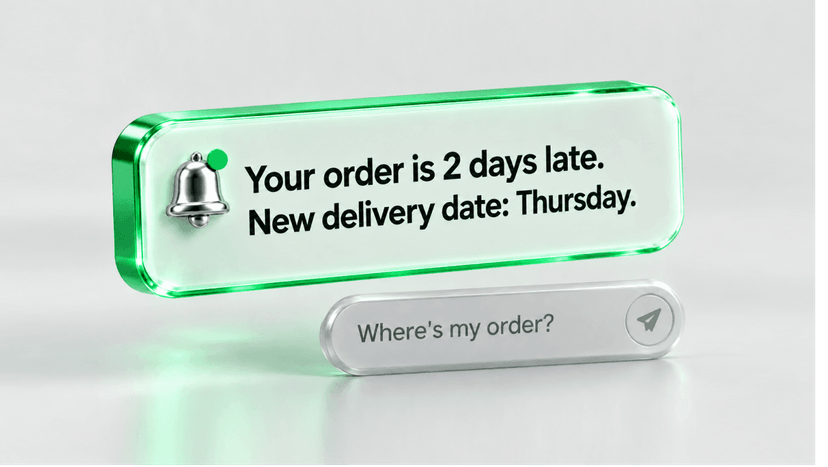
"Where is my order?" Every Shopify store answers this question hundreds or thousands of times a month. It's the same question every time. The customer ordered something, it hasn't arrived, and they want to know why. The answer is almost always a tracking number, a carrier status update, or a delivery estimate.
WISMO tickets account for 40–60% of support volume across e-commerce — making them the single most common ticket type and, counterintuitively, among the easiest to automate. The information needed to answer them is sitting in your Shopify order data and the carrier's tracking API. The gap is that most stores route WISMO to human agents who spend 5–10 minutes retrieving information that AI could surface in 3 seconds.
This guide covers how to reduce WISMO tickets at three levels: preventing them from arriving, deflecting them to self-service when they do, and resolving them autonomously when customers contact support directly.
Why WISMO volume stays high — and the psychology behind it
WISMO isn't a logistics failure. It's an information failure. Customers open WISMO tickets because they don't know their order's status — not because the order is actually late. In most cases, the package is in transit and on schedule. The customer just hasn't heard anything since the order confirmation email.
The triggers are predictable:
- Day 1–2 after ordering: "Did you receive my order? I haven't gotten a confirmation."
- Day 3–5: "My tracking number isn't updating."
- Day 5–7: "I was expecting delivery today. Where is it?"
- Day 7+: "I want to cancel / this is taking too long."
Each of these is generated by an information gap, not an actual shipping problem. If the customer knew the package was scanned at a distribution center on Day 4, the Day 5 ticket doesn't get sent.
Volume spikes during predictable events:
| Event | WISMO volume increase |
|---|---|
| BFCM / holiday peak | 5–10× baseline |
| Product launches | 3–5× baseline |
| Carrier delays (weather, peak congestion) | 2–4× baseline |
| Inaccurate estimated delivery dates | 2–3× baseline |
| Missing or broken tracking links | 3–6× baseline |
The last two are entirely preventable. Inaccurate ETAs and broken tracking links are configuration issues, not logistics issues — and they each generate disproportionate WISMO volume.
Level 1: Prevent WISMO tickets before they're created
Proactive notifications are the highest-leverage WISMO reduction tactic. Every notification you send means one fewer ticket arriving in your queue.
The minimum notification set for Shopify stores:
- Order confirmation (immediate): Confirms the order was received, sets expected processing time
- Fulfillment/shipping confirmation (when label is created): Includes tracking number and carrier link
- Out for delivery (day of): Sets the expectation that delivery is imminent
- Delivery confirmation (when delivered): Closes the loop; triggers return window communication
Stores that run all four see a 30–40% reduction in WISMO volume compared to stores running only order and shipping confirmation. The "out for delivery" notification alone eliminates the Day 5–7 "where is it?" wave because customers know the answer before they ask.
What breaks notification effectiveness:
- Tracking links that don't update for 24–48 hours (carrier scan lag)
- Estimated delivery dates that don't reflect current carrier performance
- Notifications going to spam due to sender reputation or formatting issues
- Missing notifications for specific fulfillment paths (dropship, third-party warehouse)
Audit your notification flow annually — and before every BFCM. A broken tracking link in your shipping confirmation email is responsible for an outsized share of WISMO tickets.
Level 2: Self-service order tracking
When a customer does contact support about an order, the cheapest resolution is one they execute themselves. A well-designed order status page deflects 20–30% of WISMO contacts before they become tickets.
What an effective Shopify order tracking page includes:
- Real-time carrier status (not just the Shopify fulfillment status — live carrier scan data)
- Estimated delivery date that updates when carrier timelines change
- Clear escalation path if delivery is more than 2 days past the estimate
- Return initiation link (reduces the separate return ticket that often follows a WISMO inquiry)
Shopify's native order status page covers the basics. For stores processing 1,000+ orders a month, a dedicated tracking page with live carrier integration significantly reduces the "my tracking isn't updating" tickets.
The tracking page test: Check your own tracking link 4 hours after creating a shipping label. If it shows "label created" and nothing else, your customers are opening tickets because they think nothing is moving. That's a fixable configuration issue, not a logistics problem.
Level 3: AI that resolves WISMO contacts directly
When customers contact support through email, live chat, or messaging — bypassing notifications and the tracking page — AI with Shopify order API access closes the loop in seconds.
This is how an AI-resolved WISMO interaction works:
- Customer sends: "Hi, I ordered 3 days ago and haven't heard anything. Order #4821."
- AI reads the ticket, extracts the order number and customer identity
- AI queries Shopify for order #4821: status, fulfillment date, tracking number, carrier
- AI checks carrier tracking API for current scan status and ETA
- AI replies with the specific status, tracking link, and accurate delivery estimate
- Ticket closes. No agent touches it.
Total time from ticket received to customer response: under 3 seconds.
[IMAGE: Step-by-step flow diagram showing WISMO AI resolution: customer message → AI reads ticket → Shopify order API query → carrier tracking API query → response generated → ticket closed. Each step labeled with typical time (sub-second). No human agent in the loop.]
What AI needs to resolve WISMO tickets:
- API read access to Shopify orders (read_orders, read_customers)
- Connection to carrier tracking data (either via Shopify's fulfillment API or a direct carrier integration)
- A fallback response for genuinely delayed or lost packages that escalates correctly
With CoSupport AI Agent and its Agentic API, WISMO resolution is one of the first ticket types to become autonomous — the information is structured, the answer is deterministic, and the resolution rate for clean WISMO tickets consistently exceeds 90%.
WISMO reduction tactics: effort vs. impact
Not every tactic is worth the same implementation effort. Here's how the main options stack up:
| Tactic | Implementation effort | WISMO reduction impact | Cost |
|---|---|---|---|
| Proactive shipping notifications (4-step) | Low (1–2 days in Shopify) | 30–40% | Minimal |
| Accurate ETAs (fix carrier delay data) | Low–Medium | 15–25% | Minimal |
| Self-service tracking page with live carrier data | Medium (1–2 weeks) | 20–30% | Low–Medium |
| Fix broken tracking links | Low (audit + fix) | 10–20% | Minimal |
| AI with Shopify order API (Level 3) | Medium (3–7 day setup) | Resolves remaining 70–80% autonomously | Per-resolution pricing |
| Full Agentic API (WISMO + return initiation) | Medium–High | Covers full post-order journey | Per-resolution pricing |
The most efficient sequence: fix notifications first (immediate impact, minimal effort), then add the tracking page, then connect AI for anything that bypasses both. In order of ROI, not in order of sophistication.
What keeps WISMO volume high — even after automation
Inaccurate estimated delivery dates. If Shopify shows 3–5 business days and your actual fulfillment takes 4 business days before shipping, customers receive their orders on day 8–9 while expecting day 5. That 3–4 day gap generates tickets. Audit your processing time claim against your actual fulfillment data monthly.
Broken or delayed tracking links. A tracking number that doesn't activate for 24–36 hours after label creation is effectively no tracking for the most anxious window: immediately after purchase. Customers who click a broken tracking link open a ticket. Fix carrier label scan delays in your shipping workflow or use a tracking aggregator that shows "label created" accurately.
Notifications going to spam. Email deliverability issues are invisible to the support team but highly visible in WISMO volume. If your shipping confirmation emails have a spam rate above 0.3%, you're generating WISMO tickets from customers who never received the tracking link. Monitor sender reputation quarterly.
AI without order data access. A chatbot that knows your help center articles can answer "our delivery usually takes 5 business days." It cannot tell a customer where their specific order is. AI without Shopify order API access doesn't reduce WISMO tickets — it deflects them with a generic response that sends the customer straight to the human queue.
Not covering all contact channels. WISMO arrives by email, live chat, Instagram DM, and Facebook Messenger. If your AI covers email but not chat, or chat but not social DMs, customers on uncovered channels experience full WISMO friction. Map your incoming WISMO contact channels and cover the highest-volume ones first.
Key takeaways

- WISMO accounts for 40–60% of Shopify support volume — it's the single highest-return automation target.
- Level 1 (proactive notifications) deflects 30–40% of WISMO before tickets are created. Level 2 (self-service tracking page) deflects another 20–30%. Level 3 (AI with order API access) resolves the remainder autonomously.
- The most common WISMO root cause isn't late shipments — it's information gaps. Customers contact support because they don't know their order status, not because the order is actually lost.
- AI without Shopify order API access doesn't resolve WISMO tickets. It gives generic responses. The AI must read live order data to produce an accurate, ticket-closing reply.
- WISMO volume spikes predictably: BFCM (5–10×), product launches (3–5×), carrier delays (2–4×). Proactive notifications and AI automation matter most during these periods when human queues can't scale fast enough.
WISMO tickets can take up 40% to 60% of a Shopify support queue, and most of them can be handled without an agent. If I want to cut this ticket type, I need three things working together: synced Shopify and tracking data, a self-serve order status page, and help desk automation with clear handoff rules.
Here’s the short version:
- Map the data first so Shopify, carrier tracking, and the help desk all show the same status
- Let customers check orders on their own from a branded tracking page linked in emails and account pages
- Send updates before people ask for delays, out-for-delivery scans, delivery, and shipping issues
- Auto-reply to routine WISMO tickets in Zendesk or Freshdesk when the system can match the customer, find the order, and confirm the tracking status
- Send risky cases to a person like “delivered but not received,” customs issues, billing disputes, damaged goods, or orders over $500
- Track results against a baseline using deflection rate, auto-resolution rate, first-response time, resolution time, cost per resolution, reopen rate, and CSAT
A few numbers stand out:
- AI-led WISMO programs can cut this ticket type by 60% to 75% within 90 days
- Human-handled contacts cost about $13.50 each
- AI-handled contacts usually cost $1.00 to $3.00 each
- One 2026 case study reported 74% automation of routine inquiries and $7,000 per month in savings
The core idea is simple: answer order-status questions from live order and tracking data, and only involve an agent when the case has risk, missing data, or an upset customer.
| Area | What to do | Main result |
|---|---|---|
| Data setup | Sync Shopify, carrier, and help desk data | Fewer wrong replies |
| Self-service | Add a branded order lookup page | Fewer new tickets |
| Status updates | Send delay, delivery, and exception alerts | Fewer “where is my order?” emails |
| Help desk automation | Auto-handle routine WISMO in Zendesk/Freshdesk | Lower support load |
| Guardrails | Escalate risky or unclear cases | Better control and CSAT |
| Reporting | Measure before and after launch | Clear ROI |
If I’m running Shopify support at scale, this is the play: stop preventable WISMO tickets before they start, auto-handle the routine ones that still come in, and keep agents focused on the cases that need judgment.
Map your data and workflow before you automate
Start by mapping the data flow behind every WISMO reply. If Shopify, tracking data, and support data drift apart, automation can send the wrong status or kick up tickets that never needed a human in the first place.
The three systems that must stay in sync
WISMO automation runs on three synced systems. If one slips, the whole workflow gets shaky.
| System | Data It Contributes | Role in WISMO Automation |
|---|---|---|
| Shopify | Order ID/number, customer email or phone, fulfillment status, shipping address | Source of truth for whether an order exists and whether it has left the warehouse |
| Carriers / Tracking Layer | Tracking number, carrier name, last scan event, current status, estimated delivery date, delay flags | Provides the live package status and transit location |
| Help Desk | Conversation history, intent tags, macros, customer sentiment | Detects intent and sends the reply or escalation |
Here’s the plain-English version: Shopify confirms the order, carriers show what’s happening in transit, and the help desk turns that into a reply or escalation. For this to work, each system needs current data from the other two.
A simple WISMO decision tree for support teams
Once those three systems are in sync, the logic is pretty simple:
- Detect intent - The AI reads the incoming message and flags it as a WISMO inquiry.
- Match the customer to an order - It links the customer’s email or phone number to a Shopify order record. If there’s no match, the ticket goes to a human.
- Check fulfillment and live carrier status - The AI checks Shopify first. If the order is fulfilled, it pulls live tracking data from the carrier API for the current status and estimated delivery date.
- Apply your shipping rules - Shipping rules help the system read carrier status the right way. Without that policy context, you get wrong replies and tickets that could have been avoided.
- Resolve or escalate - If the status is clear, the AI sends a live update on its own. If the package is stuck, lost, or the case involves orders above $500, it routes the issue to a human agent with a full context cheat sheet.
Once the data map is clean, you can move order-status answers into self-service tracking and automated replies.
sbb-itb-97114f1
Build self-service tracking to stop tickets before they start
Self-Service Tracking vs. Agent Lookups: WISMO Cost & Performance Breakdown
Move order status into self-service before customers contact support.
Once your data map is set, send order-status answers straight to your storefront instead of making people email support for basic updates.
Set up a branded order lookup page on your Shopify storefront

A branded order lookup page should let customers check status using their order number plus their email address or ZIP code. Keep the tracking statuses in plain language so shoppers can tell, at a glance, what’s going on.
To cut down on tickets, link this page from places customers already visit:
- Order confirmation emails
- Shipping confirmation emails
- Customer account pages
- Your site navigation
That way, customers get the same order-status answer your team would give them, without opening a ticket.
Use that same tracking data to send status updates on its own.
Send proactive updates before customers ask
Automate the updates that answer the most common WISMO questions: order confirmation, shipment delays, out for delivery, delivered, and exception notices like customs holds or address errors.
For delayed packages, run daily checks for shipments with no movement in 48 hours. If one gets flagged, send an apology or discount before the customer reaches out. That’s the whole point here: answer the question before it turns into a support request. These updates need to run 24/7.
Self-service tracking vs. agent lookups
The payoff is simple: fewer tickets, faster answers, and lower handling cost.
WISMO inquiries account for 40% to 60% of total ecommerce ticket volume, so even modest deflection can make a big dent. Here’s how self-service stacks up against agent lookups:
| Feature | Self-Service Tracking | Agent Lookups |
|---|---|---|
| Ticket Deflection | High - resolves most routine WISMO before a ticket is created | Low - each lookup becomes an agent interaction |
| Response Speed | Instant, 24/7 | Minutes to hours, depends on queue length |
| Support Cost | $1.00 to $3.00 per resolution | About $13.50 per contact |
| Customer Effort | Low - self-serve lookup anytime | High - must contact support and wait |
| Scalability | Handles volume spikes without delay | Requires hiring and training cycles |
Automate WISMO replies in Zendesk and Freshdesk
Even with self-service, some WISMO tickets will still land in your help desk. When that happens, the goal is simple: resolve them inside the tools your team already uses. No platform switch. No messy workflow rebuild. Once self-service is live, the next move is to automate the tickets that still make it into the queue.
What an end-to-end WISMO automation flow should do
A WISMO automation flow has to do more than handle the obvious cases. Customers ask order-status questions in all kinds of ways, and plenty of them don't include an order number. So the flow needs to deal with messy, everyday support messages without falling apart.
Here’s what a full flow looks like from the first message to a closed ticket:
| Step | Action | System Involved |
|---|---|---|
| 1. Intent Detection | AI parses the message for WISMO intent, even when it's phrased differently. | Zendesk / Freshdesk |
| 2. Identity Check | Match the customer to a Shopify order. | Shopify API |
| 3. Status Lookup | AI retrieves real-time tracking data and carrier milestones. | Carrier tracking API |
| 4. Translation | Convert carrier events into plain-language status updates. | AI engine |
| 5. Resolution | Send the ETA and tracking link. | Zendesk / Freshdesk |
| 6. Escalation | Missing data, negative sentiment, high-value orders, or complex billing disputes go to a human agent. | Zendesk / Freshdesk |
Only auto-resolve when the match, status, and sentiment clear your threshold. If they don’t, draft a reply or send the case to an agent. That way, the help desk becomes the main place for both resolution and escalation.
How CoSupport AI fits into a Shopify support stack

CoSupport AI connects to Zendesk and Freshdesk and trains on historical tickets, macros, and help center content. That matters because the replies come from your own support data, not generic AI text. Its zero-hallucination approach keeps answers tied to verified sources. If it can’t verify the answer, it escalates instead of guessing.
In one 2026 case study, a US-based ecommerce marketplace specializing in personalized home goods integrated CoSupport AI with Zendesk Suite and its internal order management system. With 16,000 monthly inquiries and a 21-agent team, it automated 74% of routine inquiries, cut average resolution time from 30 minutes to 4 minutes, and saved $7,000 per month.
Measure whether automation is working
You need to measure this against a baseline. Otherwise, it’s easy to mistake faster ticket closures for better support. Set a 30-to-60-day baseline before go-live, then track the numbers after launch.
Watch these metrics:
- Deflection rate and reopen rate - show whether ticket volume drops and whether solved tickets stay solved
- Auto-resolution rate - shows how many tickets the AI handles end to end without a human
- First-response time (FRT) - shows how fast the automation replies compared with your baseline
- Average resolution time - compares automated cases with manual handling to check the time savings
- Cost per resolution - shows whether the cost per ticket goes down
- CSAT on automated cases - compares automated tickets with human-handled ones to make sure automation doesn’t chip away at trust
Set guardrails, handle edge cases, and track results
Once you know the numbers, put guardrails in place so automation stays inside policy. After you measure performance, decide what the AI can handle safely and what should stay with an agent, such as when automating FAQ workflows in Zendesk.
Cases that should go to a human agent
Not every WISMO ticket is just a status check. Some cases carry real financial, compliance, or safety risk, so they should go to a human. These situations call for human judgment because the response can affect money, loss, or liability. Delivered-but-not-received claims, suspected fraud or billing disputes, and packages stuck in customs are all strong reasons to escalate.
Use shadow mode and guardrails before full rollout
Start with shadow mode. In this setup, the AI writes internal drafts for agent review, which lets you catch factual mistakes before a customer ever sees them. One jewelry retailer trial reported 93% triage accuracy, but only 12% of first drafts were ready to send without edits.
Before you go live, test the AI against the last 30 to 90 days of resolved tickets. That makes it easier to spot knowledge gaps before they turn into customer-facing problems. Move to full auto-resolution only when the system keeps hitting your confidence threshold, similar to how other brands have scaled to 81% auto-resolution.
It also helps to add negative-sentiment flags. If a message sounds angry or frustrated, or includes words like "legal", route it straight to a human. Then use what you learn from those reviews to tighten your routing rules.
Automation rules by scenario
Use clear rules to decide when the AI resolves a case, when it helps an agent, and when it escalates. One common guardrail is simple: send high-value orders above $500 to a human.
| Scenario | Category | Action |
|---|---|---|
| In Transit (On Time) | Auto-resolve | Send real-time tracking link and ETA |
| Out for Delivery | Auto-resolve | Confirm status; provide carrier contact if needed |
| Carrier delay | Agent review | AI drafts apology or proactive alert; agent reviews before sending |
| Delivered but Not Received | Always escalate | Route to human for theft or loss investigation |
| Stalled in customs | Always escalate | Human review for carrier claims or compliance |
| High-Value Order (>$500) | Always escalate | Mandatory human oversight |
| Suspected Fraud / Billing Dispute | Always escalate | Security and compliance judgment required |
| Damaged / Safety Risk | Always escalate | Human empathy and legal risk assessment required |
This shouldn’t stay a fixed ruleset forever. As the AI builds up more resolved tickets and your team fine-tunes confidence thresholds, some agent-review cases can move into auto-resolve. The point is simple: expand scope based on data, not assumptions.
FAQs
How long does WISMO automation take to implement on Shopify?
Implementation time comes down to the route you take and how your systems are set up. Some specialized tools can be live in just a few hours. More involved deployments, especially those with deeper integrations and custom workflows, usually take 1.5 months to 8 weeks.
A good way to start is with an AI copilot. Then, as your team gets more comfortable and trust builds, you can phase in full autonomy step by step.
What data do I need before automating WISMO tickets?
Before you automate WISMO ("Where Is My Order?") tickets, get a few things in place first.
You need:
- Recent WISMO and order-status ticket clusters that are driving volume
- Help center content, docs, macros, or saved replies that act as the source of truth
- Historical resolved tickets to pull phrasing from and spot edge cases
- Live order, fulfillment, and carrier tracking data, along with clear confidence thresholds and escalation rules
How do I know which WISMO cases should go to an agent?
Send WISMO to an agent when AI confidence falls below your threshold, or when the case hits an escalation trigger: frustrated sentiment, disputes tied to high-value orders ($500+), legal or safety risk, or billing issues that need closer review.
If none of those apply, let automation handle it. Pull the customer’s order details and live tracking status, send a proactive update, and, if the case still needs a handoff, pass along the full conversation context so the agent can pick it up without missing a beat.
.png)