.png&w=96&q=75)
.png&w=1920&q=75)
The outsourcing math looked good — until the volumes changed.
Outsourcing customer support used to be straightforward. Hire a BPO, pay a per-agent rate, add headcount as tickets grow. For Shopify stores scaling from 500 to 5,000 orders a month, the standard move was to outsource the support queue to an offshore or nearshore team.
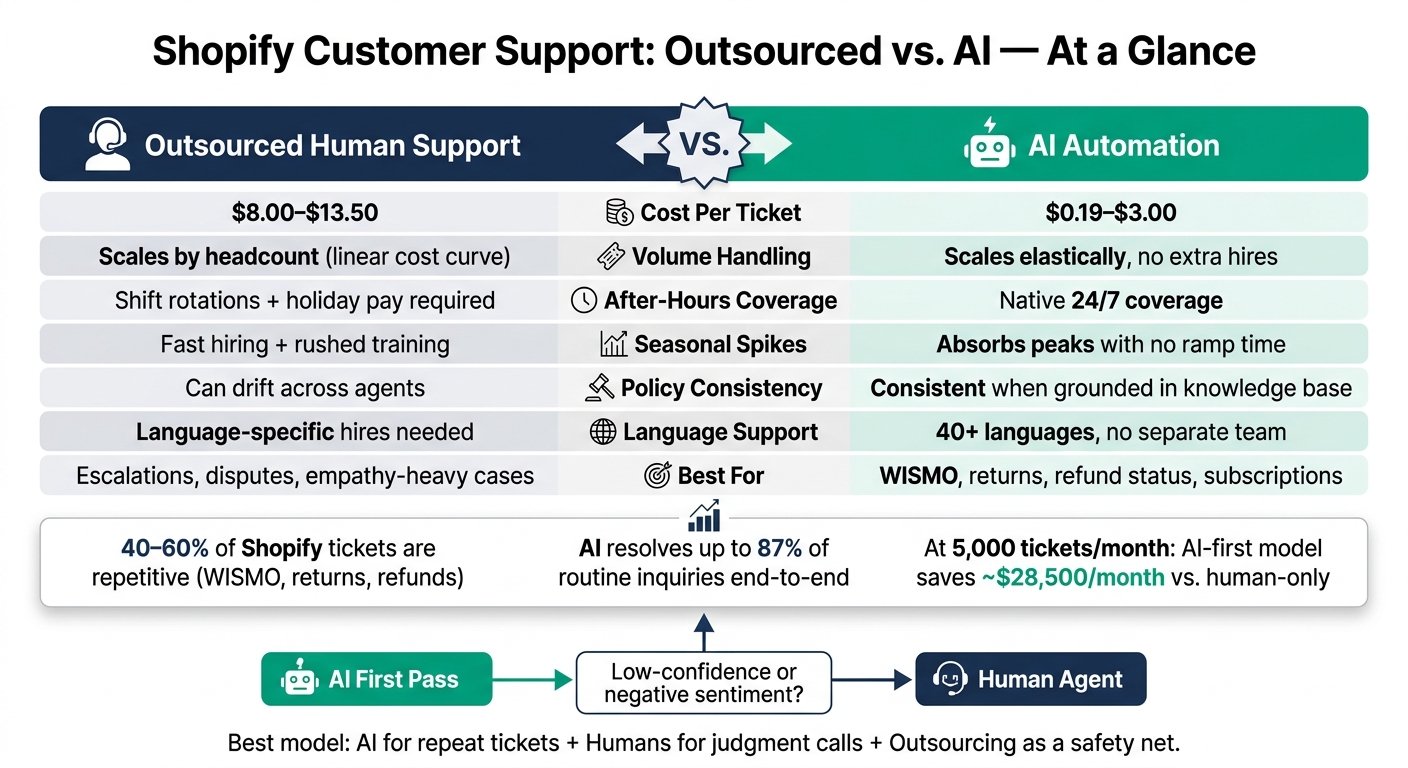
The math held until two things happened: ticket volumes grew faster than anyone projected, and customer expectations for response time shifted from "within 24 hours" to "within 2 hours." Outsourcing adds headcount linearly. AI scales instantly. At a certain volume, the economics cross over — and for most Shopify stores doing more than 1,000 tickets a month, that crossover has already happened.
This guide compares both models on total cost, resolution quality, setup time, and the edge cases where humans remain the right choice.
Outsourced Support vs. AI Automation for Shopify: Cost, Scale & Coverage
What outsourcing actually costs — fully loaded
The per-agent hourly rate is the number vendors quote. The fully loaded cost per ticket tells you what you're actually paying.
The rate varies significantly by geography:
- Offshore (Philippines, India, Eastern Europe): $8–15/hour per agent
- Nearshore (Latin America, South Africa): $18–28/hour
- US-based or Western European: $30–55/hour
At an average of 12 minutes per ticket — which is realistic for a trained agent handling a mixed Shopify queue — the math per ticket looks like this:
| Geography | Agent rate | Minutes/ticket | Cost per ticket |
|---|---|---|---|
| Offshore | $8–15/hr | 12 min | $1.60–3.00 |
| Nearshore | $18–28/hr | 12 min | $3.60–5.60 |
| US-based | $30–55/hr | 12 min | $6.00–11.00 |
These are direct labor costs. The fully loaded figure — accounting for management overhead, QA, training, attrition, and the BPO's margin — typically runs 2–3× the direct labor rate. For offshore outsourcing, fully loaded cost per ticket lands at $4–8. Nearshore runs $8–15. US-based runs $15–25.
Volume projections:
| Monthly tickets | Offshore BPO (fully loaded) | Nearshore BPO (fully loaded) | US-based BPO (fully loaded) |
|---|---|---|---|
| 1,000 | $4,000–8,000 | $8,000–15,000 | $15,000–25,000 |
| 3,000 | $12,000–24,000 | $24,000–45,000 | $45,000–75,000 |
| 10,000 | $40,000–80,000 | $80,000–150,000 | $150,000–250,000 |
That's not the ceiling — BFCM and seasonal peaks drive volume 3–7× above baseline, and BPOs typically charge overtime rates or require minimum headcount commitments for surge periods.
[IMAGE: Bar chart comparing monthly outsourcing cost vs. AI cost at three volume tiers: 1,000 / 3,000 / 10,000 tickets per month. Shows offshore, nearshore, US-based BPO versus AI + human overflow model. Y-axis: monthly cost in USD.]
What AI actually costs — and what it resolves
AI customer support pricing has three structures. CoSupport AI, for example, publishes all three so you can pick the model that fits your volume.
Per AI response: $0.04 per response the AI generates. Includes replies that a human reviews before sending, not just autonomous resolution.
Per resolved ticket: $0.19 per ticket the AI resolves without a human agent. You pay only when AI fully handles the interaction.
Flat volume plan: $99 per 1,000 monthly tickets. Unlimited AI responses within your volume tier.
At 3,000 tickets a month, the flat plan runs $297. If the AI resolves 70% of those tickets autonomously (2,100 tickets), the remaining 900 still need human agents — either in-house or via a smaller outsourcing contract. At $4–8 per ticket for overflow handling, that adds $3,600–7,200 per month.
Combined AI + overflow model vs. full outsourcing:
| Tickets/mo | Full offshore BPO | AI flat plan + 30% overflow (offshore) | Difference |
|---|---|---|---|
| 1,000 | $4,000–8,000 | $99 + $1,200–2,400 = $1,299–2,499 | Save $1,500–5,500/mo |
| 3,000 | $12,000–24,000 | $297 + $3,600–7,200 = $3,897–7,497 | Save $8,100–16,500/mo |
| 10,000 | $40,000–80,000 | $990 + $12,000–24,000 = $12,990–24,990 | Save $27,000–55,000/mo |
The savings widen at scale. That's the defining characteristic of AI pricing: the cost curve is flat while the BPO cost curve is linear.
The real comparison: what each model handles well
Neither outsourcing nor AI is the right answer for every ticket type. The practical question is which tickets belong to which model.
[IMAGE: 2×2 matrix: X-axis = "Ticket complexity" (low to high), Y-axis = "Emotional charge" (low to high). Four quadrants: Bottom-left = AI resolves (WISMO, order status, returns, account FAQ) — Bottom-right = AI drafts, human reviews (refund disputes, billing questions) — Top-left = AI routes (complaints, high-frustration) — Top-right = Human owns (complex complaints, high-value customers, regulatory issues).]
AI resolves well:
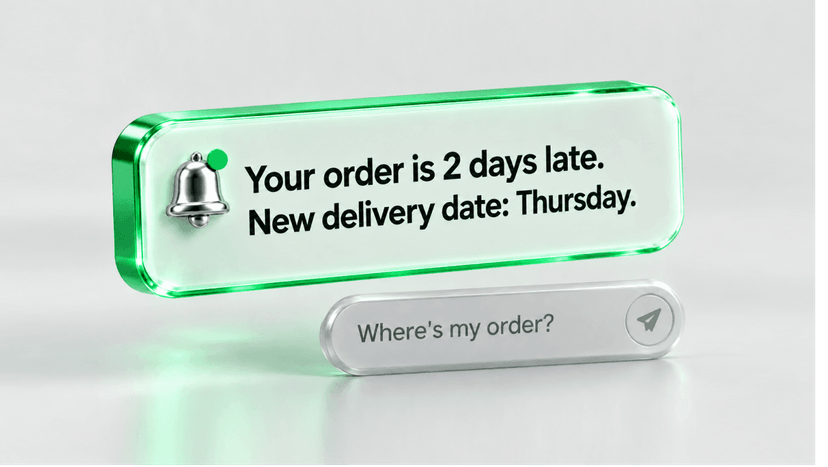
- Order status and WISMO ("where is my order")
- Standard return and refund requests within policy
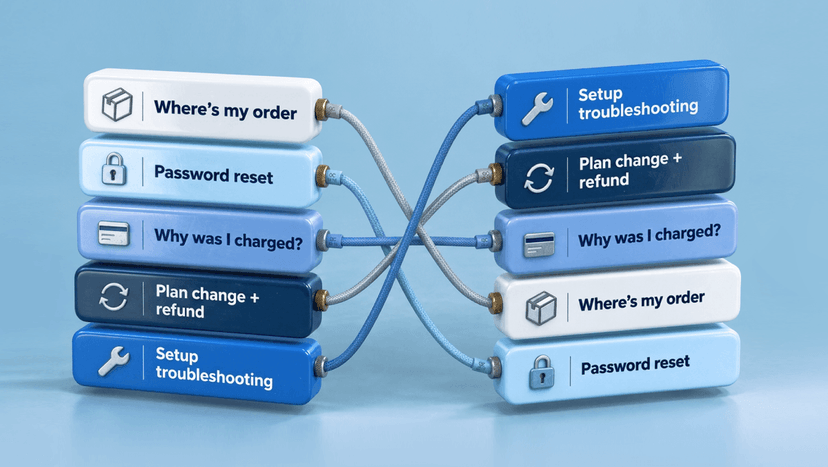
- Account lookups and password resets
- FAQ responses with known, policy-clear answers
- Shipping delay notifications and tracking links
- Exchange requests with known inventory availability
These ticket types share one property: the answer is deterministic. Given the customer's order and your policy, there is one correct response. CoSupport AI Agent finds it in seconds by querying live Shopify order data, without an agent reading the ticket first.
Humans own:
- Escalated complaints from high-LTV customers
- Refund disputes outside policy with ambiguous context
- Orders involving fraud flags or chargebacks
- Requests that require business judgment rather than policy application
- Any customer who explicitly requests a human
The hybrid outcome:
BPO handles escalations and edge cases — typically 20–30% of volume — at a rate that's significantly lower than the current fully loaded BPO bill for the whole queue. AI closes the other 70–80%. Total cost falls by 50–70%. Response time on the AI-handled tickets drops from hours to seconds.
sbb-itb-97114f1
What most Shopify stores get wrong when comparing options
Comparing sticker prices instead of outcomes. A BPO that quotes $10/hour sounds cheap. The question is how many hours it takes to resolve 1,000 tickets — and what the resolution quality looks like. An AI that costs $99/month but resolves tickets in 8 seconds with consistent accuracy isn't comparable to a $10/hour agent whose quality depends on training, tenure, and shift.
Assuming outsourcing scales linearly. BPOs charge for agent hours, not ticket outcomes. When ticket volume doubles, BPO cost doubles. When AI ticket volume doubles, cost goes from one flat-plan tier to the next — usually a fraction of the proportional BPO increase.
Ignoring ramp time. A new BPO contract takes 4–8 weeks to staff, train, and reach baseline quality. A well-configured AI is live in days. During BFCM or a product launch, that difference is the gap between covering your queue and not covering it.
Treating AI as a replacement when it's a filter. The best Shopify support operations aren't running AI instead of outsourcing — they're running AI to handle the predictable tier and outsourcing (or a small in-house team) for the exceptions. The BPO relationship gets smaller, cheaper, and more focused. The agents doing the work are handling escalations and genuinely complex tickets instead of typing the same tracking link 200 times a day.
Key takeaways
- Fully loaded BPO cost per ticket is $4–25 depending on geography; AI resolves tickets for $0.19 each on a per-resolution model. At 3,000+ monthly tickets, the cost gap is significant.
- AI resolves well when the answer is deterministic: order status, returns within policy, account FAQs, exchange requests with known inventory. Humans own escalations, edge cases, and high-LTV complaints.
- The best model isn't AI or outsourcing — it's AI handling the predictable tier and a smaller, focused human layer for exceptions. Total cost falls while quality on complex tickets improves.
- AI doesn't ramp. During BFCM or a product launch spike, AI handles 10× normal volume without an emergency staffing call. BPOs require lead time and often impose surge premiums.
- Sticker price comparisons mislead. Compare fully loaded cost per ticket handled against AI cost per ticket resolved. The denominator matters.
.png)