.png&w=96&q=75)

Noom’s hybrid support model combines AI and human expertise to assist users in health and wellness. Their AI assistant, Welli, introduced in June 2024, manages routine inquiries while escalating complex or sensitive issues - like safety concerns or motivational needs - to human coaches or specialists. This system ensures efficient, personalized, and empathetic user support.
Key takeaways from Noom’s approach:
- AI for routine tasks: Welli handles common questions about food logging, app use, and general health tips.
- Human escalation for complex needs: Clinical specialists address safety concerns, while coaches provide motivation and accountability.
- Personalized responses: Welli uses real-time user data, like health goals or treatments, to tailor interactions.
- Empathy-focused design: AI responses are crafted to be supportive and avoid judgmental language.
- Clear user options: Users can request human support at any time by typing "message coach."
This balance of automation and human care helped Noom improve its support deflection rate from 59% to 68% within 30 days of Welli’s launch, showing how AI and human interaction can work together effectively.
AI in Customer Service: What It Should (and Shouldn’t) Do for CX
sbb-itb-97114f1
Why Scaling Support is Harder for Health and Wellness Apps
Health and wellness apps face challenges that go beyond the usual hurdles of scaling support. While a mistake in responding to a password recovery request might be frustrating, an error in addressing medication side effects could be outright dangerous. This higher level of responsibility makes scaling support in this industry a particularly difficult task.
The stakes are high. Nearly 20% of consumers who interacted with AI for customer service reported no benefits - a failure rate four times higher than AI applications in general. In healthcare, the risks are even greater, as [AI-generated errors or "hallucinations"] (https://cosupport.ai/articles/ai-support-no-hallucinations-advanced-customer-service-tech) can lead to the spread of harmful health misinformation.
These challenges become even more pronounced during periods of rapid growth. For example, in early 2024, Noom experienced a massive spike in customer inquiries as New Year’s resolutions drove more users to their platform. Their existing workflow-driven system struggled to handle the sheer volume, putting service quality at risk.
What Makes Healthcare Support Different
Health-related support comes with a level of emotional complexity that standard customer service rarely encounters. Users aren’t just troubleshooting app features - they’re often dealing with deeply personal issues like weight loss, managing chronic illnesses, or addressing mental health struggles.
Trust is paramount in these interactions. When users open up about struggles like emotional eating or cravings, they need responses that feel empathetic and tailored to their experiences - not generic, prewritten templates. A single poorly worded reply can shatter trust and derail someone’s health journey.
Beyond empathy, healthcare support teams must also be equipped to recognize and respond to potential safety concerns or medical emergencies hidden within user messages. These situations often require immediate escalation to clinical specialists. This layer of complexity is unique to health and wellness support and doesn’t exist in typical software troubleshooting.
Personalization is equally critical. For instance, a user undergoing GLP-1 treatment for weight loss requires different advice than someone managing diabetes through dietary changes. Standard automation tools often fail to adapt to these specific medical needs without access to user-specific data and expert-curated guidance.
"It was trivially easy to get Welli [AI] to hallucinate... Welli's tone did not match the persona that we wanted our users to associate with Noom." - Yifan Xia, Data Scientist, Noom
These challenges underline why off-the-shelf chatbots often fall short in the wellness space.
Where Automated Wellness Support Usually Fails
Traditional chatbots struggle to meet the demands of healthcare support for several reasons. They cannot often handle sudden spikes in volume without a dip in service quality - something Noom encountered firsthand with their initial platform.
Tone is a common issue. When Noom’s team prototyped Welli using GPT-4 in mid-2024, they found the AI’s responses felt cold and disconnected. This inability to match the appropriate tone can alienate users who are seeking reassurance and understanding. Another major limitation is context blindness. Early versions of Welli couldn’t incorporate user-specific details like their program type, goals, or medication status, leading to generic and sometimes irrelevant responses.
The most critical failure, however, lies in safety detection. Standard chatbot systems often can’t differentiate between a routine question and a potential medical emergency that requires immediate escalation. While AI chatbots can handle up to 80% of routine inquiries, the remaining 20% - which are usually the most complex - are often the most crucial for user retention and health outcomes.
| Support Tier | Handled By | Topics Covered |
|---|---|---|
| General/Routine | AI (Welli) | Food logging, app navigation, general nutrition, recipes |
| Motivational | Human Coach | Goal setting, habit building, addressing challenges |
| Clinical/Safety | Clinical Specialist | Safety concerns, side effects, clinical interventions |
| Technical/Account | Support Team | Billing, app bugs, subscription management |
The takeaway: Effective automation in healthcare requires systems specifically designed for the field. These systems must integrate expert knowledge, utilize user-specific data, and ensure seamless escalation to human specialists when needed. Standard chatbot platforms built for e-commerce or SaaS simply can’t meet these demands safely.
How Noom Uses AI for Personalization and Context
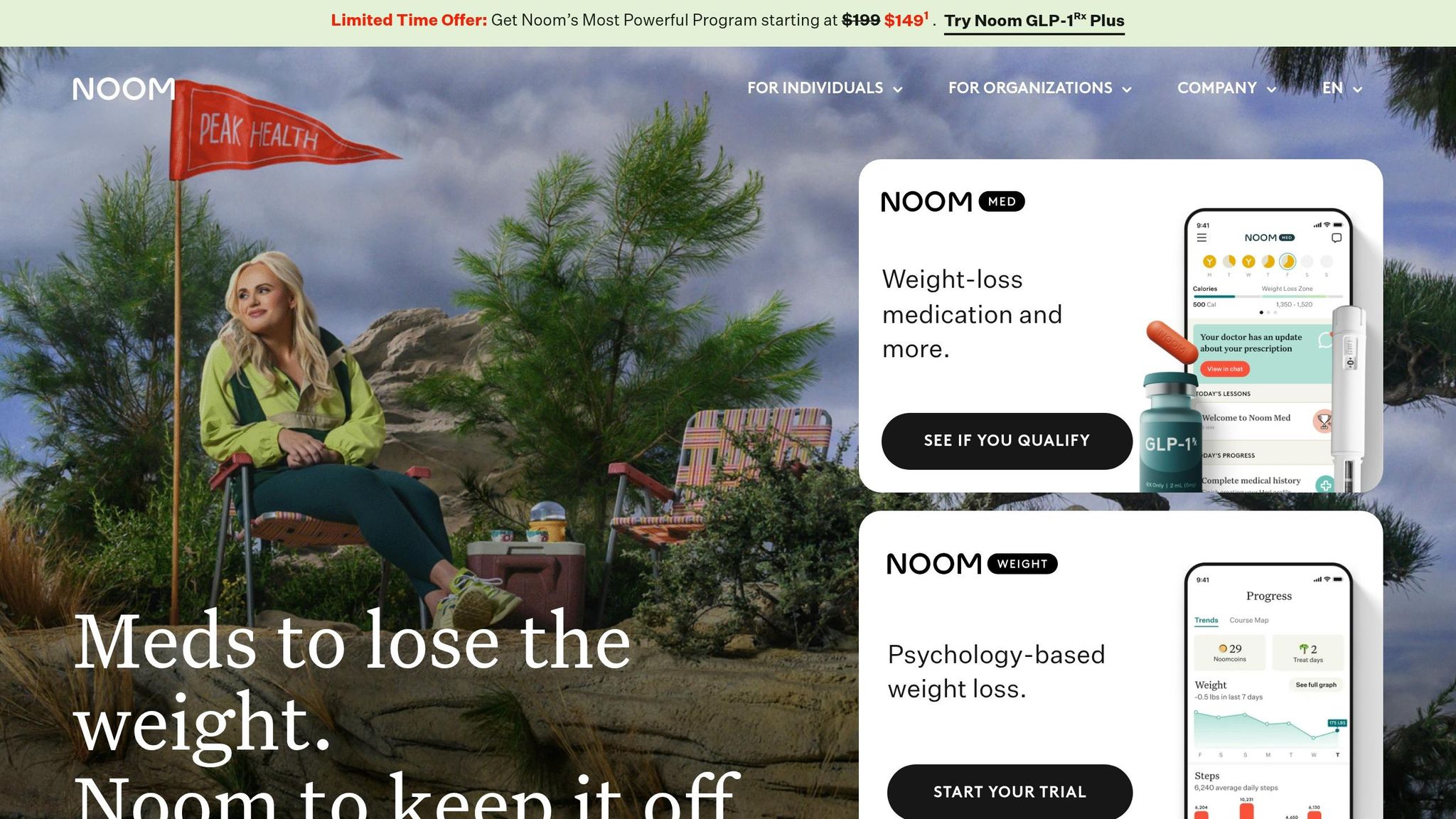
Noom has developed a cutting-edge approach to personalized care by using AI to analyze real-time user data. Their AI assistant, Welli, launched in June 2024, adapts its responses to each user's unique health journey. By pulling key details like device type, health goals, and treatment plans, the system creates highly tailored interactions.
Here’s how Noom leverages behavioral insights, emotional tone detection, and message prioritization to enhance its support model.
Using Behavioral Data for Context
Welli relies on Dynamic Prompting to adjust its responses based on a user's current situation. This means the AI adapts its instructions in real time to fit the context. For instance, if a user on GLP-1 medication reaches out, the system provides guidance specific to weight loss medication, covering both expectations and symptom management.
"When Welli interacts with a user undergoing GLP‑1 treatment, Welli will specifically know more about what to expect from weight loss medications and how to navigate symptoms, thus offering more personal care to our users." - Yifan Xia, Data Scientist, Noom
This level of precision is powered by an ML serving infrastructure that pulls user preferences and program data instantly. Welli taps into the "Noom Knowledge Base", a treasure trove of expert-curated information maintained by specialists in coaching, program management, and content. This ensures responses are based on trusted insights, not generic online data. To keep things transparent, Welli generates its responses in JSON format, including an "intermediary analysis" from its Chain of Thought reasoning. This allows engineers to trace how each recommendation is crafted.
Detecting Sentiment and Emotional Tone
Understanding emotional nuance is a key part of Noom's strategy. The AI uses Vertex AI classification models to evaluate the sentiment and urgency of user messages. Chain of Thought reasoning helps it identify safety concerns and complex emotional situations, while Few-shot prompting allows the system to handle less straightforward scenarios. Role Setting ensures that Welli consistently reflects Noom’s empathetic and supportive tone.
The results speak for themselves. Within 30 days of introducing this updated AI infrastructure in early 2024, Noom's support deflection rate jumped from 59% to 68%. This improvement highlights the AI's ability to distinguish between users who need general encouragement and those requiring urgent clinical attention.
Sorting Tickets by Sensitivity Level
Not every support request is the same, and Noom’s AI system categorizes messages into three escalation paths based on their complexity and sensitivity:
- Clinical Specialist Escalation: Safety-related concerns, such as severe side effects or mental health crises, are immediately routed to clinical specialists.
- Human Coach Escalation: When users need motivation or accountability, the AI directs them to connect with a human coach.
- Support Team Escalation: For technical or account-related issues, Welli offers clear instructions on how to contact the support team.
"We implemented a series of classification models with LLMs to detect if/what type of human touch is required under certain circumstances." - Yifan Xia, Data Science @ Noom
This tiered system ensures that sensitive or complex interactions are handled with the appropriate level of care. By combining behavioral insights, emotional analysis, and expert-curated knowledge, Noom’s AI doesn’t just address what users ask - it understands why they’re asking and how urgently they need assistance.
This thoughtful integration of technology ensures users get personalized, efficient support without losing the human touch where it’s most needed.
When AI Hands Off to Human Coaches
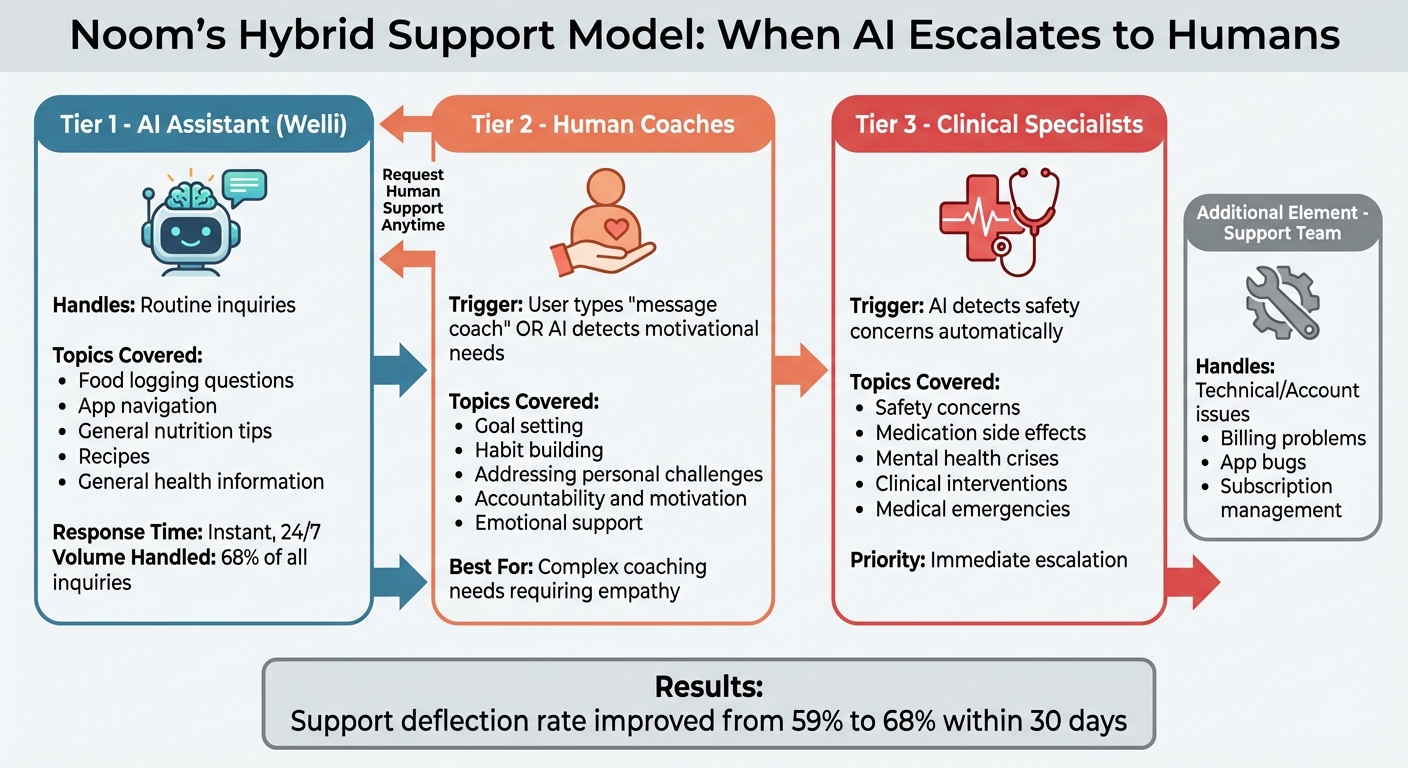
Noom's Three-Tier AI and Human Support System
Noom's approach to blending automation with human empathy includes a well-designed system where AI hands off certain situations to human professionals. This ensures users get the right kind of support, whether for clinical needs, motivational coaching, or technical help. By understanding how these handoffs work, it's easier to see why Noom's hybrid model is so effective.
What Triggers Human Escalation
Noom uses three main escalation paths, guided by insights from Vertex AI models and Chain of Thought reasoning.
-
Clinical Specialist Escalation: This kicks in automatically when Welli, Noom's AI, detects safety concerns or crisis situations in user messages. For example, if a user mentions severe side effects or mental health issues, a clinical specialist steps in right away.
"Clinical Case Specialists will intervene when there are potential safety concerns with users." - Yifan Xia, Data Science, Noom
- Human Coach Escalation: This happens when users request it directly, such as typing "message coach." These cases often involve complex coaching needs that go beyond general health tips, focusing on motivation and accountability.
- Support Team Escalation: If Welli encounters technical problems it can't solve - like app glitches or billing issues - it directs users to human support agents with clear instructions.
| Escalation Path | Trigger Mechanism | Primary Human Role |
|---|---|---|
| Clinical Specialist | Detected safety concerns | Safety intervention and clinical review |
| Human Coach | User request (e.g., "message coach") | Motivational support and accountability |
| Support Team | Technical/account limits identified | Troubleshooting and billing resolution |
These triggers highlight the specific roles humans play in Noom's system, which are tailored to meet user needs effectively.
What Human Coaches Do That AI Cannot
Human coaches at Noom focus on areas where emotional intelligence and personal connection are essential. While Welli handles routine tasks like answering nutrition questions or sharing recipes, coaches step in for more nuanced challenges, such as building relationships and providing tailored motivation. Research indicates that 85% of customers prefer human interaction for sensitive matters.
CEO Geoff Cook sheds light on this strategy:
"Our vision for coaching and Noom is to ensure we leverage human coaches for what humans do best - accountability and forming a connection - while leveraging AI for what it does best - always-on fast access and harnessing the full dataset available to it to produce quality insights."
When a handoff occurs, human coaches receive a complete user history, so users don't have to repeat themselves. This smooth transfer of context not only builds trust but also ensures sensitive issues are handled with care.
Key Takeaway: Noom's escalation system efficiently balances AI and human interaction. Routine tasks are handled by AI, while more complex or emotionally charged situations are directed to skilled human professionals. This thoughtful system strengthens user trust and delivers the personalized support necessary for a successful wellness journey.
Building Empathy Into AI Responses
Noom has taken a thoughtful approach to blending automation with personal care, ensuring empathy is a cornerstone of Welli's design. After realizing their first AI lacked the emotional connection users expected, Noom completely reworked how emotional intelligence is embedded into Welli.
The solution? Infusing empathy into the AI's core through targeted techniques. For example, Role Setting and Tone Setting prompts define Welli as a supportive health assistant, not just another generic chatbot. This ensures every interaction reflects Noom's signature non-judgmental coaching style.
Noom didn’t stop there. They implemented Chain of Thought (CoT) reasoning, a step-by-step process where the AI examines user messages to understand emotional needs, flag safety concerns, and determine the appropriate response tone. This reasoning is stored in JSON format, giving developers the ability to audit the AI's logic for potential bias or judgmental patterns before a response is generated.
To further refine Welli's responses, Noom uses few-shot prompting, providing examples of ideal interactions based on behavioral psychology. Paired with Retrieval Augmented Generation (RAG), which taps into a knowledge base curated by Noom’s coaching and clinical teams, Welli delivers responses rooted in expert guidance rather than generic health advice.
This combination of techniques ensures that Welli delivers empathetic, tailored responses that resonate with users.
Training AI to Use the Right Tone
Getting the tone just right required a sophisticated multi-prompt system. Noom's engineers created a framework that explicitly defines Welli's role as a supportive assistant focused on encouragement - not a medical professional offering clinical advice.
A key part of this system is dynamic prompt parameterization, which incorporates real-time user data into the AI's responses. For instance, if a user is taking GLP-1 medication, Welli can acknowledge this context directly and respond in a way that feels personalized, not robotic. This tailored approach ensures users on different programs receive responses that fit their unique situations, creating what Noom describes as "more personal care."
The impact of these refinements was clear. Within 30 days of launching the updated support platform with these tone improvements, Noom's support deflection rate rose from 59% to 68%. Users were getting the empathetic, tailored responses they needed without relying on human support for routine questions.
This tone refinement set the stage for integrating behavioral psychology into Welli's framework.
Applying Behavioral Psychology to AI Prompts
Noom's expertise in Cognitive Behavioral Therapy (CBT) deeply influences how Welli communicates. The goal isn’t just to sound empathetic - it’s to actively help users reshape their habits and relationship with food through psychologically sound advice.
This approach is embedded in Welli's knowledge base, which is powered by a FAISS Vector Store filled with content curated by Noom’s experts in coaching, customer support, and program management. Every response Welli generates aligns with Noom’s behavioral psychology principles, ensuring users get consistent and effective guidance.
Welli is trained to provide "light encouragement and validation" while understanding its own limits. When a conversation requires deeper emotional support or accountability, the AI knows to step back, leaving space for human coaches to step in. This self-awareness prevents the AI from overstepping into areas where genuine human empathy is essential.
An example of this psychological approach is Noom’s color-coded food logging system (Green, Yellow, Orange). Instead of labeling foods as "good" or "bad", the system focuses on nutrient density. Welli reinforces this perspective in its responses, helping users make informed decisions without guilt or shame.
Removing Judgmental Language
Health conversations can easily veer into judgmental territory, which is why Noom has made it a priority to eliminate language that might make users feel criticized or ashamed about their choices or progress.
To achieve this, Noom’s content curators carefully remove any problematic language from training data, and human reviewers validate the AI’s outputs to ensure a consistently supportive tone. This proactive approach means Welli never learns judgmental patterns in the first place, avoiding the need to "unlearn" them later.
CoT reasoning also plays a role here. Before crafting a response, Welli evaluates the user's emotional state and adjusts its language accordingly. For example, if a user shares a setback, the AI acknowledges the challenge without minimizing it or implying failure. This thoughtful language helps maintain trust while still offering constructive guidance.
By refining its language and tone, Noom ensures Welli remains a trusted, non-judgmental partner in users' wellness journeys.
Key Takeaway: Noom has successfully woven empathy into its AI design through role setting, behavioral psychology integration, and real-time personalization. By combining expert-curated content with continuous human validation, Welli delivers responses that are supportive, tailored, and aligned with proven coaching methodologies.
How Noom's AI Learns and Improves Over Time
Creating an AI that balances intelligence with empathy is no small feat. Noom's Welli achieves this through a combination of human oversight, detailed data analysis, and rigorous real-world testing. This ongoing process ensures that Welli stays effective and sensitive to the needs of users seeking healthcare support.
Using User Feedback to Refine AI
Noom relies on a multi-pronged approach to evaluate Welli, including human reviews, feedback from users, and LLM-as-a-judge evaluations. This layered system helps catch issues that might go unnoticed if only one method were used. This is a critical step when deploying an AI agent for customer service to ensure high accuracy.
One key element of this process is the "Human-In-The-Loop" system, which connects expert reviews with prompt adjustments. If users report dissatisfaction or highlight problems, these signals are directly used to refine prompts and update the AI's knowledge base.
To further ensure quality, Noom's engineering team regularly runs red team exercises - simulated stress tests that expose the AI to challenging scenarios before updates are released. These exercises help identify potential tone mismatches or factual inaccuracies, ensuring a smoother user experience.
"We've run multiple red team exercises on our models and have built out a Human-In-The-Loop adjacent... system for model output validation that also enables fast human intervention when required" - Yifan Xia, Data Scientist, Noom
Welli's responses are supported by a FAISS Vector Store, which houses the Noom Knowledge Base. This resource is continuously updated by experts from customer support, coaching, and clinical teams. When users ask questions about new features or program updates, these interactions highlight gaps in the knowledge base, prompting further updates.
This constant evaluation process allows Welli to learn from both its successes and its failures.
Learning From Both Good and Bad Interactions
Noom doesn't just focus on fixing errors; it also studies successful interactions to refine Welli's capabilities. A standout feature of Welli's learning process is its use of Chain of Thought (CoT) reasoning, which is stored in JSON format. Before generating a response, Welli evaluates the user's emotional state, flags safety concerns, and determines the best tone to use. This entire reasoning process is saved as structured data.
By recording CoT reasoning in JSON, Noom creates an audit trail that pinpoints where the AI's logic needs improvement. If an error occurs, the team can trace the problem back to its source.
"This structured method [JSON] guaranteed a seamless integration between systems and provided us with comprehensive data points to gain insights into the Welli decision-making process" - Yifan Xia, Data Scientist, Noom
Welli also learns from escalations. When its classification models pass conversations to Clinical Specialists, Human Coaches, or Support teams, these handoffs reveal areas where the AI needs more training. By analyzing the types of messages that require human intervention, Noom identifies patterns and adjusts prompts or adds new training examples.
Another tool in Noom's arsenal is few-shot prompting, where Welli is provided with specific examples of difficult scenarios. This method helps the AI recognize subtle nuances in conversations and respond more effectively over time.
By learning from every escalation and interaction, Noom ensures that Welli not only improves technically but also retains the human touch that users value.
Key Takeaway: Noom's strategy for improving Welli combines structured data analysis, layered evaluation methods, and expert input. By capturing the AI's reasoning in JSON format and learning from both positive and negative interactions, Noom has created a feedback loop that enhances Welli's intelligence while preserving its empathetic approach.
Scaling Support While Keeping User Trust
Noom's hybrid support model shows how combining AI with human expertise can deliver both efficiency and a personal touch. By assigning the right tasks to the right resources - whether it’s Welli, a human coach, or a clinical specialist - Noom balances automation with empathy.
How Automation Improves Efficiency
Welli, Noom's AI assistant, takes care of high-volume, straightforward tasks like answering questions about recipes, food logging, calorie budgets, and app navigation. These are handled instantly, freeing up human agents for more complex inquiries.
During the holiday surge in early 2024, Noom managed to handle a significant increase in support requests without hiring additional staff. With the help of AI tools, support agents were able to handle nearly 14% more inquiries per hour. This allowed the company to scale efficiently during peak times without sacrificing service quality.
This operational efficiency forms the backbone of Noom's transparent approach to AI, building trust with users.
Being Transparent About AI Use
Noom ensures users know when they’re interacting with AI. Welli is clearly labeled as an "AI Health Assistant" within the app, and a public "What to Ask" guide outlines the topics Welli can handle versus those requiring human intervention.
This clarity sets realistic expectations. If Welli encounters a question it can’t answer - like a technical issue or a medical query - it acknowledges its limits and provides instructions for contacting a human. Users can also type commands like "message coach" at any time to connect directly with a human team member, ensuring they don’t feel stuck in an automated system.
By openly communicating AI’s role, Noom not only builds trust but also supports cost-effective operations.
Scaling Support Cost-Effectively
Noom’s approach reduces costs while maintaining high-quality support. AI chatbots like Welli can handle up to 80% of routine inquiries, and conversational AI is expected to cut global contact center labor costs by $80 billion by 2026.
The tiered support structure ensures that every request is routed to the right resource. Simple questions go to Welli, motivational support is managed by human coaches, and critical safety concerns are escalated to clinical specialists. This setup keeps human resources focused on high-value tasks where expertise and empathy are essential.
By integrating Welli with real-time user data - such as whether someone is on GLP-1 medication - Noom can provide personalized, context-aware responses at scale . This combination of automation and human support delivers a concierge-like experience that keeps users satisfied, even as the company grows.
Key Takeaway: Noom’s hybrid model leverages automation for routine tasks while reserving human expertise for more complex needs. Transparency, smart escalation protocols, and tailored responses allow Noom to scale cost-effectively while maintaining user trust.
Key Takeaways From Noom's Support Model
Noom's approach to AI customer support in healthcare demonstrates that automation and empathy can work hand in hand. By using AI as a first layer to handle routine queries, the company allows human experts to focus on more complex and sensitive issues - without losing the personal touch.
Here are the key elements of Noom's support strategy:
- Start with a strong knowledge base. Noom uses Retrieval Augmented Generation (RAG) paired with a FAISS Vector Store, curated by experts, to ensure AI responses are accurate and align with their brand voice. This verified knowledge base works alongside large language model (LLM) training to minimize errors and maintain medical accuracy.
- Set clear escalation paths. Noom has a three-tiered human support system: Clinical Specialists handle safety concerns, Human Coaches focus on motivation and accountability, and Support Teams address technical and billing issues. AI manages general questions - like those about nutrition or program details - while classification models flag situations requiring human intervention.
- Use real-time context in AI responses. By factoring in user-specific data - such as medication status, device type, and preferences - Noom ensures its AI delivers personalized answers. Structured formats like JSON improve tracking and integration of AI decisions within their systems.
- Let users take control. Noom empowers users to bypass AI whenever they want by using commands like "message coach." This straightforward escalation option fosters trust and ensures that more sensitive topics are handled personally.
Geoff Cook, Noom's CEO, sums up their philosophy:
"Our vision for coaching and Noom is to ensure we leverage human coaches for what humans do best - accountability and forming a connection - while leveraging AI for what it does best - always-on fast access and harnessing the full dataset available to it."
- Geoff Cook, CEO, Noom
Noom’s strategy highlights how AI can effectively manage routine tasks, leaving human experts to handle more nuanced challenges. By combining a strong knowledge base, clear escalation paths, and user-focused features, Noom achieved a 68% support deflection rate within just 30 days of updating its AI approach. This balance between efficiency and empathy is at the heart of their success.
.png)


.png&w=828&q=100)
.png&w=96&q=100)
.png&w=828&q=100)
.png&w=96&q=100)