.png&w=96&q=75)

Intuit handles millions of tax season support requests using AI to scale operations quickly and improve efficiency. Here's how they do it:
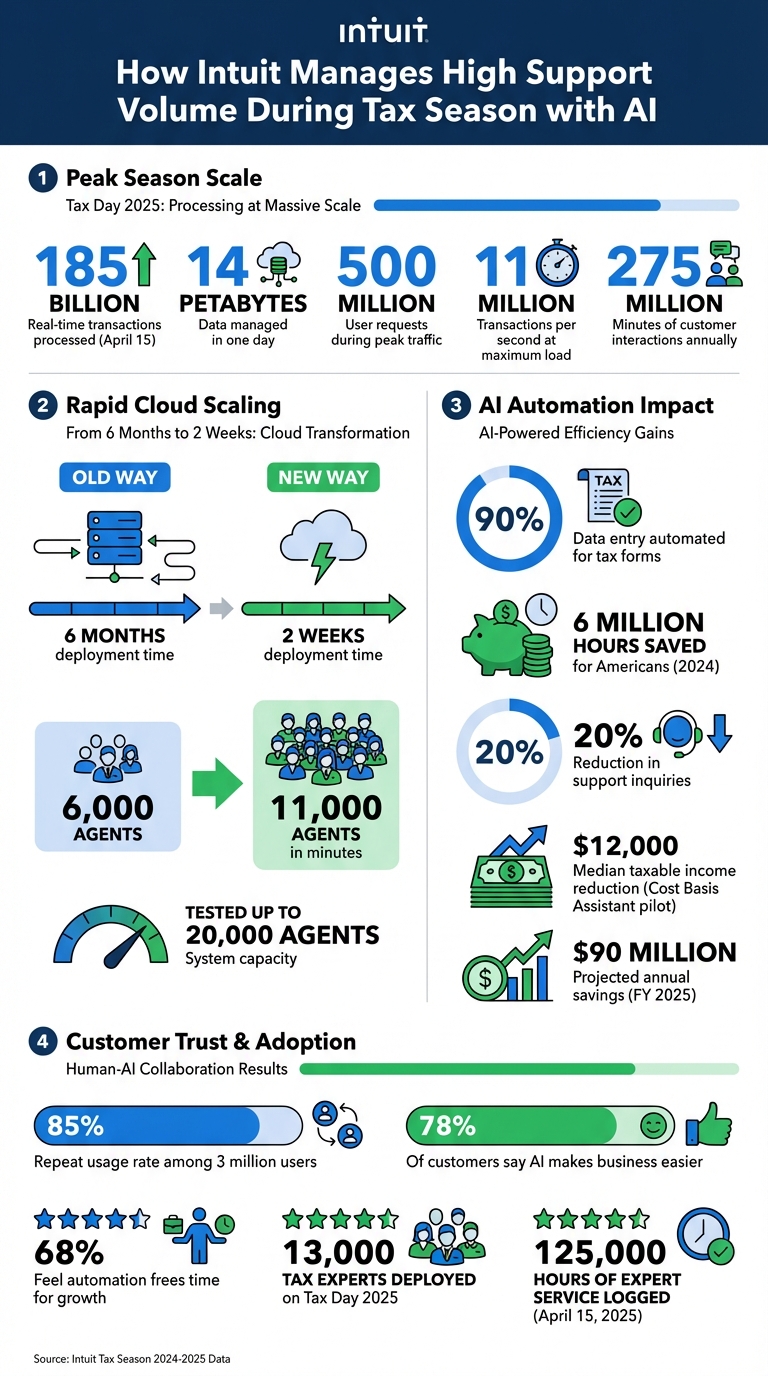
- Massive Scale: On April 15, 2025, Intuit processed 185 billion transactions, managed 14 petabytes of data, and handled 500 million user requests.
- AI-Powered Tools: Intuit Assist automates 90% of data entry for tax forms, saving users 6 million hours in 2025.
- Cloud-Based Scaling: Using Amazon Connect, Intuit expanded from 6,000 to 11,000 agents in minutes, cutting deployment time from six months to two weeks.
- Human-AI Collaboration: AI handles routine tasks, freeing experts for complex issues, resulting in an 85% repeat usage rate among 3 million users.
Intuit Tax Season AI Support: Key Statistics and Impact Metrics
Intuit's Tax Season Support Challenges
To tackle the hurdles of tax season, Intuit turned to advanced AI tools. But before diving into solutions, the company had to address three major issues that threatened its ability to maintain service quality during peak times.
High Volume of Support Requests
Tax season brings an overwhelming surge in customer inquiries. Between January and April, Intuit has to expand its contact center workforce from 6,000 to 11,000 agents, nearly doubling its capacity to handle the demand.
The scale of activity during this period is staggering:
- 185 billion real-time transactions processed on April 15, 2024
- 14 petabytes of data managed in a single day
- 500 million user requests during peak traffic
- 11 million transactions per second at maximum load
- 275 million minutes of customer interactions annually
These aren't simple queries about forgotten passwords. Customers need help navigating a tax code that spans over 100,000 pages and understanding more than 15,000 federal and state tax forms. The stakes are high - accurate answers can directly impact refunds and financial stability.
Outdated System Limitations
Before transitioning to the cloud, Intuit's older systems created significant roadblocks. Jerry Lekhter, Director of Contact Center Engineering, described the issue:
"To scale our solution, we had to physically install multiple call center servers. That was a six-month process involving setting up the hardware, assigning agents, and making sure connectivity was good."
Intuit relied on three separate on-premises contact center servers to meet expected demand. This approach required year-round investment in hardware and software licenses, even though they were only fully utilized during the four-month tax season. Beyond the cost, the fragmented setup made it hard to share data across teams.
"Our contact center agents were organized by business units, each tied to a specific contact center server. Callers often had to repeat their information to the next agent as they were transferred across business lines."
This inefficiency not only slowed down resolutions but also frustrated customers, who had to repeat themselves multiple times.
Maintaining Speed and Quality
The real test wasn't just managing the volume of requests - it was delivering quick, accurate assistance at scale. During tax season, agents face complex questions, like explaining why a refund amount has changed or why a specific tax credit was denied.
Early AI solutions didn't fully solve the problem. When Intuit first introduced a chat-based interface, users found it confusing. Dave Talach, SVP of QuickBooks, explained:
"We almost put a cognitive burden on people, like, what can it do? Can I trust it?"
The chat interface added to users' frustrations. It occupied screen space without simplifying workflows, leaving customers to manually transfer data between screens - essentially acting as "copy-paste machines". Intuit needed a better solution, one that could eliminate repetitive tasks while ensuring the accuracy and reliability that customers expect during tax season.
These challenges laid the groundwork for Intuit’s move toward AI-driven customer support solutions.
sbb-itb-97114f1
How Intuit Uses AI to Manage Support Volume
To address the challenges of outdated systems, Intuit turned to AI to create a scalable support system that handles millions of requests efficiently, without compromising quality.
Intuit Assist for Real-Time Support
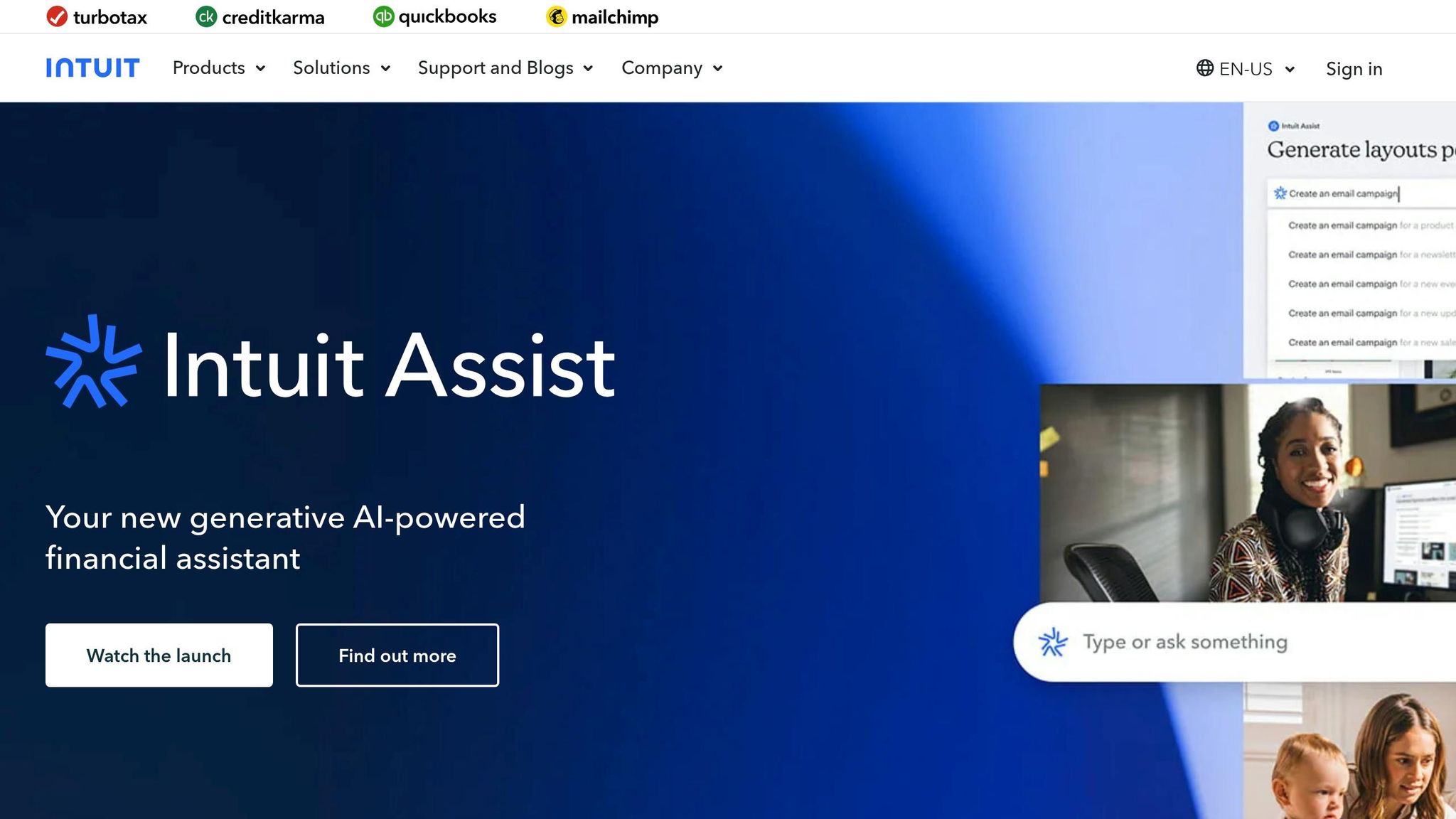
Intuit Assist plays a central role in Intuit's AI-powered customer service. Integrated into TurboTax, QuickBooks, and Credit Karma, this generative AI assistant provides immediate help to users.
At its core is Intuit's Tax Knowledge Engine, which organizes over 100,000 pages of tax code and 15,000+ federal and state forms to ensure accuracy. During the 2025 tax season, Intuit teamed up with Anthropic to incorporate Claude models via Amazon Bedrock, helping TurboTax users better understand complex tax calculations. Later that year, Intuit worked with Google Cloud to integrate Gemini models and Document AI into TurboTax, automating data extraction from intricate forms like 1099-B, 1099-COMP, and 1099-OID.
This automation eliminated 90% of manual data entry for common tax forms. Alex Balazs, Intuit's Chief Technology Officer, highlighted the impact:
"Our collaboration with Google Cloud is making a big difference... It's a shining example of how we're harnessing the power of Intuit's AI, data and tax domain expertise - with world-class Google Doc AI and Gemini technology."
By the 2024 tax season, AI automation had saved Americans 6 million hours. Customers no longer had to manually input data across multiple screens. One specialized AI tool, the "Cost Basis Adjustment Assistant", even reduced taxable income by a median of $12,000 during its pilot phase.
Key Takeaway: Intuit Assist blends tax expertise with generative AI, simplifying data entry and offering clear explanations, saving customers millions of hours during peak tax season.
Cloud Scaling with Amazon Connect
Intuit's adoption of Amazon Connect revolutionized how the company manages seasonal demand. This cloud-based contact center allows Intuit to scale from 6,000 to 11,000 agents in just minutes.
Jerry Lekhter, Intuit's Director of Contact Center Engineering, described the transformation:
"It took two weeks to deploy an integrated contact center using Amazon Connect... That process previously took us at least six months."
The cloud-based system provides a seamless experience for customers. Data continuity ensures that callers don't need to repeat information when transferred between TurboTax and QuickBooks support lines. Features like callback scheduling further reduce wait times.
Amazon Connect also integrates with Contact Lens, a tool that leverages machine learning for real-time call transcription, sentiment analysis, and automated summaries. These features help agents resolve issues faster while giving managers insights into customer satisfaction trends.
By shifting from fixed hardware costs to a pay-per-minute model, Intuit significantly cut operational expenses. Lekhter noted:
"Scaling our solution for tax season only takes a few minutes now, and it doesn't require us to manage and maintain contact centers for 11,000 agents all year."
The system has been tested to handle up to 20,000 agents, ensuring it can meet future growth demands.
Key Takeaway: Amazon Connect replaced lengthy hardware installations with instant cloud scaling, reducing costs and ensuring seamless customer support across Intuit's platforms.
Combining AI and Human Support
Intuit takes a balanced approach by combining AI with human expertise. Through its Human-in-the-loop model, AI handles routine tasks while human professionals tackle more complex challenges.
On April 15, 2025 - Tax Day - Intuit's network of tax professionals logged 125,000 hours of service. The company deployed 13,000 experts across 20 new TurboTax stores and 600 offices. AI-powered expert matching analyzed customer needs in real time, routing them to the right professional.
Marianna Tessel, EVP and GM at Intuit, emphasized the importance of this hybrid approach:
"Sometimes it's the combination of AI and HI that gives you better results."
AI now manages around 80% of routine data entry and categorization, freeing human experts to focus on advisory roles. This efficiency enabled QuickBooks Live to grow by 50%, as human accountants could support more users. With an 85% repeat usage rate among 3 million customers, it's clear that users trust this blend of automation and human expertise.
Key Takeaway: Intuit's hybrid model - integrating AI tools with human expertise - delivers speed, accuracy, and personalized service during high-demand periods.
TurboTax and QuickBooks AI Support Examples

TurboTax and QuickBooks, both Intuit platforms, use AI to make tax filing and bookkeeping easier. These tools also help Intuit scale customer service during busy periods, showcasing how AI can enhance efficiency and transform support systems.
TurboTax: AI Simplifies Tax Filing
TurboTax has significantly improved tax filing by automating data entry for standard tax forms. It now handles 90% to 93% of data entry, a jump from 68% in earlier years.
For example, its AI agent simplifies processing 1099-B forms by accurately identifying tax bases, saving up to three hours of manual work per return. The Cost Basis Adjustment Assistant further reduces the need for manual input, making tax filing faster and more accurate.
This automation has led to a 20% drop in customer support inquiries. Many users who previously needed help with complex forms or data entry can now complete their tax returns independently.
Key Takeaway: TurboTax's AI tools handle over 90% of data entry, cutting down on manual tasks and reducing the need for support during tax season.
QuickBooks: AI-Powered Bookkeeping Support
QuickBooks uses AI to simplify bookkeeping and lighten the workload for both customers and support teams. Its Accounting Agent automates tasks like transaction categorization and bank reconciliation, saving users up to 12 hours a month.
The Payments Agent helps small businesses manage late payments by flagging overdue accounts and suggesting late fees. This has made businesses 10% more likely to get paid on overdue invoices and sped up payments by an average of five days. Similar strategies help improve eCommerce customer support by streamlining transaction-related queries. The agent also drafts personalized payment reminders, reducing the need for manual follow-ups.
For support teams, AI tools provide real-time assistance by generating automatic call summaries, which eliminates the delay caused by manual note-taking. Intuit tax associate Geanna Foreman shared that AI-generated summaries have drastically reduced her workload.
Features like "Ready to Post" allow users to review and post grouped transactions with a single click. The Auto-post feature handles payroll and bill payments automatically, including tasks like matching direct deposit paychecks and tax payments.
These AI-driven tools work alongside Intuit's hybrid support model, ensuring smooth customer service even during peak periods.
Key Takeaway: QuickBooks' AI agents save users time by automating bookkeeping tasks and provide real-time support tools that reduce manual documentation, helping manage high customer demand.
How Automation Improves Customer Experience
The AI innovations in TurboTax and QuickBooks have transformed how users approach tax filing and bookkeeping. Intuit's AI investments are projected to save nearly $90 million annually by fiscal year 2025.
Customer feedback highlights the value of these tools. Intuit's AI agents have an 85% repeat usage rate among 3 million users. Furthermore, 78% of customers say Intuit's AI tools make running their business easier, while 68% feel the automation frees up time for business growth.
Automation has also redefined the role of human experts. Sandeep Aujla, Intuit's EVP and CFO, explained:
"If I can automate 90% of their tasks, that's money to the bottom line".
By automating repetitive tasks, Intuit has reduced manual work for both customers and experts by 30%. This allows professionals to focus on advisory services instead of routine data entry. During peak times like Tax Day, the platform processed 11 million transactions per second, proving that automation can maintain service quality even under heavy demand.
Key Takeaway: Intuit's AI automation not only delivers nearly $90 million in operational savings but also enhances customer satisfaction by streamlining processes and reducing manual labor during high-demand periods.
Lessons from Intuit's AI Implementation
Intuit's AI strategy offers valuable insights into managing and scaling support during high-demand periods. By leveraging cloud infrastructure, automation, and a focus on continuous improvement, they’ve successfully maintained service quality during seasonal surges.
Build Systems That Scale for Peak Demand
Handling sudden spikes in demand requires systems that can scale quickly and efficiently. Intuit transitioned from on-premises hardware to Amazon Connect, a cloud-based solution that revolutionized its scalability.
Jerry Lekhter highlighted the impact of this move, explaining that scaling now happens in minutes instead of months. For example, during tax season, Intuit expanded its workforce from 6,000 to 11,000 agents in just minutes. The time required to deploy an integrated contact center dropped from six months to only two weeks. This shift also allowed Intuit to avoid the costs of maintaining year-round infrastructure, as they now pay only for what they use.
This scalable setup ensures that both AI and human expertise can work together seamlessly when demand peaks.
Key Takeaway: Cloud-based infrastructure enables rapid scaling, reducing deployment times and operational costs during seasonal surges.
Balance Automation with Human Expertise
AI shines when it handles repetitive tasks, allowing human experts to focus on more complex challenges. Intuit employs a hybrid model that marries artificial intelligence with human intelligence to deliver better outcomes.
Their AI systems take over tasks like call summaries and repetitive processes, cutting 30% of manual work for both customers and employees. For instance, AI-generated summaries have eliminated the backlog of manual note-taking for support teams.
Marianna Tessel, EVP and GM at Intuit, underscored the importance of this balance:
"Sometimes it's the combination of AI and HI that gives you better results".
The system also flags high-stakes situations for human intervention, ensuring customers receive expert assistance when it matters most. This hybrid approach has driven an 85% repeat usage rate among 3 million users.
Key Takeaway: Use AI to handle repetitive tasks while reserving human expertise for complex and critical issues.
Track Performance and Improve Over Time
Tracking AI performance is essential for identifying weaknesses and making timely improvements. Intuit uses Contact Lens Analytics to monitor call transcriptions, customer sentiment, and overall contact center performance in real time.
They’ve also implemented a "Fast Follow Harvesting" process, where platform teams collaborate with customer-facing teams to address missing features quickly. This method allowed them to increase experimentation capacity from 10 to 1,000 customers at once, enabling more robust testing before full-scale rollouts.
The results are clear: AI-driven experiences have reduced TurboTax support contact rates by 20%. Additionally, Intuit is projected to achieve $90 million in annual efficiencies from AI investments by fiscal year 2025.
To ensure uninterrupted service, Intuit also developed resilient systems with LLM routers that automatically switch to fallback models if a primary provider goes down, maintaining service reliability even during peak demand.
Key Takeaway: Regularly monitor metrics like customer sentiment and deflection rates to identify gaps, improve performance, and ensure consistent service quality during busy periods.
Conclusion
Intuit has tackled the challenges of overwhelming support demands and outdated systems with an AI-driven approach that’s reshaped how they handle tax season. By blending cloud technology, automation, and strategic human involvement, they’ve created a support system capable of managing millions of customers while maintaining high-quality service.
The numbers speak for themselves. Scaling from 6,000 to 11,000 agents in mere minutes showcases the system's efficiency. On Tax Day alone, the platform processes an astounding 185 billion transactions, while achieving nearly $90 million in annualized savings in just the first half of 2025. With an 85% repeat usage rate, it’s clear that combining automation with human expertise resonates with users.
For businesses navigating seasonal demand spikes, Intuit’s approach offers valuable lessons. Transitioning to cloud-based systems allows for quick scaling without incurring hefty infrastructure costs. Leveraging an AI agent for customer service for repetitive tasks like data entry and call summaries frees up employees to focus on complex, high-value customer interactions. And by continuously monitoring performance metrics, businesses can identify and address gaps before the next peak period. For instance, some companies have achieved 81% auto-resolved chats by implementing these automated workflows.
Key Takeaways:
- AI enhances human expertise rather than replacing it.
- Cloud-based systems and automation lower costs while speeding up support deployment.
- Continuous performance monitoring ensures consistent improvement and reliability.
- Combining AI’s efficiency with human judgment fosters customer trust.
- Scalable infrastructure handles demand spikes without sacrificing quality.
This case study highlights an essential truth: successful AI implementation is not about replacing people - it’s about empowering them with better tools. By automating routine tasks and reserving human expertise for complex issues, businesses can build a scalable, reliable support experience that maintains customer trust.
With Intuit’s framework as a guide, businesses can confidently prepare for peak periods, whether it’s tax season or another high-demand event. It’s a proven playbook for scaling support while keeping customer satisfaction front and center.
FAQs
How does Intuit keep AI answers accurate for tax questions?
Intuit combines the power of AI with human expertise to ensure accurate answers to tax-related questions. The AI takes care of straightforward inquiries, while more complex or nuanced issues are passed on to human experts for review. This hybrid model allows the system to learn continuously from human interactions, refining its knowledge base to stay aligned with ever-changing tax laws. Additionally, Intuit employs ongoing monitoring and human validation to maintain reliable and precise responses, particularly during the busy tax season.
What makes Amazon Connect scale faster than on-prem contact centers?
Amazon Connect can ramp up operations much faster thanks to its cloud-based infrastructure. With this setup, businesses can launch a fully operational contact center in just two weeks - far quicker than the six months typically needed for on-premises solutions. Additionally, it allows scaling up to support thousands of agents within minutes, bypassing the delays associated with installing and configuring physical hardware in traditional systems.
When does Intuit route customers to a human expert instead of AI?
Intuit provides customers with access to human experts whenever personalized help is needed. Take TurboTax Live, for instance - it offers expert-assisted tax filing, giving users the confidence they need while saving them valuable time. This method addresses complex situations with tailored support, improving the overall experience for users.
.png)