.png&w=96&q=75)

IKEA saved $14.3 million in two years by using an AI agent for customer service, Billie, to handle 47% of customer inquiries. Instead of cutting jobs, they retrained 8,500 employees as remote interior design consultants, generating $1.4 billion in sales by 2022. Billie answers routine questions like order tracking, freeing employees to focus on personalized design services.
Key Points:
- Savings: $14.3 million via task automation.
- Revenue Growth: $1.4 billion from new design services.
- AI Efficiency: 3.2 million inquiries resolved without human help. Businesses looking for similar results can try a conversational AI demo to see the technology in action.
- Employee Upskilling: 8,500 workers transitioned to higher-value roles.
- Future Goals: Expand remote sales from 3.3% to 10% of total revenue by 2028.
Takeaway: IKEA combines AI efficiency with human creativity, proving automation can cut costs while creating new opportunities for employees.
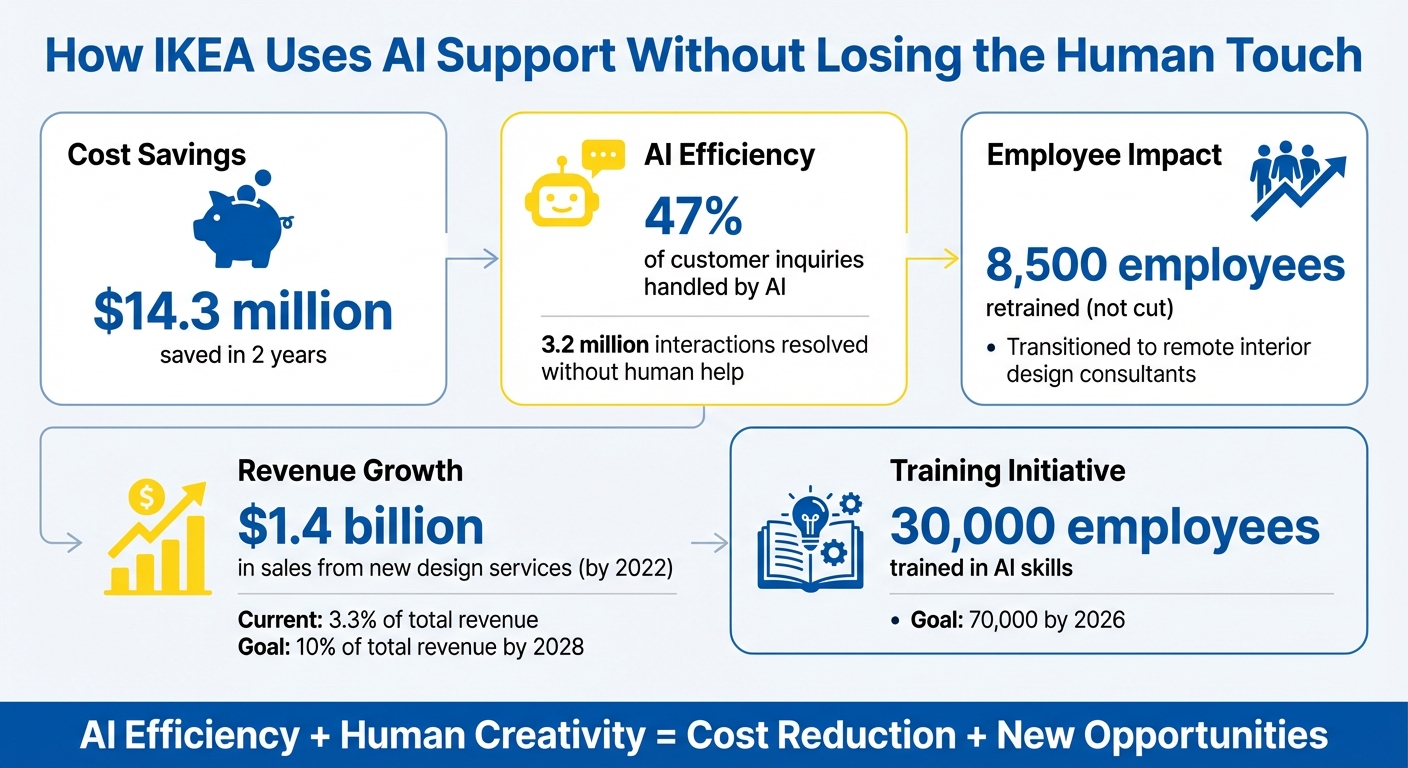
IKEA AI Implementation Results: Cost Savings and Revenue Growth Statistics
We Automated 80% of Customer Support With One AI Agent (No Code)
sbb-itb-97114f1
Billie Chatbot: How IKEA's AI Works
IKEA's approach to blending human expertise with technology is evident in Billie, their AI chatbot. Designed to simplify customer support, Billie ensures efficient service while maintaining quality.
What Billie Does: Features and Functions
Billie serves as IKEA’s digital assistant, greeting users as a yellow chat bubble on their website. Using natural language processing (NLP), Billie quickly understands customer needs and tackles a variety of tasks. Whether it’s tracking orders, suggesting products, or even sharing interior design ideas, this chatbot is up to the challenge.
Available 24/7, Billie supports customers at every step of their shopping journey - before purchase, during checkout, and even after furniture delivery.
"Billie is available 24/7 and can answer common questions about IKEA. You can find Billie almost everywhere on our website – just click on the yellow chat bubble to get help before, during, and after your purchase."
– IKEA Official Website
What sets Billie apart is its ability to personalize assistance. Drawing on IKEA's 80 years of experience in understanding "life at home", Billie offers tailored product suggestions, assembly guidance, and even helps visualize how furniture fits into a space. By handling these routine queries, Billie allows human agents to focus on more complex customer needs.
Results: 47% of Inquiries Handled, $14.3M Saved
Billie’s impact goes beyond convenience - it delivers measurable results. Between 2021 and 2023, Billie managed 3.2 million interactions without requiring human intervention. Other companies have seen similar success, with some achieving 81% auto-resolved chats in just one month. This efficiency saved IKEA $14.3 million in operational costs.
By automating routine tasks, IKEA was able to reassign 8,500 employees to more strategic roles, such as remote interior design consultations. These efforts contributed to remote sales reaching $1.4 billion by the end of fiscal year 2022, accounting for 3.3% of IKEA’s total sales.
Key Takeaway: AI tools like Billie don’t just reduce workload - they create opportunities for human teams to focus on higher-value services, ultimately driving new revenue streams.
Customer Problems IKEA Solved with AI
The Problem: Overloaded Agents and Long Wait Times
Before IKEA introduced Billie in 2021, their support agents were drowning in routine tasks like order tracking. This not only frustrated customers but also prevented skilled employees from focusing on more impactful work, such as interior design and problem-solving.
The growing volume of customer inquiries, combined with the challenges of managing global time zones, led to long wait times. Offering 24/7 support wasn’t feasible, and the strain on operations made it difficult for IKEA to expand its remote sales and design services. This bottleneck limited the company's ability to fully tap into the potential of personalized customer consultations.
The Solution: Instant Answers and 24/7 Support
Billie, IKEA’s AI chatbot, stepped in to revolutionize their support system. By automating routine tasks, Billie now handles order tracking, product questions, and assembly guidance - all available 24/7.
The chatbot can manage multiple inquiries at once, eliminating backlogs and ensuring that complex issues are passed on to human agents. This allows employees to focus on building stronger customer relationships and tackling creative challenges.
"With the chatbot handling simpler enquiries, co-workers are empowered to play a more value-adding role within remote selling."
– Parag Parekh, CDO, Ingka Group
Billie’s impact has been massive. It now handles 47% of inquiries without human intervention, enabling IKEA to redirect resources toward more innovative services. Over 8,500 employees were reskilled to become remote interior design advisors, which contributed to $1.4 billion in remote sales by the end of fiscal year 2022.
This shift also allowed IKEA to transform traditional support roles into opportunities for employees to act as design consultants, enhancing customer experiences and driving revenue.
Key Takeaway: Free Up Humans for Complex Work
When AI takes over repetitive tasks, it doesn’t replace jobs - it opens doors for employees to focus on higher-value work. IKEA’s strategy highlights how automation can empower teams to deliver personalized services, fostering growth and creating new revenue opportunities.
How IKEA Reskilled 8,500 Support Employees
From Support Agents to Design Consultants
Between 2021 and 2023, IKEA redefined the roles of 8,500 call center employees, transforming them into remote interior design consultants. As digital retail sales consultants, these employees now offer personalized design advice through video calls.
In the UK, customers can book a 45–60 minute session for $27 (£25), while a more in-depth workspace design package is priced at $137 (£125). This shift not only met a growing demand for affordable professional design services but also created a new revenue stream. By the end of fiscal year 2022, these services contributed 3.3% of IKEA's total sales.
"We're committed to strengthening co-workers' employability in Ingka, through lifelong learning and development and reskilling, and to accelerate the creation of new jobs."
– Ulrika Biesert, Global People and Culture Manager, Ingka Group
Looking ahead, IKEA plans to expand remote sales from 3.3% to 10% by 2028. This initiative reflects the company’s focus on reskilling as a cornerstone for innovation and enhanced customer experiences.
AI Tools That Help Employees Do More
IKEA didn’t stop at reskilling - it also equipped employees with advanced AI tools to streamline their work. AI assistants for agents automate routine tasks such as data analysis and administrative work, freeing up employees to focus on creative and customer-centered responsibilities.
The company also launched a one-year, full-time data analysis program aimed at training 10–15 employees annually from various departments, including sales, HR, and supply chain. Under the guidance of Chief Data and Analytics Officer Francesco Marzoni, this program transforms employees into data-savvy professionals who can bridge the gap between AI capabilities and business challenges.
By late 2024, IKEA had trained 30,000 employees in basic AI skills, with an ambitious goal to reach 70,000 by 2026. Initiatives like internal "World Data Games" and hackathons encourage collaboration between employees and AI experts to create practical, real-world solutions.
"AI is very much about data, and data is largely in people's heads, so we must invest in developing the people - the experts - who become important actors when it comes to how we build solutions."
– Francesco Marzoni, Chief Data and Analytics Officer, Ingka Group
This strategy highlights the importance of blending technical expertise with in-depth business knowledge to develop effective AI-driven solutions.
Lesson: Invest in People, Not Just Technology
IKEA's journey shows that technology and workforce development go hand in hand. The company’s Digital Ethics Policy, established in 2019, set clear guidelines to prevent surveillance and algorithmic bias, fostering employee trust as AI adoption grew. IKEA’s approach proves that prioritizing people alongside technology drives both innovation and improved customer service.
What Support Teams Can Learn from IKEA
Combine AI Speed with Human Empathy
IKEA’s success shows that improving eCommerce customer support with AI by blending automation with human interaction isn’t just possible - it’s a winning formula. The company uses AI to tackle repetitive tasks like answering questions about order tracking or product availability. This approach frees up employees to focus on more engaging and creative tasks, such as providing interior design consultations.
This strategy strikes a balance between efficiency and a personal touch. While customers get quick responses to simple queries, they also receive tailored advice for more complex needs. The key takeaway? Determine which tasks can benefit from automation and which ones thrive on human creativity.
"This level of personalisation is not only going to continue to improve but will enhance customer satisfaction and increase loyalty overall."
– Parag Parekh, CDO, Ingka Group
How to Measure Success: ROI and Performance Metrics
To know if your AI efforts are paying off, you need to track the right metrics. IKEA evaluates its AI investments through a variety of measures, such as inquiry deflection rates, cost savings, and revenue generated by reskilled employees.
For example, IKEA’s Billie chatbot achieved a 47% deflection rate, handling 3.2 million interactions and saving $14.3 million. Beyond operational savings, IKEA also measured the revenue generated by employees who were reskilled, which reached an impressive $1.4 billion by the end of fiscal year 2022.
| Metric | IKEA's Result |
|---|---|
| Inquiry Deflection Rate | 47% |
| Total Interactions Handled | 3.2 million |
| Operational Savings | $14.3 million |
| Revenue from Reskilled Staff | $1.4 billion |
| Employees Trained in AI | 30,000 (goal: 70,000 by 2026) |
It’s important to go beyond ticket deflection when measuring success. Metrics like customer satisfaction, employee productivity, and new revenue streams from freed-up staff time should all be part of your evaluation.
With clear metrics in place, the next step is to implement AI thoughtfully and strategically.
Steps to Implement AI in Customer Support
IKEA’s approach to AI integration offers a clear roadmap for success, starting with ethics and data management.
- Establish Ethical Guidelines: Begin with a strong ethical foundation. IKEA introduced a Digital Ethics Policy in 2019 to address concerns like surveillance and algorithmic bias. This step not only ensures responsible AI use but also builds trust among employees and customers.
- Organize Your Data: AI thrives on well-structured data. IKEA prioritized organizing internal data, such as supply chain information, which was easier to manage. Customer data, however, required greater transparency and care to meet higher standards.
- Build Cross-Functional Teams: Combine technical expertise with practical business insights. IKEA brought together data scientists, IT specialists, and business professionals - like those from sales, HR, and supply chain teams - to create solutions grounded in real-world needs.
- Train Your Workforce: Ongoing training is essential. Equip your employees with the skills to leverage AI while staying aligned with your business goals. IKEA’s commitment to training 70,000 employees by 2026 highlights the importance of education in bridging technology and human expertise.
"Success requires the humility to say you're learning, the courage to train broadly, and the clarity to centre trust in every decision."
– Parag Parekh, CDO, Ingka Group
By following these steps, support teams can emulate IKEA’s model, combining the speed and efficiency of AI with the empathy and creativity that only humans can provide.
Key Lesson: Implementing AI isn’t just about the technology - it’s about creating a framework that includes ethical practices, clean data, collaborative teamwork, and continuous learning.
Conclusion: AI That Cuts Costs Without Cutting People
IKEA shows how AI can lower costs without eliminating jobs. By the end of fiscal year 2022, the company saved $14.3 million through automation while generating $1.4 billion in remote sales revenue. Instead of cutting staff, they redefined roles to adapt to new opportunities.
Take Billie, for instance. This AI tool now handles 47% of routine customer inquiries, allowing 8,500 reskilled employees to shift into roles as remote interior design consultants and digital sales advisors. What was once a cost-heavy department has become a source of profit. IKEA also has ambitious plans to grow remote sales from 3.3% to 10% of its total revenue by 2028.
The takeaway? Automation works best when it enhances human roles rather than replaces them. IKEA’s commitment to reskilling is evident - 30,000 employees have already been retrained, to reach 70,000 by 2026. Combined with their strong Digital Ethics Policy, these efforts build trust and ensure a balanced approach to technology.
IKEA’s strategy isn’t just about cutting costs. It’s about redefining success by focusing on ethical boundaries, investing in employee growth, and looking beyond basic savings. Tracking how automation improves services, boosts customer satisfaction, and creates fulfilling jobs can lead to long-term growth.
In the end, AI delivers the best results when it empowers people instead of replacing them. IKEA’s ability to pair $14.3 million in operational savings with $1.4 billion in remote sales proves that keeping the human touch intact is not just achievable - it’s profitable.
Key Takeaway: IKEA’s hybrid customer service model demonstrates the power of combining automation for routine tasks with employee reskilling for customer-focused roles. By emphasizing ethical AI use and extensive training, companies can turn traditional cost centers into engines for growth while preserving empathy and human connection.
.png)


.png&w=828&q=100)
.png&w=96&q=100)
.png&w=828&q=100)
.png&w=96&q=100)