.png&w=96&q=75)

Your website visitors expect instant responses. Customer messaging platforms help businesses turn passive browsing into active engagement by centralizing communication channels like live chat, WhatsApp, email, and SMS. These tools improve lead generation, real-time support, and customer satisfaction.
Here are the 5 top platforms for managing website leads and real-time support:
- CoSupport AI: AI-driven lead qualification, multilingual support (40+ languages), and flexible pricing starting at $0.19 per resolution.
- Tidio: Budget-friendly for small businesses with live chat, AI automation, and plans starting at $24.17/month.
- Zendesk: Enterprise-grade platform with 1,500+ integrations, AI automation, and plans starting at $55/agent/month.
- Intercom: Ideal for SaaS with advanced AI tools for lead qualification and real-time support. Pricing starts at $29/seat/month.
- Gorgias: Built for e-commerce with deep Shopify integration, AI automation, and pricing based on ticket volume (starting at $10/month).
Quick Comparison
| Platform | Best For | Starting Price | Key Features | Limitations |
|---|---|---|---|---|
| CoSupport AI | Lead qualification | $0.19/resolved ticket | AI-driven support, multilingual (40+ languages) | Requires integration with helpdesk tools |
| Tidio | Small businesses | $24.17/month | Live chat, AI automation, real-time visitor insights | Limited reporting, rising costs with team size |
| Zendesk | Large teams | $55/agent/month | Omnichannel support, advanced AI, 1,500+ integrations | Complex setup, costly for small teams |
| Intercom | SaaS businesses | $29/seat/month | AI-driven lead qualification, in-app messaging | Costs escalate with team size |
| Gorgias | E-commerce | $10/month | Shopify integration, order management, and AI tools | Limited to e-commerce use cases |
Each platform offers unique benefits depending on your business type and goals. Choose one based on your priorities, like lead generation, customer engagement, or integration needs.
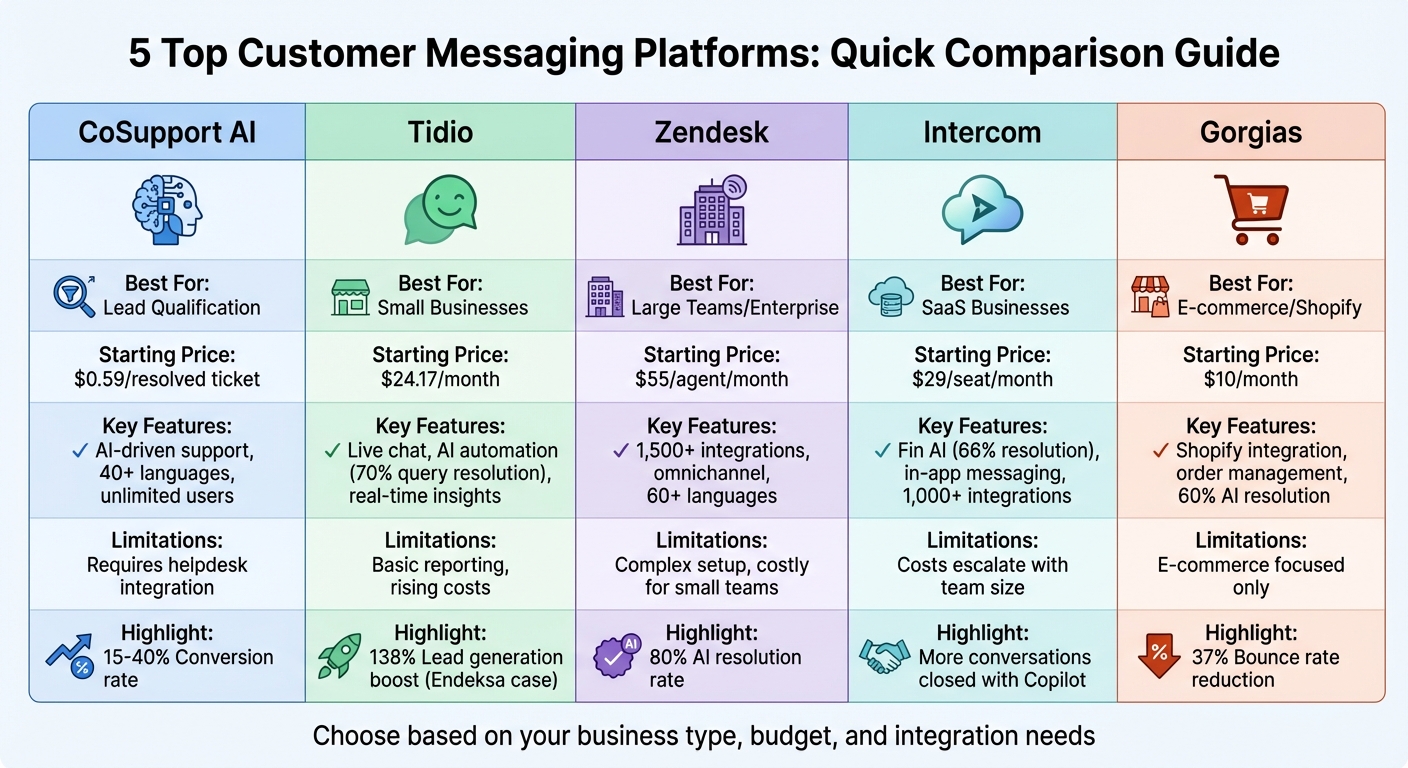
Comparison of Top 5 Customer Messaging Platforms: Features, Pricing & Best Use Cases
Best Live Chat Software 2025: Top 6 Compared
sbb-itb-97114f1
1. CoSupport AI
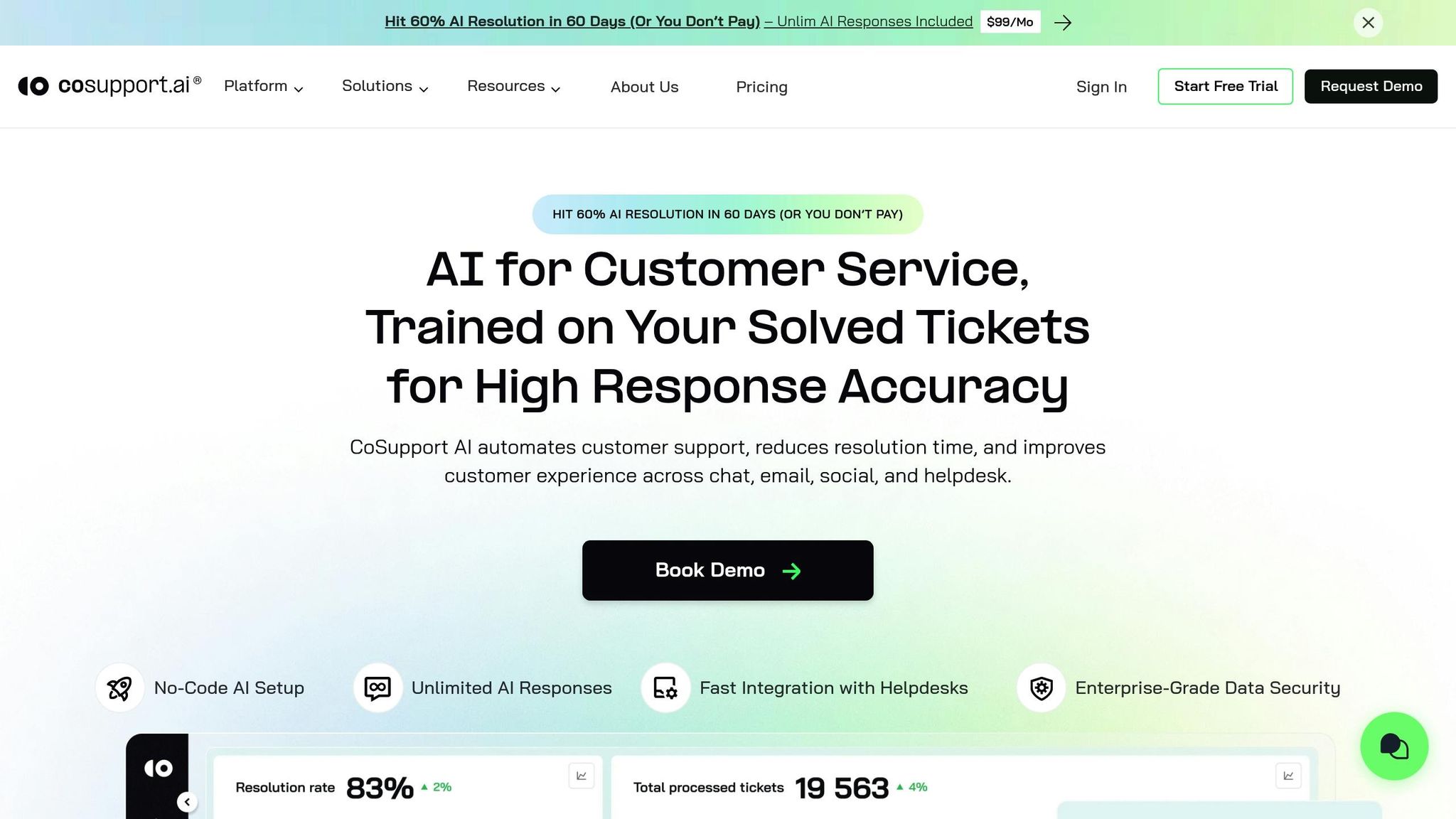
CoSupport AI uses patented technology to minimize AI hallucinations, functioning as a 24/7 assistant that automatically captures, qualifies, and nurtures leads. While static contact forms often convert at a low rate of just 2–3%, CoSupport AI’s conversational style can push conversion rates to 15–40%. By making interactions feel more like a text exchange than a chore, it transforms the lead generation process. Let’s break down what makes CoSupport AI so effective.
AI Automation
CoSupport AI streamlines the early stages of sales discovery by asking key qualifying questions about budget, timeline, and decision-making authority. This automation ensures consistent, error-free lead qualification while reducing the fatigue of manual processes. High-intent leads are routed directly to book meetings with sales reps, while lower-intent ones are automatically funneled into nurture campaigns. As Alex Khoroshchak, CEO of CoSupport AI, puts it:
"Chatbots won't solve every problem, but they're one of the smartest ways to scale lead generation without burning out your team."
Lead Capture Tools
Static forms are replaced with engaging, low-pressure conversations that feel natural. Smart triggers allow the system to respond to specific visitor actions - like offering help when someone views the pricing page. The process starts with basic details, such as name and company, and continues with interactive buttons to keep the conversation flowing. These triggers also boost engagement by offering high-value resources like guides or personalized quotes. Once leads are captured, real-time chat ensures immediate follow-up.
Real-Time Chat
With 24/7 availability, CoSupport AI greets and qualifies visitors even during nights and weekends, ensuring no leads slip through the cracks. Synced conversation histories and integrated data make it easy for CRM tools to pick up where the AI leaves off, enabling smooth handoffs to human teams for follow-up.
Multilingual Support
Supporting over 40 languages, CoSupport AI allows businesses to connect with global audiences in their preferred language. This feature is a game-changer for companies entering new markets or serving diverse customer bases, making it easier to convert website traffic into leads.
Pricing
CoSupport AI offers three flexible pricing options to fit different business needs:
- Resolution-Based Plan: $0.19 per resolved ticket, with unresolved tickets free. This plan works well for teams focused on outcomes.
- Server-Based Plan: $99 per month for unlimited AI responses, ideal for businesses with high traffic.
- Response-Based Plan: $0.04 per AI-generated response, allowing costs to scale with usage.
All plans include unlimited user access and integrate with tools like Zendesk, Salesforce, and Slack.
Key Takeaways
Here’s why CoSupport AI is a standout solution:
- Automated lead qualification ensures consistency and reduces manual effort.
- Conversational lead capture replaces static forms, boosting conversion rates up to 15–40%.
- 24/7 real-time support keeps leads engaged, even outside traditional business hours.
- Support for over 40 languages helps businesses connect with a global audience.
- Flexible pricing plans adapt to your specific needs and usage levels.
CoSupport AI redefines how businesses interact with potential customers, offering a smarter, more engaging way to generate and manage leads.
2. Tidio
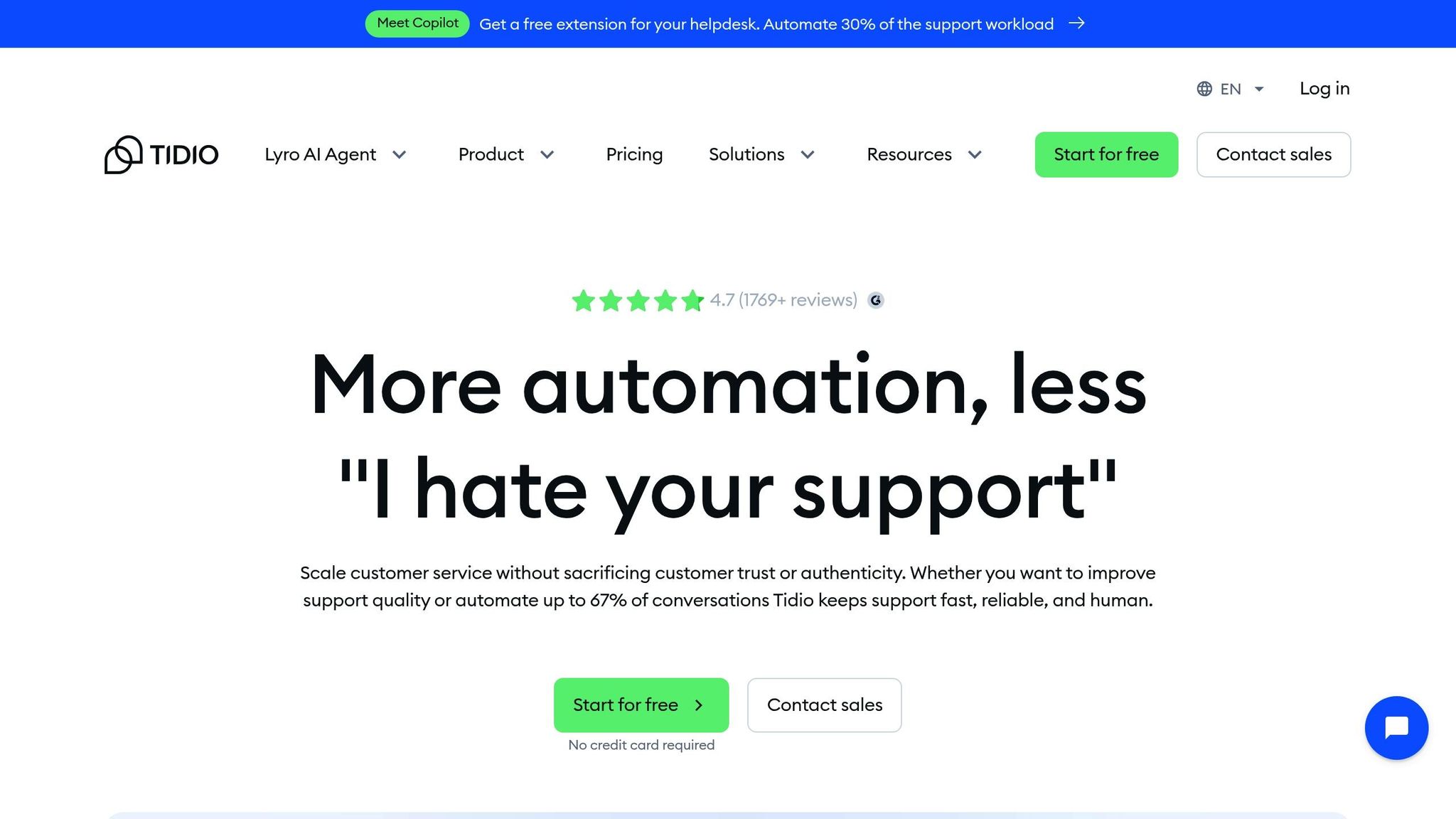
Tidio is a cost-effective solution tailored for small to medium-sized businesses, particularly those in e-commerce, aiming to streamline support and capture leads. It combines live chat, AI automation, and no-code chatbot flows into a single, easy-to-use platform.
Designed for quick implementation, Tidio helps teams get up and running with minimal effort. As a customer messaging tool, it excels at turning website visitors into qualified leads through a mix of intelligent automation and real-time engagement.
Here’s a closer look at what makes Tidio a powerful choice for lead generation and customer support.
AI Automation
Tidio's Lyro AI agent uses GPT-4 to handle up to 67% of support conversations. By learning from your website and knowledge base, it crafts professional responses that align with your brand’s tone.
For example, Suitor automated over 85% of their customer service tasks with Lyro, while Cove achieved a 75% boost in self-service resolutions. Tidio even offers a money-back guarantee if their AI doesn’t improve your resolution rate by at least 50%. These results show how AI can take the pressure off support teams while maintaining quality interactions.
Lead Capture Tools
Tidio uses chatbot lead generation strategies like pre-chat surveys and proactive triggers to capture leads based on visitor behavior, such as time spent on a page or cart activity. The results speak for themselves:
- Integratec: Achieved a 25% increase in qualified leads, with Director General Roberto Coindreau highlighting the impact on their sales pipeline.
- Endeksa: Saw a 138% boost in lead generation by implementing pre-chat surveys.
- Live Visitor List: Allows agents to see who’s browsing in real time, enabling proactive engagement.
These tools ensure businesses can connect with potential customers at just the right moment.
Real-Time Chat
Tidio’s Typing Preview feature lets agents see what customers are typing before they hit send, allowing for quicker and more accurate responses. Integratec, for instance, reduced its average response time from 2 hours to under 10 minutes by leveraging canned responses and 24/7 chatbots.
For Shopify users, Tidio takes things further by displaying cart contents and order history directly in the chat. This enables agents to offer personalized discounts or product recommendations, creating a more tailored shopping experience.
Integrations
Tidio integrates with over 120 tools, including Shopify, WordPress, Mailchimp, and Google Analytics. It also consolidates messages from platforms like Instagram DMs, Facebook Messenger, WhatsApp, and email into a single inbox for seamless omnichannel support.
Through Zapier, businesses can connect Tidio to thousands of other apps, enabling custom workflows. For example, you can sync leads with your CRM or automate follow-up emails based on chat interactions. These integrations make Tidio a versatile tool for managing customer communication.
Multilingual Support
Tidio offers customizable translations for its chat widget and pre-chat surveys, making it easier to connect with audiences worldwide. This feature is especially useful for e-commerce businesses expanding into new regions or catering to diverse customer bases.
Pricing
Tidio provides a free plan with basic live chat features and limited chatbot triggers. Paid plans start at $24.17 per month for unlimited chats.
- Lyro AI add-on: Starts at $39 per month for 50 AI conversations.
- Communicator add-on: Costs $25 per operator per month.
- Chatbots add-on: Available for $29 per month.
- Custom pricing is offered for larger teams through Tidio+.
Key Takeaways
Tidio is a standout option for businesses focused on e-commerce, thanks to its blend of AI automation, real-time engagement tools, and accessible pricing. Features like Typing Preview and Live Visitor List help teams connect with leads more effectively, while integrations and multilingual support add flexibility.
With prices starting at $24.17 per month and success stories like Endeksa’s 138% increase in lead generation, Tidio proves to be a smart investment for scaling customer support without breaking the bank.
3. Zendesk
Zendesk is a robust platform tailored for businesses seeking to manage high volumes of customer interactions while maintaining a personal touch. It combines omnichannel support with advanced AI to scale operations and enhance live chat lead generation. Whether you're handling customer service or qualifying leads, Zendesk offers tools designed to simplify and optimize these processes.
With over 1,500 app integrations and AI capable of autonomously resolving more than 80% of interactions, Zendesk is built for businesses aiming to streamline support and improve efficiency. Its combination of real-time messaging and automation helps teams deliver better results without extra effort.
Here’s a closer look at what makes Zendesk a standout choice for customer support and lead generation.
AI Automation
Zendesk’s AI goes beyond basic chatbot functionality. It can handle complex customer queries, perform secure actions like issuing refunds, and update account details seamlessly. The platform's internal support team uses this technology to handle over 60,000 requests every quarter.
The Agent Copilot feature works as a real-time assistant, offering insights and suggesting responses directly within the agent's workflow. This tool can boost productivity by up to 20%, enabling teams to manage more conversations while maintaining quality.
"Our own support team runs on the same agentic AI and Resolution Platform we offer to customers. And it's helping us deliver faster, more personalized support." - Austin Lacey, Director, Chatbots, AI & Automation, Zendesk
Zendesk also leverages AI for Quality Assurance, cutting manual review time by 80%. Features like intent and sentiment analysis ensure urgent issues are prioritized and routed to the right agents, making the platform a powerful tool for lead capture and customer engagement.
Lead Capture Tools
Zendesk’s AI-powered chatbots and customizable web forms engage visitors around the clock, gathering contact details and qualifying leads before passing them to agents. With the Flow Builder, businesses can design automated conversation paths without needing coding skills, making it accessible even for non-technical teams.
The platform tracks data like pages visited, abandoned carts, and geolocation to provide sales teams with actionable insights. Through Zendesk Sell, AI scores leads based on factors like industry, website activity, and company size, ensuring teams focus on the most promising prospects.
For example, Photobucket reduced its first reply time by 14% after adopting Zendesk, while o9 Solutions saw a 40% productivity increase and a 74% drop in average first reply time in just 18 months. These results highlight how Zendesk’s tools can directly improve lead qualification and response times.
Real-Time Chat
Zendesk’s unified agent workspace merges internal and external conversations into a single thread, eliminating the need to juggle multiple apps. The Side Conversations feature allows agents to collaborate with colleagues through Slack or email directly within a ticket, keeping all context in one place.
With 72% of customers expecting immediate responses, Zendesk’s real-time chat features help businesses meet these demands. It supports messaging across platforms like WhatsApp, Facebook Messenger, Instagram Direct, Apple Messages for Business, and SMS, while maintaining a unified conversation history. This ensures seamless communication across channels without losing context.
Integrations
Zendesk’s marketplace includes over 1,500 app integrations, such as Salesforce, Jira, Asana, Shopify, Slack, Microsoft Teams, and WordPress. Its native CRM integrations allow for bi-directional data syncing, giving agents a complete view of customer interactions during live conversations.
Automation tools streamline workflows by assigning tickets, tagging issues, and escalating cases based on customer profiles or issue types. This flexibility ensures Zendesk can adapt to a variety of tech stacks, making it easier for businesses to build workflows tailored to their needs.
Multilingual Support
Zendesk’s AI supports over 60 languages, enabling businesses to scale globally without the need for additional translation tools.
"Zendesk-KI hat die Art und Weise verändert, wie wir mit unseren Kund:innen sprechen, denn jetzt können wir uns ihrem Tonfall in der Konversation anpassen." - Stacey Zavattiero, Customer Experience Manager, Zendesk
Pricing
Zendesk offers flexible pricing, starting at $19 per agent per month for basic services. The Suite Team plan, priced at $55 per month, includes omnichannel support and automation. For $89 per month, the Suite Growth plan adds proactive messaging and multiple help centers.
The Suite Professional tier, ranging from $115 to $149 per month, includes advanced AI, custom analytics, and multilingual support. Businesses interested in the Copilot add-on, which offers intelligent triage and macro suggestions, can contact Zendesk for custom pricing. Enterprise-level plans with additional governance features are also available through consultation.
Key Takeaways
Zendesk is ideal for businesses seeking enterprise-level features and customization. With AI resolving over 80% of interactions and access to 1,500+ integrations, it’s a powerful tool for both customer support and lead generation. Companies like o9 Solutions and Photobucket have already achieved measurable success, from faster response times to increased productivity, showcasing Zendesk’s impact on business performance.
4. Intercom
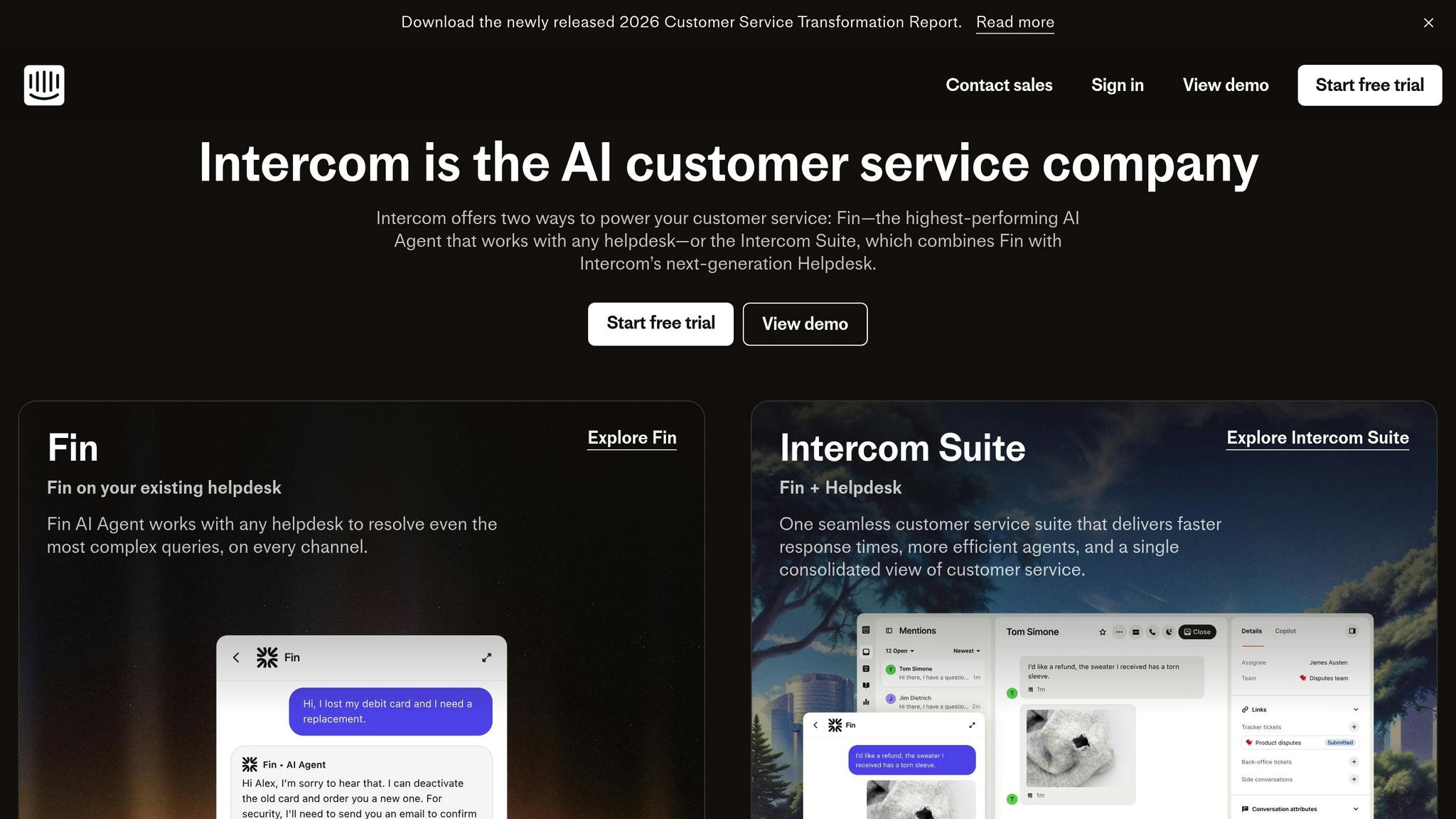
Intercom is a customer messaging platform that merges AI-driven automation with personalized human support. Designed to handle everything from qualifying leads to resolving complex customer queries, it’s a tool that helps businesses scale their support efforts efficiently.
Intercom's Fin AI Agent uses help center data and chat history to resolve customer inquiries, achieving an average resolution rate of 66% across all users - a figure that grows by about 1% monthly. For companies aiming to expand their support capacity without increasing headcount, this kind of automation can be a game-changer.
The platform also features Fin AI Copilot, an assistant that helps agents work more efficiently. It summarizes conversations, drafts responses, and offers real-time troubleshooting advice. Angelo Livanos, Vice President of Global Support, noted that agents using Copilot closed 31% more conversations each day.
For instance, Hospitable, a short-term rental management company, turned to Fin AI Agent in 2023 to clear a backlog of customer queries. The tool resolved 30% of all incoming inquiries and cut median response times by an impressive 95%.
Here’s a closer look at Intercom’s standout features.
AI Automation
Intercom’s AI capabilities extend beyond standard chatbots. The Fin AI Agent manages complex, multi-channel queries, while Fin AI Copilot drafts replies and condenses conversation threads. Additionally, the Workflows tool allows businesses to automate processes without coding, such as routing high-value leads to sales teams or tagging them for follow-ups in Salesforce.
For lead qualification, Fin AI Agent can gather up to four key data points - like company size or industry - before passing leads to sales, ensuring teams only engage with pre-qualified prospects. The platform also sends proactive messages to visitors who linger on high-value pages, such as pricing sections, helping recover potential revenue from actions like cart abandonment.
"If you're debating whether to build your own AI solution or buy one, my advice would be to buy – and specifically, buy Fin." - Emily Lampert, Head of Product Support, Anthropic
Currently, 45% of support teams use AI, with many resolving 11-30% of their total inquiries instantly via AI platforms.
Lead Capture Tools
Intercom’s lead capture tools engage website visitors effectively. Its customizable chatbots ask targeted questions and route high-intent leads to the right sales representative. A de-anonymization feature leverages Clearbit to identify anonymous visitors and send tailored messages based on factors like company size, enabling businesses to focus on high-value prospects.
The platform also integrates with tools like MadKudu for lead scoring and routing, ensuring leads are properly assigned within systems like HubSpot or Salesforce.
Statistics show that website visitors are 82% more likely to convert into customers if they chat with a business first. Conversations involving bots convert 36% better than those without, thanks to faster response times. Copper, a CRM company, saw a 13% boost in website conversion rates in 2024 by using Intercom’s targeted outbound messages to re-engage visitors who were about to leave. This approach generated 19 new sales opportunities in just one month.
"The impact is that we have more leads that would have previously not signed up had their questions not been answered in a timely manner, all for minimal effort on our part." - Thomas Hanna, Demand Generation Programs Manager, Copper
Intercom also supports integrated scheduling through apps like Calendly and Chili Piper, letting prospects book demos or meetings directly within chat. For high-intent visitors, "Call Me" cards allow them to connect instantly with a representative via phone or video.
Real-Time Chat
Intercom’s Messenger enables live conversations with features like GIFs, emojis, and typing indicators to create a more engaging customer experience. Its collaborative team inbox allows multiple agents to work on the same conversation, with internal notes and Slack integration simplifying teamwork.
Quick response times matter - visitors who get a reply within two minutes are 30% more likely to start a product trial. Automated support can also reduce first-response times by 92%. Stuart, a logistics platform, used Intercom’s Custom Bots to triage inquiries, cutting their median response time to under 30 seconds.
The platform unifies messaging from channels like WhatsApp, Facebook Messenger, and Instagram in a single inbox, ensuring seamless communication. Customers won’t need to repeat themselves, even when switching platforms.
Integrations
Intercom connects with over 1,000 tools, including Salesforce, HubSpot, Clearbit, Shopify, Stripe, Jira, and Asana. CRM integrations enable bi-directional data syncing, giving agents a complete view of customer interactions during live chats. E-commerce integrations, like those with Shopify and Stripe, allow businesses to tailor communication based on purchase history and account details.
Slack integration enhances internal collaboration, letting agents consult with technical or sales teams without leaving the conversation. This reduces app-switching and streamlines workflows.
"Intercom apps save us at least 20% of our time – since 2015 we've saved one year of work for each of our support, marketing, and sales teams." - Kamil Rejent, CEO, Survicate
These integrations also enhance Intercom’s global communication capabilities.
Multilingual Support
Intercom’s AI detects user language automatically, converting replies into the customer’s native language. This eliminates the need for separate help centers or multilingual teams, making it easier for businesses to operate across different regions. Multilingual help centers are available with the Advanced plan.
Pricing
Intercom offers tiered pricing to suit various needs:
- Essential Plan: $29 per seat/month (billed annually). Includes live chat, a help center, and basic ticketing.
- Advanced Plan: $85 per seat/month. Adds workflow automation, multilingual help centers, and 20 "Lite" seats for occasional users.
- Expert Plan: $132 per seat/month. Includes SSO, HIPAA compliance, SLAs, and 50 "Lite" seats.
AI features are priced separately: Fin AI Agent costs $0.99 per successful resolution, while Fin AI Copilot costs $29 per month per agent. Additionally, Proactive Support Plus (500 outbound messages) is available for $99 per month.
Key Takeaways
Intercom strikes a balance between AI automation and human support, making it a valuable tool for businesses. With Fin AI Agent resolving 66% of queries and Copilot boosting agent productivity by 31%, the platform delivers measurable results. Companies like Hospitality and Copper have seen faster response times and higher conversion rates, showcasing their impact on lead generation and customer support. Its features - real-time engagement, lead qualification, and multichannel communication - make it a strong contender for turning website visitors into customers.
Next, we’ll take a closer look at Gorgias to round out our review of customer messaging platforms.
5. Gorgias
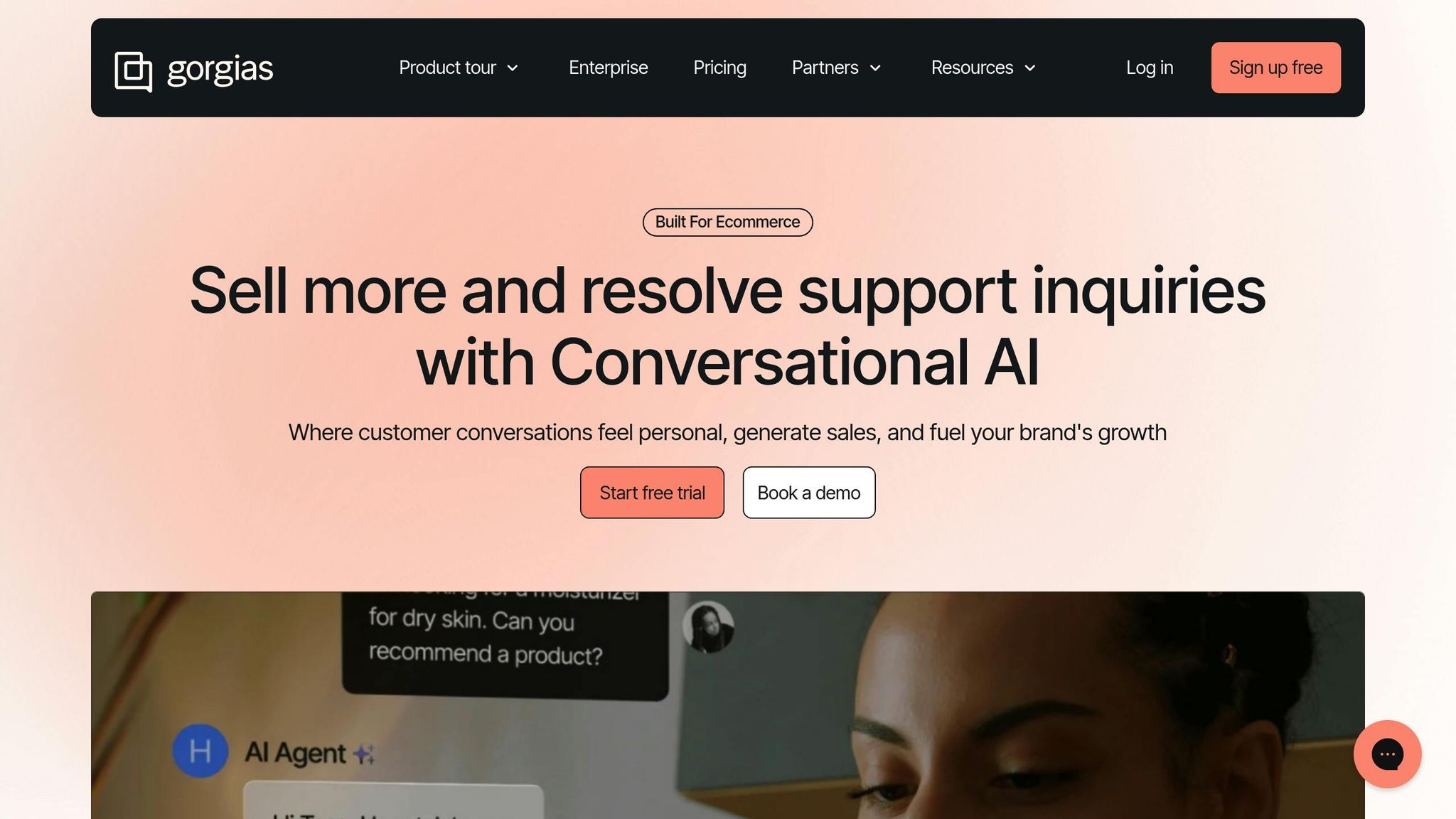
Gorgias is tailored specifically for ecommerce businesses, bringing together email, live chat, voice, SMS, and social platforms like Facebook, Instagram, and WhatsApp into one centralized dashboard. Its standout feature is how seamlessly it integrates with ecommerce tools, allowing teams to manage orders, process refunds, and update subscriptions all in one place.
The platform shines in its use of AI automation and proactive engagement tools, which help businesses efficiently capture leads and address customer inquiries. These features, highlighted below, simplify support workflows while ensuring high-quality interactions with customers.
Gorgias also includes a Marketing Suite with proactive chat campaigns and a Shopping Assistant that uses browsing behavior and cart data to engage visitors. These tools create a direct path from browsing to purchase, targeting customers at key moments of intent.
AI Automation
Gorgias builds on its ecommerce integrations with advanced AI automation to streamline customer support. The platform uses AI-powered intent detection to categorize and route messages automatically. The AI Agent can resolve up to 60% of support inquiries, allowing human agents to focus on more complex tasks.
Agent Assist enhances efficiency by offering real-time response suggestions and action recommendations. Additionally, Gorgias integrates with Aide AI, which provides highly accurate generative email responses and automates data collection from support tickets.
Automation is further enhanced with "Rules" (if/then logic) for tagging urgent tickets and "Macros" (pre-written templates) that pull real-time customer data from connected ecommerce platforms. The AI Agent add-on is priced at approximately $0.90 per automated resolution on annual plans, while Aide AI starts at $300 per month for up to 1,200 conversations.
"I believe that AI combined with human agents is the future - that's where we're going to see perfect customer experience." - Tosha Moyer, Senior CX Manager
Lead Capture Tools
The Shopping Assistant actively engages website visitors through chat triggers based on their browsing behavior, cart activity, and purchase history. It also features a Floating Query Bar, enabling customers to use natural language to search for products, simplifying the shopping experience.
The Marketing Suite complements this by initiating proactive chats, reducing bounce rates by 37%. Meanwhile, the Shopping Assistant leverages browsing and cart data to increase conversions by 2.5x. Together, these tools ensure businesses capture leads at critical moments, like when visitors explore specific product categories or arrive on the homepage.
"Customers can self-serve for 60% of interactions, which means our team has more time to focus on tickets that need human attention." - Molly Wallace Kerrigan, VP Marketing at Gorgias
Integrations
Gorgias connects with over 100 ecommerce tools, offering native integrations with platforms like Shopify, BigCommerce, and Magento. Support agents can handle tasks like viewing order details, processing refunds, or canceling subscriptions through Recharge - all directly from the ticket sidebar. This eliminates the need to switch between platforms, saving time and improving response efficiency.
Multilingual Support
Thanks to the Aide AI integration, Gorgias supports multiple languages, including English, French, German, Spanish, Portuguese, Dutch, Danish, and Italian. This capability allows businesses to serve global audiences without the need for separate help centers or multilingual teams, making it a go-to solution for international ecommerce support.
Pricing
| Plan | Monthly Price | Included Tickets | Overage Cost |
|---|---|---|---|
| Starter | $10 | 50 | $0.40 per ticket |
| Basic | $50 | 300 | $40 per 100 tickets |
| Pro | $300 | 2,000 | $36 per 100 tickets |
| Advanced | $750 | 5,000 | $36 per 100 tickets |
The AI Agent add-on costs around $0.90 per automated resolution, while the Aide AI integration starts at $300 per month for up to 1,200 conversations.
Key Takeaways
Gorgias is purpose-built for ecommerce, offering deep platform integrations and AI-driven automation to simplify support operations. By automatically resolving 60% of inquiries and reducing bounce rates by 37% with proactive engagement, it delivers measurable results for online retailers. The unified dashboard and real-time data access empower support teams to work more efficiently, enhancing both productivity and customer satisfaction.
Gorgias highlights the potential of combining ecommerce integrations with advanced AI tools, enabling businesses to address customer needs in real time while driving conversions and capturing leads effectively.
Pros and Cons
Here’s a streamlined overview of the benefits and drawbacks of each platform we’ve reviewed. Use this comparison to weigh factors like cost, ease of use, and scalability when choosing a customer messaging solution.
CoSupport AI: Offers resolution-based pricing at $0.19 per resolved ticket, supports over 40 languages, and integrates seamlessly with Zendesk, Salesforce, and Slack. However, it requires integration with existing helpdesk tools and doesn’t function as a standalone chat widget.
Tidio: Known for its quick setup and user-friendly interface, Tidio’s Lyro AI can handle up to 70% of customer queries. Starting at $24.17/month, it’s a budget-friendly option for small ecommerce stores. On the downside, it has basic reporting features, limited enterprise controls, and rising seat costs as your team grows.
Zendesk: With over 1,500 integrations and customizable workflows, Zendesk is built for large-scale operations. It offers advanced routing and enterprise-grade security, but its starting price of $55 per agent monthly and complex setup can be challenging for smaller teams.
Intercom: Designed for SaaS businesses, Intercom’s Fin AI resolves up to 70% of queries and excels in in-app messaging. While its Essential plan starts at $29 per seat monthly, costs can quickly increase as your team expands. Additionally, its AI resolution pricing at $0.99 per resolution can add up over time.
Gorgias: Perfect for ecommerce, Gorgias integrates deeply with Shopify, enabling in-chat order management. Its pricing ranges from $10 to $360 monthly, depending on ticket volume. However, it’s less suitable for industries outside ecommerce, and scaling ticket volumes can make it expensive.
Here’s a quick comparison table for easy reference:
| Platform | Key Benefits | Key Drawbacks |
|---|---|---|
| CoSupport AI | Resolution-based pricing; 40+ languages; unlimited users; no cost for unsolved tickets | Requires integration with existing helpdesk; not a standalone chat widget |
| Tidio | Quick setup; Lyro AI handles 70% of queries; affordable entry price; real-time visitor typing preview | Basic reporting; limited enterprise controls; rising seat costs |
| Zendesk | 1,500+ integrations; enterprise-grade security; advanced routing and SLA tracking | Higher starting cost; complex setup; overwhelming for small teams |
| Intercom | Fin AI resolves 70% of queries; great for SaaS; strong in-app messaging | Costs rise with team size; AI resolution fees accumulate |
| Gorgias | Deep Shopify integration; in-chat order management; flexible ticket-based pricing | E-commerce-focused; less adaptable for other industries |
Key Takeaway: Choosing the right customer messaging platform is about striking the right balance between affordability and advanced functionality. Consider your business’s specific needs - like lead generation or real-time support - when evaluating these platforms. Each option comes with trade-offs, so align your choice with your long-term goals.
Before The Conversation Starts - ZoomInfo
ZoomInfo — know who's on your site before the conversation starts. Customer messaging platforms help you engage website visitors — but engagement without identification is an opportunity lost. ZoomInfo sits upstream of the conversation, identifying anonymous visitors in real time, enriching records with firmographic and contact data, and automatically routing high-intent accounts to your sales team.
Tools like WebSights de-anonymize your website traffic so you know which companies are browsing and what they're viewing. FormComplete shortens web forms by auto-populating verified contact fields — reducing friction and increasing conversions. And when a high-value account lands on your pricing page, ZoomInfo's intent signals trigger your chat and outreach tools at exactly the right moment.
For sales teams serious about prospecting with precision, pairing your messaging stack with ZoomInfo's intelligence layer is how you close the gap between traffic and revenue.
Conclusion
Choosing the right customer messaging platform can make all the difference in turning website visitors into engaged leads while simplifying real-time support. To help you decide, here’s a quick breakdown of the options:
CoSupport AI is a solid pick for teams already using popular helpdesk tools, offering resolution-based pricing at $0.59 per resolved ticket. Tidio fits small ecommerce stores with its affordable entry-level plan at $29/month, while Lyro AI automates 70% of common queries.
For enterprise-level needs, Zendesk shines with advanced routing and SLA tracking, though its $55 per agent monthly cost and complex setup might not suit smaller teams. Intercom is ideal for SaaS companies focused on in-app messaging and lead qualification. Meanwhile, Gorgias caters specifically to Shopify merchants, letting agents handle tasks like refunds and order edits directly within chat.
When deciding, align your platform choice with your operational goals and growth plans. If your priority is capturing and qualifying leads, look for tools with proactive triggers and bots. For scaling real-time support, focus on platforms with strong ticketing systems and CRM integrations.
"For the company, live chat is a way lower cost than getting on the phone with someone, mainly because you can handle multiple live chats at once." - Adriti Gulati, Senior Instructional Designer, HubSpot
Here are a few key factors to keep in mind:
- Define your primary goal: Lead capture or real-time support?
- Choose scalable pricing: Ensure costs grow reasonably as your business expands.
- Check integration options: Make sure the platform works with your existing tools.
- Test before committing: Start with free tiers to explore features and usability.
.png)