.png&w=96&q=75)

If I had to sum it up in one line: per-resolution is usually the better pick for lower or uneven ticket volume, while flat-fee pricing starts to make more sense when volume is steady and high.
Here’s the short version:
- Per-resolution: you pay $0.19 only when the AI fully closes a ticket
- Flat fee: you pay $99 per 1,000 monthly tickets
- Response-based: you pay $0.04 per AI message, which can get expensive if one ticket needs many replies
A few numbers make the choice clearer:
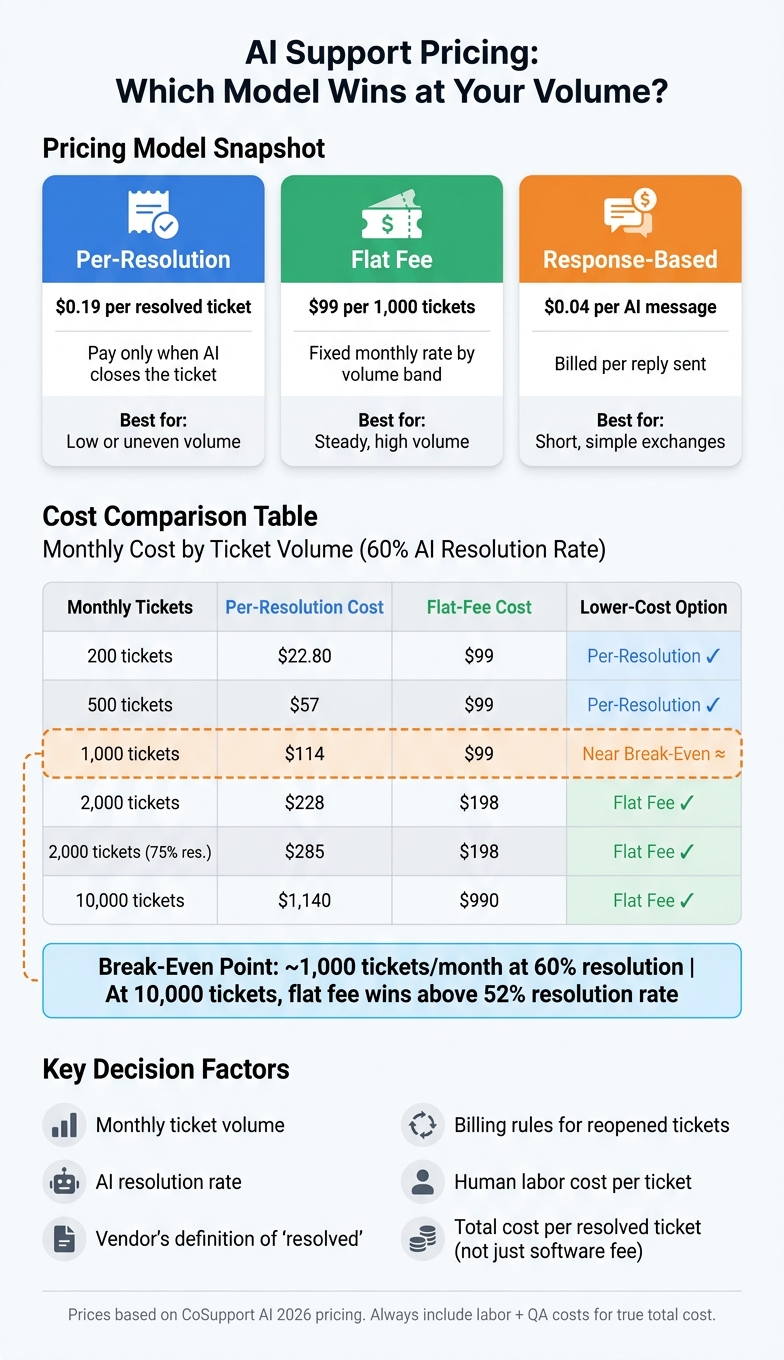
- At 200 tickets/month, per-resolution is about $22.80 at a 60% resolution rate.
- At 500 tickets/month, per-resolution is $57, while flat fee is $99.
- At 1,000 tickets/month, the two are close: $114 vs. $99.
- At 2,000 tickets/month and 60% resolution, per-resolution is $228 and flat fee is $198.
- At 10,000 tickets/month, flat fee tends to win once AI resolution goes above about 52%.
What matters most is simple:
- Your monthly ticket count.
- Your AI resolution rate.
- How each vendor defines “resolved”.
- Whether reopened or handed-off tickets get billed.
- Your total cost per resolved ticket, not just the software fee.
Quick Comparison
| Model | What you pay for | Price | Usually better for |
|---|---|---|---|
| Per-resolution | Only tickets the AI closes on its own | $0.19 per resolved ticket | Low or uneven volume |
| Flat fee | A monthly ticket band | $99 per 1,000 tickets | Steady, higher volume |
| Response-based | Every AI reply sent | $0.04 per response | Short, simple exchanges |
One more thing: I wouldn’t compare pricing without checking labor too. If AI assistants for support agents still review, fix, or finish tickets, the bill you see from the vendor is only part of the cost.
So before picking a plan, I’d do one basic check: take your monthly ticket volume, apply your expected AI resolution rate, and compare that result against the flat monthly tier.
sbb-itb-97114f1
Why AI customer support pricing models matter in 2026
Support leaders now look at pricing as a spend-control choice. That’s the big reason pricing model selection matters in 2026.
What support leaders are actually trying to control
Most support leaders track four numbers:
- Monthly spend
- Cost per resolved ticket
- First response time
- Budget predictability
When those four numbers stay in check, staffing and planning become a lot easier.
Two buying patterns show up again and again. Smaller teams usually want to lower cost per ticket without adding headcount. Bigger CX operations tend to want a firm cap on spend during volume spikes, because one rough month can push costs past plan.
Those numbers matter for a simple reason: faster resolution changes both staffing and billing. ProjectFitter cut first response time from 2 hours to 6 minutes after autonomous resolution, which changed how the team was staffed, not just how it was billed.
The two pricing models this article compares
Per-resolution pricing charges only when the AI fully closes a ticket, at $0.19 per resolved ticket. It’s a performance-based model where the vendor gets paid for outcomes.
Flat-fee pricing charges a fixed monthly amount tied to a ticket volume band. At $99 per 1,000 monthly tickets, cost stays predictable when volume is steady and high.
Response-based pricing at $0.04 per AI response is the third option. From here, the key question is what counts as a billable resolution.
How per-resolution and flat-fee pricing work
Start with the billing unit. That’s the part that decides what you’re paying for.
Per-resolution AI pricing: what counts as a billable resolution
Per-resolution pricing charges $0.19 only when the AI closes the ticket on its own. If the ticket gets routed to a human, you don’t pay.
That sounds simple. The catch is how each platform defines resolved. One may count a closed status. Another may use solved status. Another may wait for a customer-confirmed fix.
You’ll also want to ask what happens when a ticket reopens. If reopened tickets still count as resolved, your cost per ticket climbs. Under CoSupport AI's model, tickets the AI can’t close and routes to a human are not billed. That gives support teams some breathing room while AI resolution rates are still going up.
Flat-fee pricing works in a different way. Instead of billing closed tickets, it tracks monthly usage.
Flat-fee AI support pricing: what fixed monthly plans include
Flat-fee pricing charges a fixed monthly rate based on a ticket volume band. CoSupport AI's flat plan is $99 per 1,000 monthly tickets, whether the AI resolves the ticket or sends it to a human.
The math changes with volume. At 500 tickets, the effective cost is $0.198 per ticket. At 1,000 tickets, it drops to $0.099.
Look closely at the overage rules. Does ticket 1,001 cost extra? Or do you get bumped into the next tier? That fine print may not show up in the headline price, but it definitely shows up on the invoice.
Response-based pricing is the third model. It charges for each AI message, not each finished ticket.
Where response-based pricing fits in
Response-based pricing comes in at $0.04 per AI response, billed every time the AI sends a message, whether the ticket gets solved or not.
A four-message exchange costs $0.16 in response fees, which is close to the $0.19 per-resolution rate. That can work well for simple tickets that need only one reply or a short back-and-forth. But when conversations drag on, costs can pile up fast.
| Pricing model | Billing trigger | Rate | Best fit |
|---|---|---|---|
| Per-resolution | AI closes ticket without handoff | $0.19 / resolved ticket | Teams paying for outcomes only |
| Flat-fee | Monthly usage band | $99 / 1,000 tickets | Predictable, high-volume teams |
| Response-based | Each AI message sent | $0.04 / response | Simple, low-turn ticket queues |
Per-resolution vs flat fee: cost comparison by ticket volume
AI Customer Support Pricing: Per-Resolution vs Flat Fee vs Response-Based (2026)
Ticket volume is what shifts the math. The basic formula stays the same in each case: multiply resolved tickets by $0.19, or compare that with the flat monthly ticket band.
Low-volume teams: when paying per resolution usually costs less
For smaller teams, per-resolution pricing often comes out cheaper.
At 500 tickets per month with a 60% AI resolution rate, the AI would resolve about 300 tickets. At $0.19 per resolved ticket, that works out to $57/month. The flat plan, meanwhile, stays at $99.
That’s the key difference: with per-resolution, you pay only for tickets the AI closes. So if volume is low, your bill usually stays low too. At 200 tickets, per-resolution comes to just $22.80, while the flat plan still sits at $99.
As volume gets closer to 1,000 tickets, the gap starts to shrink.
Mid-volume teams: where flat pricing starts to win on predictable spend
Once ticket volume moves up, flat pricing starts to look better.
At 2,000 tickets per month and a 60% resolution rate, per-resolution pricing comes to $228/month. The $99 flat fee totals $198/month. The savings are small, but the bigger draw is that your spend is easier to plan for.
Resolution rate matters a lot here. If the AI closes more tickets, per-resolution spend climbs with it. At 75% resolution on 2,000 tickets, the cost jumps to $285/month, while the flat plan still stays at $198. So the better the AI performs, the more that gap opens up.
| Monthly tickets | Resolution rate | Per-resolution cost | Flat-fee cost | Gap |
|---|---|---|---|---|
| 500 | 60% | $57 | $99 | Flat costs $42 more |
| 1,000 | 60% | $114 | $99 | Near break-even |
| 2,000 | 60% | $228 | $198 | Flat saves $30 |
| 2,000 | 75% | $285 | $198 | Flat saves $87 |
| 3,500 | 60% | $399 | $347 | Flat saves $52 |
At this stage, the main appeal of a flat plan is spend control.
High-volume teams: why fixed plans can cap spend during spikes
At higher ticket counts, even a small shift in resolution rate can change monthly costs fast.
A move from 5,000 to 9,000 tickets makes that pretty clear. An e-commerce team would pay a steady $891 on the flat plan. Under per-resolution pricing at 60% resolution, that same jump would cost $1,026.
At 10,000 tickets, per-resolution stays cheaper only when the resolution rate is below about 52%. Once it goes above that point, the flat plan starts saving money.
| Monthly tickets | Resolution rate | Per-resolution cost | Flat-fee cost | Lower-cost option |
|---|---|---|---|---|
| 5,000 | 40% | $380 | $495 | Per-resolution |
| 5,000 | 60% | $570 | $495 | Flat fee |
| 10,000 | 40% | $760 | $990 | Per-resolution |
| 10,000 | 60% | $1,140 | $990 | Flat fee |
| 10,000 | 75% | $1,425 | $990 | Flat fee |
Break-even lands near 52% resolution at 10,000 tickets.
What most people get wrong about AI support pricing
Once you compare the monthly cost, the next step is simple: look at what that number doesn’t include.
A lot of pricing comparisons stop at the platform fee. But the better metric is total cost per resolved ticket.
Mistake 1: comparing software cost without labor cost per ticket
Complex tickets still need a human to step in, review the answer, or finish the job. So if you want the math to mean anything, you need to include labor and QA time too.
That means adding:
- AI spend
- Human handling time
- QA time
This applies to both per-resolution and response-based pricing. Neither model includes the human work that happens after a partial answer or a failed resolution.
And that’s the catch: billing only shows part of the picture when the rules for resolution aren’t clear.
Mistake 2: skipping the definition of resolution
Before you buy, ask one thing first: what counts as a resolved ticket?
Under per-resolution pricing, you only pay for resolved tickets. With CoSupport AI's per-resolution plan, tickets the AI can’t close and sends to a human aren’t billed.
Mistake 3: choosing predictability over fit without checking actual volume
Fixed monthly pricing is easy to budget. No argument there. But that doesn’t mean it’s the right fit.
The better choice still depends on your actual ticket volume and your expected resolution rate. If your volume jumps around from month to month, or your resolution rate is still improving, the earlier ticket-volume math is a better guide than price predictability on its own.
Key takeaways and next step
Here’s the simple version: per-resolution pricing tends to work better when ticket volume is lower or hard to predict. Flat-fee pricing makes more sense when volume is steady and high. The customer results below show what that looks like in practice.
The outcomes vary, but the pattern is clear. SupportYourApp saved about $14,000/month with an 80% resolution rate. ProjectFitter cut first response time from 2 hours to 6 minutes. eCatering resolved 50% of tickets autonomously on Freshdesk. Put those numbers next to your own ticket volume and resolution rate, and the fit usually becomes obvious.
Once you know those two inputs, pricing is mostly a math check. You can use the pricing page to compare:
- $0.19 per resolution.
- $0.04 per response.
- $99 per 1,000 tickets for flat-fee pricing.
If you want to test it before you commit, start a free pilot. There’s no code, no setup fees, and it includes 1,000 free AI responses. There’s also a 60-day guarantee: if you don’t hit 60% AI resolution by day 60, you get a full refund.
.png)


.png&w=828&q=100)
.png&w=96&q=100)
.png&w=828&q=100)
.png&w=96&q=100)