

Yes, it is. AI customer support can save small teams both time and money while improving efficiency. Here's why:
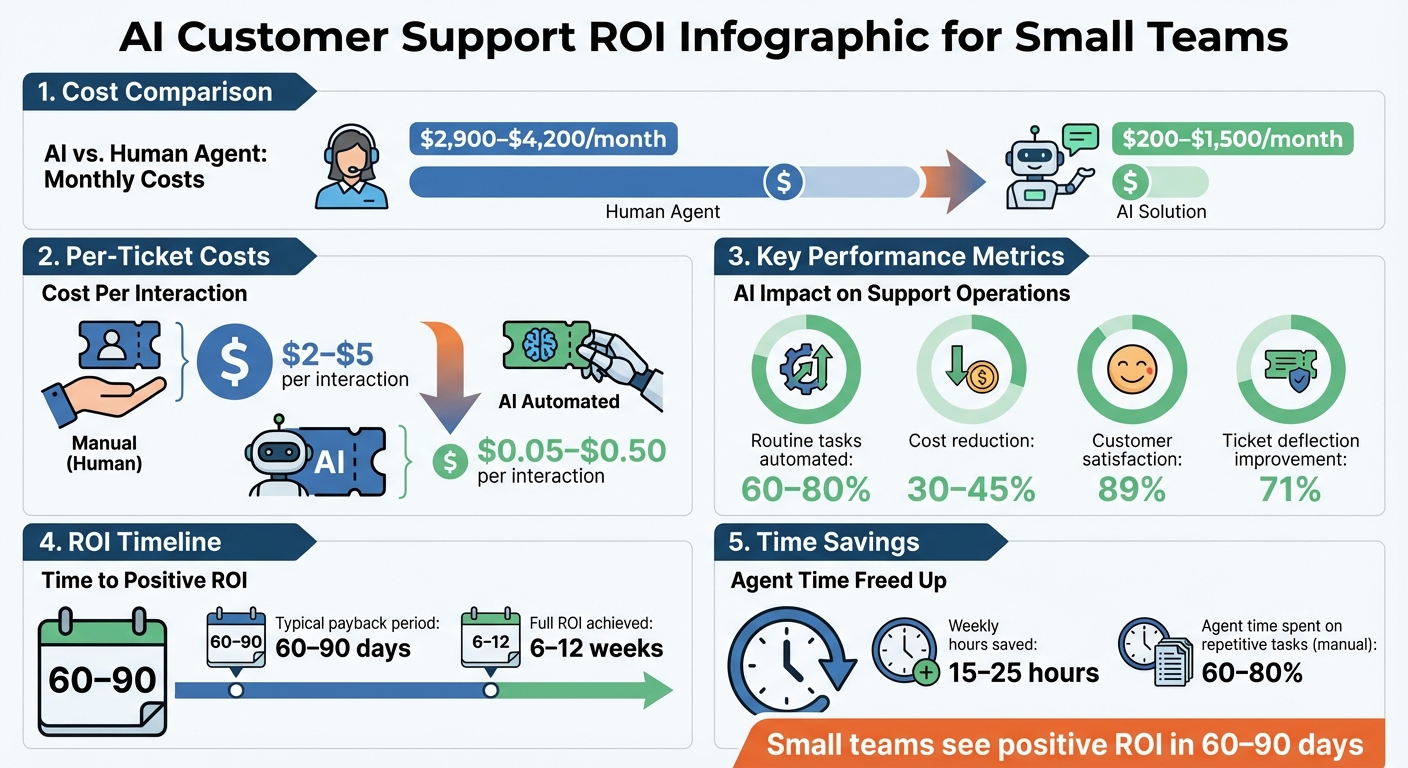
- Cost Savings: Hiring a new agent costs $2,900–$4,200 per month. AI solutions start as low as $200/month and handle up to 80% of routine tasks.
- Efficiency: AI resolves repetitive tickets like password resets in seconds, freeing agents to focus on complex cases.
- 24/7 Availability: AI provides constant support without extra hires, covering multiple languages and handling high ticket volumes.
- Improved Morale: Automating repetitive tasks reduces agent burnout, improving productivity and service quality.
Key Stats:
- AI reduces support costs by 30–45%.
- Teams using AI report 89% customer satisfaction.
- ROI is typically achieved within 60–90 days.
For small teams, AI isn't just affordable - it's a smart way to scale without the overhead of traditional hiring.
AI vs Human Agent Costs: ROI Comparison for Small Support Teams
We Automated 80% of Customer Support With One AI Agent (No Code)
sbb-itb-97114f1
Problems Small Support Teams Face with Manual Processes
Small support teams relying on manual processes often find themselves overwhelmed as their businesses grow. Without automation, agents are stuck in a constant cycle of reacting to issues rather than proactively addressing customer needs. This struggle becomes especially clear in three areas: handling sudden ticket spikes, managing rising costs, and keeping team morale intact. Streamlining repetitive tasks through automation can help avoid these challenges.
Ticket Surges During Busy Periods
When ticket volumes spike - like during product launches or seasonal rushes - small teams can quickly get buried. Agents waste valuable time sifting through lengthy conversation histories and manually prioritizing urgent cases. This can lead to critical issues, such as security breaches or outages, being delayed for hours.
Take the German nutrition app YAZIO, for instance. Between 2024 and 2025, their small team of 5 to 8 agents faced a 40% increase in support tickets as they expanded globally. Managing tickets in six languages manually created backlogs that the team struggled to clear, forcing them to consider costly hiring decisions they were hoping to avoid.
"When tickets pile up, agents spend more time reading lengthy customer conversations - leading to slower replies and reduced output." – Shubham Kale, Content Developer, ThinkOwl
This kind of backlog not only slows response times but also risks damaging customer trust. Small teams often find it difficult to ensure consistent coverage, especially outside regular business hours. And when ticket surges stretch resources thin, operational costs climb higher.
High Cost Per Ticket
Handling support tickets manually can be surprisingly expensive. Factoring in salaries, benefits, workspace, and other overheads, each ticket costs between $18 and $23 for a human agent to resolve.
But the costs don’t end there. Customer service roles see high turnover rates - 30–45% annually - which means small businesses frequently spend $3,000 to $5,000 recruiting and onboarding replacements. Meanwhile, agents spend a staggering 60–80% of their time on repetitive tasks like password resets and order tracking - simple issues that don’t require human intervention but still eat up costly labor hours.
Scaling manually only amplifies these expenses. To handle surges, businesses often rely on overtime pay or temporary hires. In contrast, automated systems can scale effortlessly without adding proportional costs. Beyond the financial strain, this repetitive workload can take a toll on team morale.
Agent Burnout and Coverage Gaps
Answering the same repetitive questions day in and day out can wear down even the most dedicated support agents. Small teams often juggle multiple communication channels - such as Instagram, WhatsApp, email, and live chat - while also updating templates and maintaining help center content.
"When you're running support for a company that's growing fast, the tickets stack up. Your team answers the same questions over and over, and everyone's doing three jobs at once." – Machielle Thomas, Forethought
This constant multitasking leads to slower responses and increases the likelihood of mistakes. For small teams, providing 24/7 support manually often means hiring additional staff or implementing rotating shifts - expenses many teams of fewer than five agents simply can’t afford. The result? Gaps in service coverage that frustrate customers. With 67% of customers expecting instant resolutions, small teams relying on manual processes often fall short, leaving both customers and agents dissatisfied.
The Bottom Line: Manual processes leave small support teams stuck in a loop of high costs, slow service, and overworked agents. The real challenge is figuring out how automation can step in to solve these issues without adding new complications.
How AI Solves These Problems for Small Teams
AI-powered customer support offers small teams a lifeline by tackling the inefficiencies of manual processes. Instead of overburdening current staff or hiring more people, automation takes care of repetitive tasks that drain time and resources. Modern AI doesn’t just answer questions - it completes entire workflows, such as processing refunds or updating accounts, all on its own.
This evolution is a game-changer. Small teams can now compete with larger operations as AI analyzes incoming tickets, identifies customer intent and sentiment, and routes urgent issues to the right agent. Meanwhile, routine requests are resolved instantly. The payoff? Quicker responses, reduced costs, and agents with more time to handle complex challenges.
Automated Ticket Handling
When manual processes slow everything down, AI steps in as a more efficient alternative. Instead of digging through long email threads, AI condenses conversations into quick, easy-to-read summaries in seconds - saving hours of effort.
The standout feature here is what experts call "agentic" AI. Unlike traditional chatbots that merely suggest help articles, agentic AI takes action. It autonomously cancels orders, issues refunds, and updates customer details. This shift has led to a 71% improvement in ticket deflection compared to older tools.
AI also assists with writing. It drafts responses aligned with your company’s knowledge base and tone, allowing agents to review and send replies in seconds. This approach slashes resolution times for routine inquiries from hours to just 2–3 seconds, meeting the needs of the 83% of customers who expect instant responses.
Round-the-Clock Support Without Extra Hires
AI doesn’t just streamline ticket handling - it ensures continuous, 24/7 support without the need for additional staff or overtime. For small teams, this is a huge cost saver. AI tools typically range from $200 to $1,500 per month, offering around-the-clock availability across all time zones.
One of AI’s major strengths is its ability to handle unlimited simultaneous conversations. During peak times, it can assist 100+ customers at once, preventing the backlogs that would overwhelm a small team of fewer than five agents. Plus, with support for over 30 languages built-in, small teams can serve a global audience without hiring multilingual staff.
"For most small businesses, AI customer service software is the better first move. It handles 60–80% of routine questions instantly, costs a fraction of a new hire, and works around the clock." – Iliyan Ivanov, Founder, AIessentials
Small teams using agentic AI have reported record-high customer satisfaction scores of 89%, proving that automation doesn’t have to come at the expense of quality.
Real Example: A Small Business Using CoSupport AI
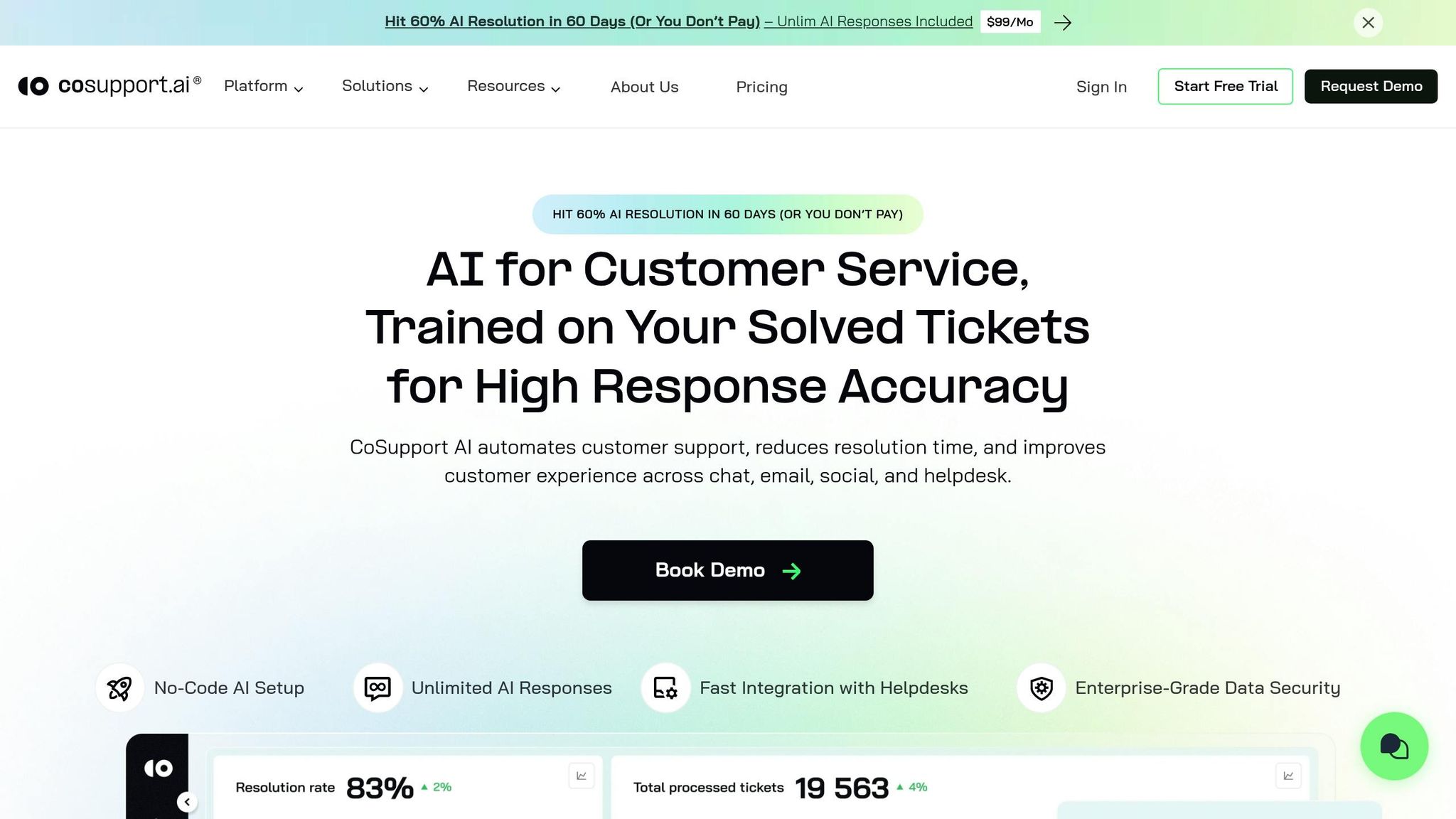
The benefits of AI become even clearer with real-world examples. Take YAZIO, a German nutrition app, for instance. Their small team of 5 to 8 agents faced a 40% spike in ticket volume between 2025 and 2026 as they expanded globally. Instead of hiring three more agents, they opted for CoSupport AI, which was trained on their historical ticket data and help center content.
In just six months, the AI was deflecting 80% of tickets across six languages. This allowed YAZIO to avoid hiring extra staff while boosting its customer satisfaction score from 3.1 to 4.0 out of 5. The AI handled routine queries instantly, freeing up agents to focus on more complex cases.
What made this even more cost-effective was CoSupport AI’s resolution-based pricing model. YAZIO paid just $0.19 per resolved ticket, and unresolved tickets cost them nothing. This flexibility allowed the team to scale their support during busy periods without worrying about skyrocketing monthly expenses.
The Bottom Line: AI empowers small support teams to move from reactive to proactive. By automating routine tasks, offering 24/7 availability, and cutting costs, it enables teams to focus on complex, high-value interactions while maintaining excellent customer satisfaction. Agentic AI takes it a step further by performing actions autonomously, ensuring small teams can achieve big results.
CoSupport AI Features for Teams Under 5 Agents
CoSupport AI brings powerful tools to small teams, helping them get more done without breaking the bank.
Small teams need solutions that are simple to set up and highly effective right from the start. CoSupport AI is built with this in mind, offering features that handle everything from resolving tickets to automating workflows - no technical expertise or complicated setup required.
One standout feature is its no-code integration. Teams can link CoSupport AI to their existing helpdesk software - such as Zendesk, Freshdesk, Zoho Desk, or Intercom - using just one API key. Josh Brown, CEO of Softorino, shared his experience:
"Setup took one API key. In three months, resolution rates grew from 69 to 82 percent."
With this approach, small teams can get up and running in as little as three days.
Custom AI Training and Tool Integrations
CoSupport AI doesn’t rely on generic responses. Instead, it trains on your historical data - like previous tickets and help center content - to reflect your specific brand voice and style. This ensures that responses are accurate and align with how your team communicates.
By learning from solved tickets, the AI understands not just what customers ask, but how your team answers. This eliminates guesswork and ensures that responses feel like they’re coming from a human, not a machine.
CoSupport AI also integrates with tools beyond your helpdesk. For example, it connects with Slack to deliver insights directly to your team where they’re already working. Karyna Naminas, CEO of Label Your Data, highlighted the benefits:
"Our decision making processes have been transformed with CoSupport AI Business Intelligence. It gives our team easy access to insights directly in Slack."
This integration means no more manual reporting or constant app-switching - your team stays informed without missing a beat.
Pricing That Works for Small Teams
Most AI tools charge flat monthly fees ranging from $200 to $1,500, which can be hard to justify for teams managing fewer than 50 tickets each month. CoSupport AI takes a different approach with flexible pricing based on actual usage:
- Resolution-based plan: $0.19 per solved ticket, with no charge for unresolved tickets
- Response-based plan: $0.04 per reply, ideal for fluctuating ticket volumes
- Server-based plan: Unlimited AI responses from $99 per month
This pricing makes AI accessible for even the smallest teams. Plus, CoSupport AI offers a 60-day guarantee: achieve a 60% AI resolution rate within that time, or you don’t pay.
Language Support and Productivity Tools
For small teams serving global customers, CoSupport AI’s support for over 40 languages is a game-changer. It allows teams to provide 24/7 assistance across time zones without hiring multilingual staff, opening doors to new markets.
The platform also includes productivity features to help agents work faster. For example:
- Case summarization condenses long email threads into quick overviews.
- Real-time translation lets agents communicate with customers in any language.
- Suggested replies help draft responses by pulling from your knowledge base and past resolutions.
ProjectFitter, for instance, saw 70% of tickets resolved autonomously, slashing resolution time from 2 hours to just 6 minutes. For teams with fewer than five agents, this kind of efficiency can free up time to focus on more complex tasks.
CoSupport AI delivers the tools and flexibility small teams need to provide top-tier support without the hefty price tag of enterprise solutions.
Calculating ROI for Small Teams Using AI
When small teams evaluate AI for customer support, understanding its financial impact is key to making smart automation decisions. The ROI figures here build on earlier examples of how AI can reshape customer service.
The math is straightforward. AI tools generally cost between $200 and $1,500 per month, while hiring a new customer service agent runs $2,900 to $4,200 monthly - or $35,000 to $50,000 annually when you include salary and benefits. For small teams managing workloads equivalent to fewer than five agents, the cost savings are striking. These numbers directly tie to the ticket costs and workload challenges discussed earlier.
Cost Reduction and Efficiency Numbers
Small teams often see savings within just a few months of deploying AI. On average, AI manages customer interactions for $0.05 to $0.50 per interaction, compared to $2 to $5 for manual responses. For teams handling over 100 tickets weekly, these savings add up fast.
The typical payback period for implementing AI is 6 to 12 weeks. By automating routine tasks like password resets and order tracking, small businesses save 15 to 25 hours of team time weekly. Multiply those hours by your average hourly labor cost, and the financial benefits become clear.
AI can reduce overall support costs by 30% to 45%. For example, during ticket surges, AI can absorb the extra workload, eliminating the need to hire additional agents. This frees up resources and allows teams to focus on more strategic tasks.
Freeing Agents for High-Priority Work
The benefits of AI go beyond cutting costs. By resolving 60% to 80% of routine inquiries instantly, AI frees up 15 to 25 hours weekly for agents to focus on higher-priority tasks. This shift can boost customer satisfaction by 25%, as agents have more time to provide personalized, thoughtful service.
With AI handling repetitive inquiries, agents can focus on tasks requiring human judgment - like calming frustrated customers, resolving billing disputes, or offering tailored product recommendations. This not only improves team efficiency but also enhances customer experiences.
The hybrid model has a staffing question buried inside it. If AI takes the routine 60 to 80 percent, the tickets that escalate are the hardest ones: billing disputes, angry customers, edge cases that need judgment. A team of three or four agents often cannot justify a fifth full-time hire just to cover those spikes, especially across time zones or languages.
Upwork is where a lot of small teams solve that second half. It is a work marketplace with independent customer support professionals across more than 10,000 skills, from ticket triage and Zendesk or Intercom experience to multilingual support and CX operations. Clients post the role, review proposals, and can have someone working on contract within days, with built-in messaging, milestones, and payments so the engagement stays managed on the platform.
For a team under five, that means the human layer of the hybrid model can flex the same way the AI layer does. Bring in a freelance support specialist for a product launch, for weekend coverage, or for a language you do not staff in-house, and scale the hours back when the queue calms down.
What Experts Say About AI for Small Teams
Experts agree that AI offers a strategic edge for teams with limited resources. Automation reduces labor costs without sacrificing service quality, but success hinges on balancing automation with human oversight.
To measure ROI effectively, track your bot resolution rate - the percentage of inquiries fully resolved without human help. Set clear escalation rules so that complex or sensitive issues go straight to a human agent. This approach ensures efficiency while maintaining customer satisfaction.
Bottom line: Small teams using AI automation often see a positive ROI within 60 to 90 days. By lowering costs, speeding up response times, and freeing agents for more meaningful tasks, AI becomes a smart financial choice for support teams working with tight resources.
Conclusion. Should Small Teams Invest in AI Support?
For small teams with fewer than five agents, AI customer support is a smart investment. With AI tools costing between $200 and $1,500 per month, compared to the $2,900 to $4,200 monthly cost of hiring a single new team member, the financial benefits are clear. Most small businesses see a return on investment within just 60 to 90 days.
But the advantages go beyond just saving money. AI offers round-the-clock availability without requiring night shifts, handles unlimited simultaneous conversations during busy periods, and instantly resolves 60% to 80% of routine inquiries. This allows your team to focus on more complex issues that require personal attention and empathy.
This balance of cost-effectiveness and efficiency makes a hybrid support model ideal for small teams. Let AI take care of repetitive tasks like password resets, order tracking, and common FAQs, while your human agents handle more nuanced issues such as billing disputes, calming frustrated customers, and fostering customer relationships. This dual approach not only reduces team burnout but also improves overall service quality.
To get started, review your support history and identify the most common questions customers ask. Build AI responses for the top 10 to 20 repetitive queries and establish clear escalation protocols to ensure complex issues are directed to human agents quickly. Tools like CoSupport AI can seamlessly integrate with your current helpdesk and offer flexible pricing options, including a resolution-based plan for just $0.59 per resolved ticket.
Key takeaway: Analyze your support history, automate repetitive queries, and set up clear escalation rules to maximize efficiency while maintaining high service standards.
Bottom line: If your team frequently handles a large number of repetitive tasks, AI automation can save time, cut costs, and improve service quality. With its affordability, advanced capabilities, and quick ROI, AI is a worthwhile addition to your support strategy.



.png&w=828&q=100)
.png&w=96&q=100)
.png&w=828&q=100)
.png&w=96&q=100)