.png&w=96&q=75)

Generative AI is transforming customer support, but handling emotional interactions - like sarcasm, anger, and mood swings - remains a challenge. Misreading emotions can escalate issues, leading to customer dissatisfaction and human intervention. This article explores how generative AI performs under emotional stress and highlights strategies to improve its responses.
Key Findings:
- AI can detect obvious sarcasm but struggles with subtle irony.
- It manages anger well by acknowledging frustration before problem-solving, but relies on human agents for complex cases.
- Emotional volatility, especially sudden shifts, occasionally disrupts AI's consistency in tone.
- Contextual analysis and real-time feedback improve emotional accuracy.
Solutions:
- Train AI to analyze entire conversations for emotional context.
- Use reinforcement learning and human-in-the-loop training for continuous improvement.
- Customize AI responses to match your brand’s tone and industry-specific needs.
Generative AI is improving at managing emotional complexity, but a hybrid approach - combining AI efficiency with human oversight - remains essential for delivering empathetic customer experiences.
AI vs. Easy, Medium, & Irate Customer Calls
Testing Methods: How We Evaluated AI Under Emotional Stress
To gauge how well AI handles emotionally charged interactions, we recreated real-world customer support scenarios. Using controlled environments and live chat data, we measured how effectively the AI understood and responded to emotional cues.
Creating Emotional Stress Tests
Our tests relied on three main data sources:
- Annotated chat logs: We analyzed over 50,000 past conversations, categorized by human agents, to train and validate the AI's responses.
- Simulated scenarios: We created controlled situations featuring common emotional triggers like billing disputes and service outages. These scenarios included gradual escalation patterns to mimic real interactions.
- Live interaction monitoring: We observed unscripted customer interactions with human oversight, ensuring the AI's behavior aligned with expectations in real-time.
The simulations varied customer communication styles, from direct anger to subtle passive-aggressiveness. This allowed us to pinpoint how the AI performed across different emotional tones and benchmark its responses consistently.
Key Metrics for Evaluation
Evaluating AI’s performance in emotional scenarios required more than just accuracy. We focused on several key metrics:
- Emotion detection accuracy: This measured how well the AI identified emotions like sarcasm, anger, and frustration in customer messages. Sarcasm, in particular, presented a challenge, as it often depends on context and subtle cues. We assessed both overtly sarcastic remarks and more nuanced expressions of irony.
- Response appropriateness: This metric determined whether the AI's replies matched the emotional tone and needs of the customer. For example, when handling anger, the AI needed to first acknowledge the frustration before offering solutions. Empathy, tone, and problem-solving focus were critical here.
- Escalation rates: We tracked how often the AI required human intervention. Lower escalation rates indicated the AI was effectively managing emotional situations. We examined both immediate escalations (when customers explicitly requested a human agent) and delayed ones (when AI responses failed to address the issue after several exchanges).
- Customer satisfaction scores: Post-conversation ratings helped us evaluate whether the AI's technically accurate responses translated into positive customer experiences during emotionally charged situations.
- Response time consistency: To ensure prompt service, we monitored how consistently the AI acknowledged and addressed emotional messages.
Tools and Frameworks Used
To analyze performance, we used advanced tools and frameworks designed for emotional intelligence in AI.
- Sentiment analysis models: These deep learning tools use natural language processing to detect emotional subtext in customer messages. For instance, the system could identify frustration in phrases like "thanks for nothing" or "this is just perfect" when used sarcastically.
- Contextual response generation: These tools evaluated the AI's ability to maintain coherent, empathetic replies by analyzing entire conversation threads rather than isolated messages. This ensured responses aligned with the overall emotional flow of the interaction.
- Human oversight tools: Experienced customer service representatives reviewed AI responses to provide feedback on emotional appropriateness. This human-in-the-loop approach validated automated metrics and highlighted nuances that algorithms might overlook.
We designed our testing environments to mirror real customer support platforms, including response time constraints and integration with customer databases. This realistic setup ensured that the AI's emotional intelligence was tested under conditions it would face in live operations.
Test Results: How AI Handles Sarcasm, Anger, and Volatility
In our testing, we explored how well the AI performs when faced with emotional challenges. The results showed both strengths and areas where human oversight remains essential, particularly in detecting and responding to emotional cues.
Handling Sarcasm: Strengths and Gaps
The AI performed well at spotting obvious sarcasm - think exaggerated statements or heavy punctuation. It also excelled at recognizing common online patterns, like quotation marks used for emphasis or over-the-top punctuation. However, subtler forms of sarcasm were harder for the AI to detect. When analyzing entire conversations instead of isolated remarks, its accuracy improved, highlighting that better contextual analysis will be key for future updates.
Addressing Anger in Customer Interactions
When faced with clear signs of anger, the AI responded empathetically before shifting to problem-solving. For more intense or passive-aggressive behaviors, it smartly escalated the issue to a human agent, ensuring complex situations received the personal touch they needed. This approach shows the importance of blending AI efficiency with human judgment to handle tough emotional scenarios.
Managing Emotional Volatility
The AI held its ground during gradual mood swings, keeping its tone steady and empathetic. However, sudden emotional shifts occasionally threw off its responses. Re-centering to a calm, consistent tone proved effective in managing volatile interactions and helped maintain customer trust during unpredictable moments.
These findings highlight the need for robust contextual understanding and adaptable responses to improve AI’s emotional intelligence in customer support. This research will directly guide the next steps in refining its performance for emotionally complex situations.
sbb-itb-97114f1
Improving AI for Better Emotional Responses
Based on our testing, we’ve identified strategies to enhance AI's ability to handle emotional interactions. These methods focus on developing a deeper understanding of context and employing learning mechanisms that help AI improve its emotional intelligence over time.
Using Contextual Sentiment Analysis
One of the key strategies involves advancing sentiment analysis. While traditional sentiment analysis examines individual words or phrases, contextual sentiment analysis takes a broader view by analyzing entire conversation threads to capture emotional subtleties. This approach has shown a noticeable improvement in the accuracy of AI responses during our tests.
For example, consider a customer saying, "Great, another system outage." Without context, this might seem like positive feedback, but it’s clearly sarcasm expressing frustration. Training AI to recognize emotional patterns across multiple exchanges helps it interpret such nuances effectively.
Multi-layered detection techniques are also essential. These include analyzing word choice, punctuation, message length, and even response timing. For instance, rapid, short responses often suggest rising frustration, even if anger hasn’t been explicitly voiced. Teaching AI to pick up on these early warning signs enables it to respond proactively, potentially diffusing tension before it escalates.
Additionally, conversation history plays a pivotal role. A customer who begins a chat politely but gradually becomes terse may be growing frustrated. AI systems trained in contextual analysis can adjust their tone and approach in real time, addressing concerns before they spiral into dissatisfaction.
Reinforcement Learning and Real-Time Feedback
Another critical component is reinforcement learning, which allows AI to refine its emotional responses based on the outcomes of interactions. Real-time feedback loops monitor conversation results and customer satisfaction scores to guide improvements.
Human-in-the-loop training is especially effective here. Supervisors can review challenging interactions, pointing out where the AI correctly identified emotional cues or where it fell short. This targeted feedback helps the AI better understand complex emotional states.
Beyond individual conversations, aggregated metrics provide a broader view of emotional intelligence performance. Tracking success rates across various emotional scenarios enables the system to identify areas needing improvement. This data-driven approach ensures the AI continues to evolve, becoming more adept at handling diverse emotional interactions.
Customizing AI for Your Organization
These strategies can be tailored to fit your organization’s specific needs, ensuring that the AI aligns with your unique customer interaction style. Every company has its own communication patterns, customer base, and industry-specific emotional challenges.
For instance, integrating industry-specific data and your brand’s voice enhances emotional accuracy. In healthcare, customers may express anxiety or fear, while retail interactions often involve frustration over delays. A casual, friendly brand might use humor to ease tension, whereas a financial services provider may require a more formal and measured tone.
Demographic insights also play a role in tailoring responses. Different age groups, communication preferences, and cultural backgrounds call for varied approaches to emotional intelligence. Regular updates to the AI model, using your organization’s real customer interactions, help it stay aligned with evolving patterns. Monthly or quarterly retraining sessions ensure the system remains effective and accurate over time.
CoSupport AI: Advanced Emotional Intelligence for Customer Support
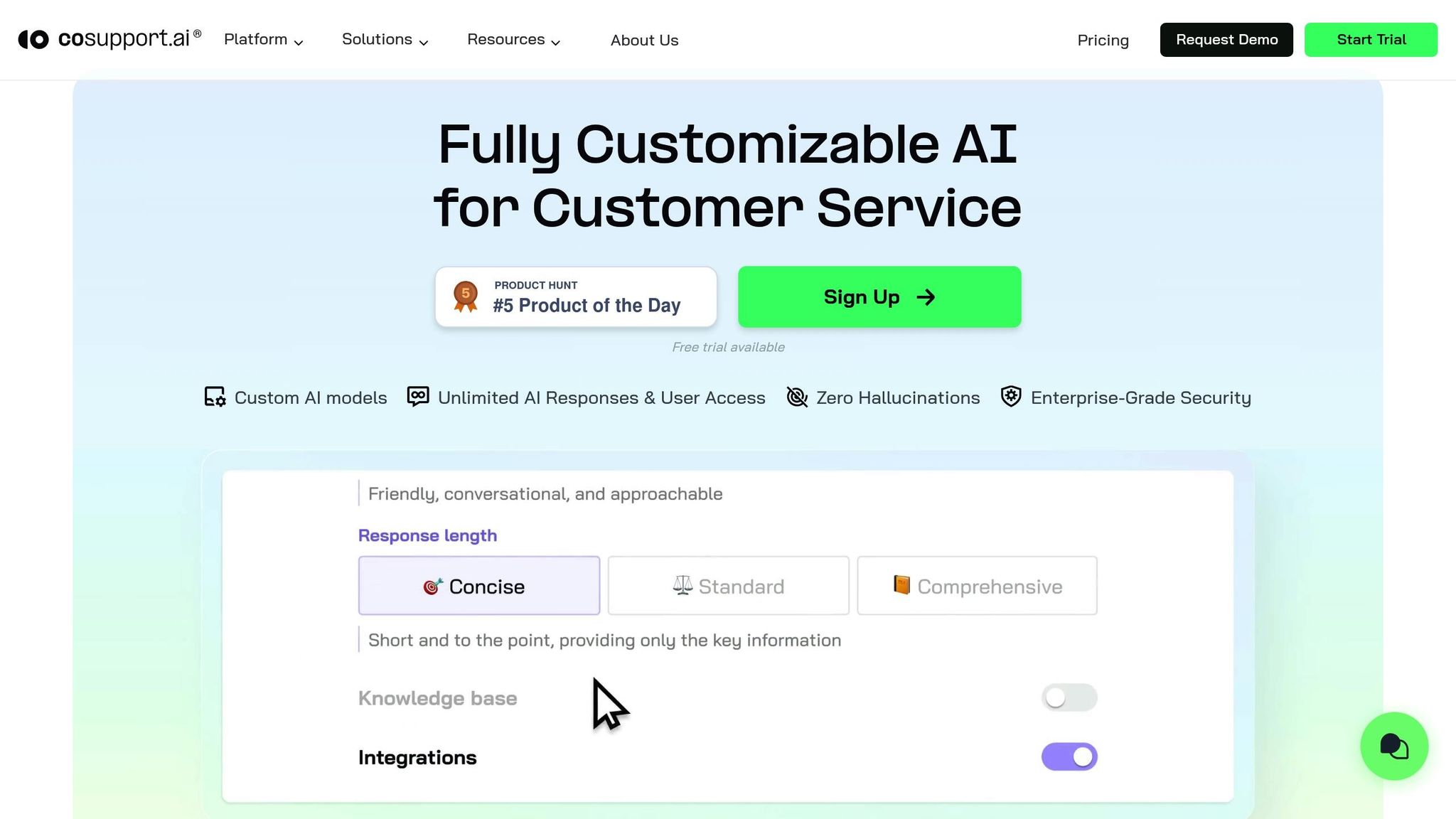
CoSupport AI takes emotional intelligence to the next level by turning it into practical tools for managing challenging customer interactions. By training on your helpdesk data from platforms like Zendesk, Intercom, and Slack, it learns your brand's unique voice and communication style. This allows it to pick up on subtle emotional signals - like sarcasm or early signs of frustration - and respond in ways that align with your brand. Building on insights from stress tests, CoSupport AI delivers tailored emotional intelligence designed specifically for your business needs.
The platform integrates seamlessly with leading customer support platforms, ensuring emotional insights are directly embedded into your existing workflows. With support for more than 40 languages, it captures emotional subtleties across a wide range of interactions. Its autonomous agents adapt to your brand’s communication patterns, offering responses that feel natural and personalized.
Key Features for Emotionally Intelligent Support
CoSupport AI comes equipped with tools to handle the emotional challenges uncovered during testing. Its advanced contextual analysis examines conversation threads to identify emotional trends before they escalate, helping your team stay ahead of potential issues.
Data Security and Compliance
When dealing with sensitive customer interactions, data security is critical. CoSupport AI is ISO 27001 certified and fully compliant with GDPR and CCPA regulations, ensuring customer information stays protected at all times. Real-time data anonymization and safeguards against prompt injection keep unauthorized access at bay. With dedicated servers and self-hosted Large Language Models, businesses retain full control over their data. Strong encryption and anonymization measures provide peace of mind, letting companies securely harness emotional intelligence insights without compromising ownership or privacy.
Best Practices for Using CoSupport AI
- Use your existing conversation history to train the AI, helping it establish a strong foundation for understanding your brand’s communication style.
- Regularly review past interactions to fine-tune the AI’s ability to manage emotionally charged situations.
- Keep an eye on analytics to spot emotional trends and refine your overall support strategy accordingly.
Conclusion: The Future of Emotionally Intelligent AI in Customer Support
Stress tests have made one thing clear: generative AI has come a long way in grasping emotional complexity, but there’s still room for growth. While AI is now adept at recognizing sarcasm and managing anger, the more delicate emotional cues remain a challenge.
The next step for customer support lies in creating AI systems that go beyond processing words to truly understand emotional context. This means moving past basic sentiment analysis and embracing emotional intelligence that takes into account historical interactions, cultural differences, and individual preferences. The best results will come from a hybrid model - pairing advanced AI with human oversight to balance efficiency with empathy. This approach ensures ongoing improvement as AI continues to evolve.
As customer expectations shift and communication styles change, AI must keep pace. Companies that invest in emotionally aware AI today will be better equipped to handle increasingly complex customer interactions in the future. This leads to happier customers, fewer escalations, and more productive support teams.
CoSupport AI is ready to help businesses embrace this evolution. By using insights from stress tests and integrating with your helpdesk data, CoSupport AI turns emotional challenges into opportunities to strengthen customer relationships. With support for over 40 languages and a focus on emotional accuracy, it enables businesses to deliver consistent, empathetic service to a global audience.
The question is: how soon will your organization adopt emotionally intelligent AI to stay ahead? With resolution-based pricing at $0.59 per ticket, this investment can boost customer retention while cutting support costs.
The tools for emotionally intelligent, personalized, and culturally aware customer support are already here. It’s time to use them.
FAQs
How does CoSupport AI identify sarcasm and distinguish it from genuine customer feedback?
CoSupport AI leverages sophisticated, context-sensitive language models to identify sarcasm by examining subtle linguistic hints and patterns. These models are trained to interpret elements like tone, word selection, and sentence structure, allowing the AI to distinguish between sarcastic comments and genuine feedback.
By prioritizing the intent behind each message, CoSupport AI delivers more accurate handling of emotionally complex or nuanced interactions. This approach not only refines response quality but also elevates the overall customer experience.
What are the advantages of combining AI with human oversight in customer support?
A hybrid approach that merges AI capabilities with human oversight in customer support brings some clear benefits. By letting AI handle repetitive tasks, it eases the workload on agents, reducing burnout and freeing them up to tackle more intricate or emotionally charged issues. This shift not only enhances the quality of service but also allows agents to focus on what they do best - providing thoughtful and personalized support.
On top of that, this model delivers faster response times, round-the-clock availability, and helps cut operational expenses, all while keeping service standards high. The combination of AI's efficiency with the empathy and problem-solving skills of human agents strikes a balance that improves customer experiences, boosting satisfaction and loyalty in the process.
How can businesses tailor CoSupport AI to match their brand voice and industry requirements?
Businesses can personalize CoSupport AI by starting with their brand voice - defining the tone, style, and core messaging that reflect their identity. By training the AI with data from past customer interactions, FAQs, and internal guidelines, companies can fine-tune its responses to mirror their personality and values.
Beyond that, CoSupport AI allows adjustments to its communication style based on different customer groups or situations. This flexibility ensures it meets specific industry standards while staying consistent. The result? Tailored, on-brand interactions that connect with customers effectively.
.png)