.png&w=96&q=75)

Choosing the right AI for customer support depends on your needs. Each platform excels in specific areas:
- OpenAI Agents: Best for complex workflows and reasoning-heavy tasks. Works well with tools like Salesforce and Zendesk, but needs skilled developers for custom workflows.
- Vertex AI: Handles large unstructured data like PDFs and wikis efficiently. Great for technical support but requires familiarity with Google Cloud.
- Microsoft Copilot: Fits seamlessly into Microsoft 365 tools like Teams and SharePoint. Easy to deploy but limited for advanced data searches.
Quick Stats:
- AI agents resolve up to 68% of tickets without human help.
- OpenAI reduces response times by 97%, from 15 minutes to 23 seconds.
- Vertex AI offers cost-effective search at $1.50–$4.00 per 1,000 queries.
- Copilot costs $30/user monthly or $200 for 25,000 credits.
Quick Comparison:
| Feature | OpenAI Agents | Vertex AI | Microsoft Copilot |
|---|---|---|---|
| Strength | Advanced reasoning | Large document handling | Microsoft 365 integration |
| Cost | $0.01–$0.03/1k tokens | $1.50–$4.00/1k queries | $30/user or $200/25k credits |
| Integration | API-first | GCP-centric | Microsoft Graph |
| Best Use Case | Complex workflows | Technical support | Routine tasks in M365 |
Bottom Line: OpenAI is ideal for custom workflows, Vertex AI for data-heavy environments, and Copilot for Microsoft-focused teams. Your choice should align with your infrastructure and team expertise. To ensure long-term success, focus on the pillars of AI in customer support, like accuracy and automation.
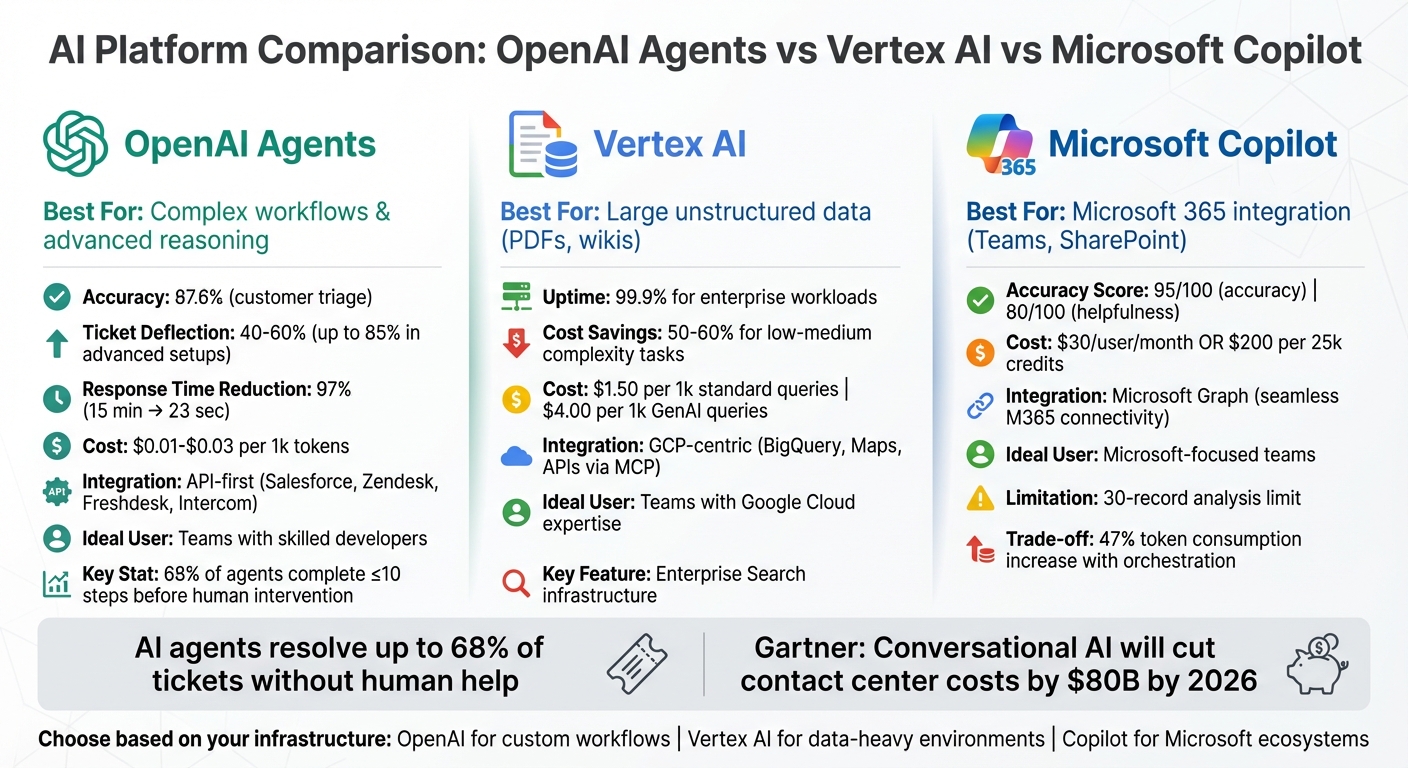
OpenAI Agents vs Vertex AI vs Microsoft Copilot Comparison for Customer Support
1. OpenAI Agents
OpenAI Agents shine in handling complex, multi-step AI for customer service workflows. For instance, in customer triage benchmarks using the Bitext 26K dataset, the native GPT-4o-mini achieved an impressive 87.6% accuracy at a cost of just $0.000074 per request. This performance far surpasses that of rule-based keyword routing, which achieved only 68.6% accuracy.
The API-first approach of OpenAI allows for custom workflow orchestration, though maintaining reliability in production can be tricky. Hugo Bowne-Anderson highlights this challenge: with 85–90% accuracy per tool call, a five-step workflow only succeeds 59% of the time.
OpenAI Agents leverage their reasoning capabilities to integrate effortlessly with leading helpdesk platforms. Through Tool Calls, these models transition from simple text generators to systems capable of executing business transactions. The GPT-4o Realtime API supports low-latency voice interactions for live customer streams, while the Model Context Protocol (MCP) standardizes access to external tools and databases. OpenAI agents are compatible with major platforms like Salesforce, Zendesk, Freshdesk, and Intercom.
When it comes to scaling in production, about 68% of OpenAI-powered agents complete 10 or fewer steps before requiring human intervention. This approach ensures a balance between accuracy and autonomy. Even so, teams using OpenAI agents report ticket deflection rates of 40-60%, with the most advanced setups reaching up to 85%. Response times also see a dramatic improvement, dropping from 15 minutes to just 23 seconds - a 97% reduction compared to traditional support methods.
Key takeaway: OpenAI Agents excel in reasoning and integration, but their reliability in multi-step workflows depends on thoughtful, single-call (Tier 1) implementations to optimize both cost and accuracy.
Up next, we’ll look at how Vertex AI addresses similar customer support challenges.
sbb-itb-97114f1
2. Vertex AI
Vertex AI Agent Builder utilizes Gemini Pro as its core reasoning engine, making it highly effective at processing large sets of documents. This feature is especially useful for teams working with large volumes of unstructured data, such as PDFs or wikis. Its capability to handle massive knowledge bases makes it a strong choice for an AI agent for customer service operations.
When it comes to automation accuracy, Vertex AI employs a token-based "thinking process", which allows teams to fine-tune reasoning for complex tasks. The platform supports multi-step workflows through a primary agent that can coordinate and delegate tasks efficiently. To top it off, Vertex AI ensures 99.9% uptime for enterprise workloads, providing consistent reliability in production environments.
For search capabilities, Vertex AI's Enterprise Search infrastructure offers competitive pricing: approximately $1.50 per 1,000 standard search queries and $4.00 per 1,000 GenAI queries. This pay-as-you-go model can lower AI operating costs by 50-60% for low- to medium-complexity support tasks, according to Wezom's analysis.
The platform also integrates seamlessly with helpdesk tools using the Model Context Protocol (MCP). This allows agents to interact with external systems like BigQuery, Maps, and internal APIs. Its hybrid low-code/pro-code builder provides flexibility for creating solutions, though it does require more technical expertise. For managing APIs at an enterprise scale, Google recommends using the Apigee API hub to ensure secure and efficient monitoring of agent tools.
Key takeaway: Vertex AI excels in data-heavy environments, offering powerful search capabilities and significant cost savings for support tasks. However, its custom integrations may require more technical expertise. This performance sets the stage for exploring how Microsoft Copilot handles similar workflows.
3. Microsoft Copilot
Microsoft Copilot Studio provides two types of agents: low-code declarative agents designed for Microsoft 365 and pro-code custom engine agents for handling more complex orchestration needs. This dual approach allows businesses to tailor Copilot's capabilities to their specific workflows, making it a flexible AI copilot for customer support workflows.
In benchmark testing, Copilot scored 95/100 for accuracy and completeness but only 80/100 for helpfulness. These results highlight its strength in technical precision but suggest it may need further tuning to handle interactions requiring emotional sensitivity or empathy. Essentially, Copilot shines in technical tasks but might fall short in more nuanced, human-like engagements.
When it comes to integration, Copilot is deeply embedded within the Microsoft 365 ecosystem, leveraging Microsoft Graph for seamless connectivity. It also supports external systems through connectors, offering both prebuilt and customizable options. These connectors can automate tasks like lead management, record updates, and personalized customer interactions. However, its orchestration framework comes with a trade-off: token consumption increases by 47%, which could drive up operational costs during periods of high activity. This is an area where comparing it to alternatives like OpenAI Agents or Vertex AI might be worthwhile.
Gartner forecasts that conversational AI will cut contact center labor costs by $80 billion by 2026. (Gartner) This shift reflects the broader future of AI in customer service, where automation drives efficiency.
Cost-efficiency is another critical factor to consider. For internal use, Microsoft 365 Copilot is included with licenses at $30 per user per month. For external or high-volume support, pricing shifts to $200 per month per 25,000-credit capacity pack. It’s important to monitor credit usage, as workflows involving multiple APIs consume credits much faster than straightforward Q&A tasks.
Key takeaway: With its strong technical accuracy and seamless integration into Microsoft 365, Copilot is a powerful option for support workflows. However, teams should carefully manage orchestration overhead and credit consumption to avoid unexpected costs in high-demand scenarios.
Strengths and Weaknesses
Let’s dive into how OpenAI Agents, Vertex AI, and Microsoft Copilot stack up in terms of strengths and weaknesses, especially for customer support scenarios.
OpenAI Agents shine when tackling complex, multi-step ticket resolutions. They’re built for deep reasoning and nuanced problem-solving, making them ideal for intricate support queries. However, this capability comes with a trade-off: you’ll need skilled developers to create custom workflows, as there’s no ready-made ecosystem to rely on.
On the other hand, Vertex AI stands out for handling search-based ticket deflection. It's a great choice when agents need to sift through large document libraries or unstructured data. Its Enterprise Search infrastructure processes PDFs and internal wikis efficiently, and it supports both Google-native and open-source models for added flexibility. That said, teams unfamiliar with Google Cloud Platform may find it challenging to navigate, and costs can climb quickly with heavy AutoML or storage usage.
Microsoft Copilot offers a different kind of advantage: speed. Its seamless integration with Teams and Outlook means support agents can get up and running fast within the Microsoft 365 ecosystem. But there are limitations. Copilot can only analyze up to 30 records from its storage at a time, which significantly restricts its ability to handle complex document searches.
"Copilot's analytical capabilities are currently limited and cannot be fine-tuned, making it less effective for complex document searches." - Ilya Skiba, AI Solutions Architect
Here’s a side-by-side comparison of key features and performance metrics:
| Feature | OpenAI Agents | Vertex AI | Microsoft Copilot |
|---|---|---|---|
| Automation Accuracy | High (best-in-class reasoning) | High (strong NLG & AutoML) | Moderate (limited context windows) |
| Scalability | High (reasoning-heavy workloads) | High (massive data sets) | Moderate (best for internal use) |
| Ticket Deflection | Strong (complex multi-step tasks) | Superior (search across large libraries) | Good (routine tasks in M365) |
| Integration Ease | API-first (requires custom work) | GCP-centric (BigQuery native) | M365-centric (seamless Graph API) |
| Cost Structure | Pay-per-token (~$0.01-$0.03/1k tokens) | Pay-as-you-go (~$1.50-$4.00/1k queries) | Seat-based ($30/user) or capacity ($200/25k credits) |
Key Takeaway: Your choice should depend on your infrastructure and the complexity of your support needs. OpenAI Agents are perfect for custom, reasoning-heavy workflows. Vertex AI is ideal for handling vast amounts of unstructured data. Meanwhile, Microsoft Copilot is a solid choice for rapid deployment within Microsoft-focused environments, despite its analytical limitations. Carefully weigh the balance between advanced reasoning capabilities, integration ease, and cost to find the best fit for your team.
Conclusion
When deciding on the best platform for your needs, it all comes down to your current infrastructure and technical priorities.
Microsoft Copilot Studio is ideal for organizations already using Microsoft 365, Teams, and SharePoint. Its quick deployment, paired with built-in Entra ID security, makes it a great choice for teams looking for low-code solutions and fast implementation.
Google Vertex AI stands out when managing large amounts of unstructured data. Whether you’re sifting through thousands of PDFs, internal wikis, or document repositories, its Enterprise Search infrastructure ensures top-notch retrieval-augmented generation capabilities. This platform is well-suited for teams with Google Cloud expertise and those needing flexible, pay-as-you-go pricing for variable support volumes.
OpenAI Agents shine in handling complex workflows with advanced reasoning. They are perfect for teams with strong development skills, offering custom orchestration layers and API-first flexibility. However, this approach demands a higher technical investment compared to ready-to-use options.
"2026 is the year AI stops being a draft assistant and starts being an operator. The best tools do not just summarize tickets. They plan, call APIs, enforce policy, and complete workflows." - William Westerlund, Suptask
Reliability remains a key challenge for production agents in 2026. Most experts address this through systems-level design rather than model fine-tuning. Start by assessing your existing infrastructure and your team’s technical capabilities. Choose the platform that integrates seamlessly and minimizes complexity.
Key Takeaway: Match the platform to your infrastructure and team strengths - Copilot for Microsoft ecosystems, Vertex AI for data-intensive tasks, and OpenAI Agents for custom, reasoning-heavy workflows. The best AI tool is the one your team will consistently use and trust.
.png)


.png&w=828&q=100)
.png&w=96&q=100)
.png&w=828&q=100)
.png&w=96&q=100)