.png&w=96&q=75)

Bank of America’s Erica has transformed customer support since its launch in 2018. With over 3.2 billion interactions handled and a 98% resolution rate, Erica has become a standout example of how AI can improve banking experiences. Here’s why Erica works so well:
- Efficiency: 98% of issues are resolved in just 44 seconds, reducing the need for human support.
- Proactive Alerts: Erica identifies issues like duplicate charges or subscription hikes, helping customers avoid problems.
- Wide Adoption: Nearly 50 million users rely on Erica, and it handles 58 million monthly interactions.
- Continuous Improvement: Over 75,000 updates have refined its accuracy and functionality.
- Internal Benefits: IT service desk calls dropped by 50%, and employee workflows became more streamlined with an AI assistant for customer support agents.
How Bank of America Scales CX to 70M Clients with AI and Action | Experience '26
sbb-itb-97114f1
How Erica Grew from Launch to Industry Leader

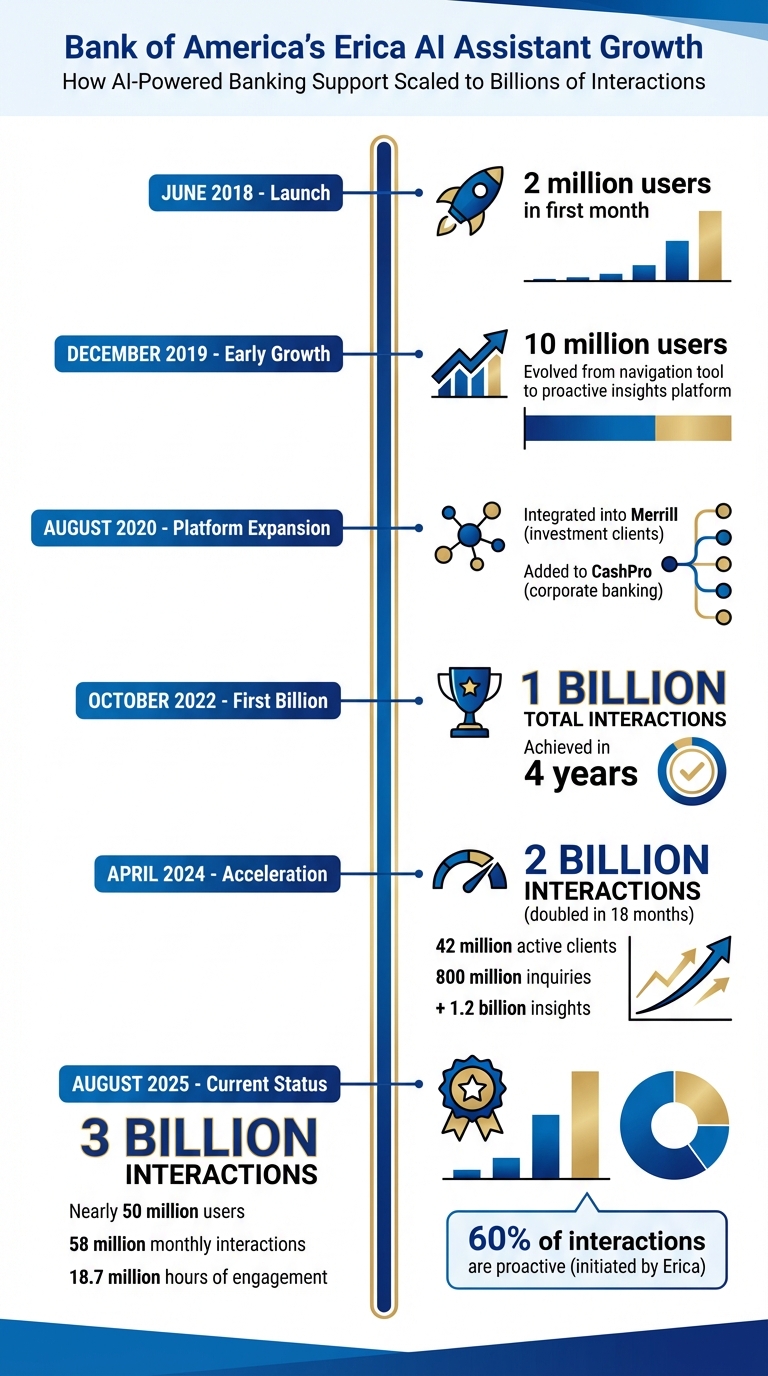
Erica's Growth Timeline: From 2M to 50M Users (2018-2025)
Launch and Early Adoption Numbers
When Erica launched in June 2018, it changed the game for Bank of America's AI for customer support. Within just a month, 2 million users flocked to the platform, eager to escape the frustration of navigating complex mobile app menus. Instead of hunting through endless screens, users could now ask questions in plain English using voice, text, or simple taps - making banking more intuitive and user-friendly.
By December 2019, Erica's user base had skyrocketed to 10 million. What started as a straightforward navigation tool quickly transformed into a robust platform capable of delivering proactive financial insights. Fast forward to October 2022: Erica hit a major milestone with over 1 billion total interactions - a feat achieved in just four years.
The platform's reach expanded beyond mobile banking. In August 2020, Bank of America embedded Erica into Merrill, catering to investment clients. It later became part of the CashPro platform for corporate banking and even supported internal employee systems. These early steps set the stage for the rapid growth that followed.
Growth Numbers and Customer Engagement
Erica's growth trajectory has been nothing short of impressive. After surpassing its first billion interactions, the pace only quickened. By April 2024, Erica doubled that figure, reaching 2 billion interactions in just 18 months. At this point, 42 million clients were actively using Erica to handle 800 million inquiries and receive 1.2 billion personalized insights.
By August 2025, Erica had crossed 3 billion interactions, serving nearly 50 million users. The platform now handles an average of 58 million interactions every month, logging 18.7 million hours of user engagement. A significant portion of this growth stems from Erica's proactive approach - 60% of interactions are initiated by Erica herself, offering personalized insights like spending trends or reward opportunities.
Bank of America’s commitment to refining Erica is evident in its numbers. Over 75,000 updates to Erica’s natural language understanding have contributed to a 98% success rate, with most users getting answers in just 44 seconds. These figures highlight Erica’s evolution into a cornerstone of modern digital banking, emphasizing speed, accuracy, and proactive customer support.
Key Takeaway: Erica’s journey from launch to widespread adoption underscores the power of solving everyday customer pain points. By making banking simpler and evolving into a proactive assistant, Erica has set a new standard for digital customer engagement.
The Technology Behind Erica
Natural Language Processing (NLP) in Banking
Erica uses advanced Natural Language Processing (NLP) to turn short customer commands into precise banking actions. It’s designed to understand conversational requests and pinpoint financial intentions. For instance, when a customer types, "I want to send Jorge $20 from my checking account for the lunch we had last week," Erica’s NLP engine identifies the intent (a Zelle payment), pulls Jorge’s contact information, extracts the $20 amount, and even fills in the memo field automatically.
This level of precision is powered by a library of over 700 pre-trained responses, developed from 10 million hours of customer interactions. To avoid errors, Bank of America intentionally steers clear of Large Language Models, which could introduce inaccuracies or "hallucinations." Instead, a team of data scientists and linguistics experts ensures Erica’s responses are accurate and compliant with banking policies through ongoing updates and refinements.
"The problem statement is: Understand short bursts of text - no one's going to type in an essay on that chatbot screen - map it to a set of clear intents and go execute them." - Hari Gopalkrishnan, Chief Technology and Information Officer, Bank of America
Erica also excels in clarifying ambiguous terms to guide users to the right solution. For example, during the COVID-19 pandemic, the system adapted quickly, learning over 60,000 related terms to address crisis-specific inquiries. This combination of technology and human oversight ensures reliable, consistent answers for millions of interactions every month. It’s a solid foundation that allows Erica to adapt and grow over time.
Continuous Learning and Updates
Erica doesn’t just stop at understanding - it’s constantly improving. Since its launch, Bank of America has made over 75,000 updates to Erica’s natural language capabilities. These updates refine its performance, expand its features, and ensure it stays relevant to customer needs. With over 270 AI and machine learning models in production, Erica benefits from a feedback loop where every interaction helps improve its accuracy.
For example, when wildfires hit Los Angeles and storms impacted North Carolina in late 2024, Erica’s predictive algorithms were updated to proactively provide disaster relief information to affected users.
"Our data science team has made more than 50,000 updates to Erica's performance since launch – adjusting, expanding and fine-tuning natural language understanding capabilities, ensuring answers and insights remain timely and relevant." - Nikki Katz, Head of Digital, Bank of America
The results are impressive: 98% of users find what they need in just 44 seconds on average. And if Erica can’t resolve an issue, it seamlessly transitions the customer to a human representative, sharing the full chat transcript so there’s no need to repeat information. This continuous improvement ensures Erica delivers fast, accurate, and reliable support, driving widespread adoption among users.
Key Takeaway: Erica’s success lies in its focus on accuracy and reliability. By combining traditional NLP methods with supervised learning and consistent human oversight, Bank of America has created a system that handles millions of queries with precision - proving that careful AI design outshines flashy, untested technology.
What Makes Erica's Customer Support Work
Erica's success in customer support stems from proactive engagement, quick problem-solving, and a hybrid customer service model that balances AI with human teams. Let’s break down how these elements come together.
Proactive Customer Notifications
Erica doesn’t just respond to problems - it predicts them. With over 1.7 billion proactive insights, she helps customers tackle issues before they even know they exist. This shift has redefined how Bank of America interacts with its clients, making proactive communication a cornerstone of customer care.
For example, Erica uses predictive analytics to monitor accounts for anomalies like duplicate charges or unusual spending patterns. Back in January 2026, Hari Gopalkrishnan, Bank of America's Chief Technology and Information Officer, shared a personal experience where Erica flagged a gym membership being charged three times in one month. Without Erica, this error might have gone unnoticed until he reviewed his statement.
Erica’s notifications are designed to be timely and relevant. When Netflix increased its subscription prices in early 2026, Nikki Katz, Head of Digital at Bank of America, received a notification about the hike before even seeing the official email from Netflix. Erica’s ability to track recurring payments and deliver updates where and when they’re needed makes her feel more like an ally than an interruption.
Here’s a quick look at Erica’s monthly proactive insights:
| Proactive Insight Category | Monthly Interaction Volume |
|---|---|
| Managing recurring subscriptions | 2.6 million |
| Understanding spending behaviors | 2.2 million |
| Deposits and merchant refunds | 2.1 million |
| Upcoming bill reminders | 332,000 |
| FICO score updates | 267,000 |
Key Takeaway: By addressing issues before they escalate, Erica transforms customer support into a preventive service. This builds trust and reduces the effort customers need to manage their finances.
But Erica doesn’t stop at notifications - she’s designed to handle tasks efficiently too.
Self-Service Efficiency and Resolution Rate
Erica’s self-service capabilities are nothing short of impressive. She resolves 98% of customer concerns in an average of just 44 seconds. This speed comes from her ability to understand over 700 pre-trained intents, making it easy for customers to complete tasks like transferring money, paying bills, or checking account details - all without navigating confusing menus or waiting for assistance.
This efficiency has a huge impact. Bank of America estimates that Erica handles the workload of 11,000 employees, freeing up human agents to focus on more complex issues. For instance, when the bank rolled out "Erica for Employees" in January 2026 to manage IT and HR queries, call volumes dropped by 55%. Whether it’s unlocking devices remotely or setting up Wi-Fi, Erica automates 614 workflows, delivering instant results.
Corporate clients benefit too. Through "CashPro Chat", Erica now manages over 40% of interactions for the 65% of corporate customers using the platform.
Key Takeaway: Erica’s high success rate in self-service shows that when AI is designed to understand user intent and execute tasks quickly, it can handle the majority of routine inquiries. This allows human agents to focus on more nuanced financial discussions.
Of course, not every issue can be solved by AI alone. That’s where Erica’s integration with human teams comes in.
Integration with Human Support Teams
Erica is built with a clear "off-ramp" strategy for situations she can’t handle. If an issue requires human intervention, Erica ensures a smooth transition by forwarding the entire conversation transcript to the human agent. This eliminates the need for customers to repeat themselves.
"The transcript of the conversation the customer had with Erica gets forwarded to the human agent. This ensures that the human agent can immediately address the issue without additional context gathering." - Hari Gopalkrishnan, Chief Technology and Information Officer, Bank of America
Bank of America’s internal teams also use a tool called "Erica Assist", which simplifies the agent’s job by pulling relevant data from multiple systems into one interface. This tool, spearheaded by Ashley Ross, Head of Client Experience, even helps agents acknowledge customer loyalty by surfacing account history details.
Another win for customers: any authentication completed within Erica remains valid when escalating to human support. Whether through live chat or video calls, this continuity ensures a frictionless experience, especially for sensitive financial matters.
Key Takeaway: Effective AI integration isn’t just about automation - it’s about collaboration. By maintaining context, sharing conversation history, and preserving authentication, Erica ensures escalations feel seamless, not frustrating.
Problems Solved and Business Results
Building on Erica's proactive support and self-service capabilities, this section highlights how the AI assistant addresses major customer pain points while delivering measurable business outcomes.
Customer Challenges Erica Solves
Traditional banking apps often require users to navigate a maze of screens just to complete simple tasks. Erica simplifies this by processing plain English requests - whether spoken or typed - instantly. No more hunting through menus; users get what they need right away.
Erica also catches financial issues that many customers might miss. For example, if a gym charges your account multiple times in one month or a streaming service quietly raises its subscription fee, Erica flags these changes immediately. This proactive approach helps users spot errors and manage recurring expenses without the hassle of combing through statements.
Wait times? Practically gone. With a 98% containment rate, Erica handles routine tasks like ordering checkbooks or tracking transactions without users needing to call a service center. On average, customers get answers in just 44 seconds - much faster than navigating traditional banking menus.
Another game-changer: Erica brings financial tools once reserved for the wealthy to everyone. Features like spending analysis, cash flow predictions, and investment tips are now available to all 50 million users. This levels the playing field, empowering everyday customers to make smarter financial choices.
Key Takeaway: Erica tackles customer frustrations head-on by making banking faster, clearer, and more accessible. These innovations not only enhance user satisfaction but also pave the way for significant business gains.
Business Impact: Efficiency and Customer Loyalty
Addressing customer challenges has directly boosted Bank of America's operational efficiency. Over seven years, the bank increased its assets under management by 90% while keeping its workforce size steady. This was made possible by automating routine customer inquiries and optimizing support systems.
Call center demand has dropped dramatically. Thanks to Erica, more than 98% of users find what they need without escalating to human agents. This frees up financial specialists to focus on complex issues like mortgages and investments, where human expertise is essential.
Internally, the efficiency gains are just as striking. When Bank of America introduced "Erica for Employees" in August 2025, IT service desk calls were cut in half. Today, over 90% of employees use the tool, which has automated 614 workflows for tasks like unlocking devices and setting up Wi-Fi.
The financial results speak for themselves. Erica's predictive analytics identified customers eligible for the Preferred Rewards program, enrolling 2 million new members and boosting digital sales by 16%. In Q2 2023, the bank reported earnings of $7.41 billion - a 19% increase - thanks in part to AI-driven efficiencies.
"More than 98% of users find the information they need, significantly decreasing call center volume and allowing financial specialists to spend time focusing on more complex financial conversations with clients." - Bank of America Newsroom
Corporate clients are also benefiting. Through CashPro Chat, 65% of business clients now use Erica, with the assistant managing over 40% of all corporate interactions on the platform.
Key Takeaway: Erica delivers a powerful combination of better customer experiences and streamlined operations. By automating everyday tasks and offering valuable insights, the assistant has strengthened customer loyalty while driving cost savings and boosting revenue. These results showcase how AI-powered solutions can transform customer service and business performance alike.
What Your Support Team Can Learn from Erica
Erica’s success highlights Bank of America’s smart approach to using AI - not as a one-and-done project, but as an evolving process. This mindset is something any support team can adopt.
Since Erica’s launch in 2018, the bank has made continuous updates. That’s the key takeaway: AI needs regular adjustments based on real customer interactions. Nikki Katz, Head of Digital at Bank of America, summed it up perfectly: "AI is never finished; you launch, and that's when the real work begins."
Here’s how you can apply these principles to create your own AI-powered customer support system.
How to Adopt AI-Powered Customer Support
The first step? Map out customer requests and connect them to specific intents. Bank of America built a library of over 700 well-defined intents to ensure its AI delivers accurate financial information. This method helps avoid AI errors, or "hallucinations", which can damage trust - especially in highly regulated industries.
Integration also plays a huge role. When Bank of America rolled out "Erica for Employees" in January 2026, they didn’t just stop at customer-facing tools. They created workflows for internal tasks, cutting IT help desk calls by 55%. Today, 95% of their 213,000 employees use the tool.
Another must-have is a smooth handoff system. When a query gets too complex, the AI should seamlessly transfer the customer to a human agent, along with the full conversation history. This ensures customers don’t have to repeat themselves and supports an impressive 98% containment rate.
Modern AI tools make this kind of integration easier than ever. Platforms like Zendesk, Intercom, or Slack allow you to train AI agents using your existing helpdesk content. This process is more effective when you optimize your knowledge base for automation beforehand. You can deploy these tools across various channels while ensuring human agents can step in when needed.
Focus on Proactive Insights and Regular Updates
For long-term success, tie your adoption strategies to ongoing improvements. Instead of just reacting to customer issues, shift to proactive support. For example, 60% of Erica’s interactions now come from outbound alerts. These alerts notify customers about duplicate charges, subscription price hikes, or rewards eligibility - before they even ask. This approach has helped identify 2 million customers eligible for the Preferred Rewards program, leading to a 16% boost in digital sales.
Regular updates are just as important. Bank of America has a team of data scientists who review AI performance every two to three weeks. They fine-tune the system based on real customer "utterances" - the many ways people phrase their questions. This hands-on approach keeps the AI accurate and adaptable.
And don’t worry about having perfect data from the start. Bank of America’s CTO, Hari Gopalkrishnan, advises focusing on building the basic “infrastructure layer” first. For instance, when they launched CashPro Chat for corporate clients in August 2023, it hit a 43% containment rate and reduced live chat volume by 42% within just a few months.
Key Takeaways:
- Map customer requests to clear intents to ensure accuracy and avoid AI errors.
- Build tools that allow seamless handoffs to human agents, complete with full conversation history.
- Use proactive notifications to address issues before customers even ask, boosting engagement.
- Set up regular review cycles (every two to three weeks) to fine-tune AI based on real interactions.
- Start with a basic infrastructure and improve it iteratively, instead of waiting for perfect data.
Conclusion
Erica’s journey at Bank of America highlights one thing: success with AI isn’t about a quick fix - it’s about building a system that evolves. With over 3 billion interactions, a 98% resolution rate, and 60% of engagement driven by proactive insights, Erica’s results are no accident. They’re the result of 75,000 updates and continuous improvement since its launch in 2018.
So, what can we learn from this? First, start by understanding your customers’ needs. Bank of America began by mapping out 700 core topics to match customer intents. Next, design systems that allow for smooth transitions to human agents when necessary. And don’t just wait for customers to reach out - proactive support, like personalized alerts and outbound notifications, can lead to measurable outcomes, such as a 16% increase in digital sales and 2 million new Preferred Rewards sign-ups.
The foundation of it all? Start with the data you already have. As Hari Gopalkrishnan, Bank of America’s Chief Technology and Information Officer, wisely points out:
"The biggest challenge is to have institutional patience and institutional support to recognize the value you get by slowing down a bit upfront accelerates you a lot going forward."
Erica’s evolution proves that treating AI as a living, adaptable system is essential. For companies looking to follow a similar path, tools like CoSupport AI can be a game-changer. They integrate seamlessly with platforms like Zendesk, Intercom, and Slack, allowing you to train AI agents on your own content, manage them across multiple channels, and even support over 40 languages - all while ensuring enterprise-grade security.
AI improves with every interaction. Start small, keep refining, and focus on solving actual customer problems. That’s how Erica reached 3 billion interactions - and it’s a roadmap for anyone aiming to elevate customer service with AI.
.png)


.png&w=828&q=100)
.png&w=96&q=100)
.png&w=828&q=100)
.png&w=96&q=100)