.png&w=96&q=75)

Autonomous AI assistants are reshaping customer service by handling complex tasks while reducing workloads for human teams. KLM's BlueBot is a standout example, managing 60% of customer queries and cutting team workload by 40%. Here’s what you need to know:
- Efficiency: BlueBot handles 16,000 weekly cases across platforms like WhatsApp and Facebook Messenger, managing tasks like booking flights and processing payments.
- Learning: Trained on 60,000+ real customer interactions, it improves continuously through feedback from agents.
- Human Support: Complex issues are seamlessly transferred to human agents via CRM integration, ensuring smooth resolutions.
- Impact: KLM’s hybrid approach balances automation with personal service, boosting productivity and customer satisfaction.
Key takeaway: AI assistants like BlueBot enhance support operations without replacing the human touch, making them a smart choice for scaling customer service teams.
How To Automate Customer Service With AI Agents (Multimodal Chatbots & Evaluation)
Introduction: Moving from Chatbots to Autonomous Assistants
If you've ever worked with traditional chatbots, you know their limitations. They're fine for answering basic FAQs, but the moment a customer asks something more complex or nuanced, they tend to fall short. These bots often provide inaccurate answers, struggle with understanding intent, and fail to adapt to context. When faced with questions outside their pre-programmed responses, they hit a dead end.
"The AI performance has been very good. It handles FAQs and many complex questions well, and the escalated tickets I'm seeing come through are ones I wouldn't expect AI to be able to handle." - Matthew Brown, Director of Customer Solutions, Shelterluv
This is where autonomous AI assistants step in to change the game. Unlike their chatbot predecessors, these systems leverage advanced natural language processing and machine learning to understand context, manage multi-step tasks, and continuously improve. They can handle tasks like processing payments, booking services, and delivering personalized support - all while knowing when to seamlessly transfer the conversation to a human agent.
Take KLM Royal Dutch Airlines, for example. Their BlueBot assistant manages about 60% of customer queries on platforms like Facebook Messenger and WhatsApp. It doesn’t just answer questions - it books flights, sends confirmations, processes payments, and provides travel details, all within a conversational interface.
What sets BlueBot apart is its ability to learn and adapt. Trained on over 60,000 questions and answers, the system keeps improving as human agents provide feedback to refine its responses. When BlueBot encounters something it can’t resolve, it hands off the conversation to a human agent through KLM’s integrated CRM system.
The impact is undeniable. KLM reduced its customer service workload by 40%, handling over 16,000 cases per week. This balance of efficiency and personalized service shows how autonomous AI assistants can scale operations without losing the human touch that customers value.
"Long term (we have been a CoSupport client for a year already) - the turnover in the team has improved as our agents were no longer bored resolving repetitive questions." - Ann Kuss, CEO, Outstaff Your Team
The move from traditional chatbots to autonomous AI assistants isn’t just a technological upgrade; it’s a shift toward creating support systems that work better for both customers and support teams. This evolution sets the stage for understanding how these advanced systems operate and why they’re becoming essential.
What Are Autonomous AI Assistants and Why They Matter
Autonomous AI assistants mark a major shift from the basic chatbots we’re used to. Unlike traditional chatbots that rely on pre-written scripts to answer simple FAQs, these advanced assistants understand context, make decisions on their own, and continuously learn from interactions. They don’t just respond - they adapt. They can recall previous conversations, adjust their replies based on context, and even handle more nuanced queries.
While traditional chatbots are great for handling repetitive, straightforward questions, they often fall short when things get complex. They also tend to rely heavily on human intervention for anything outside their programmed scope. Autonomous AI assistants, however, can manage up to 90% of customer inquiries - including multi-step, intricate requests - with a response accuracy of up to 99%.
| Feature | Traditional Chatbots | Autonomous AI Assistants |
|---|---|---|
| Contextual Understanding | Limited, keyword-based | Advanced, multi-turn conversations |
| Decision-Making | Rule-based scripts | Independent choices |
| Learning Capability | Requires manual updates | Continuous self-improvement |
| Automation Rate | Limited | Up to 90% of inquiries |
| Accuracy | Variable, often inconsistent | Up to 99% response accuracy |
With these differences in mind, let’s dive into how these AI assistants actually work.
How Autonomous AI Assistants Work
These assistants rely on a blend of natural language processing (NLP), machine learning, and CRM integration to deliver smarter, more human-like interactions.
- Natural Language Processing (NLP): NLP enables these systems to understand and produce responses that feel natural. They don’t just match keywords - they interpret complex questions, follow the flow of conversations, and remember context from earlier interactions.
- Machine Learning: Machine learning algorithms analyze patterns in conversations, customer intent, and history to determine the most appropriate response. For instance, KLM’s BlueBot can handle booking requests by assessing customer needs, checking flight availability, and completing transactions - all without human assistance.
- CRM Integration: By connecting with CRM systems, these assistants access real-time customer data such as account details, transaction history, and past interactions. This allows them to personalize responses and ensure seamless handoffs to human agents when necessary, carrying over the full conversation history.
What truly sets them apart is their ability to learn over time. They improve continually, becoming more accurate and efficient without needing manual updates.
Benefits for Support Teams
The advantages of autonomous AI assistants are immediate and measurable. Companies using these systems have seen dramatic improvements in their support operations. For example:
- ProjectFitter: Automated 70% of tickets.
- SupportYourApp: Managed 80% of requests, saving $14,000 per month.
- Softorino: Increased resolution rates from 69% to 82% in just three months.
These assistants also work around the clock, handling multiple conversations at once. This reduces response times, eliminates customer wait times, and significantly boosts satisfaction.
Their accuracy reduces the need for escalations, which means support teams can focus on more complex issues that genuinely require human expertise.
"The AI performance has been very good. It handles FAQs and many complex questions well, and the escalated tickets I'm seeing come through are ones I wouldn't expect AI to be able to handle."
- Matthew Brown, Director of Customer Solutions, Shelterluv
From faster response times to higher accuracy, autonomous AI assistants are transforming how support teams operate.
sbb-itb-97114f1
KLM BlueBot: How Autonomous AI Works in Practice
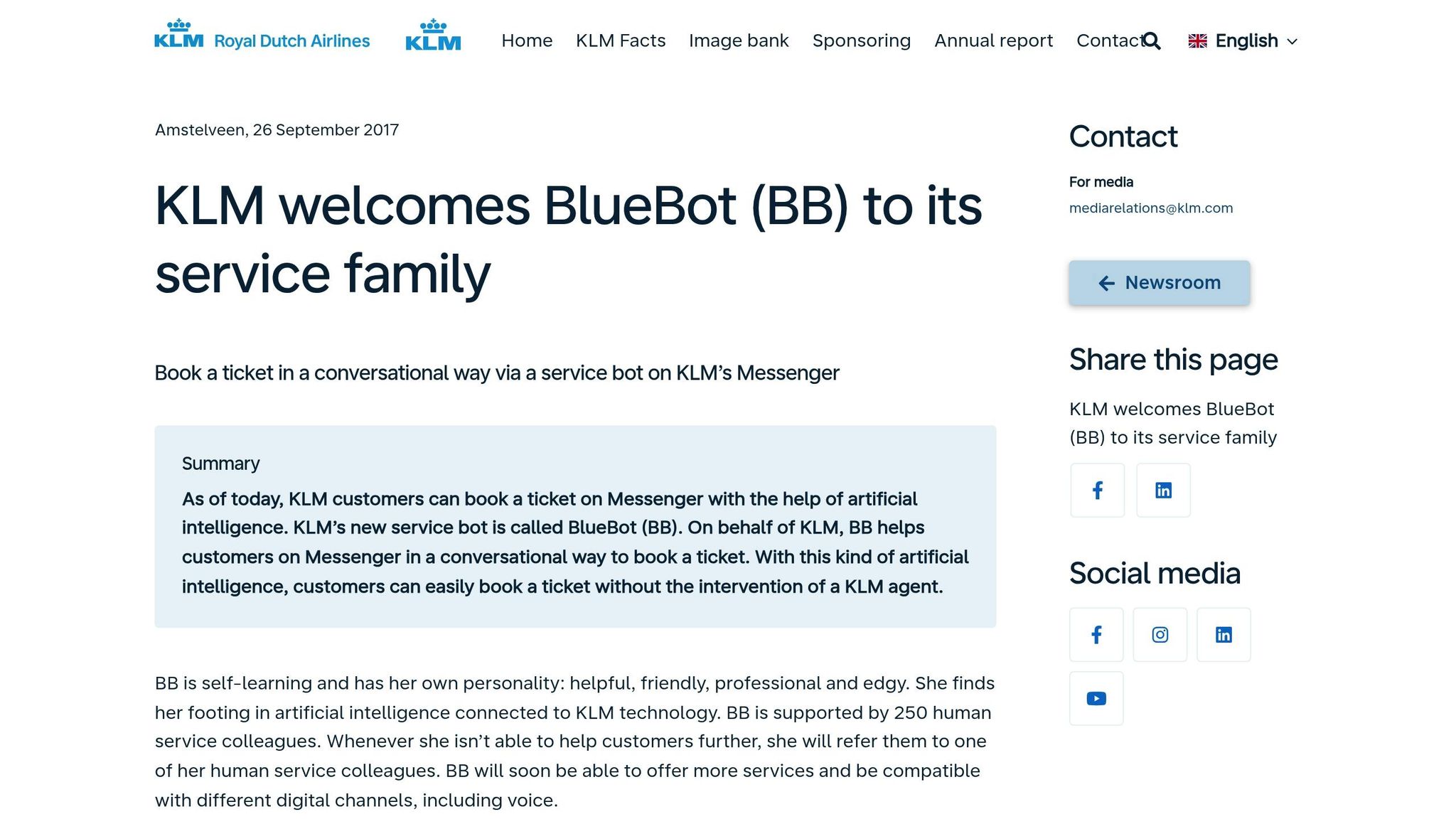
In September 2017, KLM Royal Dutch Airlines introduced BlueBot, an AI-powered assistant designed to work hand-in-hand with human support teams on social media. This initiative changed the game for customer service in the airline industry, proving that AI can effectively complement human efforts in real-world scenarios.
How KLM BlueBot Works
BlueBot is active across a variety of platforms, including Facebook Messenger, Google Assistant, WhatsApp, Twitter, LinkedIn, WeChat, and KakaoTalk. Equipped with advanced natural language processing (NLP) and integrated with KLM’s CRM systems, BlueBot manages an impressive 15,000 conversations every week.
But BlueBot is far from just a basic chatbot. On Facebook Messenger, it can handle tasks like booking flights, processing payments, and sending booking confirmations - all within the chat itself. On Google Assistant, it goes a step further by offering personalized travel tips, such as packing advice tailored to specific destinations.
The AI’s training enables it to understand context, remember earlier parts of conversations, and transition smoothly between topics. It also supports multiple languages and serves customers across different time zones. During office hours, it even handles queries in Italian. When a situation requires human intervention, BlueBot ensures a seamless handoff by transferring the full conversation history, so customers don’t have to repeat themselves.
Key Lessons from KLM's Implementation
BlueBot’s success offers valuable insights for teams exploring AI-driven support solutions. Here are some takeaways from KLM’s approach:
- Quality beats quantity in training data. KLM trained BlueBot using over 60,000 real customer interactions. These weren’t generic scripts - they were actual conversations, giving the AI the nuance and context it needed to handle real-world situations effectively.
- Integration is essential. BlueBot’s connection to KLM’s Salesforce CRM allows it to access critical customer information, like booking details and flight history. This integration enables personalized responses and helps the AI determine when to escalate an issue to a human agent.
- Balance AI and human roles. BlueBot handles about 60% of customer queries, leaving the remaining 40% - the more complex cases - for human agents. This hybrid approach has cut KLM’s customer service workload by 40%, allowing their team to focus on cases that truly require human expertise.
- Tone matters. BlueBot was designed with a friendly, professional, and slightly edgy personality that aligns with KLM’s brand. This consistency builds trust and makes interactions feel more natural, even when customers know they’re talking to an AI.
- Ongoing learning is key. KLM continuously updates BlueBot based on feedback from both customers and human agents. When agents step in to handle a conversation, BlueBot learns from their responses, improving its performance in similar situations down the line.
The results speak volumes. KLM now handles over 16,000 cases per week through this AI-human collaboration, maintaining their reputation for excellent customer service while scaling to meet increasing demand. BlueBot’s success shows that, with the right training and integration, autonomous AI can manage even complex, multi-step tasks with ease.
3 Common Mistakes When Using Autonomous AI Assistants
Autonomous AI assistants can be incredibly useful, but they aren't foolproof. If not implemented thoughtfully, they can create more problems than they solve. Early adopters have learned this the hard way, with missteps leading to frustrated customers and increased workloads. To make the most of these tools, it's important to understand where things often go wrong. Let’s take a closer look at three common mistakes, using lessons from BlueBot's implementation as an example.
Over-relying on AI Without Human Support
AI assistants excel at handling routine tasks, but they aren't equipped to deal with every situation. Complex or sensitive issues often require the judgment and empathy that only a human can provide. For example, if a customer is dealing with an emergency or a booking issue, relying solely on an AI assistant can lead to frustration. A seamless handoff to a human agent in these cases is crucial.
By setting up clear escalation rules from the beginning, businesses can ensure that urgent or delicate matters are resolved promptly and appropriately.
Inadequate Training Data
AI is only as good as the data it’s trained on. If an assistant is launched with outdated or incomplete training data, it can confidently deliver wrong answers. This not only frustrates users but also undermines trust in the system. For instance, an AI assistant trained on limited data might struggle to address a wide range of customer questions or provide accurate, up-to-date information.
To avoid this, businesses should use real, diverse interaction data when training their AI and regularly update it based on customer feedback and new trends. This ensures the assistant remains accurate and reliable.
Neglecting Updates and Feedback
One of the biggest mistakes is assuming that AI deployment is a one-and-done process. Products, policies, and customer expectations are always evolving, and your AI system needs to keep up. Without regular updates and feedback loops, the assistant can quickly become outdated, leading to confusion and more escalations to human support.
Establishing a schedule for performance reviews, feedback analysis, and system updates is key. This ongoing maintenance ensures the AI stays aligned with current needs and continues to add value over time.
Key Takeaways
Autonomous AI assistants go beyond traditional chatbots by managing more complex tasks while ensuring human support is available when needed. KLM's BlueBot serves as a great example of how this technology can reshape customer service operations when used effectively.
The hybrid approach is key, and quality training data matters immensely. BlueBot’s success highlights the power of blending AI automation with human backup. While BlueBot efficiently handles a large volume of queries, it seamlessly transfers more complicated cases to human agents. Its ability to perform well stems from being trained on robust datasets, enabling it to address a wide range of customer inquiries with precision. For teams aiming to replicate such success, investing in comprehensive and regularly updated training data is essential.
System integration sets autonomous AI apart. BlueBot’s integration with KLM’s CRM systems ensures smooth handoffs to human agents while maintaining the context of conversations. This integration elevates autonomous assistants beyond basic chatbots, allowing them to function as part of the existing workflow rather than as standalone tools.
The results speak for themselves. KLM saw faster response times and empowered their social media team to handle a higher volume of cases with AI support. These improvements stem from avoiding common mistakes, such as over-relying on AI without human backup, failing to use high-quality training data, or neglecting regular updates.
To achieve similar results, focus on three critical steps: build strong training datasets, plan for human intervention when needed, and commit to continuous updates. The technology works - it’s the execution that defines success.
FAQs
How does KLM's BlueBot combine automation with human support to improve customer service?
KLM's BlueBot (BB) combines AI-powered automation with human expertise to provide efficient and reliable customer support. It efficiently manages routine tasks like checking booking details or handling flight changes, allowing human agents to focus on more complicated or delicate matters.
When BlueBot encounters a situation it can't resolve, it smoothly hands the conversation over to a human agent. This ensures customers get the assistance they need without unnecessary hassle. By balancing AI capabilities with human support, KLM improves the customer experience while streamlining the workload for its support team.
How do autonomous AI assistants like BlueBot differ from traditional chatbots?
Traditional chatbots rely on rule-based systems, sticking to pre-set scripts to respond to specific questions. While they can handle straightforward inquiries, they often falter when faced with complex or nuanced queries. Plus, they need manual updates to stay relevant and can’t improve or evolve on their own.
Autonomous AI assistants, like BlueBot, take things to the next level. Instead of just following scripts, they leverage machine learning to grasp context, deliver more precise answers, and tackle intricate tasks like routing tickets or resolving issues in real time. When necessary, they can seamlessly transfer conversations to human agents, creating a smoother and more efficient customer experience.
What can support teams learn from KLM’s BlueBot to improve customer service with autonomous AI assistants?
While we might not have all the specifics about KLM’s BlueBot, there’s plenty to learn from the general concept of autonomous AI assistants like it. These tools are built to take on repetitive customer questions, deliver precise answers, and hand off more complicated issues to human agents when necessary.
If you’re looking to enhance your own customer support, consider these key strategies:
- Train your AI with relevant data: Use resources like FAQs, help articles, and past customer interactions to tailor the AI specifically to your business needs.
- Strike the right balance between automation and human support: Let the AI handle the straightforward queries, but ensure complex situations are smoothly transitioned to human agents.
- Commit to ongoing updates: Regularly evaluate the AI’s performance and refresh its training data to keep it accurate and useful.
When used wisely, autonomous AI assistants can cut support costs while still keeping customers happy.
.png)