.png&w=96&q=75)

Looking for the best AI agent for customer support in 2026? Here’s a quick rundown of the top five options:
- CoSupport AI: Quick setup (under 10 minutes) and affordable pricing at $0.19 per resolved ticket. Trains on your content and handles up to 90% of tasks autonomously—specific data.
- Intercom Fin: Tailored for Intercom users, it achieves a 96% accuracy rate and resolves 65% of conversations end-to-end. Costs $0.99 per resolution.
- Zendesk AI: Enterprise-focused, with over 18 billion interactions used for training. Automates 80%+ of tasks and integrates seamlessly with Zendesk workflows.
- Decagon: Designed for high-volume operations, this AI uses custom procedures for complex workflows across text and voice channels.
- PolyAI: Specializes in voice-based support, replacing traditional IVR systems and excelling in natural phone conversations.
- Tidio: Built for SMBs, Tidio combines live chat, help desk, and automation in one platform. Its AI agent, Lyro, resolves up to 67% of support requests autonomously using business-specific data.
- YourGPT is purpose-built for teams needing AI automation across customer support, sales, and operations without technical resources. It combines a no-code visual builder with AI Studio, enabling businesses to deploy one AI agent across 10+ channels: WhatsApp, Slack, Discord, Instagram, Telegram, email, and web, with instant synchronization and real-time workflow execution.
Quick Comparison Table
| Feature | CoSupport AI | Intercom Fin | Zendesk AI | Decagon | Tidio | YourGPT | PolyAI |
|---|---|---|---|---|---|---|---|
| Best For | No-code teams | Intercom users | Enterprises | High-volume teams | Ecommerce stores, SMBs, SaaS companies | Support teams, sales organizations, and e-commerce businesses | Call centers |
| Setup Time | <10 minutes | 4–6 weeks | 4–6 weeks | 6–8 weeks | Under 10 min | 5–15 minutes | 8–12 weeks |
| Pricing | $0.19/resolution | $0.99/resolution | ~$1.50/resolution | Custom | Free forever plan; paid from 24.17/mon | $39–$349/month; custom enterprise pricing available | Custom |
| Key Strength | Fast deployment | Multi-turn queries | Workflow depth | Enterprise scaling | Rapid deployment, sales automation, and 67% task resolution | True omnichannel deployment with instant synchronization and no-code to advanced automation options | Voice-first focus |
Each AI agent brings unique strengths, so the right choice depends on your team’s needs. For fast deployment and cost-effectiveness, CoSupport AI, Tidio, and YourGPT are ideal. Teams already using Intercom should consider Fin for its seamless integration. Enterprises with complex workflows might prefer Zendesk AI, while Decagon and PolyAI are best suited for high-volume and voice-heavy environments, respectively.
Pro Tip: Start with a pilot program to test resolution rates and ensure the AI aligns with your workflows before full implementation.
Introduction: Why Support Teams Need AI Agents in 2026
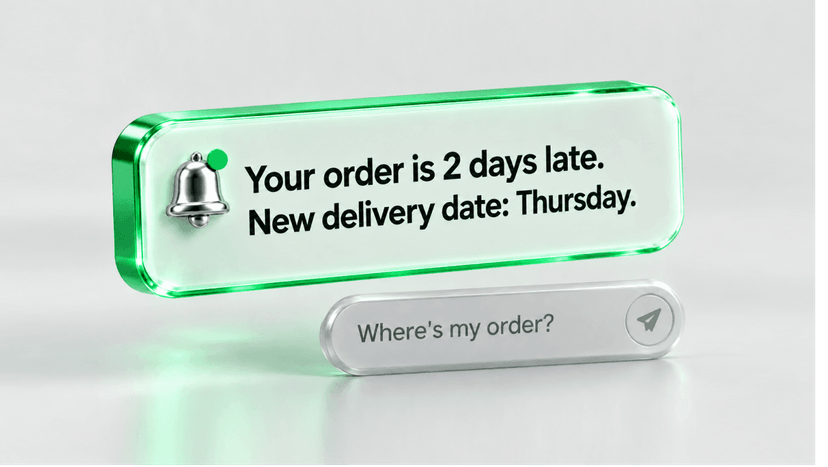
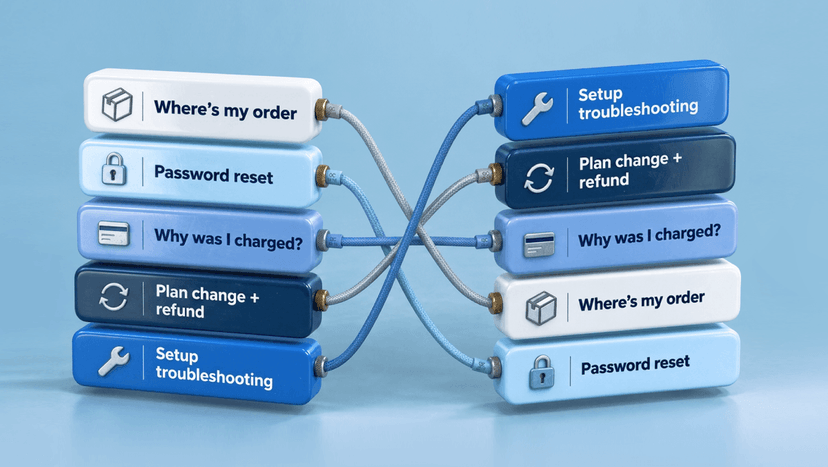
Support teams often find themselves bogged down by repetitive questions like, "Where is my order?" "How do I reset my password?", and "What's your refund policy?" These high-volume, routine inquiries eat up valuable time that could be better spent addressing more complex customer needs.
According to Gartner, conversational AI is set to save companies a staggering $80 billion in contact center labor costs by 2026. Many businesses are now turning to AI agents instead of expanding their human workforce. These AI agents operate 24/7, communicate in over 135 languages, and never need a break.
But here's the game-changer: modern AI agents do more than just answer questions - they solve problems. They can issue refunds, modify orders, and handle tasks that previously required human intervention.
For example, in 2025, Gecko Hospitality adopted Tidio's Lyro AI agent to pre-qualify job applicants. The results? The agent resolved 90% of conversations independently, routed leads to recruiters in under 90 seconds, and brought in an additional 257 candidate leads within just six months.
This evolution has driven businesses to embrace AI agents capable of managing entire support processes on their own. Unlike traditional chatbots that rely on rigid, pre-written scripts, these advanced agents use contextual understanding to resolve issues without human oversight. Take Wealthsimple, for instance - their Ada AI agent now manages the workload of 10 full-time employees, allowing human teams to focus on higher-value interactions.
This article dives into a comparison of five AI agents designed for customer support in 2026. We’ll break down their features, pricing, and real-world performance to help you decide which solution aligns best with your team’s needs.
What Makes a Good AI Agent for Customer Support
AI agents come in all shapes and sizes. Some are designed to tackle basic FAQs, while others are equipped to handle more complex tasks like processing refunds, updating CRM records, or managing subscription changes. For support leaders, the challenge lies in distinguishing between simple bots and advanced AI agents. This distinction boils down to how well these tools handle volume, complexity, and control - key factors that highlight the evolution of AI in customer support.
How AI Agents Have Evolved Beyond Basic Bots
The early days of chatbots were marked by rigid scripts and keyword-based responses - essentially, "if/then" logic that couldn't keep up with dynamic conversations. Fast forward to today, and modern AI agents leverage large language models (LLMs) to understand both intent and context. These agents are trained on your specific resources - help articles, PDFs, past tickets, and even website data - using a method called Retrieval-Augmented Generation (RAG). This approach ensures their responses are grounded in your business rules, significantly reducing the risk of inaccurate or "hallucinated" answers.
But these agents don’t stop at answering questions. They can also take action, like issuing refunds, updating shipping details, modifying account settings, or triggering workflows in tools you already use. In short, they’ve moved far beyond the limitations of basic bots.
What Matters Most to Support Leaders
As AI agents continue to evolve, six key factors stand out for support leaders assessing their value in 2026: accuracy, setup time, channel coverage, workflow capability, security, and pricing.
- Accuracy: The foundation of any good AI agent is its ability to provide correct answers. This starts with grounding - training the agent on your internal knowledge base. For instance, Intercom Fin achieves a 96% answer rate on multi-source queries, far surpassing the 78% rate of older AI agents.
- Setup Time: Time-to-deployment varies widely. Some no-code solutions can be up and running in under 5 minutes, while more complex setups might take 6–12 weeks of development.
- Channel Coverage: Customers reach out through a variety of platforms - WhatsApp, Messenger, email, SMS, or even voice. The best AI agents can operate seamlessly across all these channels, often from a unified inbox.
- Workflow Capability: The ability to go beyond answering questions is critical. Advanced agents can resolve full tickets, handling tasks like refunds or account updates. Platforms like CoSupport AI even allow agents to connect with your tools and learn from past tickets, helping them manage edge cases effectively.
- Security and Governance: Features like PII redaction, audit trails, and strict guardrails are essential. For example, you might limit the agent’s ability to process refunds over a certain amount or restrict discussions to topics within your product scope.
- Pricing: The pricing model has shifted from traditional per-seat licenses to outcome-based pricing. Now, you only pay when a ticket is successfully resolved, making it easier to measure ROI.
These factors give support leaders a clear framework for evaluating AI agents and understanding their potential across different customer support scenarios.
7 AI Agents for Customer Support: Features and Comparisons
Here’s a comparison of five AI agents, each offering distinct features tailored to different customer support needs. Let’s dive into what makes each AI agent for customer support stand out.
1. CoSupport AI: Train AI Agents on Your Own Content
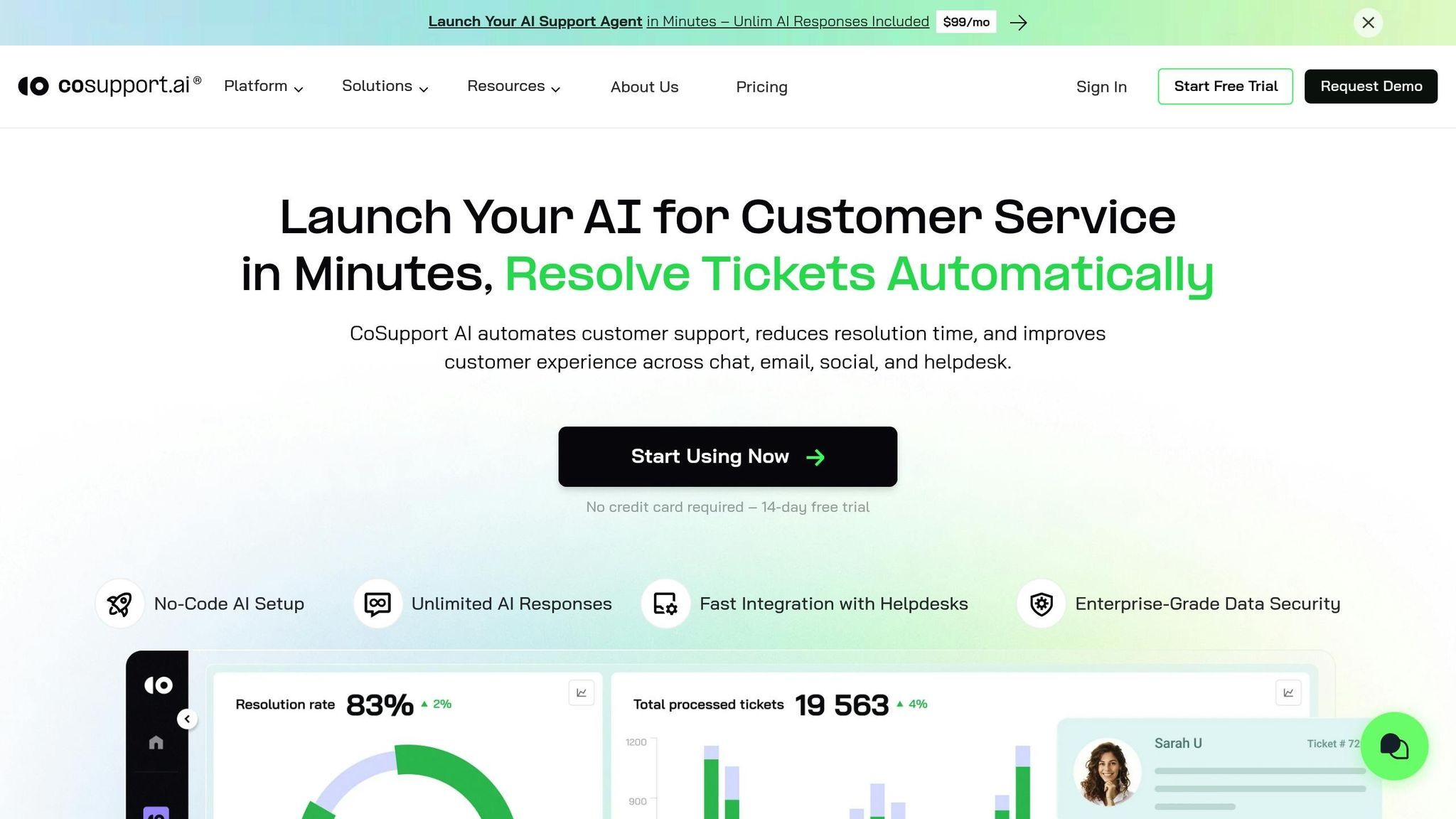
CoSupport AI is ideal for teams looking for simplicity and control. It integrates with tools like Zendesk, Intercom, Slack, or even PDFs, using your support history to train its AI agents. Setup is quick - you're up and running in under 10 minutes.
By learning from past tickets and documentation, CoSupport AI minimizes errors while preserving your brand’s tone. It also connects with CRMs and support tools, empowering agents to take actionable steps rather than just answering questions.
Pricing is flexible:
- $0.19 per resolution - pay only when a ticket is fully resolved.
- $99/month for unlimited responses with a server-based plan.
- $0.04 per AI-generated reply for a response-based model.
If you’re already using Intercom, the next option might be a better fit.
2. Intercom Fin: AI Agent for Intercom Users
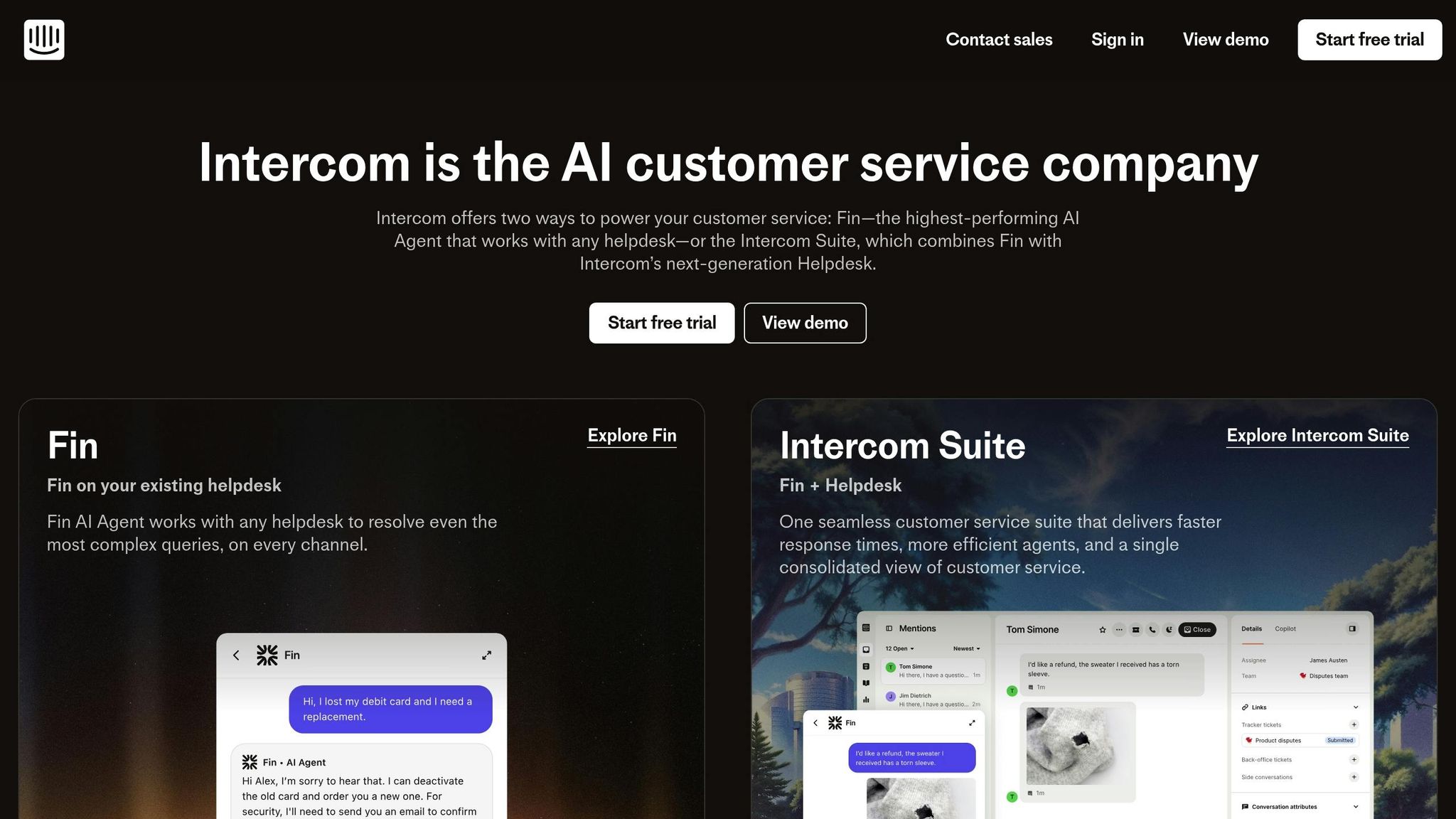
Built specifically for Intercom users, Intercom Fin leverages the Fin AI Engine to resolve complex, multi-step queries. It pulls data from conversation history and support content, achieving a 96% answer rate on multi-source queries - outperforming Zendesk AI’s 78% in direct tests.
Fin handles 65% of customer conversations from start to finish and includes proactive messaging features. However, the setup process takes 4–6 weeks. Pricing starts at $0.99 per resolution, with a 50-resolution minimum.
For larger enterprises seeking deeper integrations, Zendesk AI might be the way to go.
3. Zendesk AI: Built for High-Ticket Support Teams
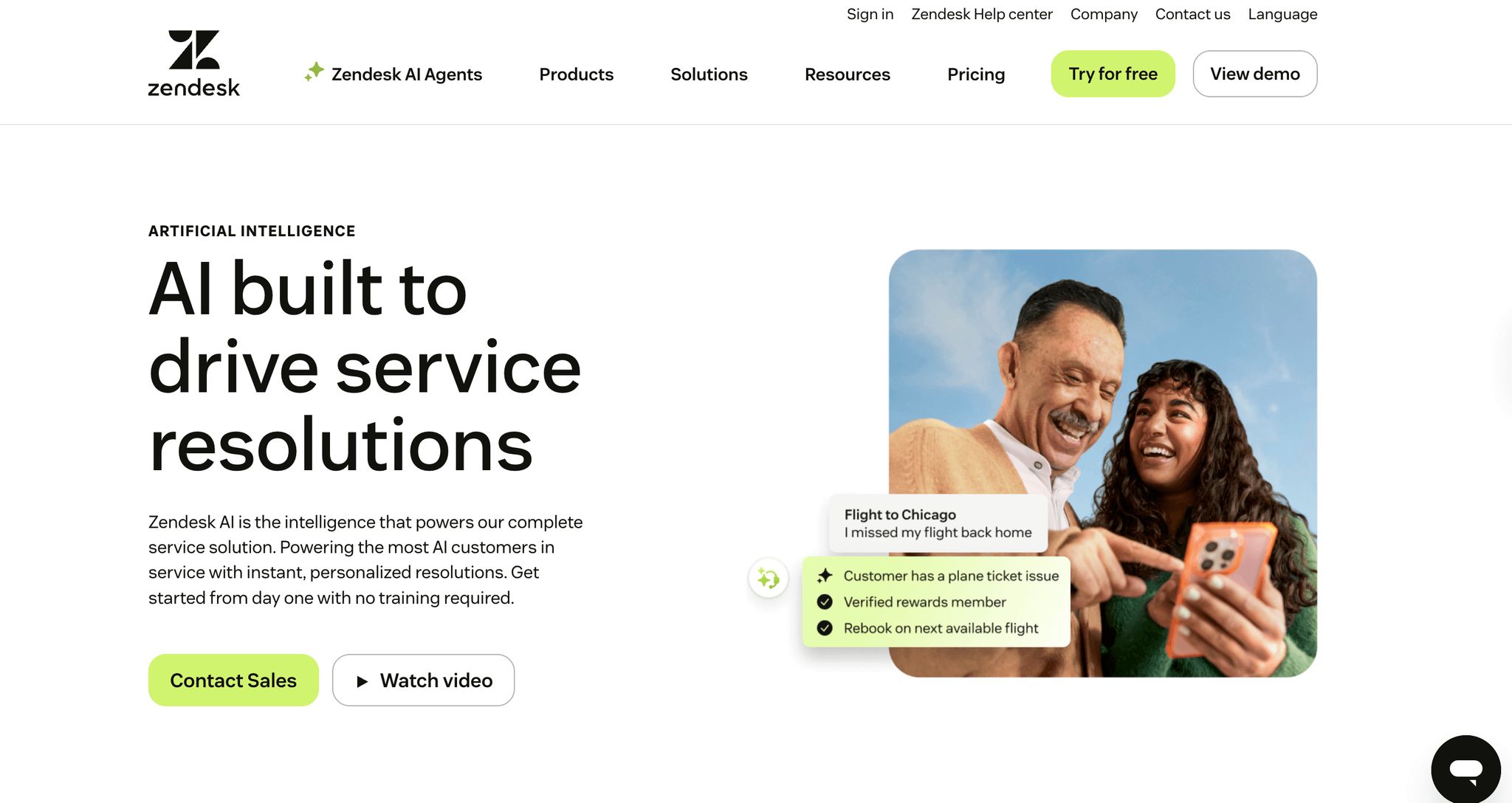
Zendesk AI is designed for enterprise-level support, pre-trained on over 18 billion service interactions. Using Retrieval-Augmented Generation (RAG), it synthesizes answers from your knowledge base and automates workflows with its Procedure Builder.
Zendesk users report an 80%+ automation rate and a 20% productivity boost for agents. A Forrester study even documented a 301% ROI over three years for enterprise clients. Setup takes 4–6 weeks, and pricing begins at $55 per agent per month or approximately $1.50 per resolution for outcome-based plans.
This platform shines when Zendesk is your primary support tool, maximizing its built-in features.
4. Decagon: Large-Scale Automation for Voice and Chat
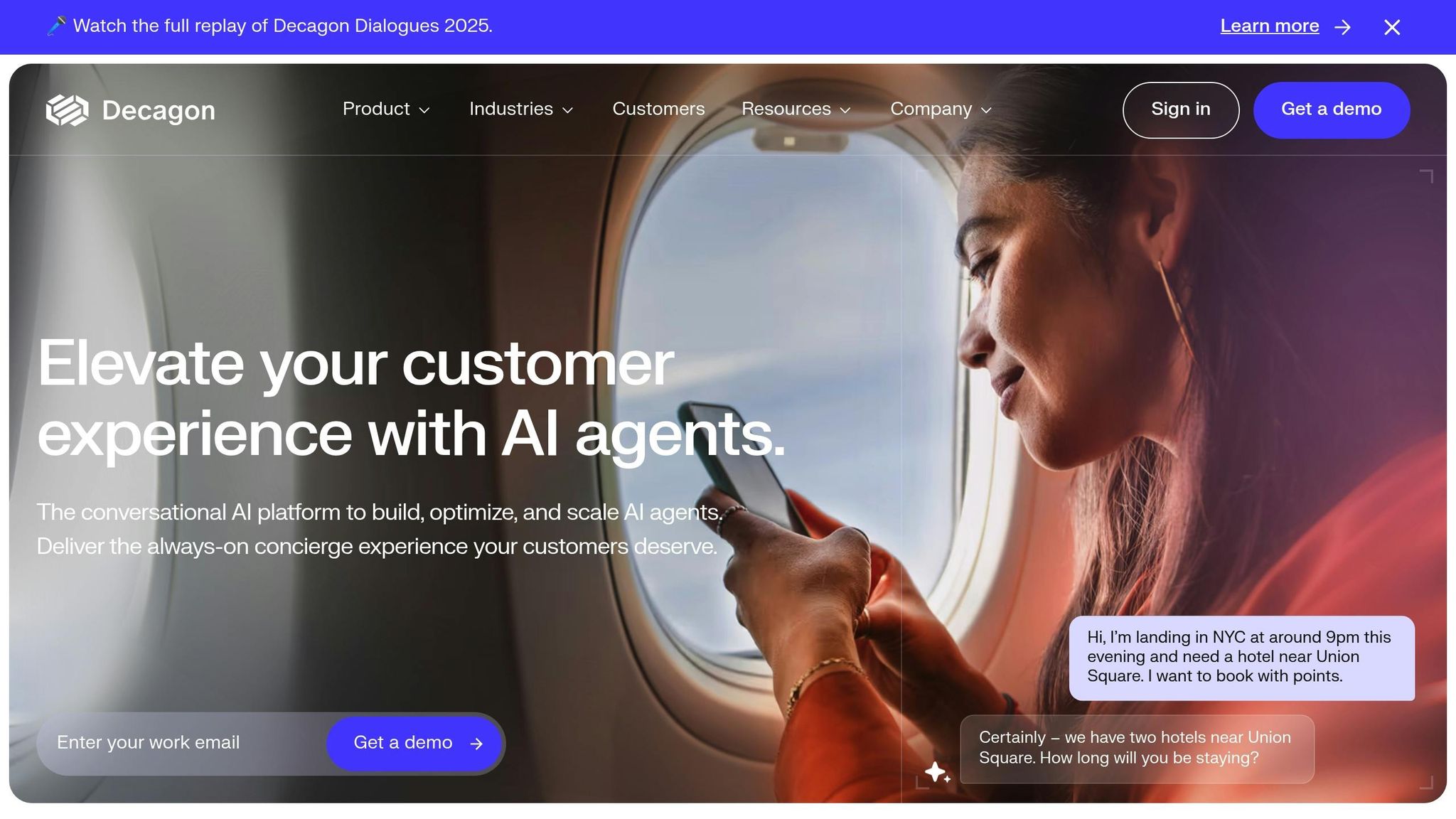
Decagon caters to enterprise teams managing large-scale operations across both voice and chat. Its Agent Operating Procedures (AOPs), written in natural language, allow teams to adjust agent behavior without heavy reliance on developers. Automation rates typically range from 60–80% for enterprise workflows.
Setup requires 6–8 weeks and developer-supported integrations. Pricing is custom and volume-based, making it a solid choice for high-volume operations. Unlike text-focused agents, Decagon handles voice and chat channels seamlessly.
5. PolyAI: Voice AI for Call Centers
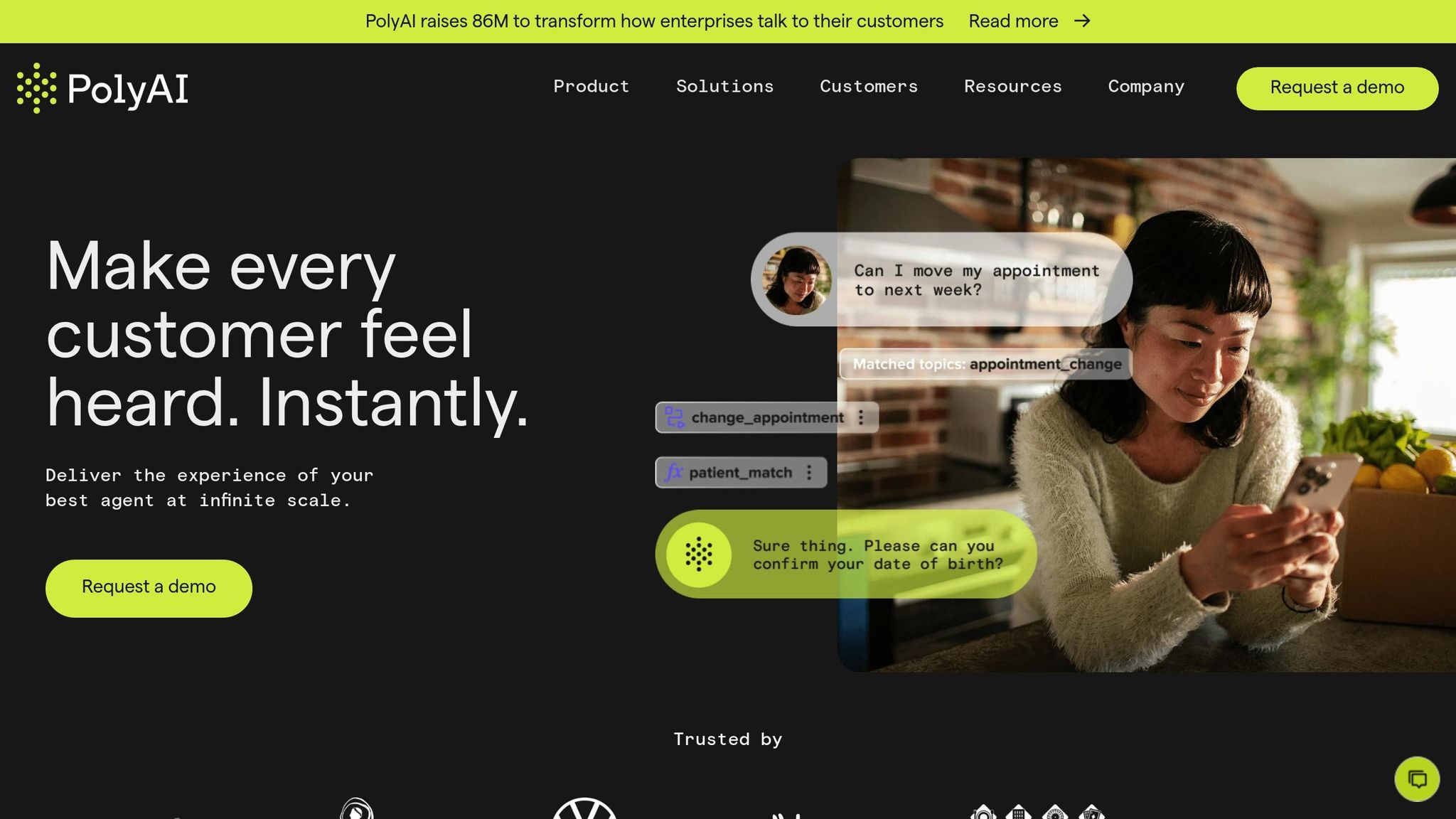
PolyAI takes a voice-first approach, tailored for call centers. It uses advanced speech recognition and natural language processing to manage phone-based support. Naturally, IVR replaces outdated menu trees, excelling in conversational voice interactions - a unique feature compared to the text-based agents.
The setup process spans 8–12 weeks due to the complexity of call center integrations. Pricing is custom and geared toward enterprise clients.
6. Tidio: AI Agent for SMB and E-commerce Support
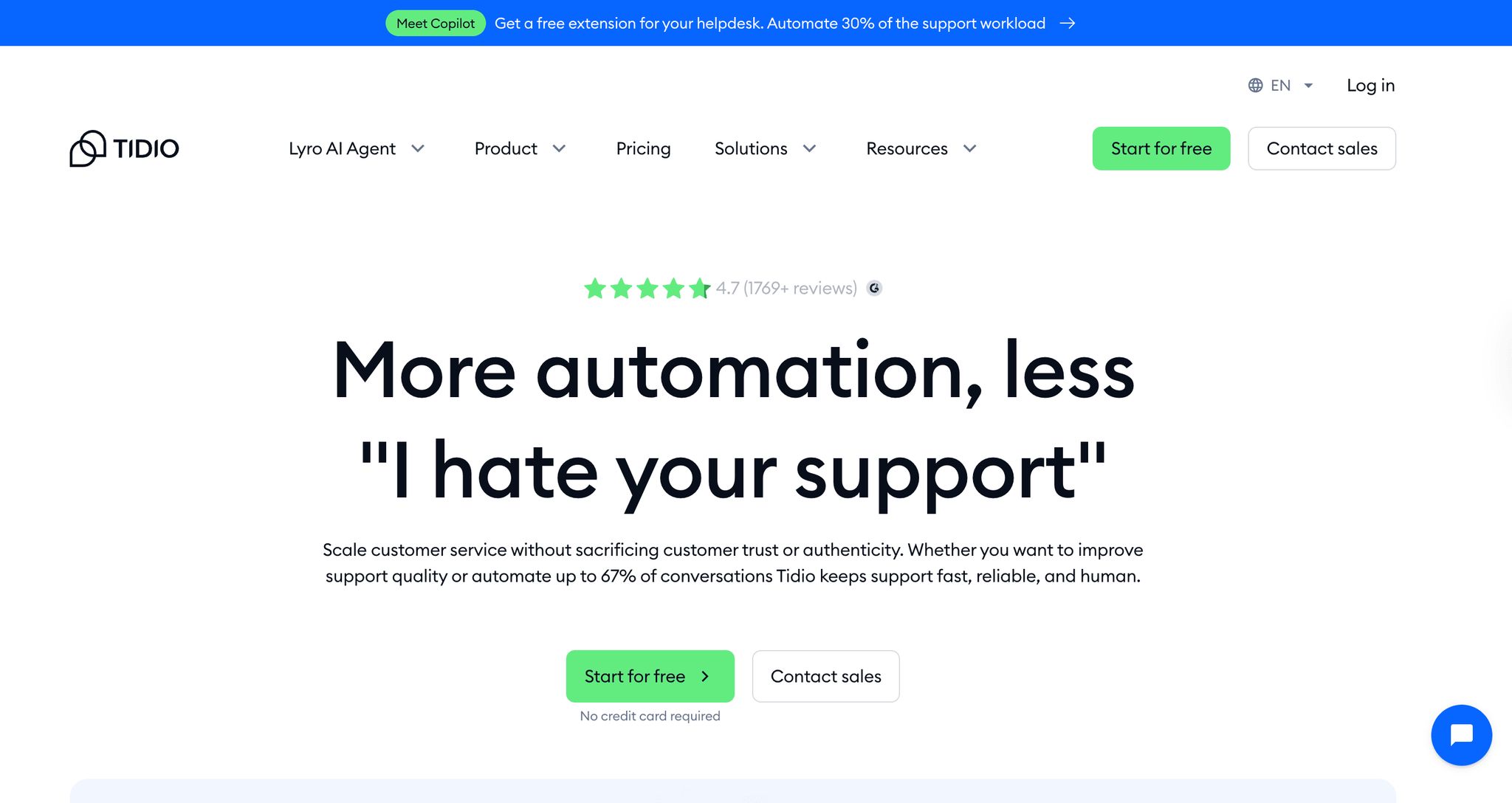 Built for small and mid-sized businesses, Tidio combines live chat, help desk, and AI automation into a single customer support platform. Its AI agent, Lyro, is designed to resolve repetitive and transactional support questions using company-specific data, including FAQs, help center articles, and past conversations.
Lyro can autonomously handle up to 67% of customer inquiries, making it well-suited for common questions around orders, shipping, returns, and product details. Responses are grounded in approved content, helping maintain accuracy while reducing agent workload.
Tidio also offers a unified inbox for email, live chat, and social channels, along with no-code automation flows and a visual chatbot builder. These features are especially popular among Shopify and WordPress users looking to automate FAQs, recover abandoned carts, and provide real-time assistance without expanding support teams.
While Tidio excels at fast deployment and ease of use, it is primarily optimized for SMBs and eCommerce use cases rather than complex enterprise workflows. For teams with simpler automation needs and a focus on speed and cost efficiency, Tidio is a practical entry point into AI-powered customer support.
7. YourGPT: Multi-Channel AI Agent for Business Automation
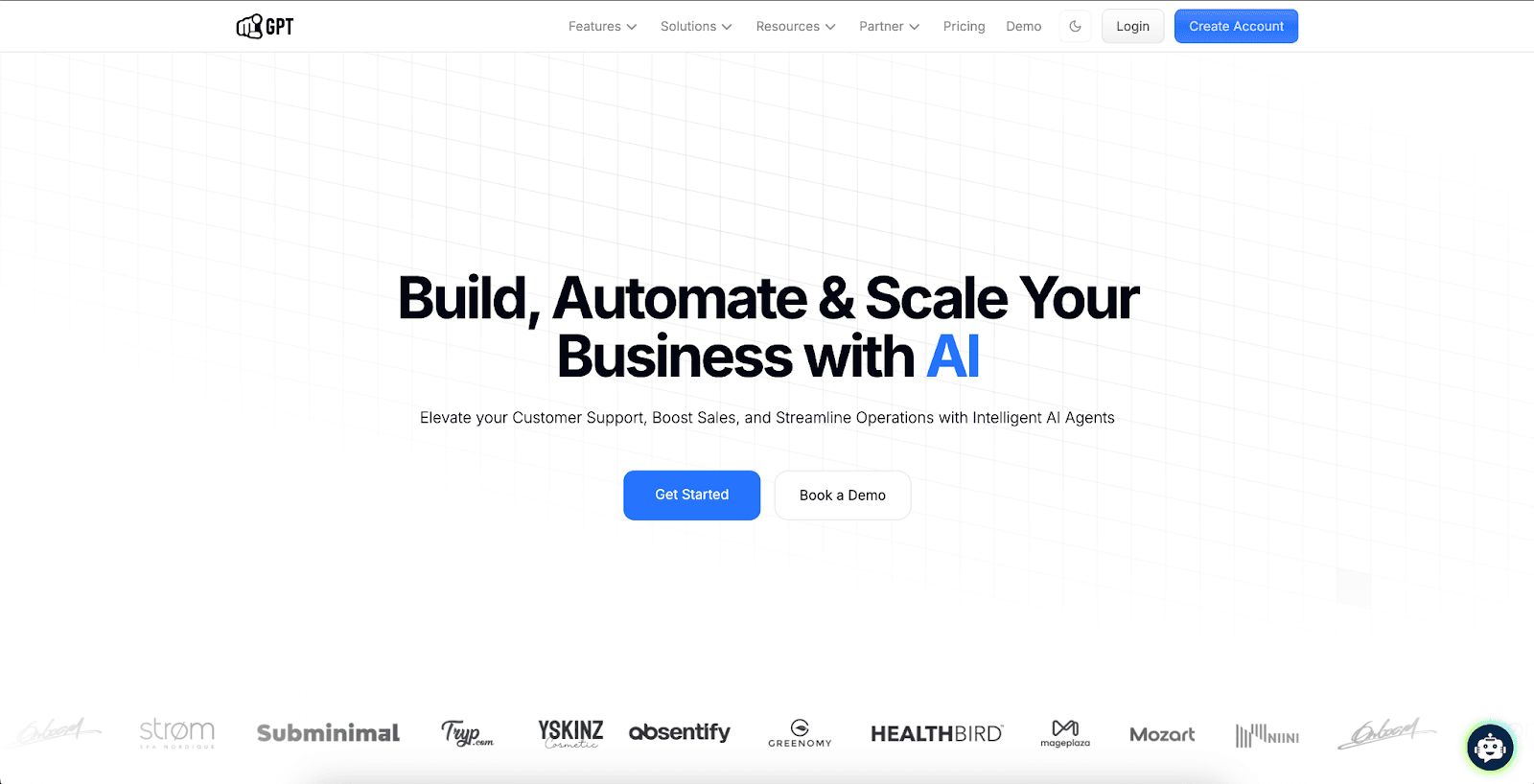
YourGPT is purpose-built for teams needing AI automation across customer support, sales, and operations without technical resources. It combines a no-code visual builder with AI Studio, enabling businesses to deploy one AI agent across 10+ channels, WhatsApp, Slack, Discord, Instagram, Telegram, email, and web, with instant synchronization and real-time workflow execution.
Built for rapid deployment, YourGPT resolves approximately 80% of routine customer inquiries automatically and handles multi-step workflows, including lead qualification, abandoned cart recovery, and order tracking. The platform deploys in minutes using pre-built templates and learns from interactions to continuously improve. Pricing is transparent at $39–$349/month based on chatbot volume and AI credits, with flexible model selection (GPT-3.5, GPT-4, Claude, o1) allowing teams to balance cost and performance.
However, manual retraining is required when knowledge sources change, and advanced features like custom branding and API Studio are restricted to higher tiers. For enterprises requiring on-premise deployment or specialized voice agent capabilities, alternative platforms might be better suited.
sbb-itb-97114f1
How to Choose the Right AI Agent for Your Team
Selecting the right AI agent isn’t about picking the "best" tool - it’s about finding one that fits your team’s workflow. A small SaaS team’s needs are vastly different from those of a 200-seat call center. The key is to evaluate features that align with your specific support operations.
6 Dimensions to Compare AI Agents
When comparing AI agents, focus on these six areas:
- Accuracy: Look for models that rely on live data and have low rates of hallucination. Agents prone to inventing answers can lead to costly mistakes and unhappy customers.
- Setup Time: Consider how quickly the tool can be up and running. No-code builders can deploy in as little as 3–5 days, while enterprise-level builds might take 6–12 weeks.
- Channel Support: Determine whether the agent supports the channels your customers use - chat, email, voice, or social media.
- Workflow Depth: Advanced agents go beyond answering questions. Can they process refunds, update subscriptions, or integrate with your CRM?
- Security: For industries with strict regulations, security features like PII redaction, SOC2 compliance, and audit trails are essential.
- Pricing: Choose a pricing model that reflects your goals. Outcome-based plans (e.g., $0.19–$1.50 per resolution) tie costs to delivered value, while seat-based pricing charges regardless of performance.
Here’s a quick table to summarize these dimensions:
| Dimension | What to Look For | Why It Matters |
|---|---|---|
| Accuracy | Grounding in live data, low hallucination | Avoids costly mistakes and improves customer trust |
| Setup Time | No-code (3–5 days) vs. enterprise (6–12 weeks) | Determines how quickly you see results |
| Channel Support | Omnichannel (chat, email, voice, social) | Matches the platforms your customers use |
| Workflow Depth | API calls, CRM updates, multi-step actions | Enables full problem resolution |
| Security | PII redaction, SOC2/HIPAA compliance | Critical for regulated industries |
| Pricing | Pay-per-resolution vs. seat-based | Links cost to actual outcomes |
With these dimensions in mind, you can identify which AI agent best supports your team’s operations.
Match AI Agents to Your Support Scenario
Using these criteria, you can align AI agents with your team’s specific needs. Let’s look at a few examples.
For a high-volume SaaS team handling over 5,000 tickets monthly, quick deployment and outcome-based pricing are essential. CoSupport AI and Tidio are strong options, deploying in under 10 minutes for $0.19 per resolution. This makes it ideal for teams that need immediate results.
If your team is built around Intercom, Fin is worth considering. It integrates seamlessly with Intercom and boasts a 96% answer rate on multi-source queries. This highlights the importance of accuracy and channel support for teams deeply embedded in the Intercom ecosystem.
Enterprise support teams with complex workflows across multiple departments might prefer Zendesk AI. Pre-trained on 18 billion interactions, it offers robust CRM integrations and achieves over 80% automation rates. A Forrester study even reported a 301% ROI over three years, showing how workflow depth can drive value for large-scale operations.
For call-heavy contact centers, PolyAI is a standout choice. Its voice-first design replaces outdated IVR menus with conversational AI, making it perfect for natural phone interactions. Here, channel support for voice becomes a critical factor.
"2026 is the year AI stops being a draft assistant and starts being an operator." – William Westerlund, Suptask
Before committing to any AI agent, it’s wise to run a two-week pilot with 50–200 real tickets. Use this period to measure resolution rates, escalation quality, and compliance with policies - not just deflection rates. Define clear boundaries for autonomous actions, like "refund up to $50," to ensure safe and effective operations.
Pros and Cons of Using AI Agents for Support
AI agents bring plenty of benefits to the table, but they also come with challenges that require careful management. By setting clear boundaries and ensuring human oversight, many support teams find these tools to be a worthwhile addition to their operations.
What Support Teams Gain
The biggest advantage? Speed. AI agents respond in seconds and are available 24/7, making them ideal for handling high volumes of repetitive questions like “Where is my order?” or “How do I reset my password?”
By taking over these routine tasks, AI allows human agents to focus on more complex issues that demand empathy and critical thinking. This shift not only improves productivity but also enhances the overall quality of customer interactions.
AI also ensures consistency. It applies policies uniformly, so every customer interaction aligns with the same guidelines - something that’s harder to achieve with human variability.
However, these benefits come with their own set of challenges.
Common Problems to Watch For
One major issue is the risk of hallucinations. AI can generate incorrect or misleading answers when it lacks the necessary data, which can erode trust - especially in sensitive industries like healthcare or finance.
Another challenge is dependency on accurate and up-to-date documentation. If your knowledge base is incomplete or outdated, AI performance will suffer.
In voice support, while instant responses are a plus, they sometimes come at the cost of slight delays in accuracy when compared to more precise systems.
Security is another critical concern. Granting write access to AI agents demands strict safeguards. Risks like prompt injection - where malicious prompts manipulate the AI’s behavior - or unauthorized data access can lead to serious issues. To mitigate these risks, organizations should enforce strict policies, such as limiting refunds to $50, and ensure personally identifiable information (PII) is redacted before data reaches third-party language models.
"The winning model is human on the loop: agents review escalations, approve high-risk actions, and improve procedures, while AI handles the volume." – William Westerlund, Suptask
Pros and Cons Table
| Advantage | Impact | Disadvantage | Impact |
|---|---|---|---|
| 24/7 Availability | Instant responses across all time zones | Hallucinations | Can produce incorrect answers |
| Cost Savings | Gartner predicts $80B in labor cost reduction by 2026 | Knowledge Dependency | Performance depends on the quality of documentation |
| Consistency | Uniform application of policies | Security Risks | Vulnerable to prompt injection and data breaches |
| Human Productivity | Frees agents for complex, high-value tasks | Maintenance Overhead | Requires continuous updates and oversight |
| Multilingual Support | Enables global scaling without local hiring | Voice Latency | Speed vs. accuracy trade-off in phone support |
| Data Insights | Tracks sentiment and trends from interactions | "Black Box" Reasoning | Difficult to audit AI decision-making processes |
Key Takeaways: Picking the Best AI Agent for Your Team
When it comes to selecting the right AI agent, it all boils down to your specific needs - not flashy claims or buzzwords. Focus on agents that can handle entire tasks - like processing refunds or updating subscriptions - rather than those that simply redirect users to static resources. For example, CoSupport AI offers the ability to train agents using your own content and launch them in under 10 minutes, with pricing starting at $0.19 per resolution.
For teams managing lower volumes, a per-resolution pricing model is often the most cost-effective. In contrast, high-volume teams might find fixed or per-response models more predictable and scalable. CoSupport, for instance, charges $0.04 per response, making it a steady option for larger operations.
Prep your documentation first. The accuracy of AI agents heavily depends on the quality of your support documentation. If your help center is outdated or incomplete, take the time to refresh your help center. This ensures the AI delivers precise answers. Start with a pilot program focused on high-volume, well-documented queries - like "Where is my order?" - to gauge performance before rolling it out more broadly. This approach reduces errors and improves response quality from the start.
Set clear limits for sensitive actions. If your AI agent has the ability to issue refunds or modify accounts, establish strict guidelines, such as a cap on refunds (e.g., "refund up to $50"). This step minimizes risks like unauthorized actions or costly mistakes.
By keeping these points in mind, you can align your AI agent’s functionality with your team’s support objectives. To see these features in action, you can book a 1:1 demo with our team.
"The winners are not defined by which LLM they use. They win on orchestration, governance, and safe action." – William Westerlund, Suptask 2026 Buyer Guide.
Challenges to Keep in Mind
Despite their advantages, AI agents come with potential risks. Issues like data privacy, security breaches, and accuracy concerns need to be addressed. Without the right safeguards, sensitive customer information could be exposed, or the AI might provide incorrect or misleading responses (commonly known as hallucinations). Over-reliance on AI without proper monitoring could lead to customer dissatisfaction, compliance headaches, or even unexpected expenses.
To truly benefit from AI in customer support, businesses must implement these tools thoughtfully. Regular evaluations and human oversight are essential to strike the right balance between automation and customer satisfaction.
.png)