.png&w=96&q=75)

Want to turn customer support into a revenue engine? Chatbots are the key. They can identify buying signals, answer questions instantly, and guide customers toward purchases - all while cutting costs. Here’s what you need to know:
- 78% of customers buy from the first company that responds. Chatbots ensure you're always first.
- The average website converts just 2.35% of visitors, but chatbots can boost conversion rates by 23%.
- Responding to inquiries within 5 minutes increases conversions by 8x.
- Chatbots reduce service costs by 50% and handle routine queries, freeing up your team for high-value sales.
Key Benefits:
- Higher Conversions: Spot purchase intent, answer objections, and recover abandoned carts.
- Lower Costs: Automate routine tasks, saving time and money.
- Personalized Recommendations: Use customer data to offer tailored product suggestions.
How to Get Started:
- Choose a chatbot platform with advanced features like intent detection and CRM integration.
- Train your chatbot using sales and support data.
- Automate chatbot lead generation and follow-ups.
- Continuously optimize chatbot performance with A/B testing and data insights.
Bottom Line: Chatbots are no longer just for support - they’re a 24/7 sales tool that can boost revenue while improving customer experience.
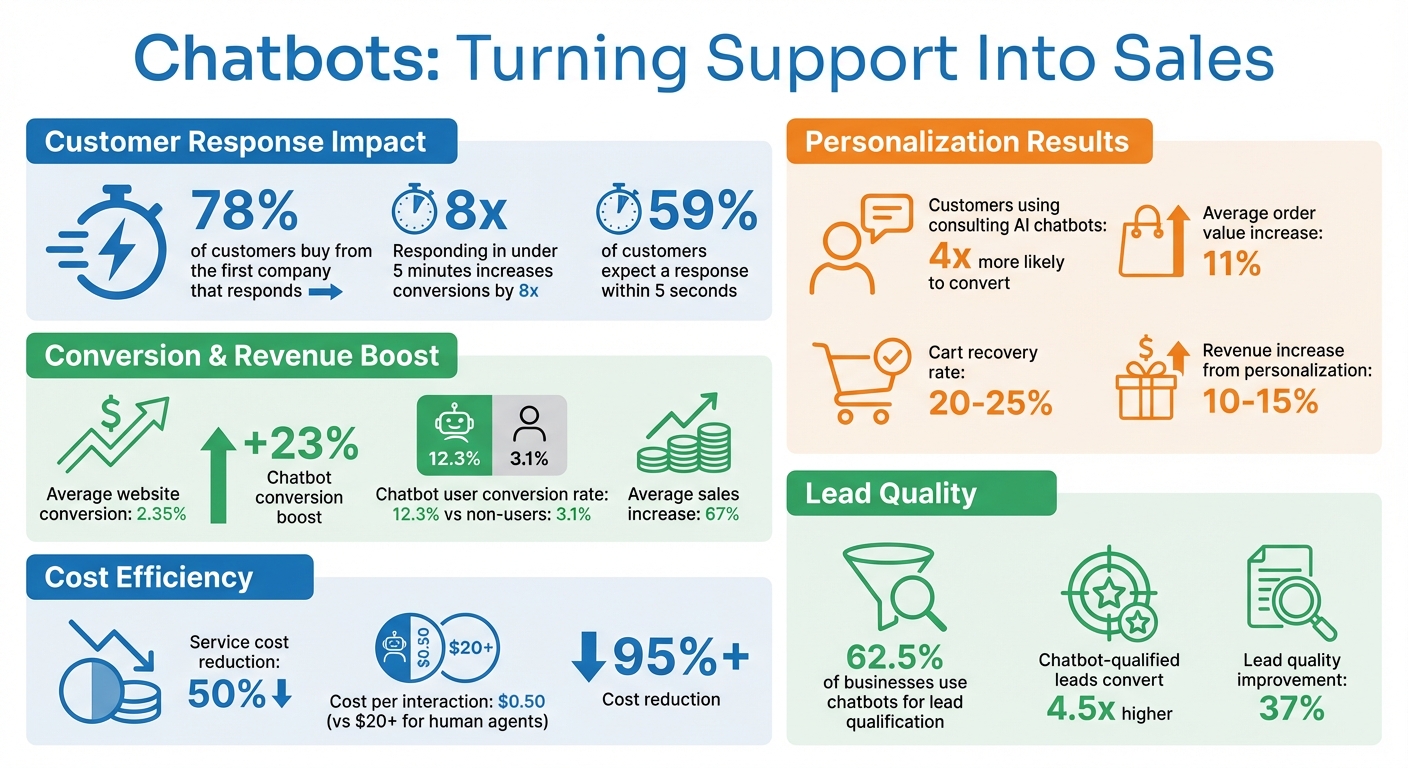
Chatbot Sales Impact: Key Statistics and Performance Metrics
AI Website Chat Agents That Sell, Support & Convert (10X Sales & Leads)
sbb-itb-97114f1
Benefits of Using Chatbots for Sales in Customer Support
Chatbots in customer support have evolved from simple ticket-deflection tools to powerful sales drivers. These AI-powered assistants work tirelessly, identifying buying signals, suggesting products, and even closing deals - all while your human team focuses on high-value, complex interactions. This shift opens the door to significant revenue growth.
Businesses are now rethinking how they approach customer engagement. Instead of merely reducing costs, chatbots actively guide potential buyers through their journey, qualify leads instantly, and provide tailored recommendations based on real-time data and behavior.
Increase Conversions and Revenue
AI chatbots excel at capturing sales opportunities the moment they arise. They answer questions, handle objections, and guide customers toward making decisions - all in real-time. For instance, adding an AI chatbot to your website can increase conversion rates by 23%, while responding to inquiries in under five minutes can boost conversions by up to 8x.
Speed matters. A staggering 78% of customers buy from the first company that responds to them, making quick engagement a competitive edge.
Take Cdiscount, a French retailer, as an example. In December 2025, their AI assistant achieved a 24% conversion rate among users who engaged with it. Operating 24/7, the chatbot resolved 40% of customer interactions automatically while identifying and nurturing sales opportunities on the spot.
Chatbots also transform lead qualification. Using frameworks like BANT (Budget, Authority, Need, Timeline), they score leads in real-time, ensuring high-intent prospects are prioritized before they lose interest. Behavioral triggers like exit intent or time spent on specific pages can recover 20% to 25% of abandoned carts by addressing hesitation at the perfect moment.
These impressive conversion rates go hand-in-hand with the efficiency benefits discussed next.
Lower Costs and Improve Efficiency
Strategically deployed chatbots can slash customer service costs by 50% while driving better sales results. By handling routine inquiries, AI frees up human agents to focus on high-value conversations and more complex sales opportunities.
A great example is Yoeleo Bike, a premium bicycle brand. In December 2025, their Chatty AI bot, trained on technical product specs, resolved 98.9% of conversations without needing human input. This saved their team over 19 hours of manual research daily. On top of that, the bot helped generate $29,586 in revenue in just one month by answering detailed compatibility questions that might have otherwise delayed purchases.
Chatbots also streamline the handoff process to human agents. When a lead is transferred, the chatbot provides the entire conversation history and lead scores, eliminating redundant questions and saving time. This efficiency can address the $1.2 million annual loss many B2B companies face due to manual qualification processes.
"The goal isn't fewer humans - it's smarter, more impactful use of their time." - Erica Agrodnia, Conversational Marketing, HubSpot
AI-driven lead qualification boosts lead quality by 37%, ensuring sales teams focus on prospects who are most likely to convert. This combination of cost savings and revenue generation transforms customer support from a necessary expense into a revenue-driving asset.
Deliver Personalized Customer Experiences
Chatbots aren’t just about efficiency - they also create deeply personalized experiences. Acting as digital consultants, they use customer data and behavioral insights to provide tailored recommendations that feel helpful rather than pushy.
By integrating with CRM systems and product catalogs, chatbots can analyze purchase history and browsing behavior to suggest products or upgrades that align with each customer’s needs. For example, customers who interact with consulting AI chatbots are 4x more likely to convert compared to those who don’t.
Sweaty Betty showcased this potential by using quiz-based chatbot interactions. Over six months, the brand achieved a 57% increase in average order value by guiding customers to products that matched their fitness goals and preferences.
Personalized upselling and bundling also drive results, increasing average order value by around 11%, while broader personalization efforts can add 10% to 15% in total revenue. The key is context - offering a premium warranty during a chat about product durability feels natural, whereas the same offer in an unrelated email might go unnoticed.
Chatbots also excel at progressive profiling. Over multiple interactions, they gather data points like budget, decision timelines, and pain points, building a detailed customer profile without overwhelming users. This enables increasingly relevant recommendations over time, making each interaction more impactful than the last.
How to Set Up Chatbots to Drive Sales in Support Chats
If you want your chatbot to do more than just answer questions, you need to set it up with a clear plan to drive sales. With the right approach, your chatbot can actively identify opportunities, guide customers toward purchases, and deliver results. Here’s how to make it happen.
Choose a Platform with Sales Features
Start by picking a chatbot platform designed to boost revenue. Tools like CoSupport AI use advanced Large Language Models to understand user intent and even analyze sentiment, moving beyond basic keyword matching.
Look for platforms that offer features such as:
- Lead qualification
- Intent detection
- CRM integration
- Multi-channel deployment
One must-have is Retrieval-Augmented Generation (RAG). This technology connects your chatbot to live knowledge sources - like product catalogs, help center articles, and technical documents - ensuring responses are accurate and based on real business data. Without RAG, chatbots risk making up information, which can erode trust and cost you sales.
A hybrid architecture is also key. Combine rule-based workflows for routine tasks (e.g., return policies) with AI-driven flexibility for more complex sales conversations. Visual flow builders with drag-and-drop interfaces allow teams to design sales funnels easily, no coding required.
Don’t forget multi-channel deployment. Your chatbot should work seamlessly across platforms like websites, WhatsApp, and Messenger, meeting customers wherever they prefer to interact. According to Gartner, chatbots are expected to become the primary tool for customer service communication by 2027, so choosing the right platform is a strategic move.
Once you’ve selected a platform, the next step is to train your chatbot with high-quality sales and support data to maximize its effectiveness.
Train Chatbots on Support and Sales Data
The quality of your chatbot’s training data directly impacts its performance. Feed it a variety of data sources, including product feeds, support tickets, help articles, and CRM data. This ensures the bot understands both technical details and the language your customers actually use.
Here’s an example: In October 2025, Yoeleo Bike trained their Chatty AI bot using their entire technical catalog and compatibility charts. Within 30 days, the bot managed 90.38% of technical chats with a 98.94% resolution rate, generating $3,496.50 in AI-assisted revenue and saving over 19 hours daily. By focusing on compatibility questions - previously a bottleneck for sales - the bot sped up decision-making and boosted conversions.
To refine your chatbot further:
- Involve your sales team. Have top-performing agents review bot interactions and provide feedback on tone and accuracy. This helps your chatbot emulate real-world selling behavior.
- Create a sales persona. Use system prompts to define the bot’s role, such as an "experienced outdoor consultant." This approach ensures the bot asks clarifying questions instead of overwhelming customers with technical details.
- Set boundaries. Equip the bot with "I don't know" responses and escalation protocols to hand over complex queries to human agents. This prevents misinformation and maintains customer trust.
"AI doesn't replace great go-to-market strategy - it accelerates it." - Erica Agrodnia, HubSpot
With your chatbot trained, the next step is integrating it with your existing systems to streamline the sales process.
Connect with Your Existing Systems
Integration is what transforms a trained chatbot into a true sales driver. Connect your chatbot to your CRM (like Salesforce, HubSpot, or Zoho) to access customer history and deal information for more personalized interactions. By mapping chatbot fields - such as name, email, and intent - to CRM properties, you can eliminate manual data entry and give your sales team full context.
Real-time catalog syncing is another crucial step. Link your e-commerce platform (Shopify, SAP, Magento) so the chatbot has up-to-date access to product details, pricing, and inventory. This allows it to handle specific queries like, "Do you have waterproof hiking boots in size 10?" without needing human help.
Take it a step further by enabling the chatbot to:
- Update CRM records
- Trigger workflows
- Process payments through platforms like Stripe or PayPal
- Schedule demos or meetings using tools like Google Calendar or Calendly
Speed matters - 59% of customers expect a response within 5 seconds. Automating tasks like scheduling ensures leads aren’t left waiting.
Finally, set up clear escalation paths. Define rules for when the chatbot should hand off conversations to human agents, particularly for high-value or complex interactions. Rather than replacing your sales team, the goal is to let them focus on areas where their expertise adds the most value.
Key Takeaway: A well-set-up chatbot can be a powerful sales tool. Choose a platform with RAG capabilities, train it with real product and support data, and integrate it deeply with your CRM and e-commerce systems. This combination creates a seamless experience that drives revenue and keeps customers happy.
How to Identify Sales Opportunities in Customer Support Chats
Recognizing sales opportunities within customer support chats is a game-changer for turning casual engagement into revenue. Many customer inquiries hint at purchase intent - they just need the right response or a gentle push. The secret lies in training your chatbot to spot these moments and act effectively.
Track Customer Queries and Intent
Chatbots can identify sales opportunities by analyzing the language customers use. AI-powered tools are designed to distinguish between routine questions like, "Where's my order?" and high-intent purchase inquiries such as, "Do you have waterproof hiking boots in size 10?" Questions about availability, pricing, or compatibility often signal a readiness to buy. Advanced systems enhance this process with propensity modeling.
Propensity modeling scores conversations (on a scale of 0–100) by analyzing CRM data, chat content, and predicted intent. For instance, HubSpot’s "SalesBot", powered by GPT-4.1 and a retrieval-augmented generation system, uses these scores to identify qualified leads. This approach improved HubSpot’s lead conversion rate from 3% to 5% and helped deflect over 80% of website chats.
Chatbots can also use frameworks like GPCT (Goals, Plans, Challenges, Timeline) to guide customers through the discovery phase. By asking targeted questions, bots determine if a customer is ready to purchase or needs to be passed to a sales rep. Behavioral triggers add another layer of insight - bots can track actions like lingering on a pricing page for over 30 seconds, revisiting specific products, or showing exit intent. These behaviors prompt immediate sales engagement.
"The shift from scripted to AI-powered bots is the inflection point where sales impact becomes significant." - Drake Q., Co-founder & CPO Chatty
Here’s a compelling stat: customers who interact with AI chatbots have a conversion rate of 12.3%, compared to just 3.1% for those who don’t. Speed also plays a role - responding within three seconds results in a 5.7% conversion rate, while waiting an hour drops it to 0.4%.
By combining intent detection with sentiment analysis, chatbots can refine their approach to upselling even further.
Apply Sentiment Analysis for Upsell Readiness
Once intent is captured, chatbots can assess customer sentiment to determine the right moment for an upsell. Sentiment analysis evaluates tone and mood, helping bots decide whether a customer is open to additional offers or needs human support.
For instance, if a customer seems satisfied and is asking follow-up questions, the chatbot can suggest complementary products or upgrades. On the flip side, if the bot detects negative sentiment, it avoids pushing sales and immediately transfers the conversation to a human agent. This approach minimizes friction and maintains trust.
Personalized product recommendations and timely upsells can increase average order value by around 11%. Additionally, proactive chatbot suggestions during checkout can recover 20% to 25% of abandoned carts. The key is timing - offering the right recommendation when the customer is most receptive.
Case Study: E-commerce Company Increases Sales Opportunities by 30%
A real-world example highlights how intent tracking and sentiment analysis can drive results. In 2024, ShopEase, an online retailer, implemented AI chatbots powered by Chatsy to handle FAQs and deliver tailored product recommendations. These bots analyzed customer queries to detect purchase intent, providing instant and personalized responses.
Within just three months, ShopEase saw a 30% increase in conversion rates. Customers appreciated the quick and accurate answers, which sped up their decision-making process. By identifying sales signals in routine chats, the chatbot turned everyday interactions into revenue opportunities.
Key Takeaway: With advanced intent detection and sentiment analysis, chatbots can uncover hidden sales opportunities, turning support chats into revenue channels. Properly trained bots can increase conversions by up to 23% while ensuring customers leave satisfied.
Upselling and Cross-Selling with Chatbots
Once your chatbot identifies a sales opportunity, the next step is turning that moment into revenue. This involves refining how the chatbot interacts with customers and tailoring product recommendations to feel natural and relevant. The goal? Transform customer support chats into moments that drive sales.
The difference between a helpful suggestion and an annoying sales pitch lies in timing, personalization, and how the conversation is designed. Done right, chatbots can boost average order value by 11% and recover 20% to 25% of abandoned carts. These results come from well-timed, data-driven product recommendations that feel like genuine help rather than a hard sell.
Businesses using chatbots effectively for sales report an average increase of 67% in revenue - but only when the chatbot reduces friction instead of adding to it.
Design AI-Powered Conversation Flows
The best chatbot interactions feel fluid, not robotic. They adapt based on what the customer says or does. To achieve this, analyze your top-performing sales conversations to uncover patterns like effective questions, language that builds trust, and ways to handle objections. These insights can shape your chatbot's conversation flows, allowing it to respond dynamically to customer needs.
Frameworks like GPCT (Goals, Plans, Challenges, Timeline) can make chatbot conversations feel more natural. They guide customers through a discovery process before introducing products, ensuring the chatbot addresses real needs instead of pushing items that don't fit.
To keep recommendations accurate, use Retrieval-Augmented Generation (RAG). This connects the chatbot to your product catalog, inventory, and CRM, enabling it to pull real-time data. For example, it avoids suggesting out-of-stock items, which helps build trust and confidence in the buying process.
Timing is everything when it comes to upselling. For instance, if a customer spends over 60 seconds on a product page or scrolls through most of the content, the bot can step in with a friendly, helpful suggestion like, "Need help with sizing?" instead of a generic prompt. These thoughtful interactions can smooth the path to purchase and directly impact your revenue.
"A good salesperson listens before they pitch. A chatbot can do the same - picking up on what a prospect actually wants and dropping the right product in front of them at the right moment."
- Sarah Chudleigh, Researcher & AI Content Lead, Botpress
Use Customer Data for Product Recommendations
Personalization is a game-changer. Chatbots that use customer data achieve a 12.3% conversion rate, compared to just 3.1% for generic interactions - a nearly fourfold improvement. This happens when chatbots combine product data (like specifications, pricing, and availability) with user data (such as browsing history, past purchases, and preferences).
Zero-party data is particularly effective. By asking direct questions like "What's your budget?" or "Who are you shopping for?" the chatbot can refine its recommendations in real time, narrowing down thousands of products to just a few highly relevant options.
Behavioral analysis adds another layer of personalization. For example, if a user revisits the same product multiple times, hesitates at checkout, or shows signs of leaving the site, the chatbot can step in with a timely nudge. This might include offering a discount, answering last-minute questions, or suggesting complementary items after an item is added to the cart.
In December 2025, ATK Gaming Gear introduced an AI chatbot to capture late-night shoppers. Trained in gaming-specific language and connected to stock data, the bot handled over 1,900 conversations during off-hours, resolving 66% of technical queries and generating $8,163 in revenue - mostly from gamers shopping between 2 AM and 5 AM.
Another success story is LEGO, which launched "Ralph", an AI chatbot for gift recommendations. By remembering user preferences across platforms, Ralph delivered an 8.4x higher conversion rate and cut purchase costs by 65% compared to standard carousel ads.
Once you’ve implemented personalized recommendations, tracking their effectiveness is crucial to maintaining and improving sales performance.
Measure the Impact of Upselling Strategies
To ensure your chatbot drives revenue, focus on three key metrics: conversion rate uplift, average order value (AOV), and cart recovery rate. Businesses using AI-powered recommendations typically see conversion rates increase by 23%, while personalized upsells boost AOV by around 11%.
Regular A/B testing is essential. Experiment with different conversation starters, qualifying questions, and calls-to-action like "Show me more like this" versus "Add to wishlist." Even small tweaks, such as delaying a proactive pop-up by just 8 to 10 seconds, can significantly reduce bounce rates.
Accuracy matters too. Connect your chatbot to live inventory systems so it only recommends items that are in stock. When customers trust the chatbot's suggestions, they’re 4 to 10 times more likely to make a purchase.
By continuously measuring and optimizing these strategies, your chatbot can consistently contribute to your sales goals.
Key Takeaway: For chatbots to effectively upsell and cross-sell, they need to deliver natural conversations, real-time personalized recommendations, and consistent performance monitoring. When done right, they can increase sales by 67%, all while enhancing the shopping experience.
How to Automate Lead Qualification and Follow-Up
Support chats are a goldmine for automating lead qualification. Let’s face it - your team can’t manually comb through every conversation to spot sales opportunities. That’s where automation steps in. By using chatbots in customer support, you can qualify leads 24/7, sync them directly to your CRM, and nurture them - all without needing to expand your team.
This approach turns routine support chats into a revenue-driving machine. Beyond just quick responses and personalized interactions, automation ensures you don’t miss out on potential sales.
Here’s a stat to chew on: 62.5% of businesses already use chatbots for lead qualification, making it the most popular sales automation tool. Why? Chatbots slash costs by over 95%, reducing interaction expenses from $20+ per human-handled chat to just $0.50. Even better, leads qualified by chatbots convert at a rate that’s 4.5 times higher.
Create Lead Qualification Scripts
The secret to effective lead qualification lies in asking the right questions in the right order. Instead of relying on generic forms, chatbots can use frameworks like BANT (Budget, Authority, Need, Timeline) or GPCT (Goals, Plans, Challenges, Timeline) to uncover whether a visitor is ready to buy.
The best scripts replicate the strategies of your top-performing sales reps. Start by analyzing successful chat logs to pinpoint the questions that drive conversions. Then, program those patterns into your chatbot. For example, instead of opening with the generic “Can I help you?”, try something more engaging like, “What’s your biggest challenge with [pain point]?” This approach encourages meaningful responses and helps gauge intent before diving into specifics like budget or timeline.
Modern chatbots, equipped with Natural Language Understanding (NLU), can handle dynamic, human-like conversations. If a customer mentions they’re “comparing options,” the bot can seamlessly shift to deeper qualification questions. And if someone asks an unrelated question, the bot can answer it while gently steering the conversation back on track.
It’s also crucial to set up clear escalation rules. If a lead mentions a high budget, shows urgency, or asks complex technical questions, the bot should immediately hand the conversation over to a human rep.
Once the chatbot has qualified a lead, the next step is to transfer this data efficiently.
Automate CRM Handoffs
Manual data entry is a time sink. Automating CRM handoffs ensures that chatbot-collected data - like name, email, intent, and budget - flows directly into your CRM system, whether it’s Salesforce, HubSpot, or another platform.
As soon as a chat ends, the bot creates a detailed contact record in your CRM. This record includes conversation notes, pain points, and readiness to buy. Sales reps then have all the context they need, so customers never have to repeat themselves. This is critical because 59% of customers expect a response within five seconds, and delaying follow-ups by even an hour can tank conversion rates by over 90%.
For an extra edge, advanced systems use propensity models to score leads on a 0-to-100 scale. These models analyze chat content and CRM data to identify high-potential opportunities, even if the lead doesn’t explicitly ask for a demo. High scores can trigger immediate actions, like scheduling a call via tools like Calendly or sending a personalized follow-up email.
Use Proactive Engagement for Lead Nurturing
Waiting for visitors to start a chat? That’s leaving money on the table. Proactive chatbots engage leads based on behaviors like time spent on a page, scrolling activity, or exit intent. For instance, if someone lingers on your pricing page for over a minute or revisits a product page multiple times, the bot can jump in with a message like, “Have questions about this plan?” instead of a generic “Need help?”
This kind of proactive engagement can boost conversion rates by up to 70% because it aligns perfectly with buyer intent. For example, if a visitor hesitates at checkout, the bot can address concerns, offer a discount, or suggest complementary products - all within the chat window.
Once a lead is captured, chatbots can seamlessly initiate nurture workflows. After the chat ends, the bot can send personalized follow-up emails, SMS messages, or even schedule a demo. This keeps leads engaged without adding to your team’s workload.
A real-world example? In December 2025, ATK Gaming Gear used proactive chatbots to engage late-night shoppers while human agents were offline. The bot, trained in gaming-specific language, handled over 1,900 conversations outside business hours. It resolved 66% of technical queries and generated $8,163 in revenue from buyers who might have otherwise abandoned their carts.
"AI's role is to scale reach and speed - not to replace human connection. Our ISCs now focus on higher-value programs and edge cases where their expertise truly shines."
- Erica Agrodnia, HubSpot Conversational Marketing
By automating these processes, you can keep engagement levels high and set the stage for long-term sales success.
Key Takeaway: Automating lead qualification and follow-up with chatbots ensures no sales opportunity is missed. With smart scripts, instant CRM syncing, and proactive engagement, you can close more deals while letting your team focus on the conversations that matter most.
How to Optimize Chatbot Performance for Sales
Setting up a chatbot is just the beginning. To truly make an impact on sales, you need to continuously fine-tune its performance. Regular testing and updates can turn an average chatbot into a high-performing sales tool.
Here’s why optimization matters: chatbot users convert at 12.3%, compared to just 3.1% for non-users. The best bots can even push conversion rates past 15% by refining their approach. Think of your chatbot as a dynamic product that evolves with each customer interaction. To get there, focus on testing and improving its conversational elements.
Run A/B Tests on Chatbot Conversations
A/B testing is key to understanding what works and what doesn’t in your chatbot’s interactions. Start with greetings and opening lines. For example, instead of a generic "Can I help you?", try a more tailored opener like "Need help finding the right [product category]?" A more specific and engaging start can boost initial engagement.
Next, experiment with calls-to-action (CTAs). Would "Book a demo" perform better than "Talk to sales"? Or does "Add to wishlist" work better than "Show me more like this"? Small tweaks in wording can lead to noticeable improvements. Similarly, test different qualification questions to find the right balance between gathering information and keeping the conversation smooth.
Don’t overlook visual elements. Try comparing buttons to free-text inputs. Buttons can simplify navigation for predefined options, while free-text inputs allow users to share specific details like company names or unique needs. Keep chatbot messages brief - 1–2 sentences - to maintain a quick and engaging pace.
For example, in October 2025, a real estate firm partnered with ConversAI Labs to test their chatbot’s objection-handling and ROI-focused responses. Over just 30 days, they achieved a 67% increase in conversion rates by refining how their bot addressed customer concerns.
Some platforms now offer adaptive testing, which automatically shifts more traffic to the better-performing variations. This speeds up optimization and reduces wasted opportunities. Use the insights from these tests to make targeted improvements that drive results.
Track Metrics for Conversion Optimization
Data is only useful if it drives action. Focus on metrics tied to revenue, rather than vanity stats like message volume. Key metrics to monitor include conversion rate uplift, average order value (AOV), lead-to-sale ratio, and time-to-purchase reduction.
Here’s a quick guide to performance benchmarks:
| Metric | Healthy Range | Elite Performance |
|---|---|---|
| Conversion Rate Uplift | 8–12% | 15%+ |
| AOV Increase | 5–15% | 20%+ |
| Lead-to-Sale Ratio | 15–25% | >25% |
| Time-to-Purchase Reduction | 15–25% | 30–50% |
| Cost per Interaction | $0.50–$0.70 | <$0.50 |
Track assisted conversions to see how often chatbot interactions contribute to sales. For instance, in December 2025, Decathlon’s AI bot, trained on over 10,000 SKUs, handled 2,000+ conversations automatically. It achieved a 96.6% resolution rate and was directly tied to $10,964 in revenue.
Also, review drop-off points in conversations. Pay attention to where users stop responding or when the bot fails to understand them. These moments highlight areas for improvement. Make sure your bot is quick to respond and escalates high-value leads to human sales reps without delay.
Improve Performance Based on Data Insights
The real power of data lies in using it to make improvements. Start by reviewing conversation transcripts regularly. Look for patterns in successful interactions - what questions worked well? How were objections addressed? Use these insights to replicate success across all conversations.
Develop a quality rubric to evaluate conversations for tone, depth, and structure. This approach can uncover issues that basic satisfaction scores may miss.
Leverage propensity modeling to score conversations based on buying signals. For example, if a chat scores above 75 on a 0–100 scale, automatically transfer it to a live sales rep. In January 2026, HubSpot upgraded its SalesBot to a GPT-4-powered system, which boosted its qualified lead conversion rate from 3% to 5% and achieved an 80% chat deflection rate.
Refine behavioral triggers based on user actions. If users who spend over 45 seconds on your pricing page are more likely to convert, program your bot to engage them at that moment. Similarly, if exit-intent popups recover 20–25% of abandoned carts, set your bot to offer assistance or discounts when users show signs of leaving.
Finally, implement a human QA loop. Have experienced sales reps review a portion of chatbot conversations to assess their effectiveness. Use their feedback to fine-tune the bot’s training. This ensures your chatbot doesn’t just answer questions - it actively contributes to sales.
"The biggest unlock in our journey was embracing a product mindset. SalesBot wasn't a one-off automation project. It's a living product that evolves with every iteration."
- Erica Agrodnia, HubSpot
Key Takeaway: By continuously testing, analyzing metrics, and acting on data, you can turn your chatbot into a powerful tool for driving sales. The more you refine and improve, the better equipped your chatbot will be to meet both customer needs and business goals.
Conclusion
Chatbots have become more than just customer support tools - they’re now driving revenue growth. By adopting the right strategies, businesses have turned chatbots into proactive sales engines. Companies leveraging these methods have seen an average sales boost of 67%, proving that support interactions can double as sales opportunities.
Think of your chatbot as a dynamic part of your business that grows and adapts. Train it to pick up on buying signals, qualify leads instantly, and engage customers at critical moments - like when they’re browsing pricing pages, showing signs of leaving, or shopping outside regular business hours.
To get the most out of your chatbot, focus on ongoing improvement. Test different conversation flows through A/B testing, monitor key metrics like conversion rates and average order value, and adjust based on real-world data. Quick responses are crucial - delays as short as one hour can lead to a 90% drop in conversions.
The best results come from blending AI capabilities with human expertise. Let the chatbot handle repetitive tasks and initial lead qualification, but make sure complex deals and high-value leads are seamlessly passed to your sales team. This combination ensures constant availability while maintaining the human touch needed to close deals.
Industry leaders have shown that evolving customer support with AI is essential for staying ahead. Use AI-powered interactions to turn everyday conversations into revenue opportunities. Start small, measure your progress, and scale up from there. The future belongs to businesses that use AI to win and retain customers actively.
.png)


.png&w=828&q=100)
.png&w=96&q=100)
.png&w=828&q=100)
.png&w=96&q=100)