.png&w=96&q=75)

AI transforms customer support by analyzing past conversations to suggest faster, consistent, and context-aware replies. Instead of starting from scratch, agents get tailored suggestions based on proven solutions, saving time and improving customer satisfaction. Here's how it works:
- Data Analysis: AI scans historical interactions (e.g., chat logs, tickets) to identify patterns and effective responses.
- Natural Language Processing (NLP): Understands context, tone, and intent to match customer queries with relevant solutions.
- Real-Time Suggestions: Provides agents with pre-drafted replies aligned with customer needs and team communication style.
- Continuous Learning: Improves over time by learning from new interactions, tracking what works, and adapting to trends.
Avoid common pitfalls like overwhelming AI with poor-quality data, neglecting full context, or over-relying on automation. AI excels at routine tasks, but human agents remain essential for complex or sensitive issues.
CoSupport AI simplifies setup, integrating with tools like Zendesk and Slack without coding. Get started in under 10 minutes, and the first 1,000 AI responses are free.
Introduction
The problem with repetitive support tasks
Support teams often find themselves answering the same types of questions over and over - think password resets, billing inquiries, or cancellation requests. Agents frequently craft responses that are nearly identical, day in and day out.
This repetitive work doesn’t just waste time; it also creates uneven customer experiences. One agent might take the time to write a detailed step-by-step guide for resetting a password, while another might simply send a quick link. These inconsistencies can leave customers with mixed impressions of the support they receive.
The bigger challenge lies in balancing speed and accuracy. To ensure their responses are correct, agents often need to dig through old tickets or consult internal guidelines. Even for simple queries, this adds unnecessary delays. Clearly, there’s a need for a smarter, more efficient way to handle these tasks.
How AI changes support workflows
AI steps in to address these inefficiencies by tapping into historical data to create faster, more consistent responses. By analyzing patterns from past conversations, AI suggests replies that are relevant and contextually accurate. Instead of starting from scratch for every customer query, agents are equipped with pre-drafted suggestions based on similar, successfully resolved cases.
For example, if a customer asks about refund policies, AI can quickly pull insights from previous responses on the same topic, offering a ready-to-use suggestion. This not only speeds up response times but also ensures consistency across interactions. With AI handling routine queries, agents are free to focus on more complex, nuanced issues that genuinely require their expertise.
Easily Build an AI Customer Support Agent (That Gets Smarter Over Time)
What It Means to Use Past Conversations in AI Support
AI taps into past conversations to learn from previous interactions. Instead of treating every support ticket as a standalone issue, it analyzes thousands of historical exchanges to uncover patterns, common challenges, and effective solutions.
This process turns your support history into a dynamic learning tool. Every resolved ticket, chat log, and email becomes part of the training data, helping AI understand your team's communication style, identify what works best, and tailor responses to fit specific customer needs.
Modern AI systems don't just process words - they grasp context and intent. By referencing similar past situations, they can suggest responses that align with your team's expertise and customer expectations. Over time, this learning enables AI to provide increasingly personalized and effective support suggestions.
How AI Analyzes Past Conversations
AI breaks down your support data into meaningful pieces to understand how conversations unfold. It looks at customer queries, agent replies, resolution outcomes, and follow-up actions to map out your support patterns.
Using tools like natural language processing (NLP) and sentiment analysis, AI interprets the meaning, tone, and flow of messages. For example, whether a customer says, "I can't log in", "Having login trouble", or "Password isn't working", AI recognizes the underlying issue as the same. It can also detect emotional cues - like frustration or confusion - and recommend responses that match the tone and detail required.
AI goes a step further by studying conversation flows to see what makes interactions successful. It identifies which troubleshooting steps resolve certain problems or which explanations tend to work faster. This pattern recognition becomes the backbone for future response suggestions.
Why Past Data Improves Support Quality
By leveraging past conversations, AI sharpens its ability to enhance support quality. Instead of generating one-size-fits-all answers, it uses insights from real-life resolutions to suggest responses that are more accurate and helpful.
Consistency improves as AI learns from your team’s best practices. For instance, if one agent has a particularly effective way of explaining a complex process, AI can replicate that approach for others handling similar queries.
Your support data also reveals customer preferences. AI picks up on whether your audience prefers detailed explanations, quick links, or step-by-step guides, and tailors its response suggestions accordingly.
With more data, AI’s context awareness grows stronger. It can distinguish between a first-time customer with basic questions and an experienced user reporting a technical issue, offering responses that are appropriate for each scenario.
CoSupport AI uses your existing support history to quickly identify key patterns and deliver consistent, context-aware responses - without requiring manual setup.
How AI Suggests Better Replies Using Past Conversations
AI takes your support history and turns it into smarter, more effective reply suggestions. This happens through a step-by-step process that combines data collection, analysis, and continuous learning. Each step builds on the last, ensuring replies become more relevant and helpful over time.
Step 1: Collecting and Organizing Conversation Data
The first step is gathering all your customer support records into one place. This includes everything - chat logs, email threads, help desk tickets, and more. AI pulls data from tools like Zendesk or Intercom to create a complete dataset that reflects the range of customer interactions your team handles.
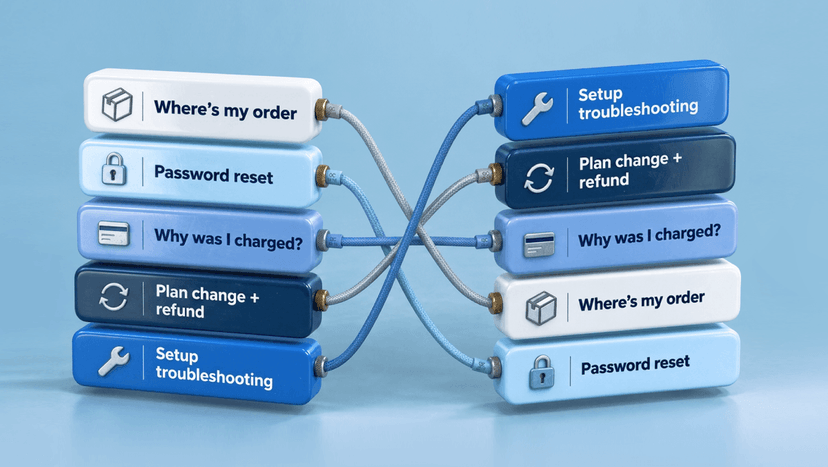
Once collected, the system automatically organizes the data. Conversations are grouped by topics, like password resets or billing inquiries, and tagged based on outcomes - whether they were resolved successfully or needed escalation. This structured approach ensures AI has a clear picture of your support landscape.
Step 2: Using NLP to Analyze Conversations
Next, AI uses Natural Language Processing (NLP) to dig deeper into the data. It doesn’t just look at what was said but also how it was said and what the results were.
NLP tools, like intent recognition and sentiment analysis, work together to uncover the core issues behind customer inquiries. They also pick up on emotional cues, helping AI suggest responses that match the tone of the conversation. By studying successful resolution paths, the system identifies which troubleshooting steps or explanations work best to minimize follow-up questions.
This analysis lays the groundwork for generating practical, context-specific reply suggestions.
Step 3: Suggesting Helpful Replies
With insights from past conversations, AI generates reply suggestions tailored to new inquiries. When a customer reaches out, the system matches their issue to historical patterns and recommends responses that have worked well in similar cases.
These suggestions aren’t one-size-fits-all. They take into account the customer’s tone, issue, and history. For example, a tech-savvy user reporting a bug might see a more detailed response than a first-time customer asking for setup help.
AI also learns from your team’s best practices. If an agent, like Sarah, consistently resolves billing disputes with a specific explanation, the system suggests similar approaches to other agents handling similar issues. And as conversations progress, AI adapts in real time. If the initial response doesn’t land well, it recommends follow-ups that have clarified similar misunderstandings in the past.
These suggestions integrate seamlessly into your existing tools, appearing as agents type their replies. The system aligns with your team’s communication style, ensuring responses sound natural and on-brand.
Context can reach wider than one inbox. Front keeps conversation history shared across teams, so a suggested reply reflects what colleagues in other departments already told the customer.
Step 4: Learning from New Interactions
Every new conversation helps the AI improve. It tracks which suggestions agents use, how customers respond, and whether the issue gets resolved. This creates a feedback loop that fine-tunes future recommendations.
The system also spots new trends in customer inquiries. For instance, if questions about a new feature start popping up, AI quickly adapts by learning from early successful responses. It then suggests those explanations to other agents.
Metrics like response time, customer satisfaction, and resolution rates feed back into the system, helping it refine its suggestions even further. And because the learning process is automatic, there’s no need for manual updates. The more your team interacts with customers, the better the AI gets at delivering responses that feel natural and effective.
CoSupport AI ensures your team stays ahead by continuously adapting to your unique customer needs and communication style, making every interaction smoother and more efficient.
sbb-itb-97114f1
What Most People Get Wrong About Using Past Conversations
When it comes to using AI with past conversations, many support teams stumble into avoidable mistakes. These missteps not only waste time but can also harm the customer experience. By recognizing these common errors, you can set your AI initiatives up for success and ensure smoother interactions for your team and customers.
Mistake 1: Prioritizing data quantity over quality
One of the biggest traps is assuming that more data automatically leads to better AI performance. Many teams upload years’ worth of old tickets, thinking sheer volume will improve results. But this often backfires.
For instance, outdated conversations about discontinued products won’t generate useful insights in the future. Worse, if you include interactions with poor resolutions or frustrated customers, the AI may learn unhelpful patterns. Feeding the system flawed data risks it repeating those same mistakes.
Focus on quality, not quantity. Instead of overwhelming the system with a massive archive, concentrate on recent, well-handled conversations. A smaller dataset of successful resolutions - say, from the last six months - will teach the AI far more than years of inconsistent interactions. This ensures the AI learns from your team’s best practices, not their missteps.
Mistake 2: Neglecting the importance of context
AI thrives on context, but many teams fail to provide the full picture. When only partial data is shared, the AI’s suggestions often miss the mark.
Take this example: if the AI only sees a customer’s latest message saying, “This still doesn’t work,” it won’t know what steps have already been tried. Without the full conversation history, product details, or the customer’s prior interactions, the AI might suggest redundant or irrelevant solutions.
Complete context is essential. Make sure your AI has access to the entire conversation thread, including customer history and product specifics. This helps it generate responses that align with the situation. Tools like CoSupport AI can automatically pull this information from your systems, ensuring the AI has everything it needs to provide accurate suggestions. Without this comprehensive view, the AI risks misinterpreting queries, creating extra work for your agents.
Mistake 3: Believing AI can replace human agents
Perhaps the most dangerous misconception is the idea that AI can completely replace human customer service agents. This belief often leads to poor outcomes for both businesses and their customers.
75 percent of customers still prefer interacting with a human for customer service issues.
AI lacks the empathy and nuanced problem-solving that human agents bring to the table. When customers are upset or dealing with sensitive matters, they need understanding and emotional intelligence - something AI simply can’t provide. Misinterpreted emotional cues or tone can even escalate customer frustration.
Over-reliance on AI also introduces potential security risks. Human agents are critical for safeguarding sensitive customer data, especially in complex scenarios like billing disputes or account verification. AI may not always recognize situations where extra care or security measures are needed.
Think collaboration, not replacement. AI is best suited for routine tasks like password resets or straightforward troubleshooting. This frees up your team to focus on building relationships and solving more complex problems. Establish clear escalation paths so customers can seamlessly transition to a human agent when needed.
A Cornell University study found that 87 percent of contact center workers experience high stress levels on the job.
By handling repetitive tasks, AI can help reduce this stress, but it can’t replicate the human touch that’s so vital to exceptional customer service.
Steering clear of these mistakes will help you unlock AI’s potential while maintaining the personal connection that customers value.
Key Takeaways
Here’s a breakdown of the main points from our guide - highlighting how AI leverages past conversations to deliver practical benefits.
AI boosts speed, accuracy, and consistency
By learning from past interactions, AI speeds up response times and improves first-contact resolution rates. It uses proven replies from earlier chats, providing both new and seasoned agents with reliable, consistent suggestions.
The secret to better accuracy lies in AI’s ability to recognize patterns. It identifies responses that successfully resolved similar issues before and recommends those solutions. This reduces unnecessary back-and-forth with customers, leading to faster resolutions.
Consistency becomes effortless as AI taps into your team’s best practices. New agents can immediately access institutional knowledge, while experienced agents save time by automating routine tasks.
High-quality data and context are critical
AI performs best when it learns from recent, well-handled conversations rather than relying on outdated or poorly organized data. A complete conversation history adds context, helping AI refine its suggestions to ensure they’re relevant and appropriate. Investing in clean, well-organized data upfront minimizes errors and streamlines the process.
This approach ensures a smoother, faster AI setup.
CoSupport AI makes setup easy
CoSupport AI uses your existing content to train itself - no coding required. It organizes your support data automatically and quickly adapts to new interactions, keeping costs tied directly to resolved issues.
The platform integrates seamlessly with tools like Zendesk, Intercom, and Slack, organizing your conversation data without extra effort. You can have AI-powered suggestions up and running in under 10 minutes instead of waiting months.
At $0.50 per AI resolution, you pay only for results, and unresolved tickets are free.
FAQs
How does AI use past conversations to provide accurate and relevant replies?
AI enhances the accuracy and relevance of responses by analyzing the real-time context of conversations. It uses sophisticated models to evaluate how well the dialogue flows and maintains quality, while also factoring in past interactions to recognize patterns and preferences.
By tapping into chat history and employing semantic search, AI pulls essential details from earlier exchanges to create responses that fit naturally within the conversation. This approach ensures replies are not just accurate but also consistent with the ongoing discussion, delivering a smooth and cohesive experience.
How can I avoid common mistakes when adding AI to customer support workflows?
To steer clear of common pitfalls, start by setting specific goals for how AI will address your business needs. Ensuring the data used to train the AI is both accurate and well-organized is key to avoiding unhelpful or incorrect responses.
Start small with limited automation - perhaps managing about 30% of customer inquiries. This approach allows you to test how well the system works while keeping risks low before expanding its role. Regularly monitor AI interactions to confirm they maintain a conversational, human-like tone and avoid excessive automation, which can erode customer trust.
Lastly, be upfront with your customers by clearly indicating when they’re engaging with AI instead of a human. This transparency helps build trust and creates a smoother, more positive experience.
How does CoSupport AI combine AI-generated replies with human support for complex issues?
CoSupport AI takes a hybrid approach to customer support, combining the speed of AI with the empathy of human agents. Routine tasks and simple questions are handled by AI, while more complex, sensitive issues are left to skilled human representatives.
By automating repetitive tasks, CoSupport AI allows your team to focus on addressing unique and challenging scenarios. This setup ensures that customers get prompt, accurate answers for basic inquiries, while more intricate concerns are met with care and thoughtful human interaction.
.png)