

Which AI tool is right for your team? That depends on whether you want to assist agents or eliminate tickets entirely.
- Eesel AI pulls answers from your existing knowledge base to help agents respond faster or handle basic self-service inquiries. It’s ideal for teams wanting AI-drafted responses and gradual automation.
- CoSupport AI goes further by autonomously resolving up to 90% of repetitive tickets (e.g., password resets, order updates) without agent involvement. This is particularly effective for improving eCommerce customer support where high volumes of routine queries are common. It’s perfect if your goal is to clear your queue and reduce workload.
Key Differences:
- Eesel AI: Supports 80+ languages, integrates with external tools (Google Drive, Notion), and costs $0.10–$0.40 per task.
- CoSupport AI: Fully automates ticket resolution, supports 40+ languages, and offers flexible pricing (e.g., $0.19/resolved ticket or $99/month flat for high volumes).
Both tools integrate with Zendesk and Freshdesk and require no developer setup. Choose Eesel AI to streamline agent workflows or CoSupport AI to eliminate routine tickets.
Quick Comparison:
| Feature | Eesel AI | CoSupport AI |
|---|---|---|
| Automation | Drafts + confidence-based responses | Fully autonomous ticket resolution |
| Languages | 80+ | 40+ |
| Setup Time | Under 15 minutes | Under 10 minutes |
| Integrations | Google Drive, Notion, Confluence | Zendesk, Freshdesk |
| Cost | $0.10–$0.40/task | $0.19/resolved ticket or $99/month |
If you handle 500–10,000 tickets monthly and want to remove repetitive tasks, CoSupport AI is the better fit. For teams needing AI-assisted responses and broader integrations, go with Eesel AI.
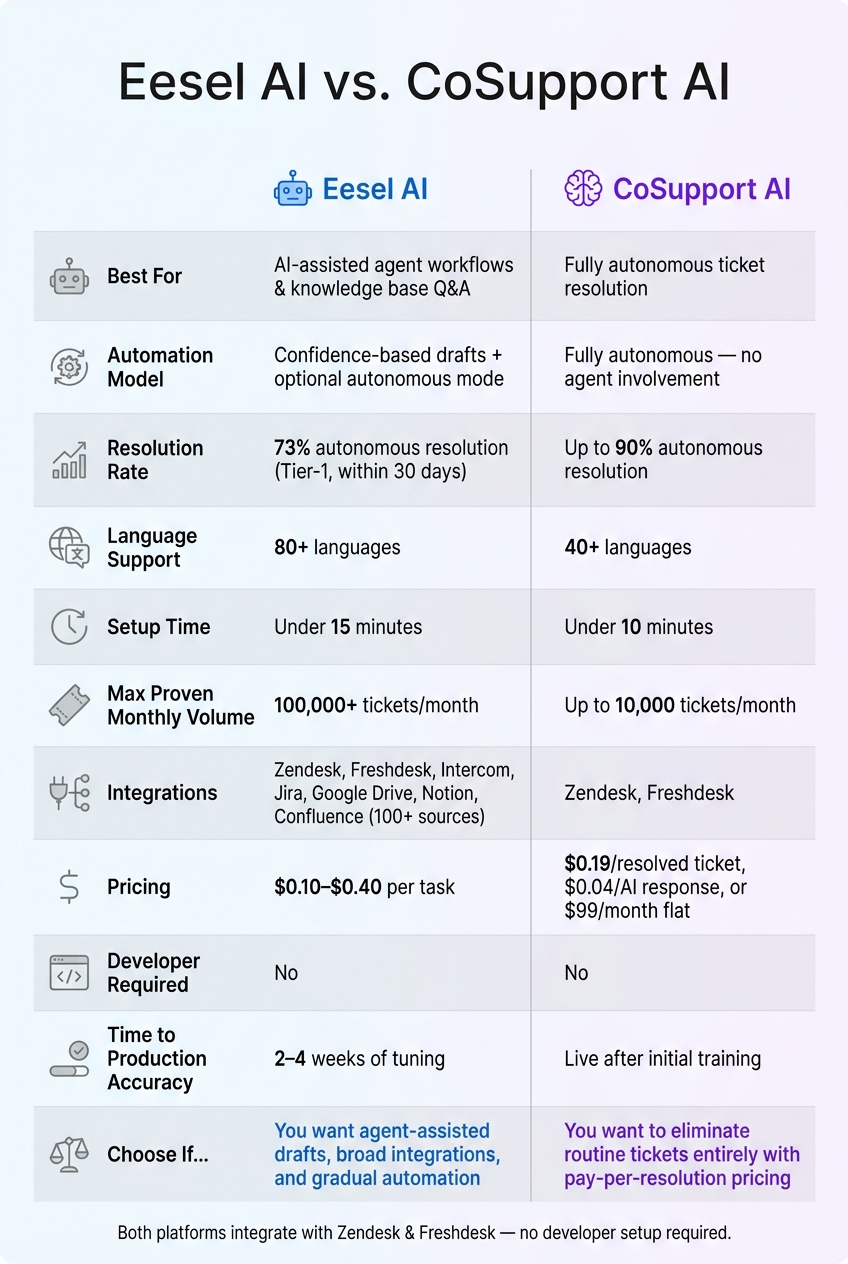
Eesel AI vs. CoSupport AI: Side-by-Side Comparison
How Each Platform Works
Eesel AI focuses on speeding up agent responses by pulling answers directly from your documentation, while CoSupport AI takes a different route by fully automating ticket resolution.
Eesel AI: Knowledge Base Q&A
Eesel AI integrates with your existing tools - like Google Drive, Notion, Confluence, or SharePoint - to instantly pull relevant answers when a question arises. No need to migrate data. It learns from your help center articles and previously resolved tickets, which helps it align with your team's tone and approach to problem-solving.
Before going live, teams can test the AI by running it against 50–200 past tickets to pinpoint any gaps in the knowledge base. Most teams start in Copilot mode, where the AI assistant for customer support agents drafts responses for review. Over time, as accuracy improves, it can autonomously handle specific categories of tickets.
"By linking our Zendesk and Google Docs, customers get instant responses and tough questions are automatically triaged." - Wesley Wang, CTO, Ecosa
Eesel AI enhances agent efficiency by drafting responses for review, while CoSupport AI takes a fully hands-off approach, as explained below.
CoSupport AI: Autonomous Ticket Resolution
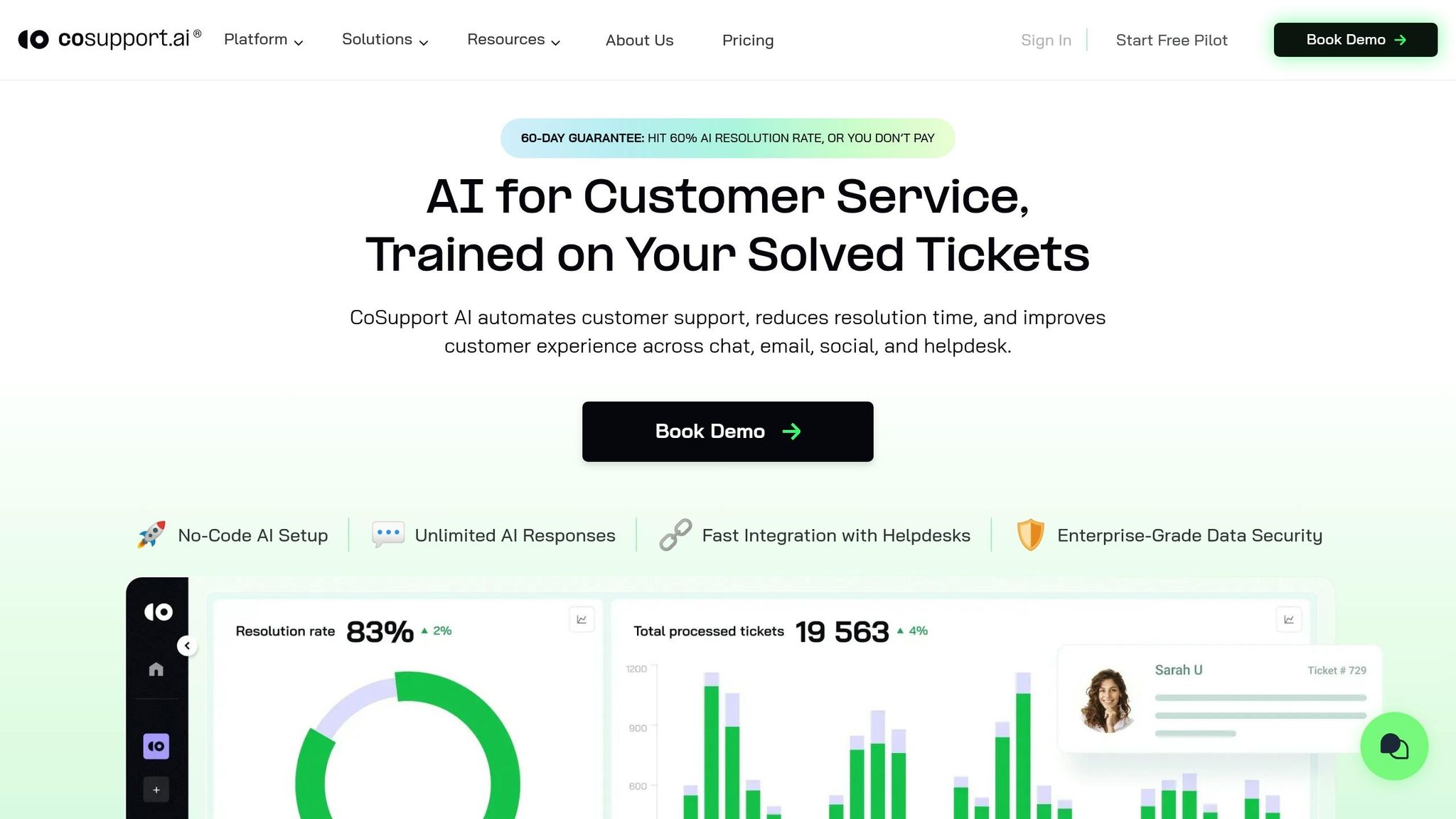
CoSupport AI connects directly to platforms like Zendesk or Freshdesk. Setup is quick - under 10 minutes - and doesn’t require developers. The AI trains on your past tickets, macros, and help center content to handle resolutions on its own.
It uses only verified information from your data and avoids guessing. If a ticket falls outside its knowledge base, it escalates to an agent. This makes it ideal for handling repetitive Tier-1 tickets, such as order statuses, password resets, and billing inquiries. Companies like Ocus (managing 6,000 Zendesk tickets monthly) and Shelterluv (handling 2,000 Zendesk tickets monthly) rely on CoSupport AI to clear these routine tasks from their agents' workloads.
While Eesel AI supports agents by drafting responses, CoSupport AI eliminates the need for agent involvement altogether for specific types of tickets.
sbb-itb-97114f1
Core Capabilities Compared
Ticket Handling and Automation Depth
The way each tool reduces agent workload is a key differentiator. Eesel AI uses a confidence-based system to draft responses for agents. High-confidence responses are sent automatically, while lower-confidence ones are flagged for agent review. On the other hand, CoSupport AI is designed to autonomously resolve tickets without requiring any agent intervention for the ticket types it has been trained on.
For example, Gridwise reported a 73% autonomous resolution rate for Tier-1 Zendesk requests within just 30 days of using Eesel AI's agent mode[1]. Meanwhile, CoSupport AI clients like Nordic Knots and iubenda, each managing 5,000 tickets per month on Zendesk and Freshdesk, respectively, have seen up to 90% of tickets resolved autonomously. This distinction is especially important if your goal is to reduce headcount pressure rather than simply streamline agent workflows. The difference in performance has direct implications for support costs and how agents are allocated - topics covered in more detail later.
Language Support and Ticket Volume
When it comes to language coverage, Eesel AI supports 80+ languages and automatically detects the customer’s language to tailor responses. Smava, for instance, processes over 100,000 tickets per month on Zendesk using Eesel AI. By comparison, CoSupport AI supports 40+ languages and is optimized for teams dealing with 500 to 10,000 tickets monthly, where autonomous resolution can significantly reduce costs.
If your team handles high ticket volumes across multiple languages, Eesel AI’s broader language capabilities might be advantageous. However, if your primary focus is eliminating agent involvement for repetitive tickets, CoSupport AI's fully autonomous model could be the better fit.
Zendesk and Freshdesk integration
Both platforms integrate seamlessly with Zendesk and Freshdesk, requiring no developer input. Eesel AI has the added ability to pull data from external sources like Google Drive, Notion, and Confluence. In contrast, CoSupport AI focuses on training within your helpdesk environment, leveraging past tickets, macros, and help center content.
These differences highlight how each tool approaches integration and setup, setting the stage for a deeper look at deployment and pricing in upcoming sections.
| Eesel AI | CoSupport AI | |
|---|---|---|
| Automation model | Drafts + autonomous (confidence-based) | Fully autonomous resolution |
| Languages | 80+ | 40+ |
| Setup time | Under 15 minutes | Under 10 minutes |
| External source integrations | 100+ (Google Drive, Notion, Confluence, etc.) | Tickets, macros, help center |
| Max proven monthly volume | 100,000+ tickets | Up to 10,000 tickets |
| Helpdesk platforms | Zendesk, Freshdesk, Intercom, Jira, and more | Zendesk, Freshdesk |
[1] eesel AI Blog, 2026
Deployment and Setup
Both tools are quick to deploy, but the steps to ensure reliable performance vary.
Eesel AI connects to platforms like Zendesk or Freshdesk in less than 15 minutes. Once connected, it syncs your knowledge base, historical tickets, and external documentation sources such as Google Drive, Notion, and Confluence. You can customize the AI's tone and simulate responses using 50–200 historical tickets to pinpoint any gaps. From there, you can choose between two modes: Copilot (where it drafts responses for agent approval) or Autonomous (where it resolves tickets directly). However, achieving production-level accuracy in autonomous mode typically takes 2–4 weeks of fine-tuning.
On the other hand, CoSupport AI simplifies the process by focusing exclusively on your internal helpdesk data. It connects to Zendesk or Freshdesk in under 10 minutes without requiring external documentation syncing or developer assistance. After training on past tickets, it immediately begins resolving issues autonomously, skipping the staged copilot phase entirely.
The main distinction between the two lies in their data requirements. Eesel AI pulls from a broader range of content by integrating external sources, while CoSupport AI relies solely on internal helpdesk data for its operations.
| Eesel AI | CoSupport AI | |
|---|---|---|
| Time to connect | Under 15 minutes | Under 10 minutes |
| Data required | Knowledge base articles, past tickets, external docs | Past tickets, macros, help center |
| External integrations | Google Drive, Notion, Confluence | Zendesk, Freshdesk only |
| Time to production accuracy | 2–4 weeks of tuning | Live after initial training |
| Developer required | No | No |
Pricing and Cost per Ticket
After breaking down deployment differences, let’s dive into how the pricing models of these two platforms affect your budget, especially when ticket volume escalates. The way each platform structures its pricing can significantly influence your overall expenses.
Eesel AI Pricing
Eesel AI follows a task-based pricing model rather than charging per agent. Each helpdesk task - whether it’s a ticket or a chat - costs $0.40 on their pay-per-task plan. If you opt for a subscription plan, the cost can drop to around $0.10–$0.15 per task as your usage increases. To sweeten the deal, new accounts also get $50 in free credits to test the system before committing. This setup is ideal for smaller teams with predictable ticket volumes who want to avoid traditional seat-based pricing.
That said, costs can climb quickly at scale. For instance, a team handling 3,500 tickets a month would be looking at roughly $1,400/month - and that’s before factoring in any additional costs for more complex tasks.
On the other hand, CoSupport AI takes a more flexible approach, offering tailored pricing plans designed to fit different operational needs.
CoSupport AI Pricing
CoSupport AI provides three distinct pricing models, each catering to different types of teams:
| Plan | Price | Best For |
|---|---|---|
| Resolution-Based | $0.19/resolved ticket | Teams focusing on paying per successful outcome |
| Response-Based | $0.04/AI response | High-volume teams requiring greater flexibility |
| Server-Based | $99/month flat | Teams preferring predictable, fixed costs |
The resolution-based plan offers a straightforward value proposition: you only pay for tickets that the AI successfully resolves. If a ticket isn’t resolved, it costs you nothing. For example, a team handling 3,500 tickets with a 70% resolution rate would spend about $465/month. Meanwhile, the $99/month flat rate is perfect for larger teams managing 5,000+ tickets, driving the per-ticket cost down to less than $0.02 - a cost-effective option embraced by companies like Nordic Knots and iubenda.
Which Tool Fits Your Team
The choice here boils down to what your team needs most: speeding up agent responses or using AI agents for customer support to automate ticket resolution entirely.
Eesel AI is ideal for teams focused on cutting down drafting time and quickly pulling answers from a knowledge base. For example, Gridwise saw a 73% autonomous resolution rate for Tier-1 Zendesk requests in just one month. However, achieving this involved careful setup, including using Simulation Mode for testing and gradually shifting from Copilot to Agent mode.
On the other hand, CoSupport AI shines in scenarios where high ticket volumes demand full automation. Companies like Shelterluv (handling 2,000 tickets/month on Zendesk), Nordic Knots (5,000 tickets/month), and iubenda (5,000 tickets/month on Freshdesk) rely on it to resolve tickets without agent involvement. With its flat rate of $99/month, a team handling 5,000+ tickets pays less than $0.02 per ticket - a highly cost-efficient option.
Let’s break it down further:
| If you need… | Better fit |
|---|---|
| AI drafts for agent review | Eesel AI |
| Gradual automation with Copilot mode | Eesel AI |
| Predictable flat-rate pricing at scale | CoSupport AI |
| Pay-per-resolved-ticket model | CoSupport AI |
| Sub-$0.02 cost per ticket at 5,000+ volume | CoSupport AI |
If your team prefers reviewing every response to build confidence in automation, Eesel AI is your go-to. But if you want routine tickets resolved without agent involvement and prefer paying only for completed cases, CoSupport AI is the better choice. Try demo now.



.png&w=828&q=100)
.png&w=96&q=100)
.png&w=828&q=100)
.png&w=96&q=100)