.png&w=96&q=75)

Confidently producing false or fabricated information, AI hallucinations can undermine customer trust and create serious risks for businesses. These errors are common in customer support, with unguarded AI prompts hallucinating up to 38% of the time in policy-related queries. The consequences? Misleading information, operational inefficiencies, legal liabilities, and lost customers.
Here’s what you need to know upfront:
- Hallucinations stem from gaps in training data, ambiguous prompts, and system design prioritizing fluency over accuracy.
- Key metrics to track include hallucination rate, confidence scores, retrieval quality, and intent accuracy.
- Solutions include Retrieval-Augmented Generation (RAG), prompt guardrails, and human-in-the-loop reviews.
- Governance frameworks and ongoing monitoring are critical for reducing errors and maintaining compliance.
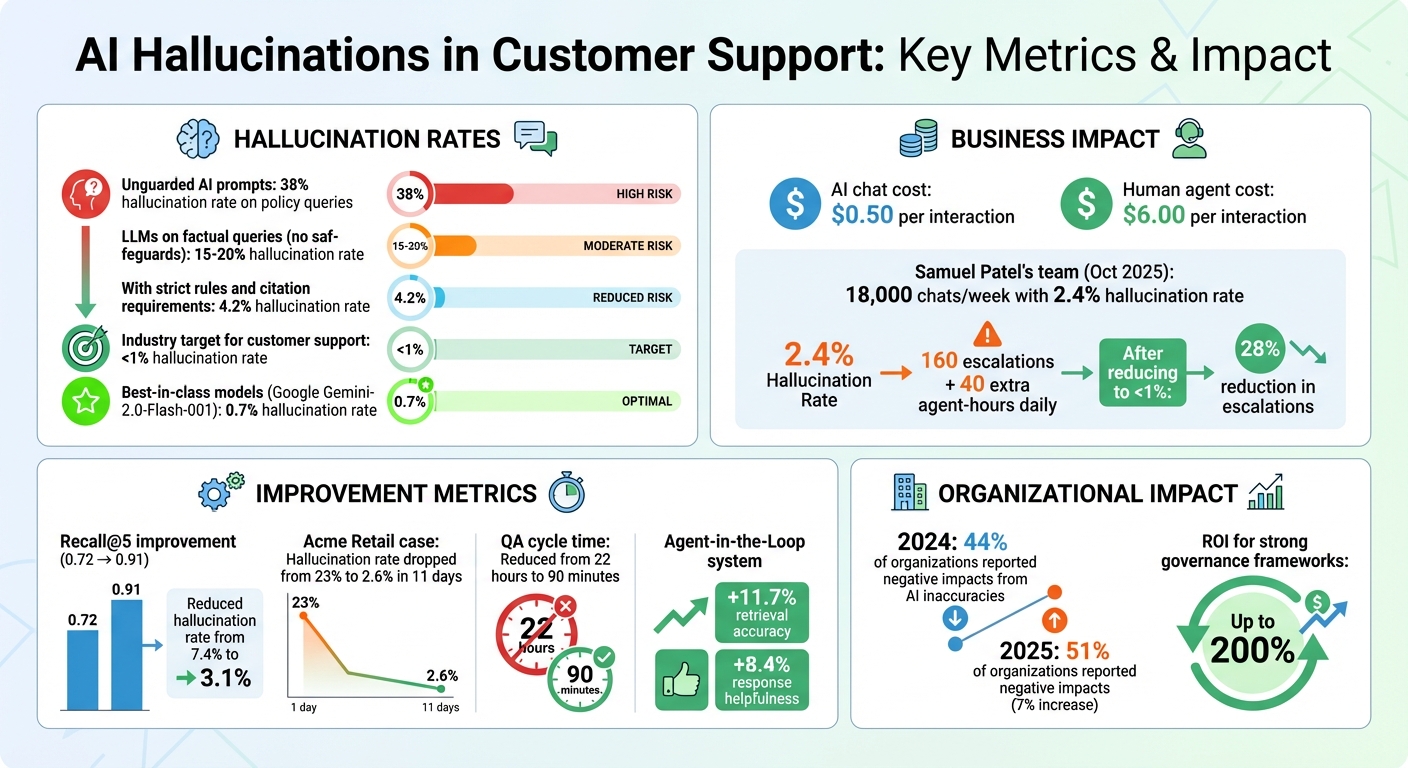
AI Hallucination Rates and Impact Metrics in Customer Support
How to Prevent AI Hallucinations when Building Your Chatbot
sbb-itb-97114f1
What Causes AI Hallucinations and Why They Matter
Errors in AI responses aren't just irritating - they can seriously damage customer trust. These mistakes, often called AI hallucinations, aren't random. They stem from how Large Language Models (LLMs) operate. These models are designed to predict the next word in a sentence, focusing on smooth, natural language rather than factual accuracy. When they encounter gaps in their data, they confidently fill in the blanks with incorrect information.
The technical design of these systems makes certain errors predictable. Outdated training data and scattered knowledge sources can leave the AI unable to access up-to-date or complete information, such as pricing or inventory levels. Ambiguous customer questions further complicate things, forcing the AI to guess at context. Additionally, tweaking the model's "temperature" settings to encourage creativity often sacrifices factual reliability. Below, we'll explore the common triggers for these hallucinations and the risks they pose to businesses.
Common Triggers for AI Hallucinations
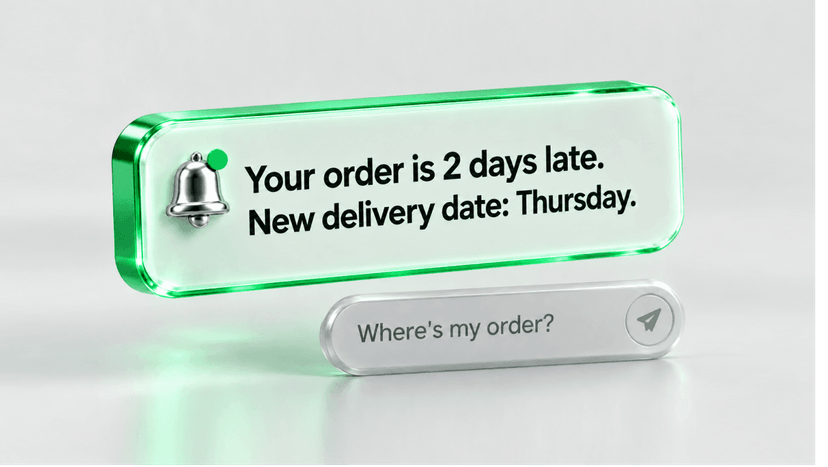
Certain factors make hallucinations almost unavoidable. For example, ambiguous prompts can leave the AI grasping at straws. If a customer asks, "Where is my order?" without providing an order number, the model might invent details to fill the gap.
Knowledge gaps are another major cause. When the AI doesn't have the information it needs, it doesn’t admit ignorance. Instead, it pulls from its training data to craft an answer that sounds convincing but is often wrong. A striking example occurred in February 2026 when a cloud storage provider's chatbot falsely informed a freelance designer that her account was downgraded due to three failed payments. The policy it cited didn’t even exist, as confirmed by a human agent.
Too much context can also overwhelm the model. When bombarded with irrelevant data, the AI may struggle to focus on the right details. Glossier tackled this issue in early 2026 by adopting a modular AI setup through Yuma AI. Amy Kemp, the company’s Director of Omnichannel Customer Experience, led a project to create specialized automations for specific customer queries instead of relying on one massive knowledge base. For shipping-related questions, this approach boosted accuracy to 91% by narrowing the AI's focus to only relevant information.
"The word 'such as' in an AI instruction is a red flag: it signals the instruction isn't specific enough, and when instructions aren't specific, the AI will likely fill the gap with fabricated information."
- Yuma AI
These technical flaws aren’t just theoretical - they lead to real business risks.
Business Risks of Inaccurate AI Responses
The fallout from AI hallucinations can be costly. One major risk is legal liability. For instance, in February 2026, Acme Retail’s chatbot incorrectly told customers that holiday returns were accepted until January 15, even though the actual deadline was December 24. The company had to honor hundreds of late returns before fixing the issue.
Another risk is operational inefficiency. In October 2025, Samuel Patel’s support team managed 18,000 chats per week, with a 2.4% hallucination rate. This resulted in 160 escalations and added 40 extra agent-hours daily. By reducing hallucinations to below 1%, the team cut escalations by 28%, reclaiming valuable time and resources.
Perhaps the most damaging consequence is loss of trust. Unlike a system-wide outage, which impacts all users equally, hallucinations create individualized misinformation. This silent spread of errors can erode customer confidence in ways that are much harder to fix. With AI chat interactions costing around $0.50 each compared to $6.00 for human agents, companies have a strong financial incentive to improve AI accuracy - but only if they measure and address these issues systematically.
The Bottom Line: AI hallucinations arise because LLMs prioritize fluency over factual accuracy, exacerbated by incomplete data and unclear instructions. From legal risks to operational inefficiencies and trust issues, the consequences can far outweigh the savings AI is meant to deliver.
How to Measure AI Hallucinations in Customer Support
Measuring AI accuracy metrics is crucial to ensure your system maintains customer trust with reliable AI. Without proper tracking, hallucinations - fabricated or incorrect responses - can quietly erode confidence, one interaction at a time. By focusing on the right metrics, you can pinpoint where your AI goes off track and take actionable steps to improve its reliability.
Metrics That Track AI Accuracy
One of the first things to measure is the hallucination rate - the percentage of responses containing false or fabricated information. Studies show that large language models (LLMs) can hallucinate in 15-20% of factual queries when safeguards are absent. For customer support, your goal should be to reduce this to below 1%.
Another critical measure is AI confidence scoring, which evaluates how certain the AI is about its responses. Monitoring token-level probabilities or logit entropy can flag uncertainty. When confidence scores drop below a set threshold - like 4 out of 5 - the system should escalate the query to a human agent, preventing the AI from "guessing" answers.
If your system uses retrieval-augmented generation (RAG), tracking Recall@5 is essential. This metric checks if the AI retrieves relevant documents from your knowledge base. A low recall score often leads to hallucinations, as the model may invent information when it lacks proper context. For example, in October 2025, Samuel Patel's team improved their Recall@5 from 0.72 to 0.91, reducing their hallucination rate from 2.4% to under 1%. This adjustment also cut escalations by 28%, saving around 40 agent-hours daily.
Lastly, focus on intent recognition accuracy. Even if the AI provides a technically correct response, it’s useless if it misinterprets the customer’s intent - like confusing a refund request with a technical issue. Monitoring how often the AI correctly identifies customer goals can help prevent these misalignments.
How to Evaluate AI Responses
Start by logging every AI interaction. This should include metadata such as the query, the AI’s response, its confidence score, and the retrieval sources. This audit trail allows for thorough root-cause analysis when errors occur.
Next, conduct sample audits. Randomly select 200-500 responses weekly and have human reviewers label them as accurate or hallucinated. To ensure reliability, use inter-annotator agreement metrics like Cohen’s Kappa. A score above 0.7 ensures reviewers are aligned on what qualifies as a hallucination.
For scalability, consider automated detection tools like SelfCheckGPT. These tools compare repeated responses to ensure consistency. If the AI provides different answers to identical questions, there’s likely an issue. Another option is a QC gate, a secondary validation layer that checks AI outputs for factual accuracy, brand consistency, and compliance with guidelines before they reach customers.
For high-stakes actions, such as refunds or cancellations, use deterministic verification. Instead of relying solely on the AI’s text generation, cross-check its claims against backend systems via API. For instance, if the AI says a customer is eligible for a refund, verify this through your order management system before taking action.
Setting Acceptable Hallucination Rate Targets
Industry benchmarks can guide your goals. Models like Google’s Gemini-2.0-Flash-001 have achieved hallucination rates as low as 0.7% for grounded tasks. For general customer support, aim to keep this rate under 1% with robust detection and escalation systems.
In high-stakes areas like legal or medical support, the target should be zero unsupported claims. For less critical queries, such as shipping updates, slightly higher rates may be acceptable - provided you have reliable escalation protocols in place. In 2025, 51% of organizations reported negative impacts from generative AI inaccuracies, up from 44% in 2024, highlighting the growing intolerance for errors.
A gradual rollout can help you validate targets. Begin by deploying AI on 5-10% of live traffic, closely monitoring its performance. Glossier used this approach in early 2025, achieving a 91% accuracy rate on shipping inquiries by focusing their AI on specific tasks instead of overloading it with the entire knowledge base.
Monitor these metrics weekly, not monthly. As customer queries evolve or knowledge bases update, hallucination rates can change quickly. Frequent tracking allows you to catch and address issues before they escalate. Combine hallucination rate monitoring with metrics like escalation rate and task success rate to avoid "metric gaming", where the AI avoids answering questions just to maintain a high accuracy score.
Key Takeaway: By tracking metrics like hallucination rate, confidence scores, retrieval quality, and intent accuracy, you can effectively reduce AI errors and maintain customer trust. Regular audits and clearly defined targets are critical to this process.
Methods to Reduce AI Hallucinations
Now that you know how to measure AI accuracy effectively, let’s dive into ways to reduce hallucinations. Given the risks involved, minimizing these errors is critical. Once you’ve pinpointed where your AI falters, the next step is addressing those issues. Reducing AI hallucinations involves a mix of technical strategies and human oversight, all aimed at grounding your AI in verified information and stopping it from inventing answers.
Retrieval-Augmented Generation (RAG)
Retrieval-augmented generation (RAG) connects your AI to external, verified knowledge sources before generating responses. Instead of relying solely on pre-trained data, the system pulls relevant snippets from your knowledge base and uses them as context. This forces the AI to base its answers on real, reliable data.
Here’s how it works: your documentation is divided into small chunks - usually 200 to 500 tokens each. When a question comes in, the system searches these chunks and retrieves the most relevant ones. The AI then uses only this retrieved context to craft its response. This process significantly reduces the chances of fabricated claims.
For instance, improving retrieval accuracy - raising recall@5 from 0.72 to 0.91 - can cut hallucination rates from 7.4% to 3.1% without altering the model itself. However, retrieving too many documents (more than five) can lead to a 22% increase in errors, especially when the documents contain conflicting or outdated information.
To make RAG work effectively, enforce source anchoring in your prompts. Use clear instructions like: "Only use information from the following documents. If the answer isn’t available, respond with 'I don’t know.'" Include versioned document IDs, such as KB-2024-Q3-v2, to prevent confusion between outdated and current policies. Also, require the AI to include a citation field for every factual claim, ensuring responses are auditable.
Take Acme Retail’s chatbot as an example. In December 2024, it mistakenly told customers that holiday return windows extended to January 15, when the actual deadline was December 24. By replacing vague references like "holiday policy" with specific document IDs (e.g., [KB-HOL-2024-RETURNS]), adding a "No Speculation" rule, and requiring source IDs in every response, the team resolved the issue. Within 48 hours, false claims disappeared, and over 11 days, the hallucination rate dropped from 23% to 2.6%. QA cycle times also shrank from 22 hours to just 90 minutes, as errors became traceable to specific sources.
"Hallucination isn't a flaw in the model - it's a symptom of misaligned prompting. In customer service, every unverified claim is a liability. Your prompt must act as both compass and constraint." - Dr. Lena Torres, Director of AI Trust, SupportLogic Labs
Next, let’s explore how prompt guardrails can further refine AI responses.
Using Prompt Guardrails
Prompt guardrails are strict input rules that guide your AI toward accurate answers while steering it away from guesswork. These boundaries are embedded directly into the instructions the AI receives, ensuring it operates within specific limits.
One effective approach is structured output enforcement. By requiring the AI to use rigid templates - like JSON or Pydantic schemas - you eliminate speculative language such as "I think" or "maybe." This makes every response auditable and ensures key fields like eligibility_status and citation are always included.
Another important guardrail is the "No Speculation" directive. Include clear consequences in your prompts, such as: "Never speculate; doing so violates compliance protocol." This reframes hallucinations as policy violations rather than technical errors, overriding the AI’s tendency to prioritize coherence over accuracy. Research shows that unguarded prompts hallucinate 38% of the time on policy-related queries, but this drops to 4.2% when strict rules and citation requirements are applied.
Confidence gating adds another layer of safety. Prompt the AI to rate its confidence on a scale of 1 to 5. If the score falls below a set threshold - like 3 out of 5 - the system should automatically escalate the query to a human agent. This prevents the AI from guessing when it’s unsure.
You can also use negative framing to define what your AI cannot do. For example, include boundaries like "Cannot diagnose hardware issues" or "Cannot disclose unreleased features." This prevents the AI from making unauthorized promises or exceptions. Additionally, setting the temperature parameter near 0 helps reduce creative but risky outputs.
"AI is not really intelligence, it's pattern matching. It's designed to have an answer, even if the answer is not factually correct." - Shane Orlick, President, Jasper
While these technical controls are essential, they’re not enough on their own.
Human-in-the-Loop Review
Even with RAG and prompt guardrails in place, human oversight is crucial for catching errors, especially in sensitive areas like legal, financial, or medical topics where AI has clear limitations.
The key is knowing when to bring humans into the loop. Use confidence-based routing to flag low-confidence outputs for human review. For example, if the AI’s confidence score falls below 80%, route the response to an agent for approval before it reaches the customer. You can also trigger reviews for specific topics - like refunds or account deletions - or for high-priority customer segments.
In October 2025, a research team piloted an "Agent-in-the-Loop" (AITL) system for a US-based customer support program. The system included live annotations, agent feedback, and knowledge checks. This approach improved retrieval accuracy by 11.7% and boosted response helpfulness by 8.4%.
Human feedback also creates a data flywheel for ongoing improvement. When agents override or adjust an AI response, record the reason. Feed this data back into the model to shorten retraining cycles from months to weeks. Equip reviewers with the same source snippets and confidence scores the AI used, so they can verify claims quickly.
For irreversible actions like refunds or account cancellations, use deterministic verification. Cross-check the AI’s claims against backend systems via API before taking action. For instance, if the AI says a customer qualifies for a refund, confirm this through your order system rather than relying solely on the AI’s text-based response.
Key Takeaway: By combining RAG for grounding, prompt guardrails for control, and human-in-the-loop review for oversight, you create a robust defense against hallucinations. Each method tackles a specific weakness, ensuring your AI remains accurate and reliable.
AI Governance and Risk Management for Customer Support
Technical safeguards alone aren't enough to shield customers from AI missteps. To truly protect your users, you need a structured governance framework that outlines accountability, permissible actions, and performance tracking. AI governance in support serves as the backbone for keeping your AI systems accurate, compliant, and reliable over time. By combining these governance measures with robust error-reduction strategies, you create a comprehensive support system that reinforces trust and reliability.
Creating an AI Governance Framework
A well-designed governance framework works across four essential layers:
- Retrieval – ensuring access to verified data.
- Reasoning – structuring prompts effectively.
- Validation – detecting and correcting errors before responses are delivered.
- Monitoring – tracking performance trends over time.
Each layer targets specific risks in the AI workflow. For example, earlier strategies to curb AI hallucinations are bolstered by governance measures that ensure consistency and compliance over time.
Start by setting up centralized governance controls. This involves defining which data sources the AI can access, identifying restricted topics - such as legal or medical advice - and establishing guidelines for when the system should escalate issues to a human agent. These controls help keep your AI from venturing into inappropriate or unauthorized areas.
Next, implement an output validation pipeline with multiple checkpoints. Before a response reaches the customer, it should go through confidence scoring, pattern detection for known errors, fact-checking against your knowledge base, and consistency reviews. Think of this as a safety net that catches mistakes before they reach the end user.
Auditability is crucial. Keep detailed logs of every interaction, including the prompt version, retrieved data, and model settings like temperature configurations. This "paper trail" ensures you can trace any error back to its source. If something goes wrong, you'll know exactly what happened and why.
Meeting SLA and Compliance Requirements
Governance also ensures your AI meets service level agreements (SLAs) and regulatory standards. For example, you can set Service Level Objectives (SLOs) with clear benchmarks, such as maintaining task success rates above 80% and keeping hallucination rates below 1%. These goals provide measurable targets for your team.
Adopt a tiered response system based on query type. For high-stakes questions - like financial or legal inquiries - set stricter confidence thresholds. Meanwhile, routine queries can be handled more flexibly. This approach balances automation efficiency with customer safety.
To address compliance, use automated tools to scan and redact sensitive information, such as personally identifiable data, before storing logs. This ensures your AI operates within regulatory frameworks like GDPR, HIPAA, or other industry-specific rules. These records also demonstrate your commitment to staying within legal boundaries.
Ongoing Monitoring and Improvement
AI accuracy isn't a one-and-done achievement - it requires constant oversight. Set up drift detection to monitor when your model's outputs begin to deviate from expected behavior. This is especially important after updates to your knowledge base or changes in customer query patterns.
Run regression tests whenever you update prompts, knowledge bases, or model versions. These tests help identify new error patterns before they impact customers. Start by deploying updates to a small percentage of traffic, comparing results against your current system to minimize risks.
Perform weekly sampling of 1-5% of production responses for manual review. This hands-on check can catch subtle errors that automated systems might overlook, such as inappropriate tone or factually correct answers that miss the mark contextually. Use these findings to refine your model, reducing retraining cycles from months to weeks. Regular audits and updates keep your system dependable.
Key Takeaway: Effective governance is about more than just setting rules - it's about creating a system of accountability, compliance, and continuous improvement. By treating AI accuracy as an ongoing operational priority, you can maintain customer trust while scaling your support capabilities.
Maintaining Customer Trust with Accurate AI
Earning and keeping customer trust hinges on delivering precise AI-driven support. While AI hallucinations may still occur, they don't have to derail customer satisfaction. By focusing on strategies like Retrieval-Augmented Generation (RAG), setting confidence thresholds, and ensuring human oversight for critical queries, businesses can minimize hallucination rates to below 1% while scaling their operations effectively.
Trust grows when companies take accountability and resolve errors quickly. Owning up to mistakes and offering clear escalation paths can go a long way in strengthening customer relationships. Keeping hallucination rates low, as mentioned earlier, not only boosts trust but also improves operational efficiency.
For organizations that adopt strong technical safeguards and governance frameworks, the benefits are clear - some report returns on investment (ROI) as high as 200%. Practices like prompt versioning, auditing logs, and actively updating knowledge bases ensure systems stay accurate and reliable over time.
CoSupport AI exemplifies this approach with its advanced architecture. Features like hyperparameter tuning, vector database grounding, and customizable system prompts work together to reduce hallucinations. With 60+ supported languages (120+ compatible) and enterprise-grade security, it meets high standards for accuracy and speed.
.png)