.png&w=96&q=75)
.png&w=1920&q=75)
By 2026, AI customer service tools will be transforming industries by cutting costs, speeding up response times, and managing high volumes of inquiries. Three sectors - e-commerce, SaaS, and telecommunications - are leading the way. Here's why:
- E-commerce: Handles repetitive tasks like order tracking and returns, achieving up to 84% autonomous resolution and saving $163,000 annually for some companies.
- SaaS: Automates onboarding and billing queries with 65–80% deflection rates, saving $1 million annually in some cases.
- Telecommunications: Manages outages and high-volume inquiries efficiently, reducing ticket costs from $11.40 to $1.18.
AI's success depends on strong knowledge bases and backend integration. While cost savings and efficiency gains are clear, emotionally complex issues still require human support.
| Industry | Auto-Resolution (%) | Cost Savings (AI vs. Human) | Key Use Cases |
|---|---|---|---|
| E-commerce | 70–84 | $0.50–$2.37 vs. $2.70–$5.60 | Order tracking, refunds |
| SaaS | 65–80 | $0.62 vs. $18–$35 | Onboarding, billing |
| Telecommunications | 43–78 | $1.18 vs. $11.40 | Outages, password resets |
AI can handle Tier-1 issues effectively, but ensuring escalation paths for complex cases is critical for maintaining customer satisfaction.
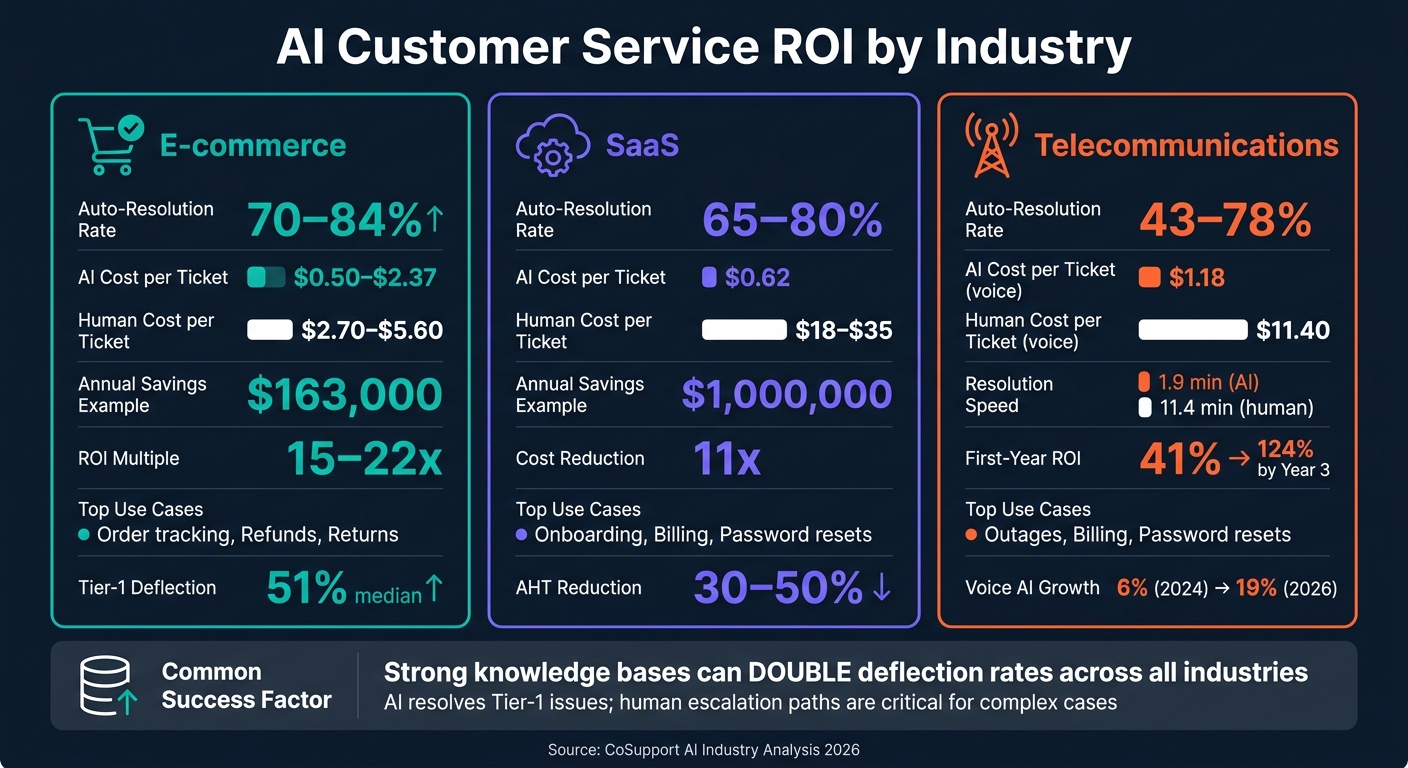
AI Customer Service ROI by Industry: E-commerce vs. SaaS vs. Telecom
1. E-commerce
E-commerce leads the way in leveraging AI for customer service. The median tier-1 deflection rate is an impressive 51%, with deployments achieving 70–84% autonomous resolution within just four to six months of implementation.
Ticket Profile
E-commerce thrives in this space because many customer inquiries are repetitive and straightforward. Common topics include order tracking, refund status, return initiation, and password resets. These high-volume, low-complexity issues rely on systems that provide live data access.
| E-commerce Intent | Median Deflection Rate |
|---|---|
| Password reset | 78% |
| Refund status | 74% |
| Order tracking / status | 69% |
| FAQ / policy | 66% |
| Return initiation | 52% |
Channel Mix
Direct-to-consumer brands see the best results with Chat and WhatsApp, achieving deflection rates of 55–70% and ROI multiples of 15–22x. Backend integration also significantly improves email efficiency, cutting response times by up to 67%. Voice AI is growing quickly, handling 19% of inbound contact-center volume by 2026, compared to just 6% in 2024. These advancements support seamless self-service options for customers.
Self-Service Potential
The depth of system integration directly impacts resolution rates. Basic AI setups resolve 30–40% of tickets, but integrating live order and payment systems boosts this to 60–70% within 2–3 months. For example, Nuuly, a fashion rental subscription service, experienced a 10% increase in resolution rate after implementing AI for subscription management. This translated to 20,000 additional conversations resolved per month while maintaining a 95% CSAT.
Cost and Efficiency Impact
AI significantly reduces costs compared to human-handled tickets. Resolving a ticket manually costs $2.70–$5.60, while AI can handle the same ticket for just $0.50–$2.37. Over time, these savings add up. For example, Peddle integrated CoSupport AI with Shopify's backend, cutting support volume in half, saving $163,000 annually, and reducing chat response times by 38%. AI also manages peak-season surges of 2.5x–4x typical volume without requiring additional staff.
sbb-itb-97114f1
2. SaaS
SaaS support teams are achieving impressive results with automation, deflecting 47% of Tier-1 tickets by automating 50–65% of complex inquiries like onboarding, billing, and technical issues. Unlike e-commerce, SaaS presents a mix of straightforward and intricate challenges that demand tailored solutions.
Ticket Profile
Many SaaS tickets fall into structured categories, such as password resets, subscription updates, billing questions, and onboarding assistance. In mature systems, these kinds of inquiries see deflection rates of 65–80%. However, more complex issues like technical troubleshooting or billing disputes typically go straight to human agents.
Channel Mix
The predictability of structured queries makes certain channels ideal for automation. AI performs especially well on chat and in-app messaging, where automation rates can hit 80%. Email, however, lags at just 20%. Here's a forecast of how AI-handled SaaS ticket volumes will be distributed across channels by 2026:
| Channel | Share of AI-Handled Volume |
|---|---|
| Chat | 41% |
| 23% | |
| Voice | 19% |
| In-app help | 11% |
Voice AI is growing rapidly, projected to rise from handling 6% of inbound volume in 2024 to 19% by 2026.
Self-Service Potential
AI-driven self-service is proving to be a game-changer. For example, Anthropic used an AI agent to manage around 50,000 monthly queries in 2026, achieving a 58% resolution rate and saving over 1,700 hours in just one month. Similarly, Rocket Money reported a 68% resolution rate and an estimated $1 million in annual savings. A well-structured knowledge base further boosted deflection rates, showing how critical it is for effective self-service.
Cost and Efficiency Impact
The cost difference between human and AI support in SaaS is striking. Human-handled tickets cost between $18–$35 each, while AI resolves the same tickets for just $0.62 on average - a cost reduction of 11x. Beyond cost savings, AI copilots also significantly improve efficiency by reducing average handle times by 30–50%. This allows agents to close 30–40% more tickets per hour.
For SaaS teams using platforms like Zendesk or Freshdesk, CoSupport AI’s tools integrate seamlessly into existing workflows. It pulls relevant knowledge base articles and drafts responses without requiring agents to switch tools. Mid-market SaaS teams often see ROI within 3–6 months, highlighting how CoAgent meets the unique demands of SaaS environments while complementing its success in other industries.
3. Telecommunications
Telecommunications is a fast-paced, high-volume field where AI thrives. With ticket complexity rated 2.5 out of 5, and monthly ticket volumes ranging from 30 to 60 per 1,000 customers, automation has a clear edge here.
Ticket Profile
Telecom support tickets often include billing inquiries, service outages, password resets, and upgrade requests. These structured issues align well with AI capabilities. For example, password resets achieve 78–91% deflection rates, while billing disputes, which are more nuanced, see lower rates of 24–38%, often requiring human intervention. This is why the telecom industry has moved toward routing billing disputes directly to agents. On average, Tier-1 deflection rates in telecom sit at 43% - below e-commerce's 51%, but ahead of healthcare (27%) and travel (36%).
Channel Mix
Voice-AI is driving a major shift in telecom customer service. By 2026, it managed 19% of inbound contact-center volume, up from just 6% in 2024. Telecom is leading this growth alongside banking, and for good reason: inbound phone calls cost $8–$25 per interaction with human agents, while AI voice solutions reduce that to just $1.18 per contact, a nearly 10x savings.
| Channel | AI Cost/Resolution | Human Cost/Resolution | Speed vs. Human |
|---|---|---|---|
| Chat | $0.41 | $5.90 | 6.0x faster |
| $0.74 | $9.20 | 4.4x faster | |
| Voice | $1.18 | $11.40 | 3.7x faster |
These cost reductions highlight the efficiency of AI-powered channels and pave the way for more robust self-service tools.
Self-Service Potential
Telecom’s repetitive, high-volume inquiries are ideal for self-service, but success hinges on backend integration. A chatbot relying solely on a knowledge base can handle basic FAQs, but to surpass the 50% deflection threshold, AI needs real-time access to billing systems, order management platforms, and service status updates. This allows it to take action rather than just provide answers.
During service outages, ticket volumes can spike 1.5x–2x overnight. AI handles these surges seamlessly, eliminating the need for emergency staffing. Outage-related questions like "Is my service down?" or "When will it be restored?" are highly structured, making them perfect for AI to tackle.
Cost and Efficiency Impact
With advanced self-service capabilities, AI dramatically reduces both resolution times and costs. AI resolves telecom tickets in an average of 1.9 minutes, compared to 11.4 minutes for human agents. In chat, this 6x speed advantage, coupled with a cost per resolution of just $0.62 vs. $7.40 for humans, delivers significant returns. First-year ROI averages 41%, climbing to over 124% by year three as AI intent models improve and deflection rates increase.
This efficiency also benefits human agents. With AI handling routine Tier-1 issues, agents can focus on complex cases like billing disputes, leading to an improvement in first-call resolution rates from 58% to 71%.
Pros and Cons by Industry
Here’s a closer look at how different industries stack up when it comes to the benefits and challenges of AI-driven support:
| Industry | Key Advantages | Key Limitations |
|---|---|---|
| E-commerce | 65–75% auto-resolution; 8x–30x ROI; handles 2.5x–4x holiday volume spikes without added headcount | Usage-based pricing can lead to budget spikes during peak seasons; relies heavily on backend data sync with order systems |
| SaaS | Protects high-value ARR; reduces AHT by 30–50% on agent-assisted tickets; speeds up onboarding | Lower deflection rates (50–65%) compared to retail; constant knowledge base updates needed as products evolve |
| Telecommunications | Absorbs outage-driven volume surges effectively; Voice AI now handles 19% of inbound contact-center volume (up from 6% in 2024) | Thin per-ticket margins require large-scale adoption for ROI; complex legacy system integrations add deployment challenges |
Across industries, these metrics highlight how ROI and capacity gains vary. However, the common thread for success lies in maintaining a high-quality knowledge base.
The Role of Knowledge Bases
The quality of a knowledge base is crucial. Strong knowledge bases can double deflection rates, making them a cornerstone for maximizing AI performance. Without this foundation, even the most advanced AI agent for customer service struggles to deliver consistent results.
Emotional Complexity and CSAT Scores
Customer satisfaction (CSAT) scores reveal a consistent trend: while AI performs well on structured tasks, it falters with emotionally charged issues. For example:
- Password resets achieve an impressive 4.41/5 CSAT.
- Billing disputes, on the other hand, drop to 3.34/5 CSAT.
This pattern holds steady across e-commerce, SaaS, and telecommunications. The solution isn’t necessarily better AI but smarter escalation strategies.
Containment vs. Resolution
Another critical insight: there’s often a 20–30 point gap between reported containment rates (issues stopped from escalating) and true resolution rates (issues fully resolved within seven days). This discrepancy can lead to misleading ROI projections if businesses rely solely on containment data. The real metric to track? Closed cases, not just cases that stop escalating.
Conclusion
ROI outcomes differ across industries, largely depending on how effectively teams combine autonomous AI with strong knowledge bases. The difference between achieving 60–70% deflection rates versus being stuck at 30–40% often boils down to the quality of the knowledge base before deployment. This trend is consistent across sectors like e-commerce, SaaS, and telecom. Build a solid foundation, and the results will speak for themselves.
See autonomous resolution in action with CoSupport AI's resolution-based pricing.
.png)