.png&w=96&q=75)
CoSupport AI 2.0: Why Every AI Support Reply Should Come With a Decision Log
When a human support agent sends a wrong answer, you can ask them what they were thinking. You can pull the ticket history, read their reasoning, and identify exactly where they went wrong.
When an AI agent sends a wrong answer, most support teams have no equivalent. They see the output. They don't see the process that produced it. The AI is a black box, and the only way to improve it is to add more training data and hope the next answer is better.
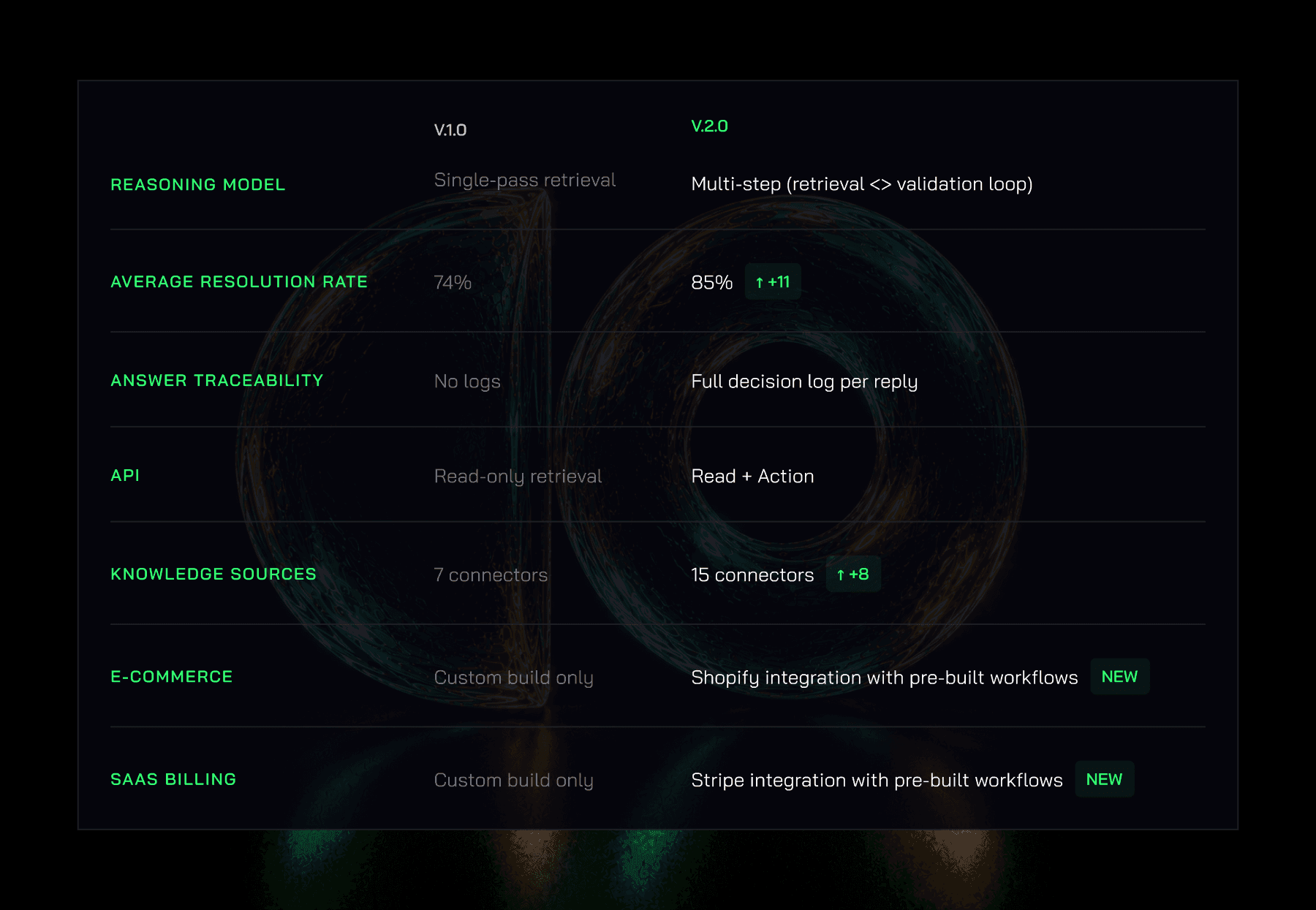
That's not good enough for teams that need to trust AI on real customer interactions. Decision logs — introduced in CoSupport AI 2.0 — change the dynamic entirely.
The Black-Box Problem in AI Customer Support
Here's what a typical AI support error looks like in practice.
A customer asks about a refund policy. The AI replies with the correct policy for standard purchases, but the customer bought through a reseller channel, where the policy is different. The reply is wrong. The support manager flags the error. But now what? Without visibility into the AI's reasoning, they can't tell whether the AI missed the reseller-specific policy entirely, found it but weighted the standard policy higher, or was never trained on it in the first place.
Each of those diagnoses leads to a different fix. Missing the policy means a knowledge base gap. Weighting it wrong means a prompt tuning issue. Not being trained on it means a data ingestion problem, check which knowledge sources are connected and what they contain. Without a decision log, the manager guesses and hopes.
What a Decision Log Shows
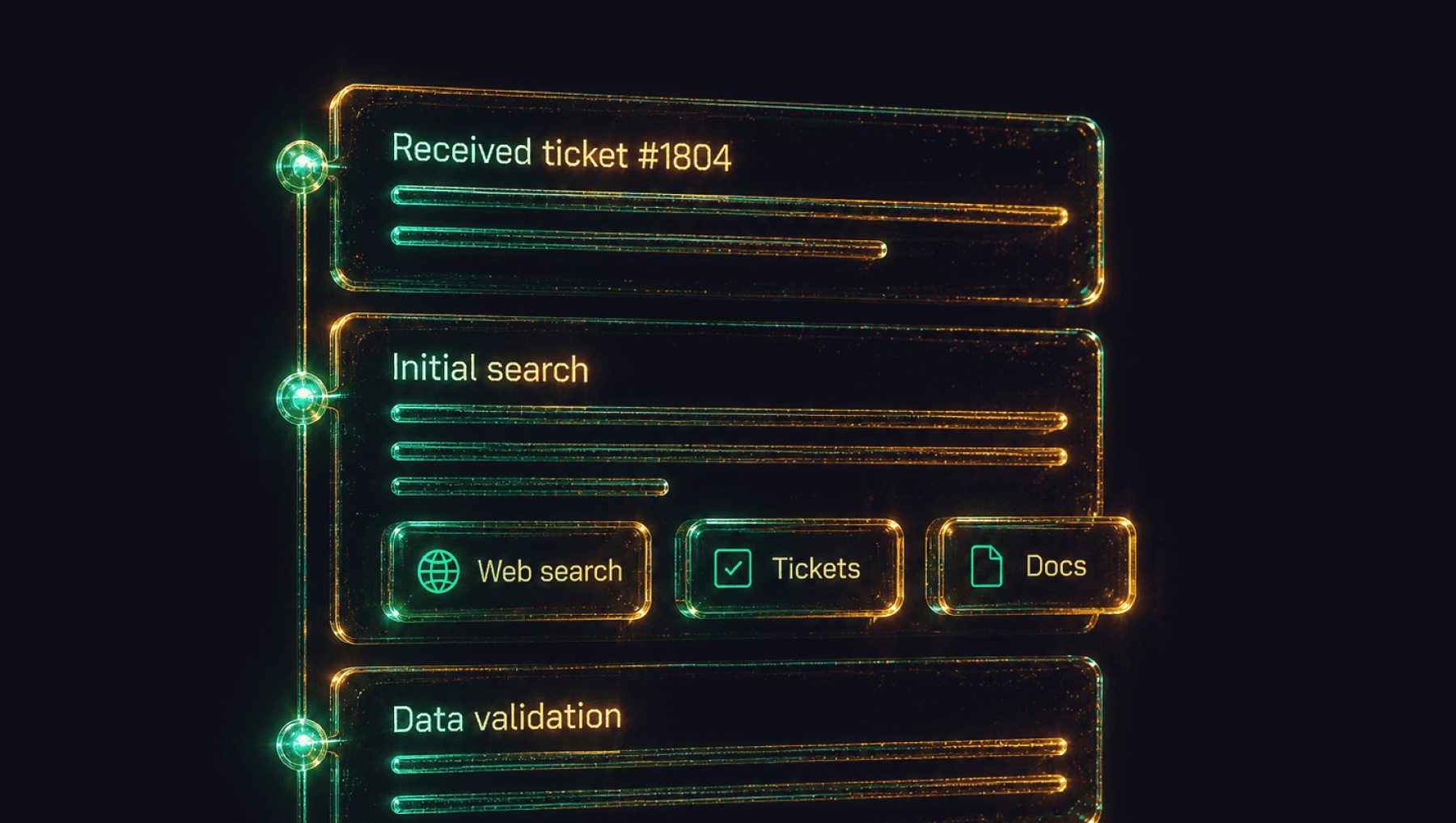
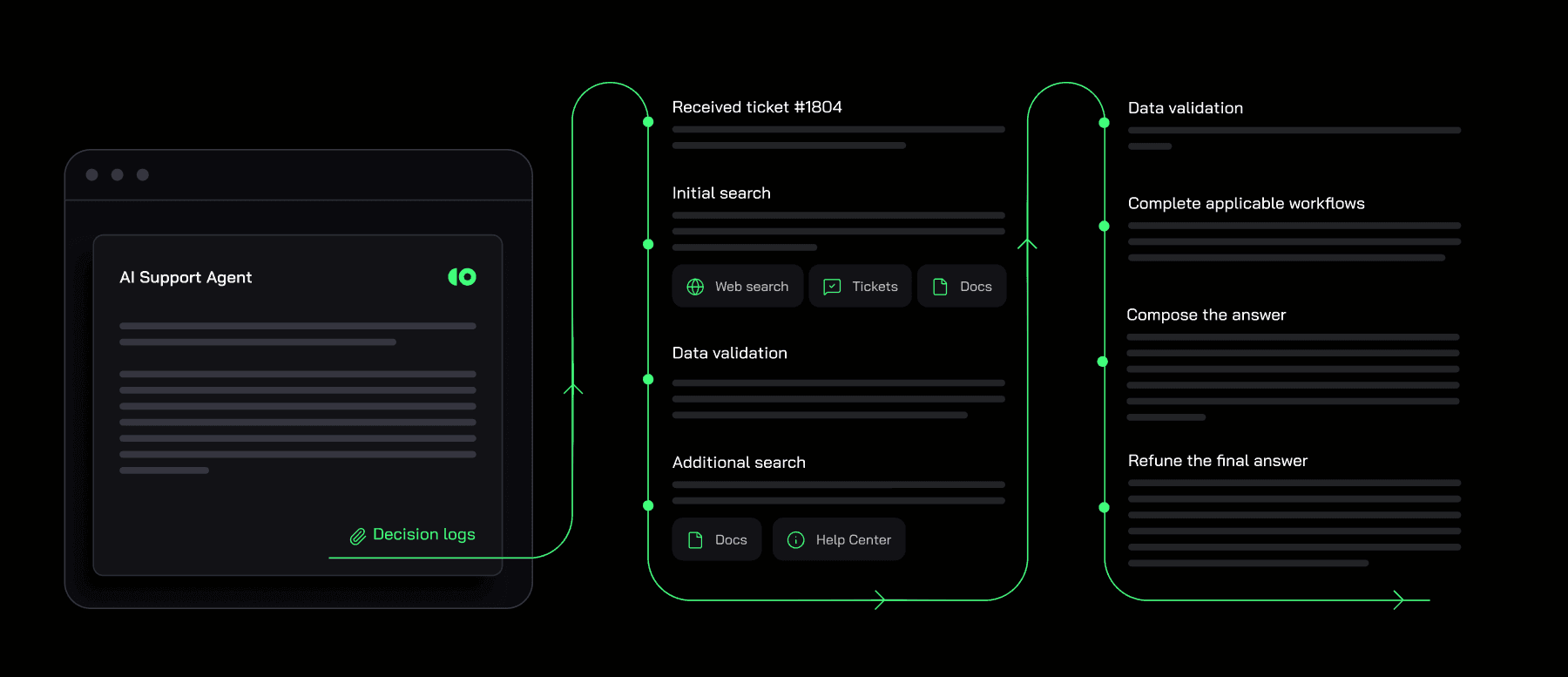
A decision log records the AI's reasoning process for every reply it generates. In CoSupport AI 2.0, every outgoing AI response ships with a log that includes:
- The reasoning steps the AI followed before answering.
- The specific data sources it searched and retrieved.
- The actions it took (if any) to resolve the ticket.
- The final output and how it was derived from the above.
This turns AI behavior from opaque to auditable. The same refund policy error now has a clear diagnosis: the AI searched for "refund policy" and retrieved the standard purchase policy document, the reseller policy was indexed under a different term and wasn't retrieved. Knowledge base tagging issue. Fixable in minutes.
How QA Teams Use Decision Logs
For support quality teams, decision logs shift AI review from sampling to systematic analysis.
Without logs, QA can review outputs — the replies themselves — and flag incorrect answers after the fact. That's reactive and incomplete. You catch errors that customers escalate or that stand out on manual review. You miss the ones that look plausible but aren't.
With logs, QA can look upstream. Instead of asking "was this reply right?", they ask "why did the AI retrieve that source?" and "what was the reasoning gap that produced this answer?" That's a fundamentally different kind of oversight, one that identifies improvement patterns instead of just individual mistakes.
In practice, this means:
- Faster identification of knowledge base gaps.
- Clearer evidence for when AI needs retraining vs. when prompt rules need adjusting.
- Auditability for regulated industries where compliance requires knowing what data drove a decision see also our security and compliance overview.
Why Decision Logs Help With the Hesitation Problem
A consistent pattern in AI customer support adoption: companies that are cautious about AI deployment aren't necessarily worried about the technology. They're worried about what happens when it makes a mistake, and they can't explain why.
That hesitation is rational. Deploying AI on customer interactions is a trust decision. And trust requires transparency. If an AI makes a wrong call and a support manager can't explain it to a customer or a compliance officer, that's a real operational risk.
Decision logs directly address this concern. They don't prevent AI from making mistakes. They make every mistake explainable, traceable, and correctable. For a support leader evaluating whether to expand AI from 20% of ticket volume to 60%, "I can see exactly why the AI said what it said" is a more meaningful assurance than any accuracy benchmark.
This is the reason CoSupport AI 2.0 ships decision logs on every reply, not as a premium feature, not as an add-on for enterprise plans. On every reply, for every account.
Conclusion: The Improvement Flywheel
The long-term value of decision logs isn't just in explaining individual errors. It's in the improvement flywheel they enable.
Every logged decision is data about AI behavior. Over time, patterns emerge: certain query types consistently retrieve suboptimal sources, specific knowledge base sections are never retrieved, and particular phrasing from customers triggers wrong reasoning paths.
Without logs, this data is invisible. Improvement is slow and hypothesis-driven. With logs, improvement becomes data-driven: here are the 15 tickets this month where the AI retrieved the wrong document first — here's why — here's the fix.
That's the compounding benefit of transparency. Not just understanding what went wrong today, but building a systematic feedback loop that makes AI measurably better every month.
CoSupport AI 2.0 ships decision logs on every reply, for every account. The 30-day pilot gives you full visibility into AI behavior on your own tickets before any paid commitment.
.png)