

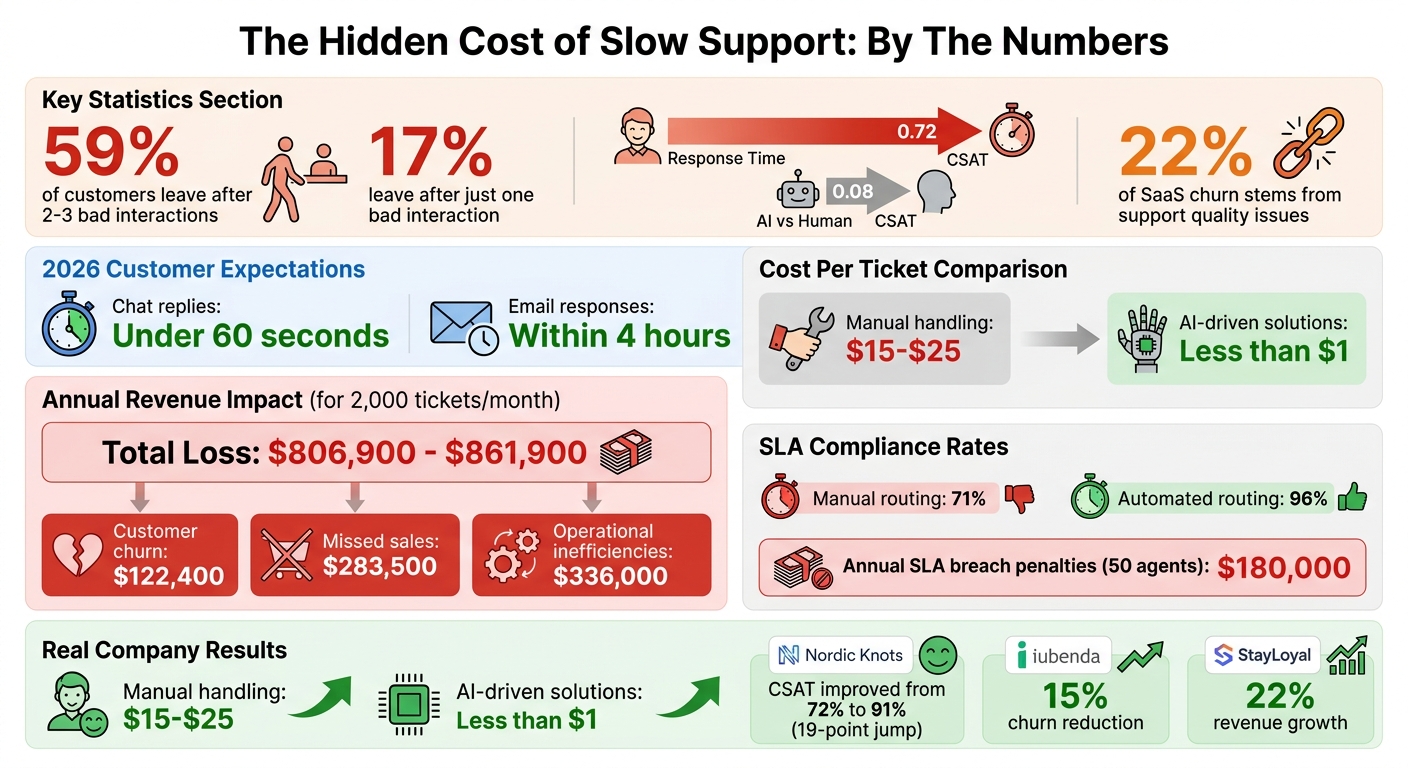
Slow support isn’t just frustrating - it’s expensive. For a SaaS company with 5,000 customers and $1M in annual revenue, delays can cost between $806,900 and $861,900 each year. These losses stem from churn, missed sales, inefficiencies, and reputational damage.
Here’s why speed matters:
- 59% of customers leave after 2-3 bad interactions; 17% leave after just one.
- Response time has a 0.72 correlation with CSAT, far stronger than whether support is AI or human-driven.
- By 2026, customers expect chat replies in under 60 seconds and email responses within 4 hours.
Companies like Nordic Knots and iubenda have shown that faster responses improve CSAT, reduce churn, and protect revenue. Automation plays a key role, cutting costs and improving SLA compliance. For instance, reducing response times can save hundreds of thousands annually while boosting customer loyalty. Time to first response isn’t just a metric - it’s revenue protection.
The Financial Impact of Slow Customer Support Response Times
How Response Time Affects CSAT Scores
Research reveals that response time has a much stronger impact on CSAT (Customer Satisfaction) than the type of support agent, with a correlation of 0.72 compared to just 0.08. By 2026, customers will expect chat responses in under 60 seconds and email replies within 4 hours. Falling short of these expectations can cause CSAT scores to drop quickly, while teams that consistently meet these benchmarks often maintain scores above 85%. Let’s explore the benchmarks that highlight how faster responses directly improve CSAT.
CSAT Benchmarks by Response Time
The best-performing support teams keep their first-response times under 1.5 hours, consistently achieving CSAT scores above 85%. This not only helps safeguard revenue but also minimizes customer churn. For instance, increasing response times from 1 hour to 6 hours can result in significant revenue losses. Leveraging automation can make a big difference, boosting CSAT by 10–20 points.
Nordic Knots: CSAT Jumped from 72% to 91%
Nordic Knots, a Zendesk customer managing 5,000 tickets monthly, achieved an impressive CSAT jump - from 72% to 91% - by cutting response times to under 15 minutes. Automation played a key role, streamlining ticket routing and reducing after-hours backlogs. This 19-point improvement not only lowered churn but also increased customer lifetime value. Additionally, their misroute rate dropped from 12% to just 2%. This success story underscores how response times and SLA compliance directly impact customer retention and satisfaction.
sbb-itb-97114f1
SLA Breaches Drive Customer Churn
Failing to meet SLA targets can push customers to leave. Studies reveal that 22% of SaaS churn stems directly from support quality issues, with SLA breaches playing a major role. When support teams miss promised response times, they break a critical trust with customers. For instance, a misrouted ticket - a frequent outcome of SLA failures and poor Zendesk AI routing - makes customers three times more likely to churn within 90 days. These breaches not only harm trust but also create a financial burden, as explored below.
The Churn Cost of Missing SLAs
The financial impact of SLA breaches adds up fast, especially with manual processes. Teams relying on manual ticket routing achieve an average SLA compliance rate of just 71%, compared to 96% for teams using automation. For a support team with 50 agents, this difference can result in $180,000 annually in SLA breach penalties - and that’s not even counting the revenue lost from customers who leave.
The situation worsens during periods of high ticket volume. Manual systems struggle to keep up, leading to slower response times and more SLA breaches. Some teams attempt to mask these issues by manipulating metrics - pausing timers or marking tickets as "on-hold" to appear compliant on dashboards. This creates the "Watermelon Effect", where metrics look good on the surface, but customers remain dissatisfied, leading to silent churn.
iubenda: 15% Churn Reduction After Automation
iubenda’s experience highlights how automation can directly address SLA-related churn. As a Freshdesk customer managing 5,000 monthly tickets, iubenda reduced churn by 15% after adopting automation to meet SLA targets. By removing manual routing bottlenecks, they cut their misroute rate from 12% to 2% and maintained SLA compliance above 95%. These improvements helped retain customers who might otherwise have canceled due to delays. The investment in automation paid off within the first quarter, thanks to the revenue saved through improved customer retention.
Revenue Lost from Slow Support
Slow customer support can drain a business's revenue. For a mid-size company managing 2,000 customer tickets each month, poor support can lead to annual losses ranging from $806,900 to $861,900.
This loss breaks down into three main areas: $122,400 from customer churn, $283,500 from missed sales opportunities, and $336,000 in operational inefficiencies. For SaaS businesses, the problem is even more severe. Their reliance on recurring revenue means every churned customer not only reduces immediate income but also eliminates future contract value and potential upsells.
What Churn Costs SaaS Companies
The numbers paint a stark picture. Out of every 1,000 tickets, 15% result in bad customer experiences, with a churn rate of 22%. Given an average customer lifetime value of $5,000, these bad experiences cost $165,000 in lost revenue per 1,000 tickets. To make matters worse, a single one-star drop in customer ratings can cut total revenue by 5–9%, and 53% of shoppers abandon purchases when they don’t get quick answers.
Handling tickets manually adds to the financial strain, especially when compared to using Freshdesk AI agents, costing $15–$25 per ticket, compared to less than $1 per ticket with AI-driven solutions. For example, one e-commerce company slashed its response time from 24 hours to just 2 minutes, saving $800,000 annually on a $150,000 investment, yielding a 433% ROI.
These figures underscore how poor support impacts revenue while highlighting the cost-saving potential of automation.
StayLoyal: 22% Revenue Growth Through Automation
Automation doesn’t just prevent losses - it can also drive revenue growth. Take StayLoyal, a Zendesk customer that handles 900 tickets per month. After adopting automation, they increased revenue by 22%. Faster response times and SLA compliance above 95% helped them retain customers and respond to 42% more after-hours inquiries that previously went unanswered. Automation also boosted conversion rates by 5–10 times, reducing cancellations and unlocking new upsell opportunities.
These examples show how automation can transform support operations, turning a potential revenue drain into a growth engine.
Conclusion
Slow support response times can hurt customer satisfaction, lead to higher churn rates, and drain revenue. For businesses managing 2,000 tickets per month, these delays could cost as much as $861,900 annually. Automation offers a game-changing solution, delivering responses in under two seconds and cutting ticket resolution costs from $15–$25 to less than $1. Companies like Nordic Knots, iubenda, and StayLoyal have already seen improvements in customer satisfaction, reduced churn, and measurable revenue growth within just a few months.
CoSupport AI integrates seamlessly with tools like Zendesk AI agents and Freshdesk in under 10 minutes, handling up to 90% of tickets automatically in Zendesk.
Curious how it works? Check out CoSupport AI to slash response times and safeguard your revenue.



.png&w=828&q=100)
.png&w=96&q=100)
.png&w=828&q=100)
.png&w=96&q=100)