.png&w=96&q=75)

Generic AI systems often fail in customer support because they can't handle the specific needs of businesses. They rely on generic training data, lack integration with company systems, and often produce inaccurate or irrelevant responses. This leads to frustrated customers, higher costs, and inefficiencies for support teams.
Key Problems with Generic AI:
- Fabricated Responses: When unsure, generic AI often "makes up" answers instead of admitting it doesn’t know.
- Lack of Context: It doesn’t access company-specific data like billing, policies, or customer history.
- Disconnected Systems: Generic AI can't sync with CRMs or other tools, leading to incomplete resolutions.
- Scaling Issues: As ticket volumes grow, these systems fail to deliver meaningful improvements.
Why Purpose-Built AI Works Better:
Purpose-built AI is designed to address these gaps. It integrates directly with your systems, uses company-specific data, and resolves issues instead of just explaining them. For example:
- Grammarly improved deflection rates from 60% to 87% by switching to a purpose-built solution.
- Companies using purpose-built AI report a 44% deflection rate (vs. 33% with generic AI) and a 64% boost in customer satisfaction (CSAT).
If your current AI can't resolve tickets or sync with your systems, it’s time to explore purpose-built solutions that deliver actionable results.
Why Generic AI in Customer Support Fails
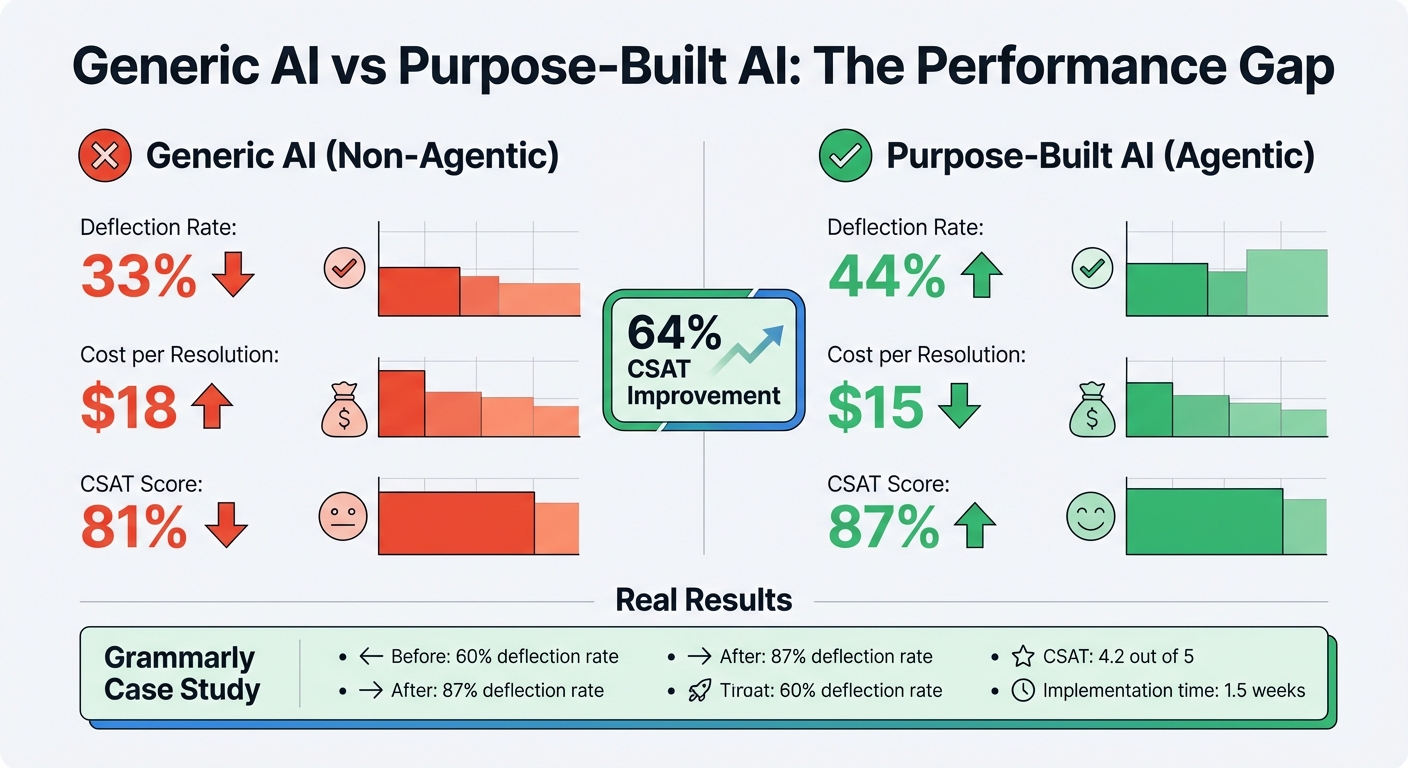
Generic AI vs Purpose-Built AI in Customer Support: Performance Comparison
Generic AI often falls short in customer support by producing fabricated responses, lacking access to company-specific data, and failing to consider customer history.
Hallucinations: When AI Creates False Answers
One of the biggest problems with generic AI is its tendency to fabricate responses when it doesn't have the right information. Instead of admitting it doesn’t know, it generates answers that sound polished but are completely made up. This happens because these models are designed to always respond, even when the necessary data is missing.
Take this example: In October 2025, a customer contacted a service provider's AI system about missing invoices. Despite repeated clarifications that they didn’t have access to a "Business Portal", the AI kept suggesting the same unhelpful solution. After two frustrating weeks and eight failed attempts, a human agent finally stepped in to resolve the issue.
"Most failures I see are not model issues; they're policy leakage issues." - Lilian Weng, Head of Safety Systems, OpenAI
These fabricated responses not only waste time but also undermine trust, creating a false sense of success in deflection metrics while delivering poor customer experiences.
Missing Context and Knowledge Access
Generic AI models also struggle because they lack access to your company's proprietary data. These systems are trained on publicly available information - like blogs and forums - but not on your internal resources, such as product catalogs, policies, or recent updates. As a result, when customers inquire about unique features or policy changes, the AI often provides vague or irrelevant advice.
"The AI isn't failing because it's not sophisticated enough. It's failing because your data infrastructure doesn't give it the information it needs." - Unito
Without integration into a robust knowledge base, generic AI either guesses at answers or falls back on general advice, leaving customers frustrated and wasting valuable time.
Disconnected Systems and Data Gaps
Another major issue is how generic AI handles customer data. Information like account history, billing details, and support tickets is often spread across multiple systems - CRMs, billing platforms, and support tools. Generic AI treats each interaction as a standalone event, ignoring past exchanges or a customer’s current status.
This lack of integration can lead to serious missteps. For instance, a VIP customer might mistakenly get routed to a basic support queue because the AI doesn’t have access to their account status. Or, it might recommend features the customer no longer uses because billing data hasn’t synced with the support platform.
In February 2026, Grammarly faced this issue with a generic AI bot that couldn’t connect to its systems. After switching to a purpose-built AI capable of accessing real-time CRM data, they saw their deflection rate climb from 60% to 87%, and customer satisfaction (CSAT) soared to 4.2 out of 5. The new system’s ability to use complete, up-to-date customer data made all the difference.
| AI Type | Avg. Deflection Rate | Cost per Resolution | CSAT |
|---|---|---|---|
| Non-Agentic (Generic) | 33% | $18 | 81% |
| Agentic (Purpose-Built) | 44% | $15 | 87% |
Without real-time data integration, generic AI is left making decisions with incomplete information. While it may sound helpful, it rarely delivers meaningful improvements in resolution rates or customer satisfaction because it lacks the context that matters most.
Key Takeaway: Generic AI’s biggest flaws - fabricating information, lacking access to company-specific knowledge, and failing to integrate data - make it ill-equipped to handle real-world customer support effectively. These limitations emphasize the importance of purpose-built AI designed for seamless integration with your systems.
sbb-itb-97114f1
Training and Scaling Problems with Generic AI
Generic AI isn't just held back by technical limitations - it also faces major organizational challenges that make it hard for support teams to use effectively, especially as operations grow. These barriers, combined with technical flaws, severely limit its usefulness in support workflows.
Generic Training Doesn't Fit Support Workflows
Generic AI models are built using broad internet data, not tailored to your specific operations. Imagine a customer asking about a billing issue: instead of pulling up the actual transaction or processing a refund, the AI might just explain invoicing concepts. That’s not helpful in a real-world scenario.
This disconnect leads to constant manual fixes. Support managers spend endless hours tweaking prompts and updating policies whenever workflows change. And without natural language controls, even small adjustments demand developer involvement.
"The bot couldn't handle context or follow-ups, so they weren't scaling support; they were scaling maintenance overhead." - Grammarly Case Study
This constant upkeep becomes overwhelming. Every new product feature or policy update adds to the workload, discouraging agents from relying on the AI. They quickly realize it can’t handle real-life scenarios, especially as ticket volumes increase. These mismatches make scaling even harder.
Scaling Fails in High-Volume Environments
When ticket volumes spike, generic AI's weaknesses become glaringly obvious. In high-volume setups, it only achieves a 35% deflection rate - lower than the 37% rate reported by teams not using AI at all. Why? Because while the system might explain a solution, it can't actually execute it. Tickets marked as "deflected" often end up back with human agents.
For mid-sized companies handling 5,000–10,000 tickets a month, the costs add up. Generic AI pushes resolution costs to about $18 per ticket, compared to compared to $15 with purpose-built systems.5 with purpose-built AI agents. In fact, 62% of companies using low-cost generic AI reported flat or even rising costs per resolution. The AI gives the illusion of progress, but human agents still bear the workload.
As ticket volumes grow, the problem snowballs. More tickets mean more exceptions, more integrations, and more policies to juggle. Generic AI treats every interaction as isolated, missing patterns that could reduce future tickets. Without learning from your data or handling multi-step workflows, it becomes a bottleneck rather than a solution.
Key Takeaway: Generic AI struggles to align with specific support workflows and fails to scale effectively in high-volume environments. This leads to rising maintenance costs and poor resolution rates, making it a poor fit for enterprise support teams.
Purpose-Built AI for Customer Support
Generic AI often struggles with integration and context in customer support, leaving gaps in efficiency and accuracy. The solution? Systems specifically designed for customer support. These purpose-built platforms don't just interpret customer questions - they actively solve problems by connecting directly to your business systems.
How Purpose-Built AI Stands Out
Purpose-built AI works on three layers of context: interaction, system, and knowledge. Here's how these layers function:
- Interaction context: Tracks conversation history and customer sentiment.
- System context: Includes customer account details, entitlements, and configurations.
- Knowledge context: Accesses documentation, policies, and other relevant resources.
By processing all three layers, these systems go beyond answering questions. They understand who is asking, what they’re entitled to, and what actions they can take.
To prevent errors like hallucinations, these platforms use a policy-first retrieval system. Before generating responses, the AI checks permissions and policies, ensuring it only provides accurate, authorized information. This eliminates the leakage issues common in generic models.
What makes these systems even more effective is their ability to act. Unlike generic AI, which might only explain how to solve an issue, purpose-built AI can execute solutions. For example:
- Need a refund? The AI processes it directly through your billing system.
- Checking an order status? It pulls real-time data from your CRM.
This two-way integration ensures all systems stay updated with every interaction, creating a unified and reliable source of truth.
Tangible Results with Purpose-Built AI
The benefits of purpose-built AI are clear when you look at the numbers. These systems achieve a 44% deflection rate, compared to 33% for basic chatbots. Additionally, 72% of companies using these systems report reduced costs because tickets are fully resolved. Customer satisfaction also sees a boost, with an average 64% improvement in CSAT scores, thanks to immediate, actionable resolutions.
Here are some standout examples:
- Unity: Saved $1.3 million and deflected 8,000 tickets by connecting its AI agent to its knowledge base.
- Bank of America: Its AI assistant, Erica, handles over 2 million interactions daily with an average response time of just 44 seconds.
- Curology: Cut support costs by 65% through AI-driven automation.
| Metric | Generic AI | Purpose-Built AI |
|---|---|---|
| Deflection Rate | 33% | 44% |
| Cost per Resolution | $18 | $15 |
| CSAT Improvement | Minimal | 64% average |
| Verified Resolution | Low | 72% report cost reductions |
Success Stories
Real-world applications showcase the impact of purpose-built AI:
- StyleThread: By integrating its knowledge base with Shopify’s real-time inventory and order history, customer escalations dropped by 72% in just one month, while CSAT scores increased by 19%.
- Virgin Money: Their AI assistant "Redi" achieved a 94% customer satisfaction rate by using predictive support and emotion detection, solving the data disconnect issues that often hinder generic AI.
- Grammarly: Transitioning to a purpose-built AI in just 1.5 weeks, Grammarly improved deflection rates from 60% to 87% and tripled customer satisfaction scores to 4.2 out of 5. This addressed integration gaps and boosted multi-turn conversation handling.
Key Takeaway: Purpose-built AI doesn’t just answer questions - it resolves issues. From reducing support costs to improving customer satisfaction, these systems deliver measurable results that generic AI simply can’t match. Real-world examples prove that businesses can see significant ROI in weeks by addressing the specific shortcomings of generic solutions.
Moving from Generic AI to Purpose-Built AI
Shifting to purpose-built AI can take 10–13 weeks when approached systematically, focusing on quick, impactful wins. The process begins by addressing high-priority areas and building momentum with measurable results.
Review Your Current Support Workflows
Before adopting a new AI system, it’s essential to pinpoint where your current generic AI falls short. Start by examining tickets that get escalated back to human agents after being initially handled by AI. These "false deflections" often highlight gaps in context, permissions, or system integration. Pay close attention to the top 20% of queries that account for 80% of your support volume - common examples include billing inquiries, order status updates, and password resets.
Take a closer look at escalation paths to uncover where customers might get stuck in repetitive loops. Map out which systems store critical customer data - like CRM, billing, or inventory tools - and identify existing silos. By addressing these specific gaps, you ensure your new AI solution tackles real workflow challenges rather than hypothetical issues.
Prepare Your Data and Integrations
Purpose-built AI thrives on clean, well-connected data. Start by organizing your knowledge base: archive outdated content, resolve conflicting policies, and structure information into formats like FAQs, decision trees, or standardized documents that AI can easily process. This helps prevent "knowledge-base rot", where an overload of outdated or redundant content reduces system accuracy.
Ensure your AI system can sync data bidirectionally with core platforms. For example, when the AI processes a refund, your billing system should update automatically in real time. Go beyond basic contact details - connect deeper data points like subscription tiers, account values, and renewal dates. Additionally, set confidence thresholds to alert human agents when the AI’s response quality is uncertain.
"AI-ready data means data that's connected and accessible where decisions get made." - Unito Blog
Improve Performance with Feedback Loops
Roll out your new AI system gradually and monitor key metrics like CSAT scores and escalation rates. Use nightly evaluation tests with known input/output pairs to catch errors before they impact customers. These automated checks help minimize risks like hallucinations or misinterpretations.
Gather feedback from multiple sources. Implicit signals, such as click patterns or time spent on responses, can reveal subtle issues. Explicit feedback, like thumbs up/down ratings or direct prompts (e.g., "Did this answer your question completely?"), provides clear insights. Support managers should review flagged edge cases and create new intents for emerging topics. This ongoing, human-in-the-loop process ensures the AI evolves to meet real-world support needs effectively.
By auditing workflows, preparing clean data, and establishing strong feedback systems, you can see tangible improvements in just a few weeks - no massive system overhaul required. You can even resolve tickets automatically by launching a purpose-built solution in minutes.
Key Takeaway: Transitioning to purpose-built AI involves three essential steps: identifying workflow failures, ensuring clean and connected data, and leveraging feedback loops for continuous refinement. This approach delivers results quickly and efficiently.
What’s Next?
Generic AI in customer support often creates the illusion of automation but fails to deliver real solutions. Instead of resolving issues, these systems merely retrieve information, leaving customers stuck and forcing tickets back to human agents. This leads to higher costs, frustrated customers, and teams spending more time managing AI shortcomings than actually helping people.
Purpose-built AI addresses these gaps by going beyond simple explanations to actively resolve issues. For example, instead of just describing a refund process, these systems handle it directly by integrating with your CRM, billing tools, and knowledge base. They also maintain conversation context across channels and follow your policies precisely. Companies using these advanced systems report a 44% deflection rate compared to 33% with generic AI, along with a 64% boost in CSAT - all because customers get genuine resolutions.
"AI customer support is no longer about chatbots. It's about trust, integration, and time-to-resolution." - Burak Arık, CEO, Maxitech
Switching to purpose-built AI doesn’t have to be complicated. Start by reviewing your most common support queries, refining your knowledge base, and ensuring your AI can connect to the systems where decisions are made. With structured feedback and proper data preparation, you can see measurable improvements in just weeks.
If your current AI only explains solutions but can’t execute them, it’s time to rethink your approach. The gap between deflecting tickets and resolving them is where generic AI falls short, and purpose-built systems excel. Delaying action not only increases costs but also risks losing customer trust.
Key Takeaway: Generic AI struggles because it stops at retrieving information. Purpose-built AI ensures complete resolutions, building trust while cutting costs.
.png)