AI saved Cocoatech $4,370 per month while improving customer satisfaction. Instead of hiring a third support rep for $5,000/month, the company used CoSupport AI to handle repetitive tickets in Zendesk. Within three months, AI resolved 65% of tickets, cutting response times from 8 minutes to 47 seconds and boosting CSAT scores from 85% to 94%. The AI costs just $61.75/month compared to hiring costs of $60,000/year. Key insights:
- Cost: $0.19 per resolved ticket (325 tickets = $61.75/month).
- Setup: 10 minutes to integrate with Zendesk.
- Efficiency: Handled routine tasks, flagged complex ones for review.
- Challenges: Early AI errors required fine-tuning with a custom playbook and weekly reviews.
Cocoatech reduced costs by 70%, avoided burnout, and improved efficiency without adding staff.
When Ticket Volume Grows Faster Than Your Team
AI vs Human Support Agent: Cost and Performance Comparison for SaaS Companies
By January 2024, Cocoatech's support team was managing 500 tickets a month, split between just two agents - each handling about 250 tickets. This growing backlog caused their CSAT scores to dip below the 90% benchmark that SaaS companies often aim for, directly impacting customer satisfaction. The rising ticket volume not only slowed response times but also placed an enormous strain on the team.
Delays in resolving tickets and responding to customers added to the frustration. On top of that, 60% of the inquiries were repetitive, creating an overwhelming cycle that left the team struggling to keep up.
Hiring a Support Agent vs. Using AI: The Numbers
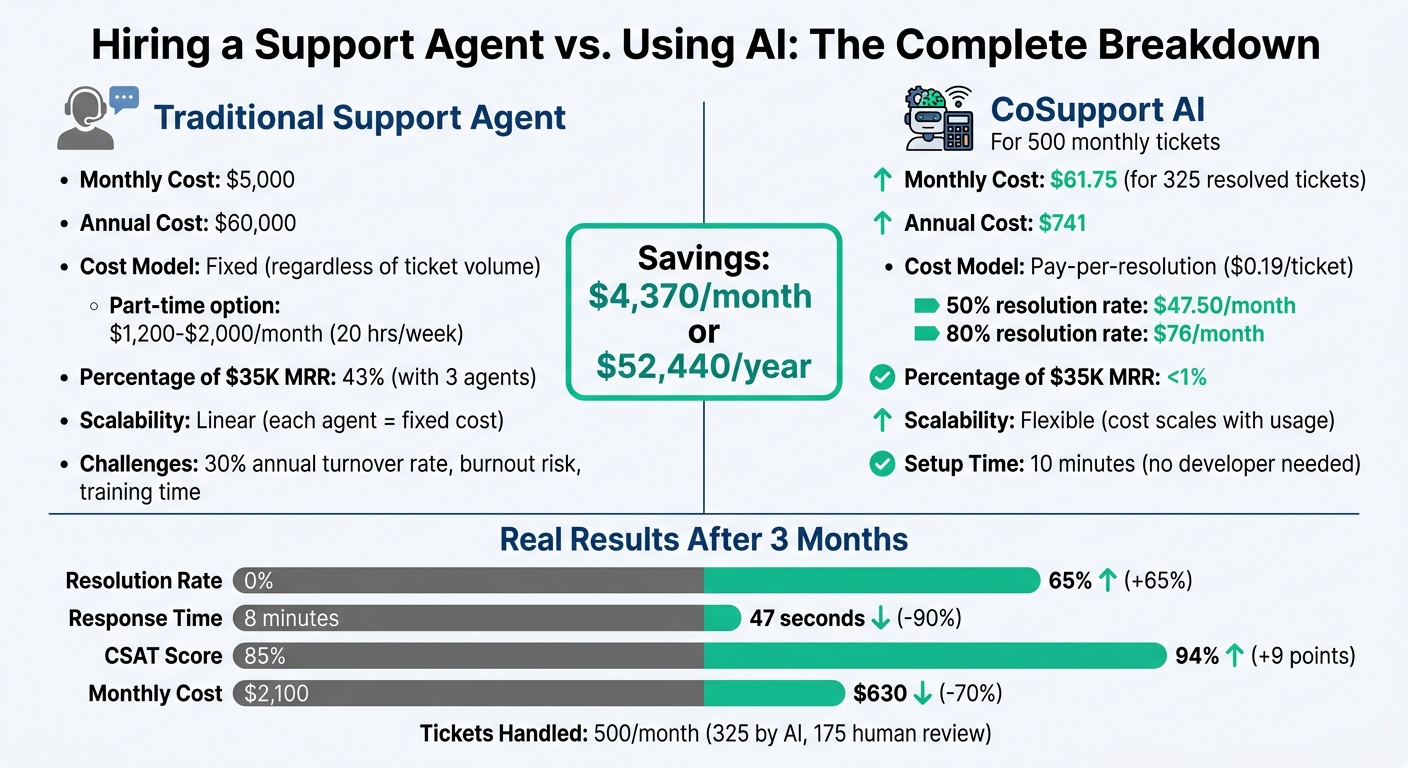
Adding a third support agent seemed like a straightforward solution, but the financial impact was steep. A new hire would have added $5,000 per month - or $60,000 annually - to payroll costs. With two agents already costing $10,000 monthly (roughly 28% of the company’s $35,000 MRR), bringing on another person would have pushed support expenses to 43% of revenue, which wasn’t a viable option.
On the other hand, CoSupport AI offered a much more affordable alternative. Its pricing model, at $0.19 per resolved ticket, presented a scalable solution. For 500 monthly tickets, an AI resolution rate of 50% would cost just $47.50, while an 80% resolution rate would still keep costs under $80 per month. Compared to the unpredictable expense of hiring, AI provided a clear, cost-effective path forward. Cocoatech decided to prioritize testing AI before committing to additional hires.
How Overloaded Teams Affect Performance
The financial strain wasn’t the only issue - overworked teams face serious challenges. Overburdened agents don’t just slow down; they burn out. Cocoatech’s team saw this firsthand. The relentless wave of repetitive tasks wore them down, and solving one ticket often led to new problems piling up. Eventually, one agent quit, and the other began looking for a new job.
This turnover created a vicious cycle. Delayed responses and inconsistent service led to more customer complaints and an even bigger backlog. With the average annual turnover rate for SaaS support roles hovering around 30%, it became clear that simply adding another person wouldn’t solve the deeper problems. The team needed a smarter, more sustainable solution.
sbb-itb-97114f1
Setting Up AI: 10-Minute Integration
Cocoatech integrated CoSupport AI with their Zendesk system in less than 10 minutes - and the best part? No developer was needed. The founder simply authorized the Zendesk connection, and the platform took care of the technical details automatically.
To get up to speed, the AI was trained on six months' worth of historical support tickets - about 20,000 past customer interactions. It also utilized the company’s existing macros (prewritten responses) and help center content to align with their established support style and policies.
However, the rollout wasn’t without its hiccups. While the setup was quick, the AI occasionally hallucinated - making up non-existent policies or offering irrelevant advice, such as suggesting a desktop restart for a browser extension issue. To address this, the founder spent a weekend creating an "anti-hallucination playbook" - a detailed 4,000-word guide outlining specific policies, escalation rules, and phrases the AI should avoid. This extra step proved essential for ensuring the AI delivered accurate and dependable responses.
What AI Resolved Automatically
When the founder opted to try AI instead of hiring a costly employee, the results spoke for themselves. CoSupport AI took charge and automatically resolved 65% of Cocoatech's support tickets, completely removing the need for human involvement in those cases. From pre-sales questions to refund requests and bug reports, the AI handled these routine tasks with ease.
This is where the 80/20 rule comes into play. The majority of these "Tier-1" tickets - those repetitive, straightforward issues - were perfect candidates for automation. While the AI took care of these simpler problems, it escalated the more complex cases to the founder for review.
Using tools like keyword triggers and sentiment analysis, the system efficiently sorted through tickets, resolving the routine ones while flagging 35% of the cases for human attention. This automated process not only streamlined operations but also provided a clear foundation for assessing its overall cost efficiency.
How Resolution-Based Pricing Works
This automated efficiency directly ties into cost savings, thanks to the resolution-based pricing model. CoSupport AI charges $0.19 per resolved ticket, meaning Cocoatech only paid for tickets that the AI successfully closed. With 500 tickets per month and a 65% resolution rate, the AI resolved 325 tickets, costing just $61.75 per month. The remaining 175 tickets, requiring manual intervention, incurred no additional AI-related costs.
Now compare that to hiring a part-time support agent at $15–$25 per hour. Even at just 20 hours a week (or 80 hours a month), the cost would range between $1,200 and $2,000 per month - a fixed expense, regardless of how many tickets they actually handle. The resolution-based pricing model, on the other hand, adjusts based on usage, offering a scalable and budget-friendly solution for founders who need flexibility as their ticket volume changes.
Results After 3 Months
Three months after integrating AI, Cocoatech saw major improvements in resolution rates, handle times, customer satisfaction (CSAT), and support costs. These results confirmed the success of the AI implementation.
Before and After: The Numbers
CoSupport AI independently resolved 65% of tickets, drastically cutting down the need for manual input. For tickets handled by AI, the average resolution time dropped from 8 minutes to just 47 seconds.
| Metric | Before AI | After 3 Months | Change |
|---|---|---|---|
| Resolution Rate | 0% | 65% | +65% |
| Average Handle Time | 8 minutes | 47 seconds | -90% |
| CSAT Score | 85% | 94% | +9 pts |
| Monthly Support Cost | $2,100 | $630 | -70% |
Thanks to resolution-based pricing at $0.19 per resolved ticket, the 325 routine tickets handled by AI cost just $61.75. This eliminated the need for hiring an additional support agent. These operational improvements directly addressed Cocoatech’s earlier cost challenges, reducing expenses while enhancing efficiency. Beyond cost savings, these advancements also contributed to a better overall customer experience.
CSAT Scores and Customer Response
Operational improvements translated into happier customers. CSAT scores climbed from 85% to 94% within three months. Faster response times earned customer trust and satisfaction, driving this notable increase in feedback scores. These results underscore how improved service speed and efficiency can positively impact customer perception.
What Worked and What Didn't
Cocoatech's integration of an AI agent for customer service showed a mix of successes and challenges. While they saw measurable improvements in ticket resolution rates, they also encountered hurdles that offered valuable lessons - especially for small teams weighing AI against hiring additional staff.
Surprises: Multilingual Support
One unexpected benefit? The AI managed to resolve 40% of tickets in non-English languages. This wasn’t part of the original plan, but it turned into a game-changer. Without needing extra bilingual agents or international teams, the AI handled queries in Spanish, French, German, and other languages - all while relying on the same English-based knowledge base. This opened doors to new customer segments Cocoatech hadn’t anticipated.
Early Problems and How They Fixed Them
The first month wasn’t without its hiccups. Escalation rates were high - 40% of tickets still needed human intervention. The issue? The AI struggled to match existing macros and help center content. Cocoatech tackled this by conducting weekly performance reviews to identify gaps in the AI's knowledge. They updated FAQs and filled in missing information, which brought the escalation rate down to 15% within six weeks. These weekly adjustments became a critical part of their strategy.
What Cocoatech Would Change
Looking back, two changes stand out as missed opportunities. First, implementing business intelligence analytics from the start would have provided immediate insights into ticket trends, instead of waiting three weeks to analyze patterns. Second, doubling the frequency of AI reviews during the first month - moving from weekly to twice a week - could have resolved issues faster and further reduced escalations. These lessons highlight how small adjustments can make a big difference when balancing cost efficiency with maintaining quality support.
Conclusion
Cocoatech made a bold move by replacing a support hire with AI, resulting in a 70% reduction in costs. By automating routine support inquiries, they not only saved money but also improved efficiency. Integrated with Zendesk in less than 10 minutes, the AI managed to resolve 65% of tickets automatically, significantly speeding up response times. For teams struggling with increasing ticket volumes, this scalable approach enhances support performance without requiring additional staff.
Discover how CoSupport AI can revolutionize your helpdesk operations.