.png&w=96&q=75)
ChatGPT can handle simple, general customer queries but struggles with company-specific questions and complex issues. Its main limitations include outdated knowledge, an inability to access real-time data, and a tendency to generate incorrect yet plausible-sounding responses. While it’s fast and cost-effective for repetitive tasks, it’s unreliable for nuanced or regulated cases without extensive customization.
Key Points:
- Strengths: Great for FAQs, summarizing tickets, and general questions.
- Weaknesses: Lacks real-time data, struggles with company-specific details, and is prone to errors ("hallucinations").
- Solution: Custom training on company data and integration with tools like CRMs can improve accuracy by over 70%.
- Best Approach: Use AI for simple tasks and human agents for complex or sensitive cases.
A hybrid model combining AI and human oversight ensures efficiency without sacrificing quality or trust.
How AI Helped This Business Scale | Customer Support Automation
Introduction: Can ChatGPT Handle Customer Support?
Can ChatGPT ease the workload of your support team? The answer depends on the type of tasks. ChatGPT excels at tasks like summarizing support tickets, polishing agent notes, and adjusting communication tone. In fact, a study involving over 5,000 customer service agents revealed that AI assistance boosted productivity by an average of 14%, with newer team members benefiting the most.
That said, ChatGPT isn't built to provide verified, company-specific information. It’s a generative model trained on publicly available internet data, not your company’s unique policies, product details, or customer history. Without direct integration into your company’s systems, it might offer answers that lack accuracy when it comes to specific operational details.
For reliable support, additional training and system integration are essential. Let’s take a closer look at how ChatGPT performs with support queries and where its strengths and limitations lie.
How Accurate Is ChatGPT for Customer Support?
ChatGPT’s accuracy depends heavily on the type of query it handles. For general, public-facing questions, it performs well, drawing from its extensive training data. However, when it comes to company-specific inquiries requiring detailed internal knowledge, its performance falters unless it has been trained on that specific data. Let’s break down where ChatGPT shines and where it falls short.
What ChatGPT Does Well
ChatGPT excels at addressing common, broad questions. For example, when customers inquire about general industry terms or concepts, it provides helpful answers based on its training. It also proves useful for internal tasks like summarizing lengthy ticket threads, translating help center articles, or drafting email responses for human review. These tasks don’t demand in-depth, company-specific knowledge, allowing ChatGPT to perform effectively.
Where ChatGPT Struggles
Challenges arise when queries require detailed, internal knowledge. Without direct access to your company’s data, ChatGPT cannot reliably answer questions about return policies, product details, or customer account information.
Another issue is its tendency to "hallucinate", or generate plausible-sounding but incorrect responses. For instance, during a 2023 internal test by Help Scout, ChatGPT gave inconsistent answers to a question about redirecting emails in Outlook, highlighting its unpredictability.
"ChatGPT sometimes writes plausible-sounding but incorrect or nonsensical answers." – OpenAI
Even minor changes in how a question is phrased can lead to entirely fabricated answers, making precise query formulation and careful verification essential.
Accuracy in Complex or Regulated Queries
While ChatGPT performs adequately with simple questions, it struggles with complex or highly regulated inquiries. This makes it less reliable for critical support tasks. Without tools like Retrieval-Augmented Generation (RAG), which connects AI to real-time, verified company data, its error rate can be unacceptably high.
RAG-based systems, by grounding responses in accurate and up-to-date information, reduce misinformation by over 70% compared to standalone models. This stark improvement highlights the gap between general AI-generated answers and those tailored with verified internal data. These challenges underline the importance of aligning ChatGPT with your proprietary information for better accuracy.
Why ChatGPT Isn't Reliable Enough on Its Own
ChatGPT wasn’t built with customer support in mind. It’s a general-purpose language model that predicts the next likely word based on patterns, not factual accuracy. This design creates three major challenges when attempting to use it for customer-facing support without proper customization. These challenges can significantly impact its reliability in live support scenarios.
Knowledge Gaps
ChatGPT’s knowledge is frozen at a specific point in time. It doesn’t have access to real-time company data, meaning it can’t check live inventory, current shipping statuses, or up-to-date pricing. When faced with such queries, it either guesses or fails to respond, which can erode customer trust. Using an AI agent for customer service with access to company data can prevent these gaps.
"There's just so much information and knowledge that's particular to these very many different industries and companies, and I think that just isn't going to go away." – Professor Chris Manning, NLP Expert, Forethought
### Hallucination-Free AI Risk
Since ChatGPT generates responses based on probabilities rather than verified facts, it often prioritizes what sounds plausible over what is accurate. This can result in confidently delivered but incorrect information - such as citing non-existent sources, incorrect dates, or entirely fabricated procedures.
Even OpenAI’s CEO, Sam Altman, has acknowledged this limitation: "I probably trust the answers that come out of ChatGPT the least of anybody on Earth." Small changes in how a question is phrased can lead to drastically different - and often incorrect - responses.
"ChatGPT is incredibly limited but good enough at some things to create a misleading impression of greatness. It's a mistake to be relying on it for anything important right now." – Sam Altman, CEO, OpenAI
Struggles with Complex Cases
Beyond factual inaccuracies, ChatGPT has practical limitations. Its decision-making process is opaque, making it difficult to trace errors or perform audits. This is particularly problematic in regulated industries like healthcare, finance, or insurance, where compliance is non-negotiable. Moreover, it lacks the empathy and judgment necessary for handling delicate situations, such as addressing an upset customer or processing a sensitive medical claim.
Without direct integration to tools like CRMs, billing systems, or order management platforms, ChatGPT is unable to perform critical tasks such as issuing refunds or updating customer details.
"Human empathy and understanding, particularly in delicate or complex situations, will likely remain crucial." – Candace Marshall, VP of Product Marketing, Zendesk
ChatGPT vs Human Agents: A Direct Comparison
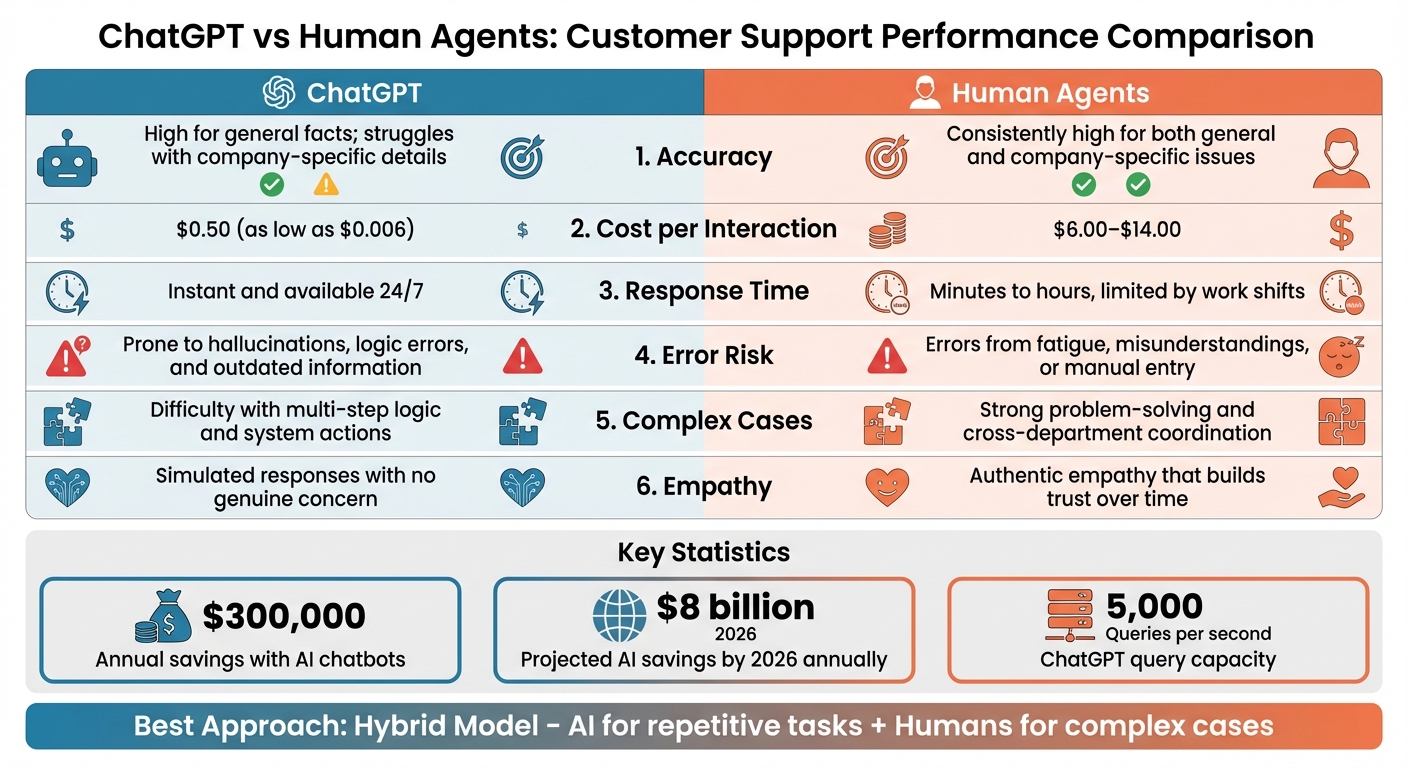
ChatGPT vs Human Agents: Customer Support Performance Comparison
If you're evaluating whether ChatGPT can be trusted for customer support, the best way to decide is by comparing it directly to human agents across key performance metrics. It's not as simple as "AI vs. humans" - both have their own strengths and limitations. Let’s break it down.
Comparison Table
| Metric | ChatGPT (Standalone) | Human Agents |
|---|---|---|
| Accuracy | High for general facts; struggles with company-specific details | Consistently high for both general and company-specific issues |
| Cost per Interaction | $0.50 (as low as $0.006) | $6.00–$14.00 |
| Response Time | Instant and available 24/7 | Minutes to hours, limited by work shifts |
| Error Risk | Prone to hallucinations, logic errors, and outdated information | Errors from fatigue, misunderstandings, or manual entry |
| Complex Cases | Difficulty with multi-step logic and system actions | Strong problem-solving and cross-department coordination |
| Empathy | Simulated responses with no genuine concern | Authentic empathy that builds trust over time |
What the Numbers Reveal
ChatGPT offers a massive cost advantage, with interaction costs as low as $0.006 compared to $6.00–$14.00 for human agents. On average, businesses using AI chatbots save $300,000 annually, and by 2026, Juniper Research estimates AI could save companies over $8 billion annually.
However, cost efficiency comes with compromises. While ChatGPT thrives on speed and volume - it can handle 5,000 queries per second - it struggles with complex or sensitive issues. For example, OPPO's 2025 rollout of an AI chatbot showed how AI could manage high query volumes efficiently, but human agents were still critical for escalated or nuanced problems. This is why modern systems rely on pillars of AI accuracy to ensure seamless handoffs.
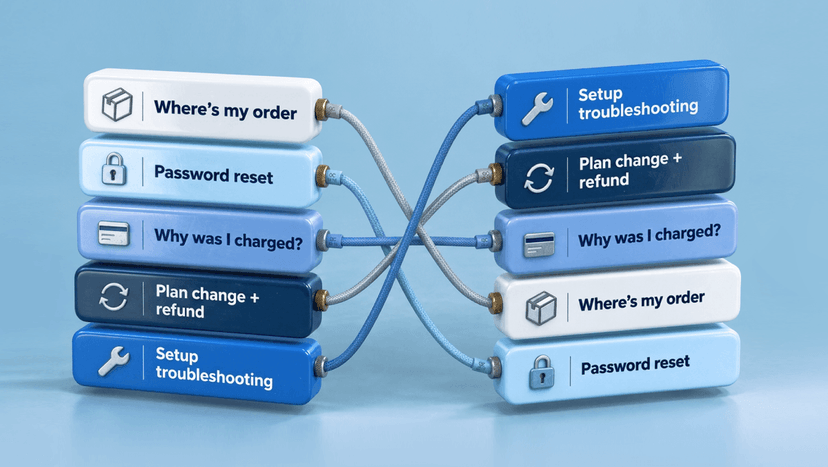
The takeaway? A hybrid model is the sweet spot. AI shines in repetitive tasks like password resets, order tracking, and FAQs, while humans tackle cases requiring empathy, judgment, or intricate problem-solving. This balance allows businesses to reduce costs without sacrificing the quality of support where it truly counts.
sbb-itb-97114f1
How to Make ChatGPT More Accurate with Your Company Data
To address ChatGPT's knowledge gaps, you need to connect it directly to your company’s data. Without access to your specific pricing, policies, or product details, the AI can't provide precise answers. Here's how to fix that in three steps.
Train It on Your Knowledge Base
A great way to improve accuracy is by using Retrieval-Augmented Generation (RAG). This approach pulls answers from your live documentation instead of relying solely on the model’s built-in knowledge. It can reduce misinformation by over 70% compared to standalone AI systems.
Start by uploading key resources like FAQs, helpdesk articles, past tickets, and internal documents. Break these materials into smaller, searchable chunks, and include variations like synonyms, common typos, and casual language. Store this data in a vector database for easy access.
Keep your documents in consistent formats, such as Markdown, so the AI can process them more effectively. Also, train the system using real chat logs and emails to ensure it understands the specific language and tone your customers use.
Once the foundational training is complete, link the AI to live data for up-to-date accuracy.
Connect It to Real-Time Data
Static training data can quickly become outdated. To keep ChatGPT accurate, connect it to your CRM (like Salesforce) or ticketing systems. This allows the AI to pull real-time information, such as current account details, order statuses, or updated pricing.
By integrating RAG with live databases, the system can query fresh data during conversations. This prevents errors like referencing canceled plans or outdated policies. For even better results, enable bidirectional syncing so live data always takes precedence over older information.
After setting up these connections, it’s essential to monitor and fine-tune the system regularly.
Test and Adjust Regularly
Keep a close eye on how the AI performs. Use a dual-agent setup where one system validates responses against live data to ensure accuracy.
Be on the lookout for "policy leakage", where the AI shares information it shouldn’t. Analyze performance by customer tier and issue type to identify where automation is effective and where human intervention is still needed. Regularly update the knowledge base and flag interactions with signs of frustration for human review using sentiment analysis.
The goal isn't just to deflect inquiries but to provide verified resolutions. Over-automating without solving issues can harm customer satisfaction, so prioritize real solutions over sheer efficiency.
3 Common Mistakes When Using ChatGPT for Support
Support teams often rush to implement AI tools without proper preparation, leading to avoidable failures. In fact, 80% of AI tool failures in customer service stem from three key mistakes.
Not Training It on Your Content
If you don’t train ChatGPT with your specific company data, it won’t know your products, pricing, or policies. This can result in responses that sound confident but are completely wrong.
Take this example from a 2023 Help Scout test: ChatGPT was asked the same question about redirecting Outlook emails three times. It got it right once, added irrelevant Zapier references the second time, and provided incorrect IMAP settings the third time. Without company-specific training, every response runs the risk of being inaccurate.
"ChatGPT sometimes writes plausible-sounding but incorrect or nonsensical answers." - OpenAI
Generic answers won’t solve real customer issues. To deliver useful responses, your AI needs access to your documentation, past support tickets, and product catalogs. Using Retrieval-Augmented Generation (RAG) to pull from verified company data can reduce misinformation by over 70% compared to standalone AI models.
But training alone isn’t enough. Oversight is critical to catch errors before they reach customers.
Removing Human Review
Letting ChatGPT interact directly with customers without human oversight is risky. Mistakes can go unchecked, and the AI lacks the empathy that human agents bring to the table.
Here’s a surprising stat: 42% of Americans would share secrets with a chatbot over a therapist. While this shows people trust AI, it also highlights a dangerous gap - emotional trust often exceeds the AI’s factual reliability. If the AI invents a policy or misinterprets a refund request, there’s no immediate safety net.
The solution? Treat AI responses as a draft. Have human agents review and approve them, especially for complex or sensitive cases. This approach ensures errors are caught before they harm customer trust.
But even with oversight, proper integration is essential for AI to function effectively.
Ignoring System Integrations
When ChatGPT isn’t integrated with your systems, it can’t handle tasks like checking order statuses, processing refunds, or updating account details. Without these capabilities, it’s reduced to a basic FAQ tool, creating more manual work for your team.
"Given that integrations and extensibility are basic prerequisites to taking any kind of action, it means ChatGPT can only serve as entertainment... it can't help you rebook your flight, return a damaged item or change your mobile phone plan." - Jarrod Davis, Author, Cognigy
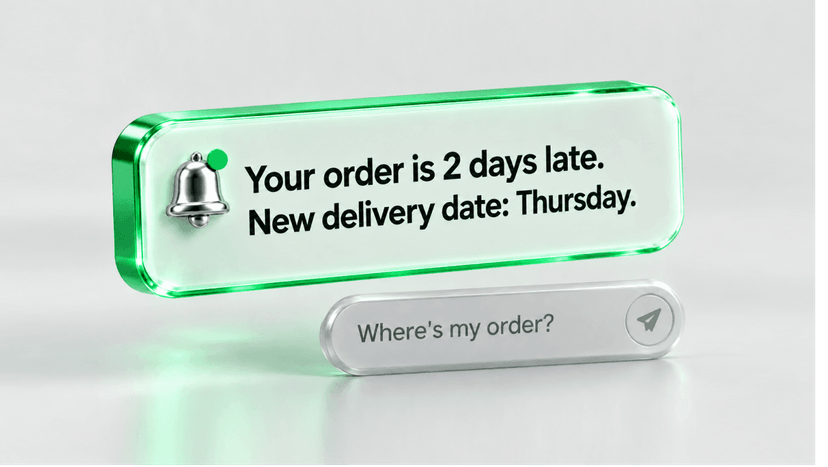
For AI to be useful, it needs real-time access to your CRM, ticketing system, and ecommerce platform. This allows it to answer questions like “Where’s my order?” with accurate tracking details instead of vague guesses. Without these integrations, the efficiency gains AI promises are lost.
Avoiding these mistakes ensures ChatGPT becomes a reliable tool that aligns with your company’s needs and enhances your customer support experience.
Key Takeaways
Here’s what the analysis reveals:
ChatGPT Excels at Simple Tasks
ChatGPT is effective for handling basic FAQs and repetitive tasks. However, it struggles with more complex, data-heavy queries because it lacks real-time integration. Its knowledge is limited to what was available up until its cutoff date, so it can't account for recent product updates, pricing adjustments, or policy changes. This makes it unsuitable for anything requiring up-to-date or in-depth information.
Custom Training Makes a Difference
To improve accuracy, custom training on your company’s data is a must. Without it, ChatGPT may generate incorrect or misleading responses. AI models using Retrieval-Augmented Generation (RAG) can reduce misinformation by more than 70% compared to untrained, generic models.
Integrating AI with live databases and CRM systems allows it to pull verified information instead of making assumptions. This transforms AI from a potential risk into a reliable tool for customer support. This evolution is part of a broader shift toward smarter support solutions in the industry.
Human Oversight Is Indispensable
While AI can boost productivity - studies show a 14% increase for human agents - it can't replace the empathy and accountability that human oversight provides. A hybrid approach is key.
AI can draft responses and handle repetitive tasks, but it’s crucial for your team to review these drafts before they reach customers. This blend of speed and human quality ensures accuracy and builds trust with your audience.
Try CoSupport AI - Free Trial Period
While ChatGPT can manage simple queries, it wasn’t designed for customer support. That’s where CoSupport AI steps in.
CoSupport AI learns directly from your resources - like help docs, past tickets, FAQs, and product catalogs - to provide accurate answers about pricing, policies, and products. It uses Retrieval-Augmented Generation (RAG) to pull verified information, cutting down on misinformation significantly.
With seamless integration into platforms like Zendesk, Freshdesk, and Intercom, CoSupport AI can draft responses, link directly to source articles, and flag any uncertain answers. This helps your team resolve tickets up to 20% faster. By addressing the gaps left by ChatGPT, CoSupport AI delivers the reliable, integrated support solution you’ve been reading about.
Getting started is quick and painless - it takes less than 10 minutes, and no coding is required. Just connect your knowledge base, set your brand’s tone of voice, and you’re ready to go. You can test it out risk-free for 14 days - no credit card needed, no hidden fees.
Start your free trial today and see what precise AI-powered support can do for you.
FAQs
How can businesses make ChatGPT more accurate for customer support?
Businesses can boost ChatGPT's accuracy by training it with their own content, such as product manuals, FAQs, ticket histories, and knowledge-base articles. This approach ensures the AI provides answers rooted in company-specific information instead of relying solely on its general training.
One effective method is using retrieval-augmented generation (RAG), which allows ChatGPT to pull relevant documents in real time. This reduces errors and minimizes the chances of the AI generating incorrect or irrelevant responses. Fine-tuning the model with past customer interactions and incorporating company-specific prompts can also help tailor responses to match your brand’s tone and preferred terminology. To further enhance reliability, businesses can implement safeguards like response validation rules or fallback options that redirect complex queries to live agents.
Clear and structured prompts, such as “Refer to the updated policy dated 12/01/2024,” can direct the AI to the right sources, ensuring accurate answers. Pairing these strategies with human oversight creates a system that delivers consistent and dependable customer support.
What are the risks of using only ChatGPT for customer support?
Relying entirely on ChatGPT for customer support introduces a range of challenges. One major issue is its tendency to generate confident but incorrect answers - a phenomenon often referred to as hallucinations. These errors can erode customer trust and may even create compliance risks, especially in industries with strict regulations. Consistency is another hurdle, as slight changes in how a question is phrased can lead to different responses, making it unreliable for delivering uniform support.
ChatGPT’s knowledge is also capped at its training data, which means it lacks real-time updates. This limitation can result in outdated or inaccurate information, particularly in industries that evolve rapidly or require up-to-the-minute accuracy. On top of that, the absence of native integrations with tools like CRMs or ticketing systems restricts its ability to streamline workflows effectively.
Security concerns add another layer of complexity. The model can be vulnerable to prompt manipulation and may inadvertently expose sensitive information. Without human oversight or specialized AI tools built specifically for customer service, these limitations make ChatGPT a risky choice as the sole channel for handling customer support.
Why do AI-powered customer support tools still need human oversight?
AI tools like ChatGPT tend to produce responses that may sound accurate but are factually wrong. These mistakes, often referred to as hallucinations, can mislead customers, damage your brand’s reputation, and even create compliance risks - especially in industries with strict regulations.
Involving human oversight is key to preventing these issues. It ensures that responses are correct, align with your company’s data, and stay consistent with your brand’s voice. Plus, it allows complex or sensitive questions to be routed to live agents when necessary. By integrating human review, you can deliver a more dependable and trustworthy support experience while reducing potential risks.
.png)