.png&w=96&q=75)

Airbnb uses AI to handle 33% of customer support issues in North America, aiming to expand globally by 2027. The company focuses on automating routine tasks like refunds and booking changes using an AI agent for customer service while relying on human agents for sensitive cases. This hybrid approach balances efficiency with maintaining trust in its two-sided marketplace. Key insights include:
- AI's Role: Resolves 1 in 3 tickets in North America, improving response time and efficiency while reducing costs.
- Human Oversight: Complex cases like safety concerns or disputes are escalated to human agents.
- Custom AI: Built with proprietary data, including 200M verified identities and 500M reviews, ensuring tailored responses.
- Testing First: Rolled out in phases, starting in North America, to refine the system before scaling globally.
Airbnb’s strategy highlights the importance of balancing automation with human judgment to maintain trust between hosts and guests.
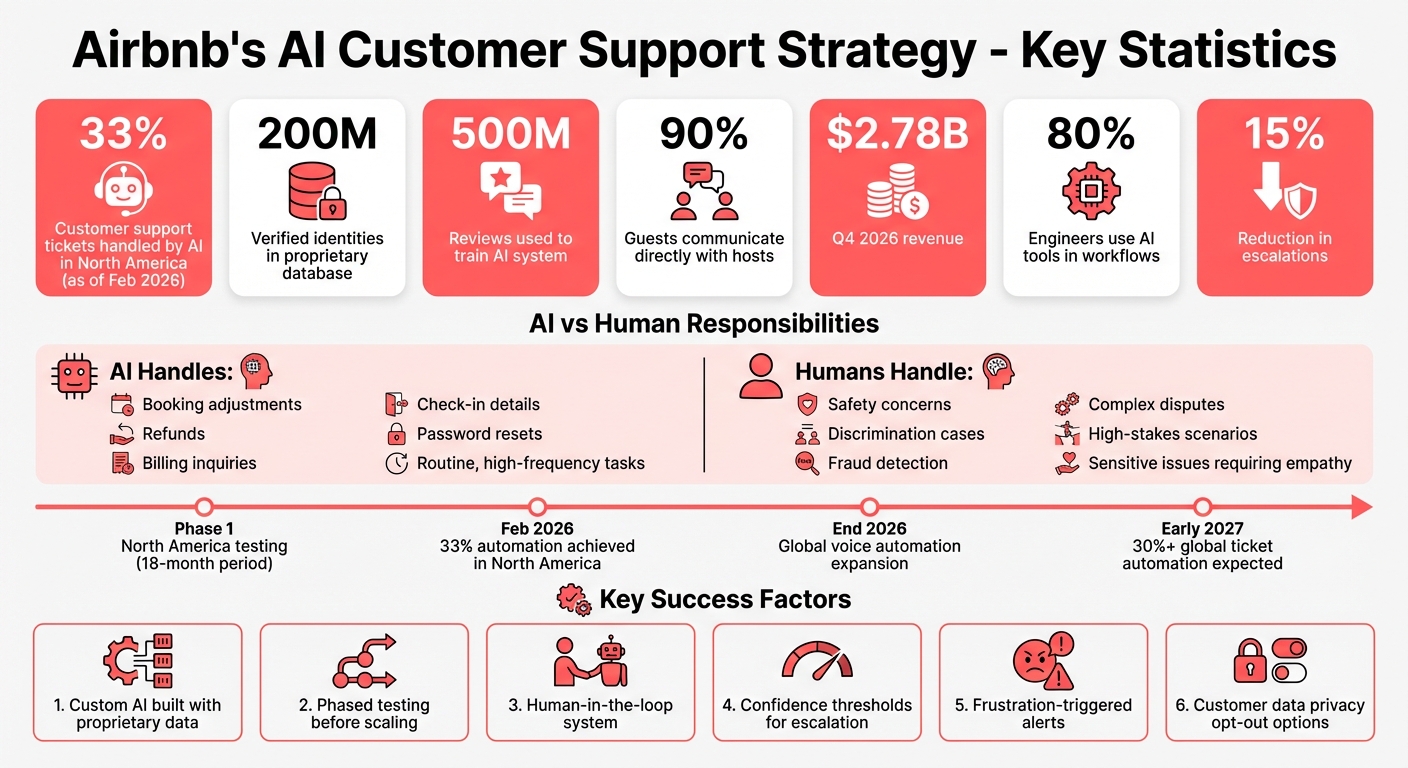
Airbnb's AI Customer Support Strategy: Key Statistics and Hybrid Model Overview
How Airbnb Uses AI in Customer Support
Automation at Scale
Airbnb's AI system currently manages about one-third of all support tickets in the U.S. and Canada without human intervention. It takes care of routine tasks like booking adjustments, refunds, billing inquiries, and check-in details. Operating across both chat and voice platforms, the system is set to expand its global voice automation capabilities by the end of 2026.
For more complicated issues - such as safety concerns, discrimination cases, or disputes involving significant amounts - the AI quickly escalates these tickets to specialized human teams. This approach allows Airbnb to balance automation with the need for human expertise in sensitive situations.
Key takeaway: Using AI for customer service to automate routine tasks effectively lays the groundwork for scalable and dependable support.
Custom AI Technology
Instead of using generic chatbot solutions, Airbnb has developed a custom AI system, guided by CTO Ahmad Al-Dahle. This system adapts third-party models by incorporating Airbnb's proprietary data, which includes 200 million verified identities and 500 million reviews. It also uses a "messaging graph" that highlights how 90% of guests communicate directly with their hosts.
"A chatbot doesn't have our 200 million verified identities or our 500 million proprietary reviews, and it can't message the hosts, which 90% of our guests do." - Brian Chesky, CEO, Airbnb
This tailored approach ensures the AI adheres to Airbnb's global service standards, delivering a consistent experience for both hosts and guests.
Key insight: Using proprietary data allows Airbnb to offer a service that stands out and remains consistent.
Benefits of AI Support at Scale
Airbnb's integrated AI system not only streamlines routine tasks but also boosts revenue. By reducing costs and eliminating wait times for common issues, the AI system has a direct impact on the bottom line. For instance, in February 2026, Airbnb reported that its AI system contributed to Q4 revenue of $2.78 billion while maintaining strong margins during a period of global growth.
Additionally, AI adoption extends beyond customer support. Currently, 80% of Airbnb's engineers use AI tools in their workflows, with the company aiming for full adoption. What's more, traffic driven by AI-powered conversational tools converts at a higher rate compared to traditional channels.
Key lesson: Thoughtful AI integration improves operational efficiency while driving substantial financial results.
Bottom line: Airbnb's custom AI system handles routine tasks on a large scale, leveraging exclusive data and human escalation to maintain efficiency and customer trust.
sbb-itb-97114f1
Balancing Automation and Trust in Two-Sided Marketplaces
Human Oversight for Complex Cases
Trust is the foundation of two-sided marketplaces. Without reliable support, that trust can crumble. To address this, Airbnb uses a human-in-the-loop system. AI handles straightforward tasks like booking changes and refund requests, while human agents step in for more sensitive issues like fraud, safety concerns, or disputes. This approach ensures that trust between hosts and guests remains intact.
The system is designed to identify frustration signals, automatically escalating complex cases to human agents. This strategy has reduced escalations by 15%, making resolutions smoother and more effective.
"AI doesn't entirely eliminate humans in the loop. Sensitive cases still require human judgment. But automation handles rules-based interactions, keeping people focused only on exceptions." - Rahul Neel Mani, Vice President of Community Engagement, ISMG
This careful balance between automation and human judgment strengthens the trust framework, setting the stage for proactive trust management.
Key takeaway: Automation works best when it knows its limits, passing challenging cases to humans before trust is at risk.
Monitoring Customer Feedback and Trust Metrics
Airbnb extends its trust-building efforts by closely monitoring customer feedback. The company tracks satisfaction scores for tickets handled by AI. To ensure the system's reliability, Airbnb introduced its AI agent in North America first, testing its effectiveness before planning a global rollout. By early 2027, Airbnb expects AI to manage over 30% of support tickets worldwide.
Transparency also plays a key role. Airbnb gives users the option to opt out of having their personal data used for AI training. This open approach reassures customers that automation is designed to serve them without compromising their privacy.
Bottom line: Keeping an eye on satisfaction metrics and maintaining clear data policies are crucial for scaling automation without losing customer trust.
I Tried Airbnb's New AI Customer Service
Risks of Over-Automation
Airbnb’s approach highlights a critical lesson: while AI can streamline operations, too much reliance on automation can backfire, eroding customer trust and creating new challenges.
Containment Rates and Empathy Gaps
When AI systems are poorly designed, they often generate more problems than they solve. Instead of resolving issues, they can create a domino effect of follow-up tickets, burdening support teams further.
"A bad AI agent doesn't reduce support load. It multiplies it. Every wrong answer creates a follow-up ticket." - The Meridiem
This issue becomes especially problematic during disputes. If frustrated guests or hosts receive canned, context-free responses, their trust in the platform can quickly evaporate.
Key takeaway: Mismanaged AI not only wastes time and resources but also risks alienating customers by amplifying support failures.
Beyond customer interactions, over-automation also has a profound impact on the workforce.
Workforce Changes and Job Reductions
With AI now managing 33% of Airbnb’s support cases, the company has seen a natural reduction in traditional support roles. Rather than resorting to mass layoffs, Airbnb has allowed attrition to gradually shrink the workforce.
This shift has fundamentally altered team dynamics. Human agents are now tasked with handling more specialized, high-stakes scenarios like fraud detection and complex escalations, while AI takes care of routine, repetitive tasks.
Bottom line: Large-scale automation changes the nature of work. Gradual adjustments, rather than abrupt reductions, help maintain stability during this transition.
Airbnb’s cautious rollout of AI also highlights the importance of testing before scaling.
Testing Before Scaling
Airbnb introduced its AI system in North America first, carefully evaluating its performance before rolling it out globally. This phased approach allowed the company to pinpoint which tasks AI could handle effectively and where human involvement was still necessary.
By taking the time to test and refine, Airbnb avoided the pitfalls of rushing into full-scale deployment, which can lead to customer dissatisfaction and operational chaos.
Key takeaway: Rushing to deploy AI without rigorous testing can worsen existing issues. Starting with a smaller rollout ensures reliability and minimizes risks before scaling.
Lessons for Support Leaders: Applying Airbnb's Strategy
Airbnb's journey provides practical lessons for support teams looking to scale AI while maintaining customer trust. The company's strategy highlights the importance of starting small, leveraging proprietary data, and combining automation with human oversight.
Key Takeaways:
- Focus on high-frequency, low-complexity tasks first.
- Train AI using your own data for better results.
- Adopt a hybrid model to ensure human involvement in complex cases.
Start with High-Volume, Low-Complexity Tasks
The best way to introduce AI is by addressing routine queries. These are repetitive issues that take up agent time but don’t require much judgment. Airbnb began with tasks like refund status checks and password resets before moving on to more complex disputes. This initial step allowed them to automate 20–30% of their ticket volume.
To ensure success, Airbnb reviewed historical chat logs to identify "gold standard" cases - interactions where agents resolved issues flawlessly. These examples became the foundation for training their AI system. They also used constraint mapping to define areas where automation wasn’t appropriate. For instance, cases involving safety concerns or significant legal issues were immediately routed to human agents.
Key takeaway: Starting with simple, repetitive tasks builds trust in the system while avoiding scenarios that require human empathy or nuanced judgment.
This initial focus lays the groundwork for more advanced AI applications, as discussed in the next section.
Train AI with Your Own Data
Generic AI models often fall short when it comes to understanding the subtleties of a specific business. Airbnb gained an edge by training its AI using its proprietary data, including verified identities and reviews.
"Our unique data gives us an edge - a lesson for leaders aiming to tailor AI to specific customer needs."
Before launching the system, Airbnb tested AI responses alongside human agents to ensure accuracy without risking customer satisfaction. They also set confidence thresholds, where any response falling below a certain confidence level was automatically escalated to a human agent.
Bottom line: Using your own data allows AI to better reflect your brand’s voice, understand your customers, and handle edge cases that generic models might miss.
Once the AI system is trained and tested, the next step is integrating human oversight through a hybrid model.
Use a Hybrid Model for Long-Term Success
A sustainable AI strategy keeps humans involved in complex or sensitive cases. Airbnb’s hybrid model lets AI handle routine tasks while escalating high-stakes issues to specialized teams. One effective method they used is the "silent assistant" model, where AI drafts responses for human agents to review and send. This approach speeds up resolution times while maintaining quality.
Airbnb also implemented frustration-triggered alerts to flag dissatisfied customers, prompting immediate intervention by human agents. When cases are escalated, the AI provides a summary to prevent customers from repeating themselves.
By February 2026, Airbnb reported that its AI system resolved 33% of customer support tickets in North America. This not only reduced costs but also maintained customer satisfaction, with plans to expand globally within a year.
Key takeaway: Automation should enhance human capabilities, not replace them. This balance ensures efficiency while preserving the empathy needed for complex interactions.
Airbnb’s hybrid approach demonstrates how support teams can achieve operational efficiency while maintaining the trust essential in a two-sided marketplace.
Conclusion: Finding the Right Balance
Airbnb's use of AI in customer service shows that automation, when done thoughtfully, can uphold trust. By February 2026, their custom AI agent was managing 33% of support interactions across North America - a testament to careful planning, proprietary data use, and human oversight. The challenge isn’t whether to use AI, but how to implement it responsibly. This approach highlights the potential for blending automation with human expertise.
Rather than replacing human agents, AI should complement them. With Airbnb's hybrid model, routine questions are automated, while sensitive issues like safety concerns are handled by human agents. This ensures both efficiency and empathy remain priorities.
Before scaling, Airbnb invested in an 18-month testing phase to refine and validate the system. CEO Brian Chesky explained:
The way we do things with AI is much more rapid iteration, not big launches.
This deliberate process helped avoid missteps that could erode customer trust.
For support leaders, the focus must go beyond cutting costs to genuinely improving service quality. Chesky pointed out that the goal was twofold: to reduce operational expenses and to significantly enhance the customer experience.
To stay ahead, companies need to embrace being "AI-native" while safeguarding human judgment where it matters most. As Chesky aptly stated:
If you don't disrupt yourself, someone else will. And we're not going to allow people to disrupt ourselves… We're going to disrupt ourselves first.
Airbnb's approach underscores the importance of striking the right balance between automation and human empathy. This balance is key to achieving long-term success in customer support.
.png)