.png&w=96&q=75)

CoSupport AI Pricing: Three Models, No Hidden Fees
Most companies considering AI for customer support run into the same wall during procurement: they cannot figure out what the product will actually cost until they are on a call with a sales rep, and by then they have already spent two weeks getting there.
CoSupport AI publishes three pricing models publicly, each built around a different way of running support. This article explains what each model covers, which one fits which kind of operation, and why the prices are what they are.
Three pricing models
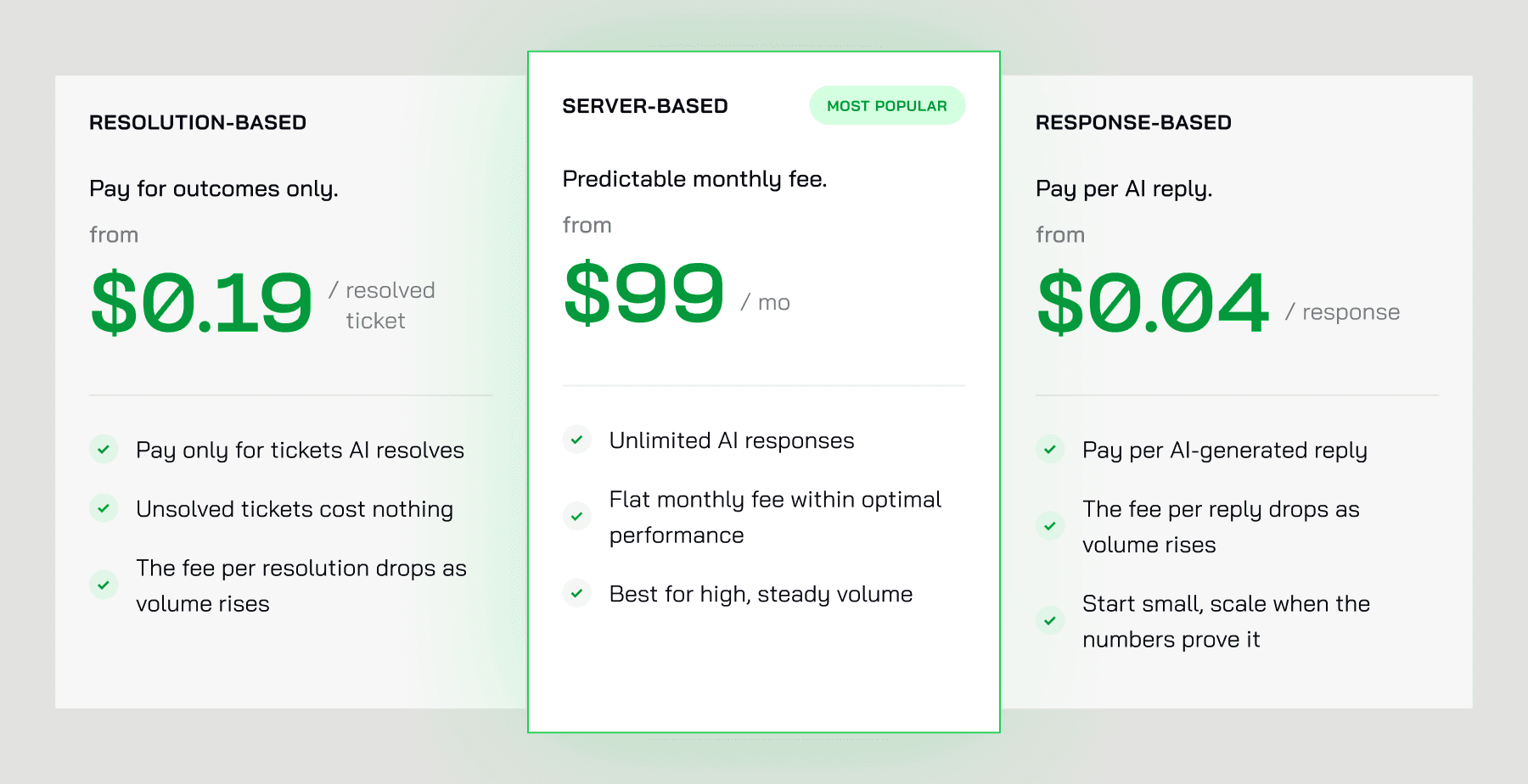
Resolution-based: $0.19 per resolved ticket
You pay $0.19 for each ticket the AI agent closes autonomously. If the AI does not resolve the ticket, you pay nothing for that interaction.
This model puts the financial incentive exactly where it should be. The vendor earns only when the customer is actually helped. For teams running variable ticket volumes - seasonal spikes, product launches, occasional quiet months - resolution-based pricing means costs track output rather than time. The per-resolution fee drops as volume grows, so high-volume months get better unit economics, not worse.
Best fit: E-commerce and D2C teams with fluctuating ticket volume. Teams that want to start cautiously and pay proportionally to what the AI delivers.
Server-based: from $99/month
A flat monthly fee covers unlimited AI responses, priced to your ticket volume. No per-ticket tracking, no variable monthly bills.
This model suits operations where the support queue is large and consistent. At high volume, a flat rate produces a much lower cost per ticket than any per-unit model. The math gets better the more tickets you run through the system.
Best fit: High-volume support teams with stable, predictable ticket flow. BPO operations. Companies processing thousands of tickets per month who want cost certainty above all else.
Response-based: $0.04 per AI response
You pay for each AI-generated reply, regardless of whether the ticket closes. This model is the lowest entry point and works well for teams that want to start small, measure performance on a subset of tickets, and scale once the data supports it.
The per-response fee also drops with volume.
Best fit: Smaller operations or teams piloting AI alongside existing processes before committing to full automation.
What every plan includes
The pricing model you choose changes how you pay. It does not change what you get. Every plan ships with the same platform and the same feature set: all integrations (Zendesk, Freshdesk, Zoho, Intercom, Salesforce, Shopify, and more), 40+ language support across chat, email, and voice, the full CoSupport AI 2.0 architecture including multi-step reasoning and decision logs, and ISO 27001, GDPR, and CCPA compliance. There are no setup fees and no long-term contracts.
Why these prices
The question comes up often, usually phrased as: "This seems lower than we expected. What's the catch?" There is no catch. Here is the explanation.
The patented architecture reduces the cost of running AI at scale. CoSupport AI holds a USPTO patent (US11823031B1) covering its generative architecture. That architecture was built specifically to minimize the computational cost per AI interaction while preventing hallucinations. Lower infrastructure cost per ticket makes lower pricing per ticket possible without margin compression.
Three years of R&D went into making the system efficient, not just capable. Most AI customer support tools are wrappers around general-purpose language models with limited optimization for support-specific workloads. CoSupport AI was built from the ground up for this use case. That specialization reduces the operational cost of running the product, and that saving gets passed through to pricing.
The goal is accessibility, not price signaling. Many AI solutions price themselves as enterprise software: high entry cost, custom quotes, long procurement cycles. That pricing model delays adoption and excludes smaller teams who could benefit most from automation. CoSupport AI was deliberately priced to let companies start quickly, measure results, and scale based on what the data shows, not based on what they were willing to commit to before the pilot. Clients pay for value, not for a complicated pricing model.
What the savings look like in practice
The pricing only tells part of the story. What matters is what a company keeps after subtracting the CoSupport AI cost from what they would have spent on manual support. SupportYourApp cut $14,000 per month in support costs after deployment, roughly $168,000 per year. Remedico saves $9,300 per month running at 74% AI resolution. ProjectFitter brought first response time from two hours to six minutes. The ROI calculator models these numbers against your own ticket volume and current support cost structure.
The 60-day guarantee
Every plan includes the same pilot structure and the same performance guarantee.
Days 1 to 4: setup, integration, and training on historical ticket data. Days 5 to 30: the AI agent handles real tickets at no charge, with 1,000 free AI responses included. Days 30 to 59: paid service at the selected pricing model, with the AI running at full capacity. Day 60: the resolution rate gets checked. If the AI has not reached 60% autonomous resolution, every paid day gets refunded.
Conclusion: Choosing a model
The right model depends on two variables: ticket volume and how predictable that volume is. High, steady volume points toward server-based. The flat rate becomes a significantly better deal than per-unit pricing once volume is consistent enough to predict. Variable or growing volume points toward resolution-based. Costs track what the AI actually delivers, and slow months do not carry the same cost as peak months. Small volume or a first pilot points toward response-based. The lowest per-unit entry point lets a team test AI support without committing to a volume-based structure before the data exists to support it. CoSupport AI models all three against real ticket data before recommending a plan. The starting point is a pilot, not a pricing conversation.
.png)