.png&w=96&q=75)

A ticket handled by a person costs whatever your monthly support spend divided by your ticket count says. For most teams that's a two-digit number. A ticket resolved by CoSupport AI costs $0.50. If the AI can't resolve it, you pay nothing for the attempt.
That gap is where the savings live. This guide covers the 7 places AI in customer support takes cost out of an operation, with the math you can run on your own queue, and what to expect in the first two months.
The short version:
- AI agents handle the repetitive tickets so your team doesn't.
- Routing sends each ticket to the right person the first time.
- Forecasting stops you from overstaffing quiet weeks and understaffing busy ones.
- Self-service lets customers fix simple things on their own.
- One AI covers 60+ languages instead of one hire per market.
- Case summaries and knowledge updates write themselves.
- You pay per resolved ticket, so the bill tracks the work the AI actually did.
First, the math
Start with your real cost per ticket. Take everything you spend on support in a month (salaries, tools, management, training) and divide it by the tickets handled. $40,000 a month across 2,500 tickets is $16 a ticket. Write your number down. Everything below uses it.
Where the cost per ticket comes from
Most of it is people. Salaries are usually the largest share by a wide margin, then the helpdesk and tooling, then the time managers spend on quality review and coaching. A ticket that takes a few minutes to answer still carries its share of all of that.
Channel changes the number. Chat and email tickets are cheaper than phone, because a person can work several chats at once and none on the phone. Simple questions (a password reset, an order status) cost a fraction of a technical case that needs three replies and a screenshot. If you want one useful refinement, split your cost per ticket by channel and by simple versus complex. The AI will take most of the simple ones, so that's the number the savings come from.
The formula
Monthly saving = tickets × AI resolution rate × your cost per ticket, minus the AI bill.
Worked example. 5,000 tickets a month, 70% resolved by AI. The AI bill is 3,500 × $0.50 = $1,750. At $16 a ticket, those 3,500 tickets were costing you $56,000 in people time. Net saving: around $54,000 a month, before you count the 1,500 tickets that still reach your team, now with a summary attached.
For comparison, Intercom's Fin bills $0.99 per outcome on its published pricing. The same 3,500 resolutions would cost $3,465.
Which resolution rate to plug in: teams typically land between 60% and 70% in the first 60 days. The average across CoSupport AI 1.x deployments is 74%, and the 2.0 architecture reaches up to 85%. Up to 90% of repetitive first-line tickets is the ceiling. If you'd rather have the sheet do the arithmetic, the ROI calculator runs the same formula, and there's a longer walk-through of the return on investment if you need to show it to finance.
sbb-itb-97114f1
1. AI agents handle the repetitive tickets
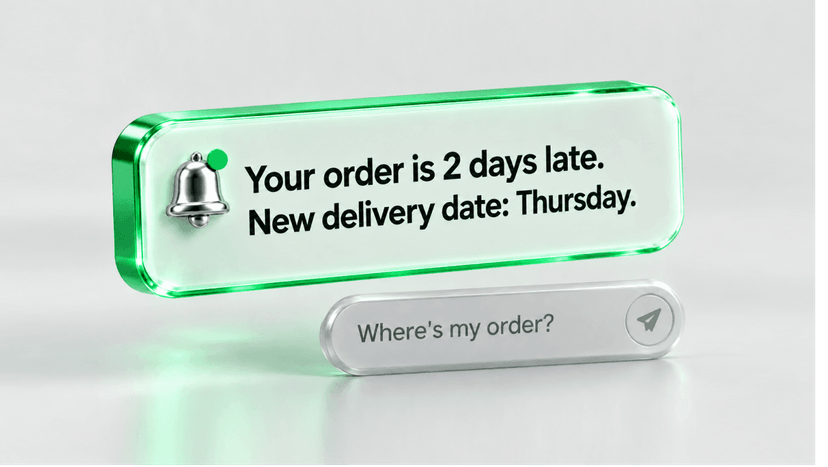
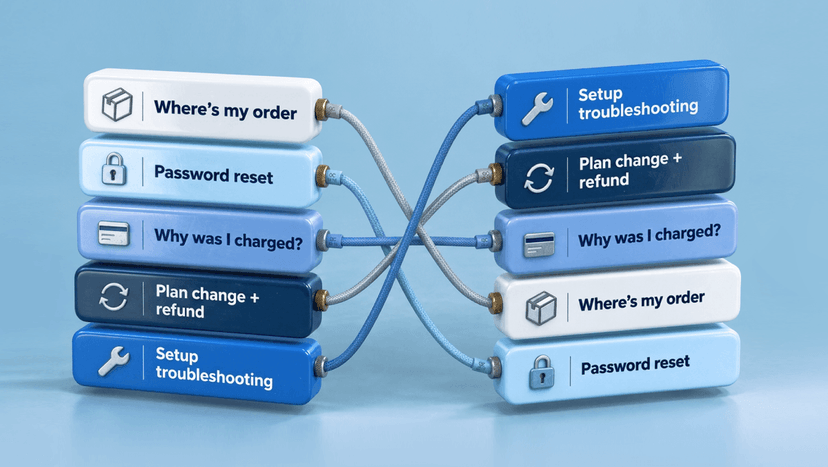
"Where's my order." "Reset my password." "How do I change my plan." In most queues, questions like these are the bulk of the volume, and each one takes a few minutes of a person's time.
CoSupport AI Agent learns from your past tickets, macros and help center. It understands customer intent and responds using your knowledge base and connected business systems. It can check an order status in your backend, process a return, or walk a customer through a setup, with no agent in the loop. When it hits something it can't close, it escalates the case with the full conversation history and a structured summary of what it found and did, so the person who picks it up doesn't start from zero.
What it costs you versus what it saves
Two numbers from real queues. Cocoatech, a SaaS team on Zendesk with roughly 500 tickets a month, has 81% of tickets handled without an agent. Nordic Knots, an e-commerce brand on Zendesk with 5,000 tickets a month, saves around $7,000 a month.
On accuracy: 99% response accuracy with near-zero hallucinations. The patented multi-model architecture (US11823031B1) is built to keep answers grounded in your own content rather than in whatever the model remembers from the internet. That matters for cost too: a wrong answer creates a second ticket, and a second ticket costs the same as the first.
Where it stops
Judgment calls, edge cases, a customer who's already angry. The AI's job there is to get the case to a person fast, with context, and that's what the escalation does. If you're automating routine questions in Zendesk, the practical rule is simple: let the AI own the categories where it's above your target rate, and route the rest.
| AI Agent | Live agents | |
|---|---|---|
| Cost per interaction | $0.50 per resolved ticket | Your payroll number, often $10 to $25 |
| Availability | 24/7 | Business hours, overtime for the rest |
| Simultaneous conversations | As many as arrive | One at a time |
| Complex problem solving | Escalates with context | The right place for it |
| Emotional support | Standard | Real empathy |
| Training | Learns from your content, keeps learning from resolutions | Ongoing coaching |
2. Routing sends each ticket to the right person the first time
Manual triage is a quiet cost. Someone reads every ticket, guesses who should own it, and the guess is wrong often enough that tickets bounce between queues for hours. Nobody logs that time as "triage", so it never shows up in the budget. It shows up as resolution time.
AI reads the ticket as it arrives, tags intent, urgency and sentiment, and sends it to the queue that can close it. A refund request from a customer who's already written three times gets flagged and goes to a senior agent. A password reset goes to whoever's free. Misroutes drop, escalations drop, and the time a ticket sits untouched drops with them.
"Traditional triage systems rely on manual review or traditional rules-based routing. While these methods can work for predictable, low-volume environments, they often fail when ticket surges occur or when a case doesn't fit neatly into predefined categories." Joshua Silvia, Director of Growth Marketing, EverWorker.
Why routing matters more after automation, not less
Once the AI Agent resolves the repetitive 60% to 80%, routing only has to deal with what's left. That's a smaller pile, but it's the expensive pile: the cases that need a specialist, a refund decision, or a manager. Getting those to the right person on the first pass is where the remaining people time goes, so a misroute now costs more than it used to.
What to measure
Two numbers tell you if routing is working: the share of tickets reassigned after first assignment, and the time from arrival to first human action. Both should fall in the first month. If reassignments don't fall, the categories need work, not the AI.
| Manual triage | AI routing | |
|---|---|---|
| Who reads the ticket first | A person | The AI, on arrival |
| Priority | Oldest first, or whoever shouts | Urgency and sentiment |
| Misroutes | Common | Rare, and they shrink as it learns |
| Time to first action | Hours | Seconds |
3. Forecasting: staff for the week you'll actually have
Staffing a support team is a guess about next week's volume. Guess high and agents sit idle. Guess low and the backlog grows, response times slip, and people quit.
How it works
AI forecasting uses your own history (past volumes, product releases, campaigns, seasonality) to tell you when tickets will rise and fall, and by how much. The useful part is the breakdown by type and complexity: "more billing tickets Tuesday, mostly simple." That lets you put senior people on the complex window and keep the quiet window lean.
It also reacts. If volume jumps mid-week because a release broke something, the forecast updates and the manager sees it before the backlog does.
Where the saving shows up
Less overtime, fewer temporary hires, and fewer panicked onboarding sprints before a launch. If you see seasonal spikes, you plan for them in September instead of discovering them in November. Hiring gets calmer too: you can see whether a volume increase is a trend that needs a permanent hire or a bump that the AI and the existing team will absorb.
What to measure
Forecast error against actual volume, week by week. In the first month it'll be rough. By the third it should be close enough to schedule against, and the overtime line in your budget is the proof.
4. Self-service that answers instead of searching
A static FAQ page makes the customer do the work: scan, guess, click, scan again. AI self-service takes the question in plain language and gives the answer, including step-by-step guidance for things like a failed payment or a setup problem.
Why customers use it
It's faster than waiting for a reply, it works at 2am, and it doesn't depend on which agent happened to pick up the ticket. For simple issues most customers would rather fix it themselves than open a ticket and wait. For you, every question answered this way is one that never became a ticket, and never carried a cost per ticket at all.
Where it fits with the AI Agent
Self-service catches the question before it's a ticket. The AI Agent catches it after. Together they cover the same repetitive volume from both ends, and the help center content you maintain for one feeds the other. Keep the help center current and both get better; let it rot and both degrade together.
| AI self-service | Live agent support | |
|---|---|---|
| Cost per interaction | Near zero | Your payroll number |
| Availability | 24/7 | Business hours |
| First-contact resolution | Consistent | Depends on the agent |
| Language support | 60+ languages | Whatever your team speaks |
| Consistency | Same answer every time | Varies by agent |
5. One AI, 60+ languages
Selling into a new market used to mean hiring native speakers for that market, with the recruiting, salary, benefits and training that come with it. The AI Agent detects the customer's language and responds in it, in 60+ languages, inside the same deployment and with the same tone.
The hidden costs it removes
The savings go past salaries. There's no per-language training program, no regional staffing to manage, no coverage gap at 3am in a time zone you don't staff, and no translation vendor sitting between your knowledge base and the customer. One help center, maintained once, serves every market.
The team you have handles the complex cases in whatever language they speak. The AI handles the rest in all of them. For a company that's opening its second or third market, that's often the difference between "we can support it" and "we can support it next year, after we hire".
6. Summaries and knowledge upkeep write themselves
Documentation is a cost nobody budgets for. Agents write up each case, summarize the thread, and update the help center when something changes. At volume, that's hours a day across the team, and it's the first thing that gets skipped when the queue is busy, which is exactly when it matters.
What the AI does with it
AI drafts the case summary from the conversation (resolution steps, customer sentiment, outcome), adds new resolutions to the knowledge base, and flags issues that keep coming back. When a ticket is escalated, the summary travels with it, so the agent reads 5 lines instead of 40 messages.
Why training costs fall
New agents onboard against a live, searchable library of real cases instead of a training deck that was accurate six months ago. They find how a similar case was resolved last week, by whom, and what the customer said afterward. Ramp time shortens, and the senior agent who used to spend afternoons answering "how do we handle this?" gets those afternoons back.
| Manual | AI-assisted | |
|---|---|---|
| Case documentation | Written by the agent after the ticket | Drafted from the thread |
| Knowledge base | Updated when someone remembers | Updated as resolutions happen |
| Onboarding | Shadowing and reading old tickets | Searchable case library from day one |
7. You pay per resolved ticket
CoSupport AI is priced at $0.50 per ticket the AI resolves. Unresolved tickets cost nothing. There's no flat plan, so a quiet month costs less than a busy one and you never pay for capacity you didn't use.
Why the billing unit matters
That's the difference between this and most support software. Per-seat tools bill for agents whether or not tickets came in. Some AI vendors bill per conversation, which includes the conversations that went nowhere. A per-resolution meter runs only when the work got done, which means the AI bill and the saving move together. More resolutions, bigger bill, bigger saving. Fewer resolutions, smaller bill, and your people handle the rest at the cost they always did.
What happens as volume grows
This is where per-resolution pricing changes the shape of the budget. With a people-only team, every extra thousand tickets a month means more hires, and the cost per ticket stays flat or rises. With the AI handling the repetitive share, the extra thousand tickets mostly land on the AI at $0.50 each, and the team grows only when the complex share grows. Support cost stops tracking ticket volume one-to-one. For a small team on Zendesk that's the difference between hiring ahead of growth and hiring behind it.
The first 1,000 AI responses are free, on your real tickets. A resolution usually takes one to three responses, so that's roughly 300 to 1,000 resolved tickets before you've paid anything. You'll know your own resolution rate and your own cost per ticket before the first invoice. Full details are on the pricing page.
What to expect in the first 60 days
Connecting takes about 10 minutes on Zendesk, Freshdesk, Intercom or Zoho Desk, and about 3 days to be fully live. Teams typically reach 60% to 70% AI resolution in the first 60 days, and the number keeps climbing as the AI learns from every resolved ticket.
Then run the formula from the top of this page with your real numbers. That's the business case, and it's one your finance team can check line by line.
.png)