.png&w=96&q=75)

AI projects tend to stall when a team goes from a test to production without a plan. An AI strategy with LLMs comes down to five steps: define a specific problem, prepare your data, design workflows with escalation rules, put governance in place, and measure results. Start with repetitive, low-risk tasks and expand once the numbers hold.
- Start with a problem: define specific goals, like automating answers to billing questions or cutting first response time in half.
- Prepare your data: use clean, well-organized sources like FAQs, helpdesk tickets, and internal documents.
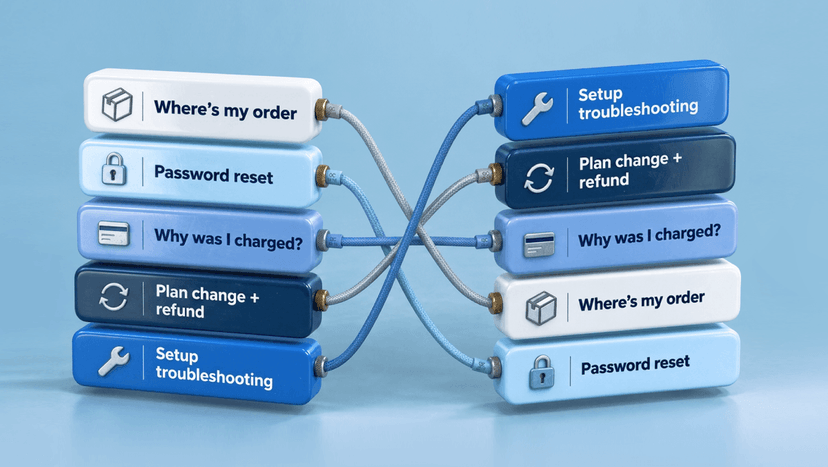
- Set up workflows: map tasks, use LLMs for repetitive ones (like password resets), and set escalation rules for complex cases.
- Put governance in place: add approval workflows, content filters, and human review for high-risk tasks.
- Measure success: track accuracy, resolution rate, and ROI, and adjust based on feedback.
LLMs work best for repetitive, low-risk tasks like FAQs or multilingual support. Keep them away from compliance-heavy or precision-critical work.
Here's the AI strategy framework in one table:
| Step | What you do | Example |
|---|---|---|
| 1. Define the problem | Pick one measurable goal | Answer most password reset questions without an agent |
| 2. Prepare the data | Clean and organize your sources | FAQs, helpdesk tickets, product docs |
| 3. Design workflows | Route low-risk tasks to AI, set escalation rules | Hand off when confidence is low or a customer mentions a dispute |
| 4. Add governance | Approval workflows, filters, human review, audit logs | A person approves refunds above a set amount |
| 5. Measure and adjust | Track accuracy, resolution, CSAT, cost per ticket | Weekly review of failed answers |
What an AI strategy with LLMs actually means
Experiments vs. production systems
It's easy to mistake a quick test for a working system. Experiments are short trials, like testing a chatbot on sample data for a couple of weeks without real users. They show whether an idea has potential.
Production systems are far more demanding. They need infrastructure that handles real volume, continuous data pipelines, and clear governance. They're connected to tools like your ticketing system and talk to actual customers.
Experiments can wrap up in a few weeks. Production needs a phased rollout, and this is the step where projects tend to stall. The way through is to answer a few questions before development starts.
Questions to answer before you start
- What specific problem are you solving? "Improve support" is too broad. Automating most billing questions, or cutting response time on password resets, is specific.
- Where is your data coming from? FAQs, helpdesk tickets, internal documentation, or a mix.
- How will you measure success? Resolution accuracy, average handle time, or cost per ticket.
- Who owns the workflow? Assign clear owners for escalation rules, quality checks, and maintenance.
Write the answers down before the pilot starts. Without them, you get scattered tests and no way to tell which one worked.
Why LLMs matter for customer support
LLMs understand and write natural language far better than rule-based systems. Combined with your company's content through retrieval-augmented generation (RAG), they can answer accurately in real time, pulling from your help center, resolved tickets, and internal policies.
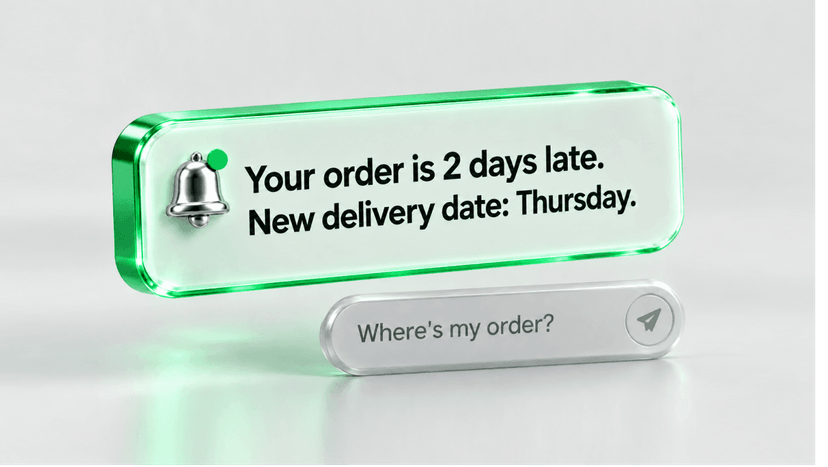
The goal is to take repetitive work off your team: password resets, order status checks, basic troubleshooting. Agents then spend their time on issues that need human expertise.
Well-configured AI agents resolve a large share of repetitive tickets and hand the rest to people. Teams using CoSupport AI Agent typically reach 60–70% AI resolution in the first 60 days. To see what that could mean for your volume, try an ROI calculator.
sbb-itb-97114f1
Choosing the model: what business leaders need to know
Business leaders read a lot of AI terms: recurrent neural networks, GANs, transformers. You don't need to tell them apart. All widely used LLMs run on the transformer architecture, and most of them handle common business tasks at an acceptable level.
The real decision is picking the option with the right performance and cost for your project. That part is a joint job with your CTO or ML engineers:
- The technical team compares models on parameters, context window size, expected token volume (which drives cost), latency, and quality scores, and judges how well a model fits the specific project.
- The business leader defines the goal, sets the limits, and makes sure the project fits the company's wider strategy.
One strategic question sits with the leader: should the solution run on a general-purpose LLM used as is, or on a solution built for your domain? Smaller, task-specific models have been gaining ground since 2024. In 2025, Gartner predicted that by 2027 organizations will use small, task-specific AI models three times more than general-purpose LLMs. In practice, many companies also adapt a general model to their domain with retrieval (RAG) or fine-tuning.
General-purpose LLMs: powerful but broad
LLMs such as the models behind ChatGPT, Microsoft Copilot, and Google Gemini are huge neural networks trained on general data, then fine-tuned for specific tasks. They power content generation, chatbots, search, and recommendations.
They also have real drawbacks for a specialized tool:
- Too general. General models know less about rare, specialized topics. A study covered by TechTalks found that adding retrieval (RAG) improved results on such topics more than fine-tuning alone.
- Data leakage. Data you send to a shared model can leak. In 2023, Korean media reported that Samsung engineers pasted internal code into ChatGPT, and the company then restricted the tool.
- Jailbreaking. Researchers keep finding ways around safety rules. In 2024, the ArtPrompt study used ASCII-art prompts to get past the safeguards of GPT-3.5, GPT-4, Gemini, Claude, and Llama 2.
- Hallucinations. A model with broad knowledge can invent answers, so anything critical needs checking.
- Unpredictable costs. API access is priced per token, and the budget also has to cover the ML and backend engineers who build and maintain the pipeline.
Domain-specific solutions: focused and custom
A solution built for one domain, such as customer support, works differently. It may be a smaller custom model or an LLM grounded in your data and tuned for that one job:
- Focus. It's built for support content only, so its answers stay on topic.
- Your data. It answers from the data you provide about your products and services, so you know where an answer came from.
- Lower hallucination risk. Verified sources and a narrow scope mean fewer made-up answers.
- Data security. It can be isolated from shared systems, and personal data can be anonymized.
- More predictable pricing. Domain vendors often price by outcome or by plan instead of by token, and they handle most of the engineering.
Comparisons between these approaches are still early, so test any option on your own tickets.
CoSupport AI is one example: it's built for one domain, support, and answers from your content. Its patented multi-model architecture (US11823031B1), which CoSupport AI Assistant is built on, matches a new thread or a message with an error log to a stored solution by similarity. Follow-up messages go to a response model trained on threads of support messages and replies. CoSupport AI Agent answers from your knowledge base and business systems and hands off what it can't resolve.
Before you choose, ask each vendor four questions: what the AI is trained on, where it's weak, how it prevents made-up answers, and how the price changes as your volume grows.
| Criterion | General-purpose LLM used as is | Domain-specific solution |
|---|---|---|
| Knowledge | Broad, general | Focused on one domain, such as support |
| Training data | Mostly unknown to you | Your own content and past conversations |
| Hallucination risk | Higher without grounding in your data | Lower with verified sources |
| Data security | Depends on the provider's terms | Can be isolated, data can be anonymized |
| Cost | Per token, varies with volume | Often per outcome or plan, easier to budget |
| Team needed | ML and backend engineers to build and maintain | Mostly handled by the vendor |
Implementing private large language models
Some companies go a step further and run a private LLM in-house. This video from SoftEd covers what that involves:
When LLMs make sense and when they don't
Use cases that work well
LLMs are strong at language-heavy, repetitive work. In support, that means FAQs, multilingual replies, and helping agents search internal knowledge. These tasks are high-volume, low-risk, and follow clear patterns. Password resets and order tracking are typical examples: the model answers from your help center, resolved tickets, and documentation.
Multilingual support is another good fit. An LLM can detect the language, answer in it, and handle cultural nuance in one step, without extra translation tools. Internally, LLMs search documentation, summarize past tickets, and draft replies, where speed often matters more than perfection. Low-level support, content drafting, and document analysis are good first projects because a slightly imperfect result still saves time.
Use cases that don't work or carry high risk
Compliance is where LLMs fall short. Legal advice, regulated disclosures, or anything tied to laws or contracts is risky: one wrong answer can lead to fines or lawsuits. Work that needs exact numbers, like financial calculations, inventory, or pricing, is a poor fit too. LLMs work on probabilities. That works for drafting an email. For processing a payment, it's a risk.
Medical, financial auditing, and safety-critical decisions are also high-risk. Without RAG, LLMs are more likely to get facts wrong. For sensitive data, real-time decisions, or high stakes, rule-based systems or AI with human review are more reliable.
How to decide if a use case is worth it
A simple scoring method helps. Rate each task on ticket volume (high = 3, medium = 2, low = 1), risk (low = 3, medium = 2, high = 1), and automation potential (high = 3, medium = 2, low = 1). A total above 7 signals a good candidate. FAQs score 3 + 3 + 3 = 9. Compliance questions score 2 + 1 + 1 = 4, so they should be avoided or kept under close human review.
Also look at historical volume (ideally 500+ tickets a month on the topic), the accuracy you need, and the cost of an error. After launch, watch the escalation rate and customer satisfaction. If a use case scores low, wait, and start with quick wins instead.
| Criterion | Good fit for LLMs | Poor fit or high risk |
|---|---|---|
| Task type | FAQs, ticket summaries, reply drafts, knowledge search | Billing calculations, compliance checks, tax computation |
| Risk level | Low to medium; errors cause minor inconvenience | High; errors have legal, financial, or safety consequences |
| Precision required | Approximate, conversational answers are acceptable | Exact outputs required (numbers, terms, deadlines) |
| Support examples | Tier-1 FAQs, multilingual chat, agent reply suggestions | Regulatory guidance, financial commitments, account takeover decisions |
Core components of a practical LLM AI strategy
Data foundation and retrieval-augmented generation (RAG)
Every LLM strategy rests on its data. Start by listing your sources: documentation, FAQs, helpdesk tickets, internal runbooks, and chat logs. Check each for completeness and accuracy. Then clean and standardize the content and add metadata such as product category, language, and last update date.
A RAG pipeline works like this: content is ingested, split into chunks (for example, 500–1,500 tokens), turned into embeddings, and stored in a vector database. A hybrid search, semantic plus keyword with reranking, finds the most relevant context for each question. In support, you can index Zendesk tickets and product docs so the LLM can reference resolved cases. Validation steps catch outdated or duplicate content before it reaches customers.
Workflow design and escalation rules
Break support work into tasks: triage, answer lookup, troubleshooting, and policy decisions. Route low-risk questions like password resets or order tracking straight to the AI. Set escalation triggers, such as a confidence score below a threshold (for example, 75%), keywords like "refund dispute", or negative sentiment. When a trigger fires, the system can create a helpdesk ticket or send a Slack alert.
Escalations work best when they're fast and the agent gets full context: conversation history, the customer's plan, and ticket metadata. Connect tools like Zendesk, Salesforce, Intercom, or Slack through their APIs, and use response templates and prompt instructions so the AI answers consistently, cites documentation, and matches your brand tone.
Governance, guardrails, and safety controls
Decide who can approve what before the AI answers its first customer. Set ethical guidelines, data privacy policies, and clear decision rights. Add content filters for toxicity, rate limits to prevent misuse, and checks that outputs follow your business rules. Prompt templates can stop the AI from inventing prices or policies. High-stakes decisions, like refund approvals or legal questions, should always go to a person.
In practice, this means moderation templates, audit logs of every interaction, and dashboards that track hallucinations, escalations, and policy violations. Check your vendor's security too: CoSupport AI, for example, is ISO 27001 certified, GDPR and CCPA compliant, and uses data anonymization and encryption (security overview).
Ownership, metrics, and feedback loops
Give the AI strategy a clear owner, a dedicated lead or a cross-functional team that reports to leadership. Tie KPIs to business goals: resolution rate (tickets handled without an agent), customer satisfaction, first response time, and cost per ticket. Set targets from your own baseline. Dashboards connected to tools like Zendesk help you track them, with a weekly review.
Feedback loops improve the system over time. Collect user reactions (thumbs up or down), agent escalations, and conversation logs, then update content and prompts on a regular schedule. Send negative feedback to whoever owns the knowledge base. Resolved tickets can be used to label data for further improvement.
| Component | Key actions | What to track |
|---|---|---|
| Data and RAG | Catalog sources, clean data, chunk content, use hybrid search | Answer accuracy, outdated content found |
| Workflow and escalation | Map tasks, set confidence thresholds, connect your helpdesk and Slack | Resolution rate, time to escalate |
| Governance and safety | Define policies, add content filters, require human review for high-risk tasks | Error rate, policy violations, audit results |
| Ownership and metrics | Assign an AI lead, track resolution, CSAT, and ROI, review weekly | Trend against your baseline |
Choosing the right use cases for LLM adoption
Customer support automation examples
Start with high-volume, repetitive tasks: password resets, order tracking, account status updates, and basic troubleshooting. That's where LLMs deliver results first.
Softorino uses CoSupport AI Assistant inside Zendesk to draft replies and cut its full ticket resolution time by 53%. Softorino's CEO put it this way: "Setup took one API key. In three months, resolution rates grew from 69 to 82 percent. We tested six other tools before. Nothing performed as well as CoSupport AI."
Ticket routing is another good use case. LLMs read incoming messages, sort them by urgency or topic, and send them to the right team. ProjectFitter, on Freshdesk and Freshchat, went live in 15 days. The AI now resolves 75% of chats on its own, and chat resolution is 93% faster. Its project manager described the result as "automating about 70% of support tickets and shortening resolution time from hours to minutes."
Internal knowledge and workflow automation
LLMs help inside the company too. Instead of digging through Confluence pages or Slack threads, agents can ask the AI for the right document, a past resolution, or a product update. Conversation summaries turn long chats into key points for managers. Action item extraction pulls tasks like "follow up with the customer on the refund" out of conversations and sends them to your project tool.
This only works with a well-organized knowledge base and clean conversation data. Start with the teams that handle the most conversations, then expand once security and integration needs are covered.
What to consider for enterprise deployment
For enterprise deployments, security and compliance are non-negotiable. Look for ISO 27001, GDPR and CCPA compliance, plus data anonymization and encryption. Some vendors isolate customer data on dedicated servers; CoSupport AI, for example, runs each customer on a dedicated, isolated server. Test the integrations with Zendesk, Salesforce, Intercom, or Slack thoroughly, and monitor the APIs before going live.
Set up governance to catch hallucinations, bias, and policy violations early. Start with low-stakes tasks like FAQ automation, and track resolution rate and customer satisfaction before moving to more complex workflows.
3 common mistakes when building an AI strategy with LLMs
Starting with technology instead of problems
Many companies pick a model before they know what problem it should solve. Picture a SaaS company that puts a well-known model on all customer questions without analyzing its ticket data. It ends up with a tool that misses what customers actually ask.
Start by analyzing recent tickets to find recurring issues. Then hold a team workshop and rank those issues by impact and by how ready your data is. Focus on one high-volume problem that affects your operations. And watch your data quality, because poor data makes every other problem worse.
Ignoring data quality and maintenance
Outdated content leads straight to wrong answers. If your FAQs still describe an old product, the AI will repeat that information with confidence, and customers lose trust.
Set up regular pipelines that pull updated content from your helpdesk. Validate it and remove duplicates. Without regular updates, even a good AI strategy fails.
Lack of governance or oversight
Without oversight, LLMs can expose sensitive data, give unsafe advice, or break compliance rules.
Set up a governance group before rollout. Define clear escalation rules, such as sending any response that involves a refund over $500 to a person. Set a high accuracy target, for example above 95% on the topics you automate, and log every interaction for audits.
Key takeaways
Focus on solving specific problems
Start with a clear, measurable challenge, like cutting first response time or handling a high volume of routine questions. List your top 10 ticket categories by volume and pick the ones with the most impact. Check which can be answered from existing content, then choose one or two with specific targets, such as cutting cost per ticket by 20% within six months. Treat it as a business project with business outcomes.
Emphasize data quality and governance
If your FAQ still shows last year's return policy, the AI will quote it with full confidence. The same happens when FAQs are inconsistent, docs are outdated, or policies live in scattered chats. Build one up-to-date source of truth for policies and product information, version it with timestamps, and review sensitive topics like refunds or data deletion regularly.
Set clear limits for AI answers, such as no legal advice or contract changes, and escalation rules for high-risk cases. Log every interaction for audits.
Start small and scale gradually
Plan a phased rollout over about 90 days:
- Weeks 1–2: define the use case and success criteria.
- Weeks 3–4: connect content sources and pilot on low-risk topics.
- Weeks 5–8: roll out to a limited group with human oversight.
- Weeks 9–12: refine, and expand only if the metrics hold.
Set your own scale-up benchmarks before you start, for example a target accuracy, no critical errors for 30 days, and a measurable drop in handling time. Once the AI reliably handles a share of "how-to" questions in chat without hurting satisfaction, extend it to email suggestions or more product categories.
.png)