.png&w=96&q=75)

Crypto trading never stops, and AI tools are transforming how traders analyze data and make decisions. These systems process vast amounts of information in real time, predict trends, and execute trades faster than humanly possible. Between late 2024 and 2025, the market for AI in crypto trading surged from $4.8 billion to $15.5 billion, with 67% of Gen Z traders now relying on AI tools.
Key features include:
- Real-Time Data Processing: AI scans millions of sources like blockchain networks, exchanges, and social media for insights.
- Predictive Analytics: Models forecast price trends with accuracy rates of 52.9%-66%.
- Automated Trade Execution: Trades are executed instantly when conditions are met.
- Sentiment Analysis: AI interprets market mood from news and social media.
- Dynamic Risk Management: Adjusts strategies based on market volatility.
Top platforms like Token Metrics, CryptoHopper, 3Commas, and Pionex cater to different trading needs, from portfolio optimization to automated trading. However, over-relying on automation, using poor-quality data, or neglecting security practices can lead to risks. Always combine AI tools with human oversight and clear strategies for the best results.
I Trained AI To Build Trading Tools & Indicators (Full Blueprint)
What Are AI Business Intelligence Tools for Crypto Trading?
AI business intelligence tools for crypto trading are automated systems designed to process vast amounts of crypto-related data using advanced algorithms and machine learning. These tools act as tireless assistants, working around the clock to analyze data, monitor hundreds of assets across various exchanges, and make informed decisions - all without being influenced by emotions or fatigue.
"AI in crypto works like an always-on trading assistant. It studies market patterns, compares thousands of data points, and places trades without hesitation." - Ampcome
The global market for AI trading platforms is projected to reach $69.95 billion by 2034, with an annual growth rate exceeding 20%. This rapid expansion highlights how these tools are reshaping crypto trading, turning it from a manual, emotion-driven activity into a fast, data-focused process.
These tools come with several key features that make them indispensable for crypto traders.
Key Features of AI Tools
Real-Time Data Processing is at the core of these systems. AI tools gather data from diverse sources such as blockchain networks, exchange APIs, social media, news outlets, and on-chain analytics. For instance, Signal AI scans an impressive 5 million documents daily in 75 languages, tracking cryptocurrency mentions and gauging market sentiment.
Predictive Analytics is where AI tools truly shine. Unlike traditional trading bots, machine learning models analyze historical data to predict market movements. For example, AI models can forecast Bitcoin price trends with 66% accuracy, and studies show similar tools achieve 52.9% to 54.1% accuracy when predicting daily movements for the top 100 cryptocurrencies. This foresight allows traders to seize opportunities before they become widely apparent.
Automated Trade Execution eliminates delays and emotional interference. Once specific conditions are met, AI systems execute trades within milliseconds across various exchanges. In 2024, AI-powered arbitrage bots identified and acted on price differences across exchanges in milliseconds, capturing profits that manual traders often missed.
Sentiment Analysis provides an edge by interpreting the mood of the market through news, social media, and forums. During the Ethereum rally in 2025, AI sentiment models picked up on optimism in social media weeks before technical indicators confirmed the trend, enabling early adopters to benefit significantly.
Dynamic Risk Management ensures adaptability in volatile markets. These tools automatically adjust stop-loss levels, diversify portfolios intelligently, and scale down positions when risk thresholds are exceeded. Such features are invaluable for traders, founders, and support teams alike.
Why These Tools Matter for Support Teams and Founders
AI tools not only enhance trading strategies but also revolutionize how support teams and business leaders operate in the crypto space.
Faster Customer Response Times are achievable with AI-generated insights. Support teams no longer need hours to research market conditions or answer customer questions about trading performance. Instead, they can access real-time analysis and provide accurate, immediate responses.
Reduced Analysis Time changes the game for teams. Tasks that used to take hours or even days - like analyzing market trends - can now be completed in minutes. This efficiency allows support teams to stay ahead of customer needs and market shifts.
Improved Decision Accuracy is another major benefit. By removing human bias and emotions, AI tools enable better decision-making. In fact, 60-75% of trading volume in major traditional financial markets already comes from algorithmic trading, proving the reliability of automated systems.
Cost Reduction is a natural outcome of automation. Many tasks that would require dedicated analysts are now handled by AI, allowing founders to maintain smaller, more efficient teams without compromising on quality or market awareness.
Shifting from manual processes to AI-driven solutions isn’t just about adopting new technology - it’s about creating support systems that can keep up with the fast-paced crypto world while delivering accurate, timely assistance to customers who rely on up-to-the-minute information.
Top AI Tools for Analyzing Crypto Trading Data
The world of crypto trading has seen a surge in AI-driven platforms that simplify market analysis and automate trading processes. Here’s a closer look at some standout tools catering to different trading styles and needs.
Token Metrics

Token Metrics serves as a powerful AI research engine, analyzing over 80 data points for each cryptocurrency. It provides AI-generated coin ratings and helps identify emerging market trends. The platform also includes portfolio optimization tools that automatically rebalance holdings based on AI predictions, along with real-time risk assessment to monitor security threats.
"AI trading tools have become indispensable for retail and institutional traders alike, offering insights that were once only available to hedge funds with large research teams." - Token Metrics Team
Its support teams can access AI reports instantly, making it easier to address complex questions about market trends and investment strategies.
CryptoHopper

CryptoHopper stands out with its diverse range of 16 trading bots, including Market Making, Exchange Arbitrage, and Triangular Arbitrage bots. It features an AI Strategy Designer, a social trading marketplace, and a backtesting engine to test strategies using historical data. Additionally, its paper trading feature allows users to practice without risking real funds.
"I enjoy working with the trailing stop loss. It gives me peace of mind that I know that the hopper will take profit at the moments the prices fall again." - Richard Engel
CryptoHopper also offers a free plan with basic portfolio tracking and a 20-position limit, making it a flexible option for traders at any experience level.
3Commas
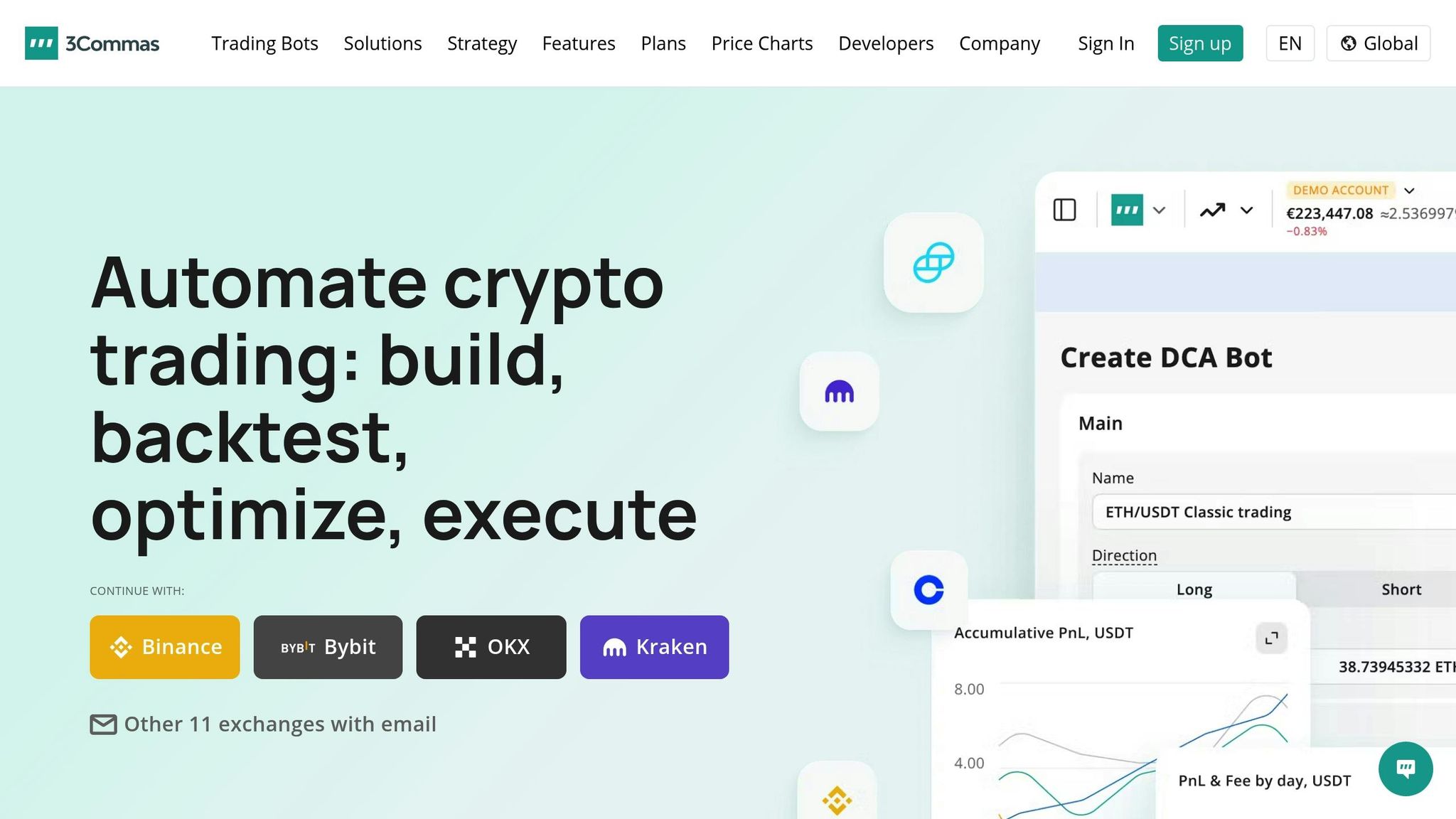
3Commas is a favorite among professional traders managing multiple accounts and portfolios. Its SmartTrade terminal introduces advanced order types, such as trailing stop-loss and multiple take-profit levels, while the AI Grid Bot adjusts trading grids based on market volatility.
The platform also supports portfolio rebalancing across various exchanges, handling hundreds of trading pairs and redistributing assets based on AI-driven market insights.
"I've been with 3Commas for a couple of years now, and its powerful bots, once you understand their mechanics, can generate good returns with minimal risk." - Mick Gallacher
3Commas provides a free tier with limited features, while its mobile app mirrors the full functionality of the web platform and boasts a 4.6/5 rating on Google Play.
Pionex

Pionex offers a unique blend of an exchange and a bot platform, making it highly accessible for beginners. It includes 16 free trading bots that require no API setup. The Grid Bot is particularly useful for capturing sideways market movements by placing buy and sell orders at predetermined intervals.
Its arbitrage bots capitalize on price differences across major exchanges, executing trades within milliseconds. Pionex charges a low 0.05% trading fee per transaction and doesn’t require a monthly subscription. For those managing long-term investments, its DCA (Dollar Cost Averaging) bots are a convenient tool for automated cryptocurrency purchases at regular intervals.
| Tool | Monthly Cost | Key Strength | Best For |
|---|---|---|---|
| Token Metrics | Varies | Early trend detection | Research and analysis |
| CryptoHopper | $24-$108 | Strategy marketplace | Social trading |
| 3Commas | $49-$59 | Multi-account control | Professional traders |
| Pionex | Free | Built-in exchange | Automation beginners |
Each of these platforms brings something unique to the table. Token Metrics shines in research and trend spotting, CryptoHopper offers a variety of automated strategies, 3Commas provides detailed control for advanced trading operations, and Pionex simplifies automation for those new to the process. While these tools can significantly enhance trading efficiency, it’s essential to use them wisely to avoid common missteps.
sbb-itb-97114f1
3 Common Mistakes When Using AI Tools for Crypto Data
AI tools can be incredibly powerful for analyzing crypto data, but even the most advanced systems can lead to errors if not used thoughtfully. Here are three mistakes that can turn valuable insights into potential risks.
Relying Too Much on Automation
One of the biggest pitfalls is treating AI like a magic solution that can predict every market move. Over-dependence on automation can create blind spots, particularly during market crashes or unexpected events that the AI hasn’t encountered before. For instance, AI models often excel with historical data but may falter when faced with unprecedented scenarios.
Historical market disruptions highlight this vulnerability. As Gary Stone puts it: "These AI systems are creating unprecedented risks in our markets... And the threats have only grown more sophisticated."
The issue is compounded by the "black box" nature of many AI algorithms, which don’t always make their decision-making processes transparent. This lack of clarity can leave you guessing about the reasons behind unexpected trades. To mitigate these risks, think of AI as an assistant, not a decision-maker. Always review and manually approve major trades.
Now, let’s explore how data quality can further influence AI performance.
Using Poor Quality Data
The accuracy of AI tools hinges on the quality of the data they process. In fact, nearly 70% of financial AI project failures are linked to flawed or incomplete data. Even small errors can have big consequences - just 5% of mislabeled data can reduce model accuracy, while datasets with 20–30% errors might cause performance to drop by around 5%.
In crypto markets, poor data quality can be especially damaging. Flash crashes, for example, can create misleading price spikes that AI may interpret as opportunities. Similarly, exchange APIs often fail during high trading volumes, leaving critical gaps in historical data. Add issues like wash trading, which generates fake volume signals, and you’ve got a recipe for unreliable insights.
To counteract these challenges, verify your data sources regularly. Cross-check price feeds from multiple exchanges, and set up alerts for unusual patterns. Avoid relying on a single data source for crucial decisions - it’s a risk you can’t afford.
Weak Security Practices
AI trading tools often require API access to your exchange accounts, making them tempting targets for hackers. The risks are real: between 2017 and 2023, AI-related security incidents surged by 690%. In 2022 alone, several traders suffered losses after hackers exploited leaked API keys to manipulate trading bots.
The problem is compounded by poor security habits. Many users reuse API keys across platforms, store credentials in unsecured files, or skip two-factor authentication. These practices make it easier for attackers to gain access. In fact, 89.4% of IT leaders have expressed serious concerns about AI-related security threats.
To protect yourself, use separate API keys for each platform, and set them to read-only access whenever possible. Always enable two-factor authentication on your trading accounts, and store credentials securely in encrypted password managers instead of plain text files. Before linking any AI platform to your accounts, research it thoroughly. Look for independent security audits, user reviews, and clear details about their security measures.
These missteps highlight the importance of using AI tools with caution and a well-rounded strategy when navigating the complexities of crypto trading.
Key Takeaways
Looking back at the insights and challenges we've explored, three main principles stand out for navigating the fast-paced crypto market wisely.
AI Simplifies Crypto Data Analysis
AI tools take the complexity out of analyzing the flood of crypto market data. Instead of painstakingly monitoring hundreds of coins across countless exchanges, these platforms process massive data sets in real-time, spotting trends in minutes - something traditional methods might take hours to achieve.
"AI tools are only as good as the data they're trained on, and they can sometimes make mistakes or fail to predict sudden market changes." - Coinbase
Think of AI as an assistant that helps you analyze data, not as the ultimate decision-maker.
Choose Tools That Match Your Goals
The right tool depends on your trading approach. Day traders need features tailored to fast-paced decisions, while long-term investors require tools for broader market analysis. If automation is your priority, look for platforms that align with that strategy.
Start by clearly defining your objectives. Are you aiming for portfolio optimization, automated trading, or detailed market research? For example, Token Metrics shines in delivering in-depth analysis and coin ratings, while CryptoHopper specializes in automation, and Pionex focuses on grid trading and arbitrage.
The trick is to choose tools that meet your specific needs instead of paying for features you won’t use.
"To find the best fit, start by assessing your specific needs. These should include your trading style, comfort with technology, required features, and budget." - Pragmaticcoders team
Combine Tools for a Well-Rounded Strategy
Using multiple AI platforms together can enhance your trading strategy far more effectively than relying on just one. Each platform has its strengths, and combining them gives you better insights and execution.
For instance, you could use Token Metrics for its market intelligence and coin analysis, then rely on CryptoHopper for its automation capabilities. This pairing offers both deep analytical insights and seamless trade execution.
"Integrating AI agents with your trading bots allows seamless coordination between different tools, enabling automated execution of custom strategies across multiple assets and exchanges." - Token Metrics team
Having multiple tools also ensures you’re prepared for unexpected issues. If one platform experiences downtime or glitches during a volatile market period, you’ll have a backup ready to go.
"AI is a guide, not a guarantee. Use it to inform, not to blindly decide." - Powerdrill.ai
By combining tools and maintaining human oversight, you can create a more reliable and effective trading strategy.
These principles can help you make smarter decisions when selecting and integrating tools into your crypto trading approach.
FAQs
How can AI business intelligence tools help traders make faster and more accurate crypto trading decisions?
AI-powered business intelligence tools are transforming the way traders approach crypto trading by analyzing massive amounts of market data in real time. They uncover patterns, trends, and anomalies that could easily slip past during manual analysis.
What makes these tools stand out is their ability to process data from various sources at once - price fluctuations, breaking news, and even social media sentiment. This multi-source analysis allows traders to act swiftly on actionable insights, boosting both the speed and accuracy of their decisions while minimizing the chances of human error.
What are the risks of relying too much on AI tools for crypto trading, and how can you reduce them?
Relying too much on AI tools for crypto trading can introduce risks like market manipulation, security vulnerabilities, and overfitting - all of which can lead to inaccurate predictions or poor trading decisions.
To manage these risks effectively, consider the following steps:
- Keep human oversight in the loop: Always review and validate what the AI outputs before making decisions.
- Test and update AI models regularly: This helps maintain accuracy and ensures the models stay reliable over time.
- Strengthen security measures: Protect sensitive data and guard against potential breaches with robust security protocols.
AI can undoubtedly enhance your trading strategies, but pairing it with human expertise and strong safeguards is the best way to stay in control and reduce potential pitfalls.
How do AI platforms like Token Metrics, CryptoHopper, and 3Commas support different crypto trading strategies?
AI-driven platforms like Token Metrics, CryptoHopper, and 3Commas bring tailored tools to meet the diverse needs of crypto traders:
- Token Metrics offers analytics powered by AI, aimed at helping traders make informed choices, reduce risks, and boost profitability.
- CryptoHopper specializes in automated bots and customizable strategies, making it a go-to for techniques like trend following, scalping, or grid trading.
- 3Commas provides features for portfolio management, arbitrage, and high-frequency trading, with options for both pre-configured and user-designed strategies.
These platforms are designed to suit traders at all levels, from beginners exploring the market to seasoned professionals, ensuring the tools align with their unique trading objectives.
.png)


.png&w=828&q=100)
.png&w=96&q=100)
.png&w=828&q=100)
.png&w=96&q=100)