.png&w=96&q=75)

Spotify’s Discover Weekly playlist is a masterclass in personalization and prediction. It uses advanced AI to analyze user behavior, delivering tailored music recommendations to 40 million users weekly. This approach has driven 100 billion streams since its launch. The same principles can transform customer support by shifting from reactive to predictive strategies.
Here’s what support teams can learn:
- Predictive Support: Analyze patterns to anticipate and resolve issues before they arise.
- Personalized Service: Use customer behavior data to create tailored, meaningful interactions.
- Feedback Loops: Continuously refine systems by integrating customer actions and feedback.
Modern customers demand fast, accurate, and personalized help. By applying Spotify’s AI-driven methods, businesses can reduce ticket volumes, improve response times, and build lasting loyalty. The key? Focus on preventing problems rather than just solving them.
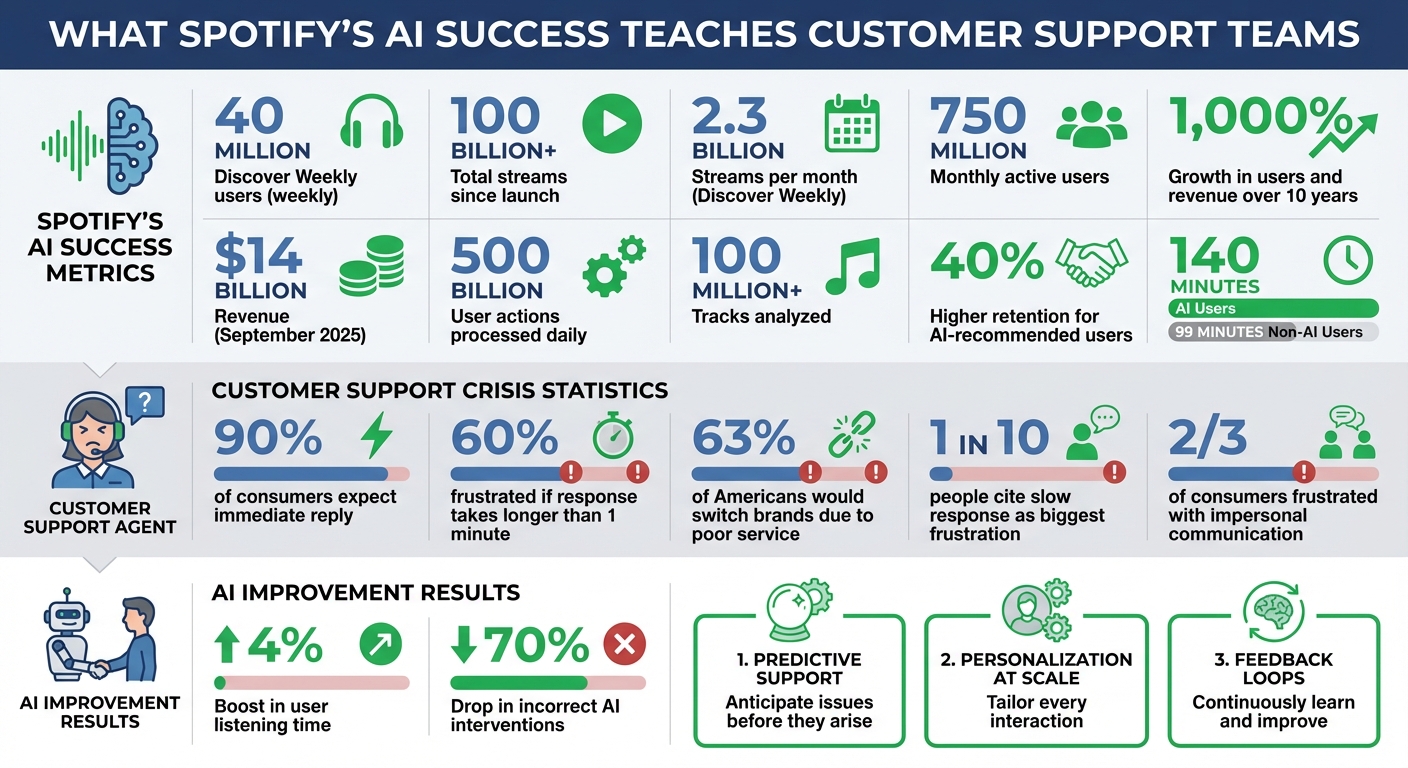
Spotify's AI-Driven Growth and Customer Support Statistics
AWS re: Invent 2025-The AI revolution in customer support: Building predictive service systems-SPS315
sbb-itb-97114f1
The Problem: Reactive Customer Support Can't Keep Up
Support teams often wait until issues arise, scrambling to fix problems after the damage is already done. This approach may have worked when customers were willing to wait days for a response. But in 2026, 90% of consumers expect an immediate reply, and 60% become frustrated if it takes longer than one minute.
These numbers highlight a serious challenge. By reacting only after problems surface, businesses are forced into a constant game of catch-up. The fallout is significant: 63% of Americans would switch brands due to poor customer service. This delay sets off a chain reaction of recurring issues, leaving customers dissatisfied and businesses struggling to keep up.
High Ticket Volumes and Repetitive Issues
Reactive support creates a cycle that’s hard to break. When teams focus on quick fixes instead of solving root causes, the same problems keep resurfacing. Each unresolved issue generates another ticket, and before long, the support queue spirals out of control.
Take Spotify as an example. Over the past decade, they’ve grown their user base and revenue by 1,000%, now serving more than 750 million monthly active users. A reactive support model would crumble under this kind of growth. Manually handling every ticket simply isn’t sustainable.
Another downside of reactive systems is their inability to detect patterns. Every ticket is treated as an isolated event, missing subtle signals like repeated searches, abandoned shopping carts, or recurring questions across different channels. These micro-signals could help identify and address problems before they escalate into full-blown support tickets.
How Slow and Generic Responses Damage Customer Experience
The problems don’t stop with ticket volume. Slow and impersonal responses make things even worse. Speed and personalization are no longer optional - they’re essential. One in 10 people say slow response times are their biggest customer service frustration. By the time customers reach out, they’re often already annoyed, and long wait times only amplify their dissatisfaction.
Generic responses add fuel to the fire. Nearly two-thirds of consumers become frustrated with impersonal communication, whether it’s an email, text, or social media reply. Template-based answers signal that you don’t understand their unique situation. In an era where platforms like Spotify use AI to deliver highly tailored experiences, customers expect the same level of attention from support teams.
When customers don’t get fast, personalized help, they’re more likely to leave for competitors. Spotify recognized this early: if users couldn’t quickly find songs they loved, they’d switch to another streaming service. The same principle applies to customer support - slow, generic responses drive customers to brands that can better meet their needs.
Example: Revenue Loss from Poor Support Practices
The financial toll of reactive support is undeniable. While specific e-commerce examples weren’t available, broader data shows that businesses relying solely on reactive models face higher levels of customer frustration due to unresolved issues and repeated escalations.
Escalations come at a steep price. Major problems demand more time, resources, and often several team members to resolve. Meanwhile, customers experience negative emotions that weaken their loyalty and trust.
"If brands aren't proactively resolving customer pain points, their reputation and revenue could both be on the chopping block." - Mitto
This cycle underscores why proactive strategies are essential - not just for improving customer satisfaction, but for protecting long-term revenue and growth.
Key Takeaway: Reactive support leads to overwhelming ticket volumes, slow responses, and generic communication - all of which erode trust and drive customers away. The gap between what customers expect (instant answers) and what traditional support delivers (delayed resolutions) poses a direct threat to retention and revenue.
Lesson 1: Predictive Support Based on Spotify AI Customer Experience
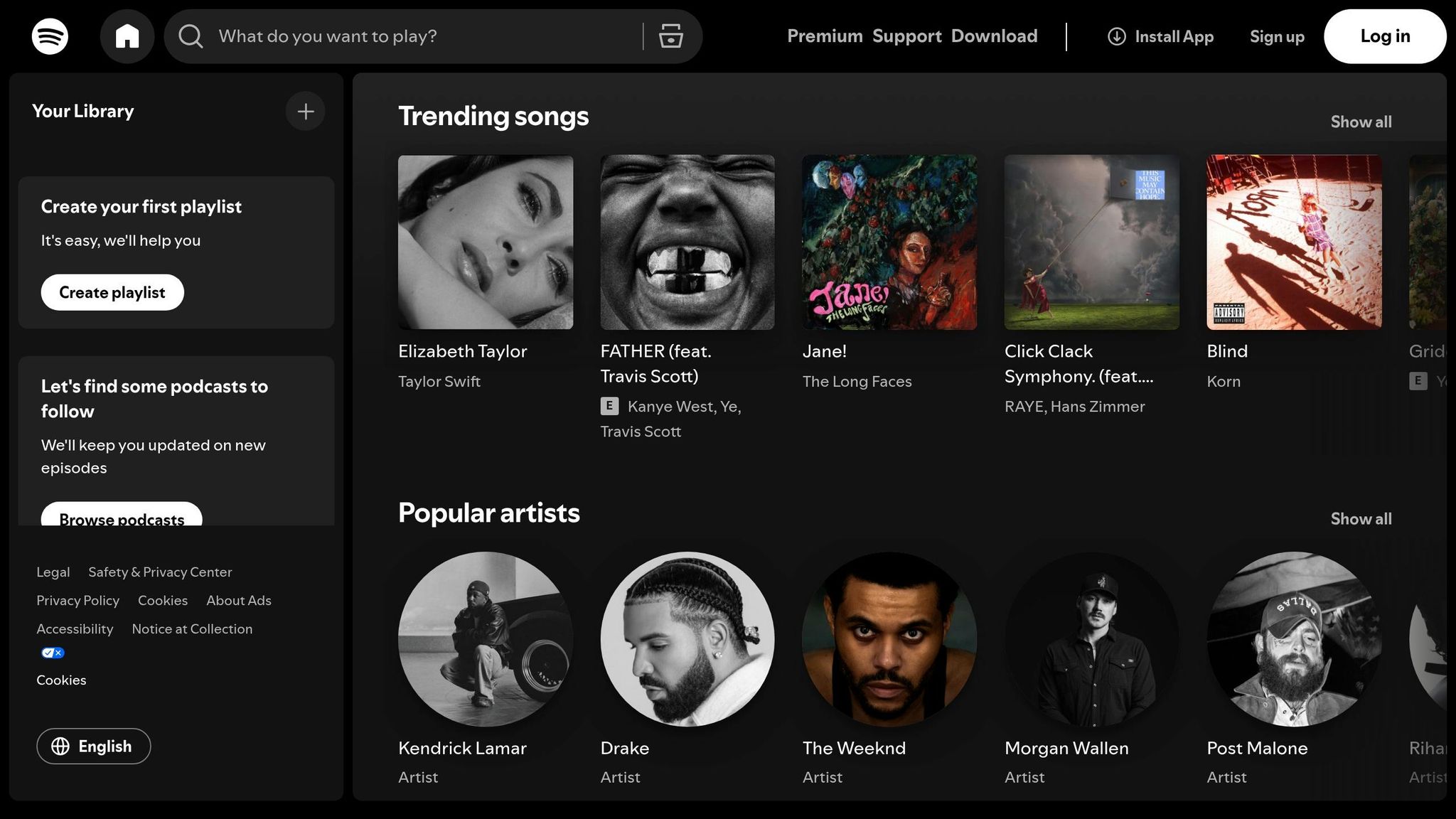
How Spotify's AI Predicts User Preferences
Spotify has a knack for knowing what you'll love next. It sifts through billions of data points - like the tracks you play, the podcasts you listen to, your listening habits, and even how you discover new music - to create a detailed map of your preferences, often before you even realize them yourself.
Ruchika Singh, Spotify's Director of Data Science, describes this process as a "symphony of algorithms". It combines several techniques:
- Collaborative filtering compares your listening habits with those of users who have similar tastes.
- Natural language processing (NLP) dives into lyrics, analyzing mood and themes.
- Audio analysis examines tempo, genre, and energy levels in tracks.
Together, these methods fuel Spotify's predictive models, powering features like Discover Weekly - which racks up an impressive 2.3 billion streams every month.
But Spotify's AI isn't just about music recommendations. It also predicts user behavior, such as mapping customer journeys and identifying when someone might cancel their subscription. This allows Spotify to step in with personalized offers or content before a user decides to unsubscribe.
The same approach can be used to automate customer service, shifting the focus from solving problems after they arise to preventing them in the first place.
Applying Predictive Models to Customer Support
Predictive AI can help support teams stay ahead of potential issues by analyzing user behavior. For example, if a customer repeatedly searches for the same help article, abandons the checkout process multiple times, or logs in at unusual hours, these patterns can signal an underlying problem. Identifying these micro-signals early allows teams to act before the customer even files a ticket.
The first step, however, is defining the problem you want to solve. As Singh puts it:
"The secret of building a good data science model is being able to fit the data to the assumptions that you have around the business problem you are trying to solve".
For support teams, this might mean deciding whether to focus on predicting ticket volumes or uncovering why certain issues arise in the first place.
Predictive models aren’t static - they need ongoing updates and evaluation. As a business evolves, its AI tools must grow alongside it to remain effective.
By embracing these methods, support teams can address problems faster - or even prevent them altogether. Just as Spotify reimagines how we discover music, predictive AI can transform customer support by moving from reactive solutions to proactive care.
Key Takeaway: Predictive AI Reduces Response Times
Predictive AI shifts support strategies from reacting to problems to preventing them. By spotting issues before customers reach out, teams can use automated messages, targeted help articles, or proactive outreach to resolve concerns quickly - or eliminate the need for a ticket entirely. This approach not only cuts response times but also improves the overall customer experience.
Lesson 2: AI Personalization Customer Support at Scale
Spotify's Balance of Familiarity and Discovery
Predictive AI might speed up response times, but personalization is what makes customers feel genuinely valued. Spotify is a prime example of how to strike this balance, blending comfort with the thrill of discovery.
The platform uses advanced AI to analyze over 100 million tracks, tailoring recommendations to user preferences. It doesn’t stop there - it also factors in contextual details, like whether you're starting your morning workout or relaxing in the evening. By considering elements like device type, location, and activity, Spotify transforms generic suggestions into experiences that feel individually crafted.
This approach works. Discover Weekly, for instance, attracted 40 million users within its first year and has driven over 100 billion streams since its debut.
Building Personalized Support Solutions
Support teams can take a page from Spotify’s playbook by tailoring responses to individual customer needs. One way to do this is by observing small but telling customer actions - what some call micro-signals. For example, if a customer clicks on a help article but quickly closes it, or abandons a process halfway through, these actions reveal potential pain points. Adding layers of context, like the time of day or previous interactions, can lead to more effective and relevant solutions.
The results speak for themselves. By September 2025, Spotify’s AI-driven personalization helped the company surpass 600 million users and achieve $14 billion in revenue - a staggering 1,000% growth over the previous decade. The takeaway for support teams? Personalization at scale isn’t just possible - it’s profitable.
As Alex Lielacher, Editor at Prompt Horizon, aptly states:
"Catalogs are commodities; experience is where AI wins customers".
Key Takeaway: Personalized Support Increases Customer Loyalty
Support that goes beyond generic templates fosters trust and builds long-term loyalty. By combining customer behavior insights with contextual awareness, support teams can create interactions that feel as intentional as Spotify’s Discover Weekly. And as we’ll see in the next section, feedback loops are crucial for scaling these personalized experiences effectively.
Lesson 3: Using Feedback Loops to Scale Support
How Spotify Uses Feedback to Improve Recommendations
Spotify handles an astounding 500 billion user actions daily. These actions include everything from searches to playlist creations, all of which feed into its recommendation engine through advanced feedback loops.
The platform gathers two types of feedback: explicit feedback (like saving songs, adding to playlists, sharing, or skipping tracks) and implicit feedback (such as session length or repeated plays). Explicit actions carry more weight because passive listening is common - an intentional skip or save sends a much stronger signal than simply letting a track play.
Spotify also factors in context. For instance, a high skip rate in a discovery session, like the "What's New" tab, is expected and doesn't penalize the algorithm. But skips in a curated "Deep Focus" playlist are treated differently. This nuanced approach ensures the algorithm interprets user intent accurately.
In September 2025, Spotify Research introduced a hybrid preference optimization method for its AI Playlist feature. Using a "Preference Tuning Flywheel", it refined recommendations through four stages: Generate, Score, Sample, and Fine-Tune. A/B testing showed impressive results, including a 4% boost in user listening time, a notable increase in playlist saves, and a 70% drop in incorrect AI interventions.
"We're not just optimizing for the current moment... Instead, we want a healthy journey for a lifetime of fulfilling content".
This continuous learning approach not only enhances Spotify's recommendations but also provides valuable lessons for support teams aiming to adopt similar adaptive methods.
Implementing Feedback Loops in Customer Support
Feedback loops can take customer support systems to the next level by integrating predictive and personalized techniques. Like Spotify, support teams can track both explicit and implicit customer signals:
- Explicit signals: CSAT scores, "Was this helpful?" responses, and direct customer feedback.
- Implicit signals: Metrics like ticket reopen rates, time spent on support sessions, or ignored help article suggestions.
These signals act as data points to improve processes over time.
It's also important to weigh feedback contextually to avoid misinterpreting customer intent. For example, a negative rating on a complex technical issue requires a different analysis than one on a simple password reset. This prevents your AI from drawing inaccurate conclusions about what’s effective.
Intermediate outcomes can serve as valuable indicators of success. For instance, if a customer reads a help article and doesn’t submit a ticket within 24 hours, that’s likely a positive outcome. Spotify employs a similar strategy, analyzing the first 10–20 days of user data to predict 60-day engagement trends.
By leveraging these customer signals, support teams can create systems that evolve and improve, much like Spotify’s adaptive algorithm. It's worth noting that Spotify's AI-recommended users show 40% higher retention rates compared to non-AI users, and they spend an average of 140 minutes daily on the platform versus 99 minutes for non-AI users.
Key Takeaway: Feedback Loops Enable Scalable Support
Feedback loops turn customer support into a dynamic, learning system. By collecting and analyzing both explicit and implicit signals, support teams can train AI models that improve with every interaction. This reduces manual effort while maintaining high-quality service. Adopting feedback loops creates a proactive, ever-evolving system capable of delivering AI-driven support at scale.
Conclusion: What Support Teams Can Learn from Spotify
Spotify's impressive growth over the past decade showcases how advanced AI strategies - like predictive intelligence and continuous learning - can create outstanding user experiences. Support teams can take a page from Spotify’s playbook to shift from reactive service to proactive, customer-focused solutions.
Here are three key takeaways for support teams:
- Predictive models: Anticipate customer needs before they even submit a ticket.
- Scalable personalization: Make every interaction feel relevant and tailored to the individual.
- Feedback loops: Build systems that learn and improve with every interaction, reducing manual work while maintaining high-quality service.
These principles - anticipating needs, personalizing at scale, and leveraging feedback - lay the groundwork for ongoing improvement in customer support.
AI isn’t a set-it-and-forget-it tool; it’s an evolving resource that adapts to customer behavior. As Ruchika Singh, Director of Data Science and Insights at Spotify, puts it:
"Predictive modelling or ML-based methods are not a one-time thing. You build a model... and you constantly evaluate how they're doing. It is almost like managing a product of its own".
Just as Spotify continually fine-tunes its music recommendation algorithms, support teams must regularly refine their AI systems to maintain effectiveness and relevance.
To make support AI successful, teams need to foster cross-functional collaboration and embrace a culture rooted in data. Models should address specific business goals, whether that's lowering churn, speeding up resolutions, or boosting customer satisfaction.
The path forward is clear: by adopting anticipatory design, tailoring models to solve real problems, and committing to constant improvement, support teams can deliver experiences that feel timely, personal, and genuinely helpful. Much like Spotify creates moments of discovery for its listeners, modern support teams have the chance to create moments of delight for their customers.
.png)