.png&w=96&q=75)

Duolingo English Test achieved an 80% chat deflection rate in just 30 days. Here's how they did it:
- Switched AI Vendors: Replaced their underperforming system in August 2024 with CoSupport AI, which launched in one month.
- Automating FAQ workflows: New system synced updates hourly, saving 20 hours of manual work weekly.
- Simplified Tools for Agents: A user-friendly interface eliminated the need for technical training.
- Multilingual Support: Enabled global rollout without additional workflows.
- Improved Metrics: Chat deflection soared from 30% to 80%, reducing agent workload and improving response times.
These changes allowed Duolingo to manage global support for 500 million users without hiring more agents. The new AI system resolved 8 of 10 customer inquiries, freeing up agents to handle complex cases such as urgent student deadlines.
Duolingo's Customer Support Problems Before the Switch
Before August 2024, the Duolingo English Test relied on an outdated AI system that created more issues than it solved. It struggled to keep up with global demand, leaving support agents overwhelmed and test-takers frustrated. For those needing urgent help, such as students racing against university application deadlines, the system's inefficiencies were a major roadblock.
30% Chat Deflection and Overworked Agents
The previous AI system could only deflect 30% of customer tickets, and even that was limited to email inquiries. Live chat automation? It never got off the ground. This meant every single chat inquiry required manual attention. For test-takers, who often needed results within 48 hours, this delay was unacceptable. Essentially, 70% of customer inquiries still demanded human intervention, leading to a backlog that support agents struggled to handle.
Where the First AI Vendor Fell Short
The low deflection rate was just the tip of the iceberg. The system’s design flaws directly impacted students’ tight timelines and added unnecessary stress to the support team. For instance, the Duolingo English Test team spent a full year trying to implement live chat automation with their vendor, but the project never saw the light of day.
One glaring issue was the system's inability to adapt. Every time the team updated an FAQ article, someone had to manually refresh the vendor’s backend because the platform didn’t support bulk updates. This tedious process ate up around 20 hours a week - time that could’ve been spent improving the overall customer experience.
Ian Riggins, Senior Operations Manager, described the frustration perfectly:
"With the previous vendor, at least half my week was dedicated to maintaining their system."
After a year of effort, the system still fell short of automating live chat, leaving agents drowning in inquiries. It was clear something had to change.
sbb-itb-97114f1
What Changed: 4 Steps That Drove 80% Chat Deflection
In August 2024, Duolingo made a game-changing move, replacing an underperforming AI system with one that achieved an impressive 80% chat deflection rate in just 30 days. Here’s how they turned things around so quickly.
Hourly FAQ Syncing Replaced Manual Updates
Before the change, updating FAQs was a tedious, time-consuming task. Managers spent nearly half their workweek manually refreshing updates in the vendor's backend whenever a new FAQ was published. The new system automated this process, syncing updates every hour. For example, if an article was updated in Zendesk, the system would automatically refresh itself within 60 minutes. This automation freed up managers to focus on more strategic tasks and eliminated the need for constant backend maintenance, allowing the team to prioritize improving the customer experience.
Simple Tools That Agents Could Use Without Training
The new platform didn’t just automate processes - it made life easier for agents, too. Its straightforward interface allowed agents to add content snippets and QA responses without requiring technical expertise. No training sessions or IT involvement were necessary. This flexibility meant agents could quickly make updates or adjustments on their own. Within the first month, they shifted their efforts from repetitive, routine queries to tackling complex, urgent issues - like helping test-takers meet tight university deadlines.
Fast Setup and Support for Multiple Languages
Speed was critical. The previous vendor took an entire year to attempt chat automation, with limited success. In contrast, the new system went live in just one month and immediately delivered an 80% chat deflection rate. With over 500 million users across 213 countries, multilingual support was non-negotiable. From day one, the platform could handle multiple languages, overcoming earlier challenges in serving a global audience. Its built-in multilingual capabilities allowed for a smooth worldwide rollout without requiring separate workflows for different regions.
How CoSupport AI-Powered the Turnaround
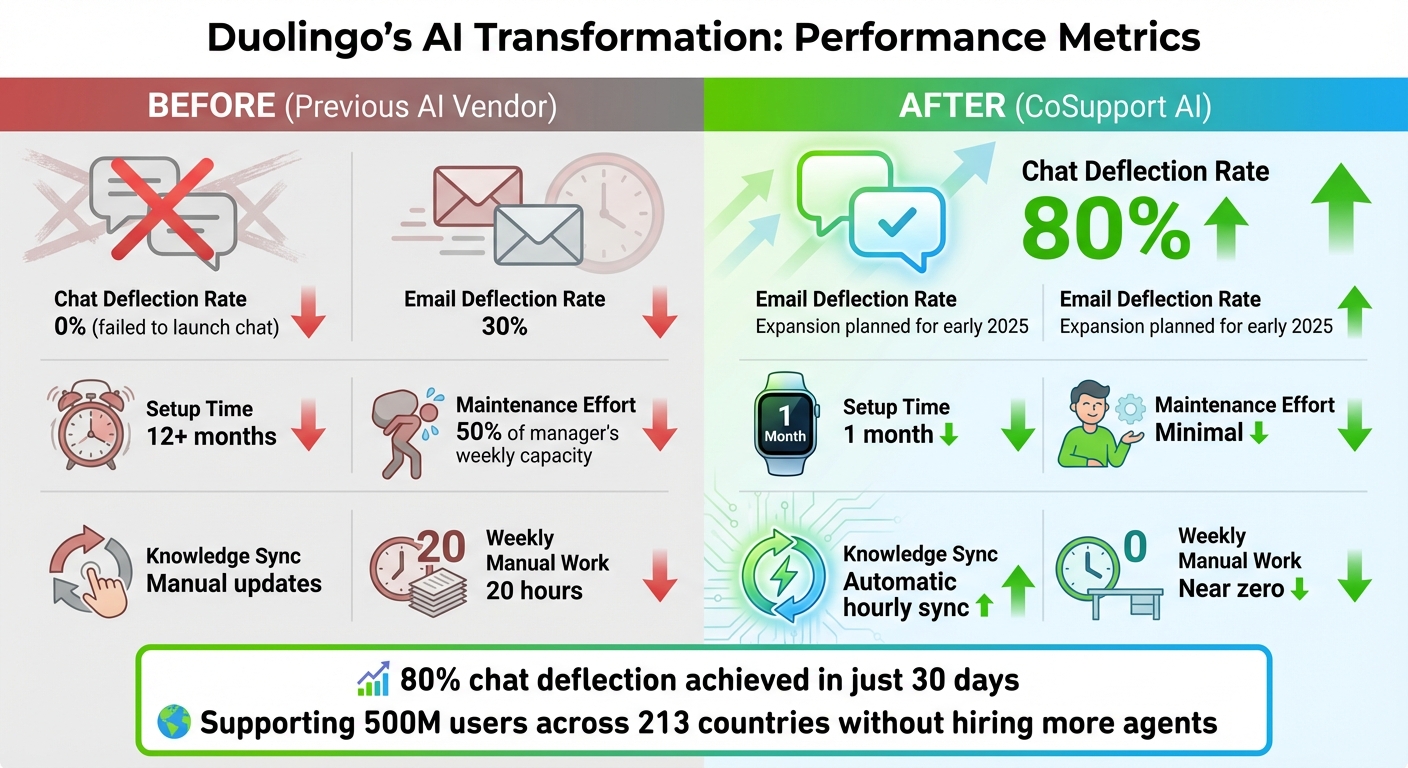
Duolingo English Test AI Performance: Before vs After CoSupport AI Implementation
CoSupport AI brought a major shift to Duolingo's customer support, streamlining operations through smooth integration and automated workflows.
Training on Existing Zendesk and Intercom Data
CoSupport AI started by syncing effortlessly with Duolingo's existing platforms - Zendesk and Intercom - without requiring any data migration. It trained itself using the existing FAQs, help articles, and support snippets, enabling it to resolve inquiries right out of the gate.
A major time-saver came with its automatic hourly sync. Previously, the support team spent 20 hours each week manually refreshing content. Now, the system updates itself within 60 minutes of any new FAQ or article being published, eliminating the need for human intervention.
Before and After: Performance Metrics
| Metric | Previous AI Vendor | CoSupport AI |
|---|---|---|
| Chat Deflection Rate | 0% (failed to launch chat) | 80% |
| Email Deflection Rate | 30% | Expansion planned for early 2025 |
| Setup Time | 12+ months | 1 month |
| Maintenance Effort | 50% of the manager's weekly capacity | Minimal |
| Knowledge Sync | Manual updates | Automatic hourly sync |
In just one month, CoSupport AI achieved an 80% chat deflection rate - something the previous vendor couldn't accomplish in over a year. By reducing chat volume so significantly, agents could shift their focus to more critical tasks, like helping students with certification requirements for academic admissions. This efficiency laid the groundwork for scaling support to meet the demands of a global audience.
Scaling Support Without Hiring More Agents
Thanks to these advancements, Duolingo managed to scale its support operations for a global user base of 500 million without increasing team size. The 80% chat deflection rate meant that agents could concentrate on complex issues that truly required human expertise.
Looking ahead, Duolingo plans to expand the AI's role to include handling email tickets by early 2025. They are also exploring automated playbooks for recurring inquiries. This strategy highlights how smart automation can grow support capabilities without requiring additional staff or budget.
Key Takeaway: CoSupport AI’s seamless integration and automated updates allowed Duolingo to significantly improve chat deflection rates, free up agents for complex tasks, and scale support to serve a massive global audience - all without adding to their team.
3 Lessons from Duolingo's Chat Deflection Success
Duolingo's impressive leap from a 30% to an 80% chat deflection rate offers valuable insights for support teams aiming to scale effectively. By examining their transformation, we can uncover the strategies that made this success possible.
Key Takeaways
- Automate knowledge base syncing
- Opt for intuitive, no-code tools
- Track metrics like deflection, resolution quality, and agent productivity
Keep Your Knowledge Base Updated Automatically
In the past, Duolingo's support team faced a major hurdle: manually updating FAQs. Every single change had to be refreshed individually, a time-consuming process that drained resources. The new approach changed everything. By syncing updates from Zendesk and Intercom every 60 minutes, their system now ensures the AI stays current with the latest content. This real-time updating is especially crucial for handling critical customer needs.
Lesson: Automating repetitive updates frees up support teams to focus on resolving more complex and meaningful customer inquiries.
Choose Tools That Don't Need Developer Support
Duolingo initially worked with a vendor whose system required constant involvement from developers, delaying progress. After a year of frustration and no live chat launch, they made a switch. The new tool was so user-friendly that support managers could manage it themselves, going live in just 30 days. The intuitive interface allowed teams to add content and perform quality checks without relying on technical assistance.
Lesson: Tools that are easy to use and don’t require developer input not only speed up implementation but also empower support teams to take ownership of their workflows.
Track Deflection Rate, CSAT, and Agent Productivity
Duolingo didn’t just look at whether the AI could answer questions - they measured whether it fully resolved them. They focused on three key metrics:
- Chat deflection rate soared to 80%.
- Maintenance time dropped from 20 hours per week to almost nothing.
- Agents shifted their attention from repetitive tasks to more complex, high-priority cases.
By monitoring these metrics, Duolingo could quickly evaluate how well its system was performing and make adjustments as needed.
Lesson: Keeping a close eye on performance metrics like deflection rates, customer satisfaction, and agent productivity ensures that AI-driven improvements deliver real, measurable results.
Conclusion
Duolingo's leap from 30% to 80% chat deflection in just one month highlights how the right AI tool can completely reshape support operations. By adopting CoSupport AI, the English Test team streamlined knowledge management and allowed agents to dedicate their time to more complex issues.
This transformation was driven by three key decisions:
- Automating hourly FAQ updates
- Implementing tools that eliminate the need for developer involvement
- Consistently tracking critical performance metrics
These changes didn’t just improve efficiency - they also freed up agents to focus on urgent, high-stakes cases, like helping students meet tight university deadlines.
Duolingo’s approach serves as a blueprint for scaling support teams without adding headcount. A well-implemented AI tool doesn’t just deflect chats - it resolves them, reduces stress for agents, and scales operations effectively. By monitoring deflection rates, resolution quality, and agent productivity, the team achieved measurable gains across all support channels.
If your support team is bogged down by repetitive tasks or outdated systems, modern AI tools can bring rapid transformation. Duolingo’s success proves that even after setbacks with previous vendors, the right platform can deliver game-changing results in as little as 30 days.
Key Takeaway: By automating processes and adopting intuitive tools, Duolingo empowered its agents to tackle high-value tasks, significantly boosting chat deflection and operational efficiency. Strategic AI integration can revolutionize customer support.
.png)