.png&w=96&q=75)
Understanding the Operational Gap Between Chatbots and AI Agents
Artificial intelligence has become a core component of modern customer support operations. Yet despite widespread adoption, confusion remains around terminology. Many vendors market 'AI chatbots' and 'AI agents' interchangeably, implying similar functionality and outcomes. In practice, these systems are fundamentally different in architecture, capability, and operational impact.
For support leaders evaluating automation in 2026, the distinction is not semantic. It determines whether AI becomes a superficial layer that handles greetings and FAQs, or a strategic asset capable of resolving tickets, reducing costs, and improving customer satisfaction at scale.
This article breaks down the real difference between AI chatbots and AI agents, how each functions in a support environment, and what support teams should prioritize when choosing between them.
The Evolution of AI in Customer Support
To understand the difference between chatbots and AI agents, it is useful to examine how automation in support has evolved. The first generation of support automation relied on rule-based chatbots. These systems followed predefined decision trees. If a customer selected option A, the system responded with message A1. If they selected option B, it responded with message B1. While predictable, these bots lacked flexibility and often failed when customers deviated from expected flows.
The second generation introduced natural language processing and machine learning. AI chatbots could interpret free-text queries and match them to predefined intents. This improved conversational flow, but the underlying architecture still relied heavily on scripted logic and static intent libraries.
Today, a new generation of AI systems has emerged: AI agents. These systems do not simply respond to inputs. They analyze context, retrieve relevant company knowledge, operate within helpdesk workflows, and autonomously execute multi-step support tasks.
The shift from chatbot to AI agent mirrors the broader shift in AI from conversational novelty to operational infrastructure.
What Is an AI Chatbot?
An AI chatbot is primarily a conversational interface designed to interact with users through text or voice. In customer support, chatbots are commonly deployed on websites, messaging apps, and mobile platforms.
Modern AI chatbots typically include:
- Natural language understanding to detect intent.
- Predefined intent libraries.
- Scripted response flows.
- Limited integrations with support systems.
- Basic routing capabilities.
Their primary goal is to manage initial engagement. They greet customers, answer frequently asked questions, guide users to relevant resources, and route conversations to human agents when necessary.
In practical terms, AI chatbots excel in scenarios such as:
- Providing store hours or shipping information.
- Helping customers track orders.
- Offering password reset instructions.
- Guiding users to documentation.
These use cases are valuable, but they represent the simplest tier of support interactions. The key limitation is structural: chatbots are designed around conversations, not operational workflows.
What Is an AI Agent?
An AI agent is an autonomous support system embedded directly into the support team’s operational environment. Rather than acting as a surface-level conversational tool, an AI agent functions as a digital team member.
AI agents typically include:
- Advanced contextual understanding across full conversations.
- Access to historical ticket data.
- Direct integration with helpdesk platforms.
- Knowledge grounding in verified company documentation.
- Multi-step reasoning capabilities.
- Automated escalation logic.
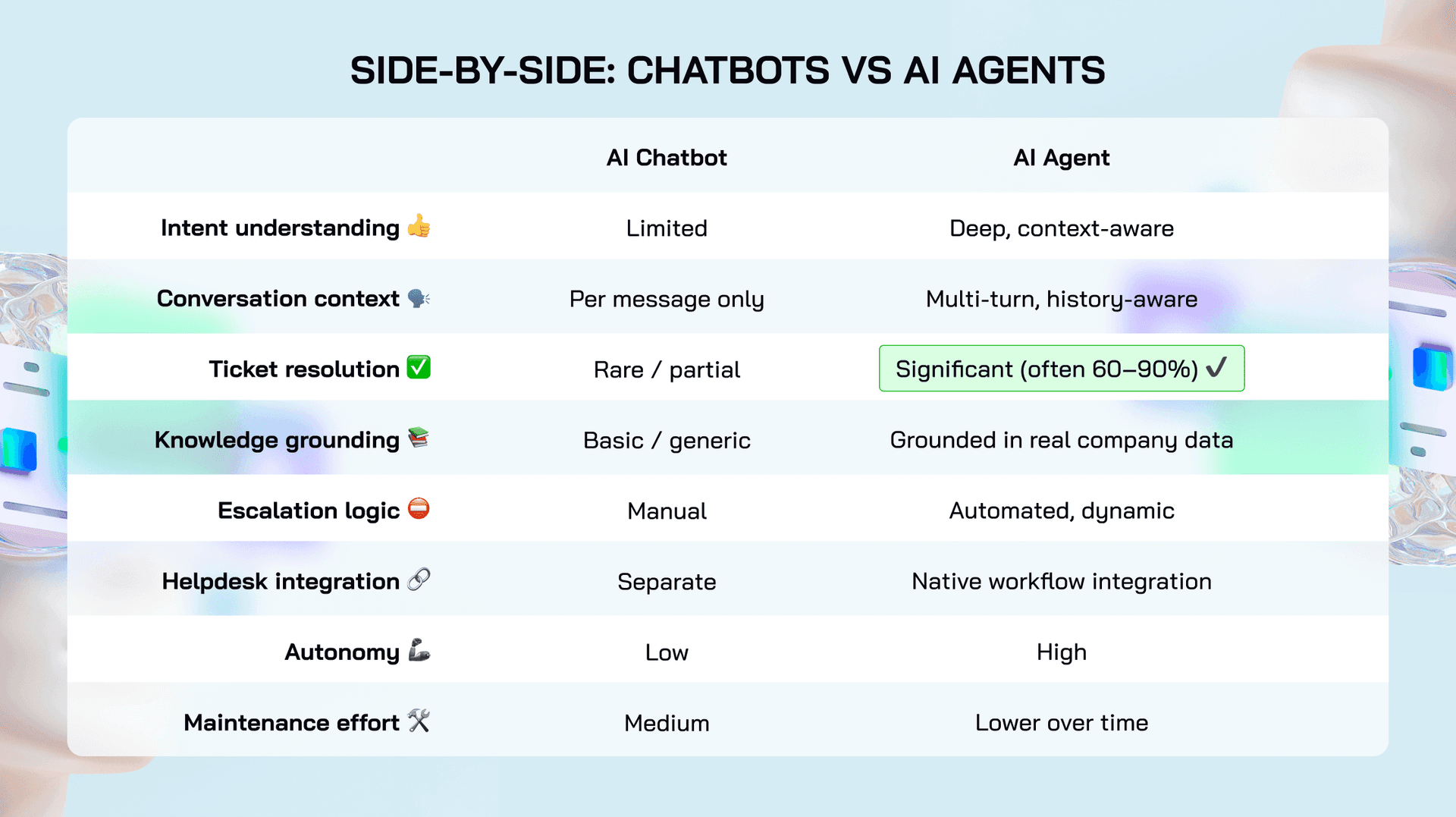
Unlike chatbots, AI agents do not simply respond to questions. They analyze entire cases, retrieve relevant information, generate accurate responses, update ticket statuses, and determine whether an issue can be resolved autonomously or requires human intervention. In high-performing support environments, AI agents are capable of resolving a significant percentage of inbound tickets independently, often ranging between 60-90% depending on industry and ticket complexity. The architectural difference is substantial: AI agents operate within workflows, not outside them.
Core Architectural Differences
To understand the practical implications, it helps to compare their foundations.
1. Scope of Understanding
Chatbots interpret individual messages and match them to predefined intents. If a message falls outside trained patterns, performance declines. AI agents analyze entire conversations, including historical interactions and contextual signals. They are not limited to static intent libraries.
2. Knowledge Retrieval
Chatbots often rely on pre-written scripts or loosely connected FAQs. AI agents retrieve information dynamically from structured knowledge bases, internal documentation, and past resolved tickets, ensuring responses are grounded in company-specific data.
3. Workflow Integration
Chatbots typically operate in separate interfaces and pass conversations into ticketing systems when escalation is required. AI agents are embedded within helpdesk platforms. They read, update, and manage tickets directly inside the operational workflow.
4. Autonomy Level
Chatbots assist. AI agents act. A chatbot might provide guidance and suggest solutions. An AI agent can execute resolution steps, adjust ticket metadata, trigger internal processes, and close cases autonomously when appropriate.
Operational Impact on Support Teams
The distinction between chatbot and AI agent becomes most visible in daily operations.
Resolution Rates
Chatbots are often limited to partial deflection. They reduce the number of basic inquiries reaching agents, but complex tickets still require full human handling. AI agents, when properly implemented, resolve a large share of routine tickets end-to-end. This directly reduces backlog and agent workload.
Average Resolution Time
Because chatbots frequently escalate to humans, customers may still experience delays. AI agents can provide complete, context-aware answers immediately. This dramatically reduces average resolution time and improves first-response performance.
Agent Productivity
Chatbots reduce repetitive front-line engagement but do not significantly change agent workflows. AI agents eliminate repetitive ticket handling and allow agents to focus on high-complexity or high-value cases. This improves productivity and morale.
Scalability
Scaling chatbot systems often requires expanding rule trees and maintaining intent libraries manually. AI agents scale through data expansion. As knowledge bases and historical tickets grow, the system becomes more effective without requiring constant rule editing.
Where AI Chatbots Fall Short
Despite their usefulness, chatbots have inherent limitations. Here is the list of the limitations.
Rigid Intent Matching
Even advanced chatbots depend on intent classification. When customers phrase issues in unexpected ways or combine multiple concerns in one message, accuracy decreases.
Limited Context Memory
Chatbots frequently struggle with multi-turn conversations. Context from earlier exchanges may not be fully retained or understood.
Incomplete Case Handling
Most chatbots cannot complete multi-step support tasks that involve checking policies, retrieving account details, and updating ticket fields simultaneously.
Manual Maintenance Burden
Intent libraries must be continuously updated. Rule trees must be expanded. Edge cases require manual adjustments. Over time, maintenance costs increase. These limitations are not flaws in design. They reflect the purpose chatbots were built to serve: conversational assistance, not autonomous case resolution.
How AI Agents Transform Support Operations
AI agents represent a structural shift in automation philosophy.
1. End-to-End Resolution
AI agents can analyze a ticket, determine root cause, retrieve policy guidance, draft a response, and close the ticket when appropriate. This reduces repetitive human effort significantly.
2. Data-Driven Accuracy
By grounding responses in verified internal documentation and historical data, AI agents reduce hallucination risk and maintain policy compliance.
3. Intelligent Escalation
When confidence thresholds are not met, AI agents escalate tickets to human agents with full context. Escalations include reasoning and relevant information, reducing duplication of work.
4. Continuous Learning
AI agents improve through exposure to resolved cases. The system becomes more accurate over time without requiring manual intent rewriting.
5. Cost Implications
The financial difference between chatbots and AI agents is substantial. Chatbots primarily reduce the volume of basic inquiries, which may lower entry-level workload but does not significantly change staffing models for complex support. AI agents directly affect ticket resolution rates. When a large percentage of tickets are handled autonomously, organizations can:
- Maintain service levels without increasing headcount.
- Reduce overtime costs.
- Reallocate human agents to strategic initiatives.
- Support higher growth without proportional staffing increases.
In high-volume environments, the cost savings compound quickly.
6. Customer Experience Considerations
Customer perception is another differentiator. Chatbots often create frustration when they fail to understand nuanced requests or loop through scripted options. AI agents deliver responses that feel context-aware and complete. Customers receive solutions rather than partial instructions.
Moreover, intelligent escalation ensures that when a human agent joins the conversation, they do so with full context. Customers are not required to repeat information. This continuity directly impacts customer satisfaction scores.
When Chatbots Still Make Sense
Chatbots are not obsolete. They remain valuable in specific scenarios:
- Website lead qualification.
- Pre-sales assistance.
- Basic FAQ delivery.
- Navigation guidance.
- Marketing engagement.
In these contexts, lightweight conversational tools are appropriate and cost-effective. However, organizations seeking meaningful automation in support operations should recognize that chatbots alone are insufficient.
Evaluating Solutions: Questions Support Leaders Should Ask
When assessing AI vendors, support leaders should focus on operational criteria rather than marketing language.
1. Is the system embedded in the helpdesk or operating separately?
2. Does it retrieve answers from verified company knowledge or generate generic responses?
3. Can it resolve tickets end-to-end?
4. How does it handle uncertainty and escalation?
5. What measurable KPIs improve after deployment?
6. How long does implementation take?
7. What ongoing maintenance is required?
The Strategic Shift in 2026
Support operations are increasingly expected to function as revenue protectors and growth enablers rather than cost centers. To meet this expectation, teams require automation that:
- Handles scale.
- Maintains quality.
- Delivers measurable ROI.
- Integrates seamlessly with existing tools.
AI chatbots represent incremental improvement. AI agents represent structural transformation. The distinction is no longer theoretical. It determines whether AI is an experimental feature or a foundational component of support strategy.
Choosing the Right Level of Automation
AI chatbots and AI agents both play roles in modern customer support. However, they address different layers of the support stack. Chatbots enhance conversational engagement and reduce basic inquiry volume. AI agents operate within workflows, resolve tickets autonomously, and deliver measurable operational impact. For organizations focused on scalability, efficiency, and customer satisfaction, the decision should align with long-term objectives rather than short-term convenience. The real difference between chatbots and AI agents is not the interface customers see. It is the depth of integration, autonomy, and operational value delivered behind the scenes.
Support leaders evaluating AI in 2026 should move beyond labels and examine capability. The future of customer support belongs not to systems that merely converse, but to systems that resolve.
.png)


.png&w=828&q=100)
.png&w=96&q=100)
.png&w=828&q=100)
.png&w=96&q=100)